




S11 E6: Nicholas Gregory on MercuryWallet, Statechains & Privacy

The audio keeps playing while you browse the site.
Ask the Archive
Nicholas Gregory is the CEO and director of CommerceBlock, a privacy-oriented company whose best known product is MercuryWallet. If you’re familiar with obfuscation techniques on the Bitcoin blockchain, then you already know about Chaumian CoinJoins: a method which involves taking equal outputs and creates a collaborative transaction which puts everybody’s signature on the coins to produce extra plausible deniability.
The main drawback of the CoinJoin is that it’s pretty obvious when it happened – anyone looking at the public ledger will notice large transactions with many participants who put together equal or otherwise divisible bitcoin amounts. While figuring out to whom the outputs belong is nearly impossible (unless the participants make post-mix mistakes), knowing that the participants CoinJoined is an observable phenomenon.
CoinSwaps, on the other hand, make use of Statechains in order to swap outputs between unknown participants. The advantage of this technique, which MercuryWallet employs, is that the swap doesn’t take place on Bitcoin’s open ledger and therefore is impossible to detect by a blockchain analyst. Another advantage is scalability, as the Statechain does not have the same block size limitations as the base layer. The drawback, however, is that there is no way to know what kind of UTXO you’re about to receive: it can either be “clean” in the sense that there’s no dubious past associated with it, or it can belong to a known bad actor.
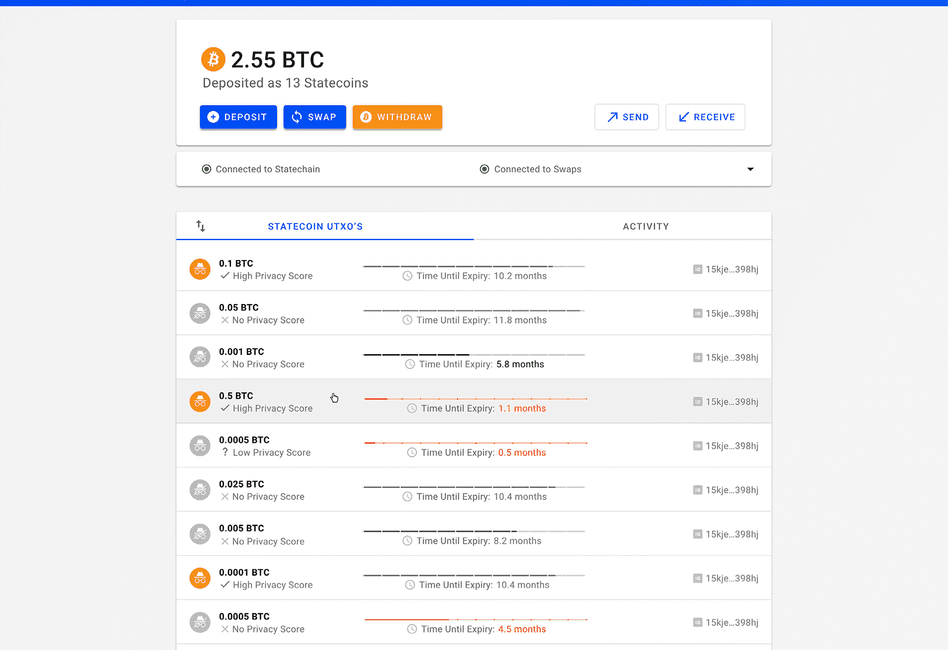
For this reason, CoinJoin and CoinSwaps are complementary tools that serve the same purpose of maximizing Bitcoin’s privacy with different tradeoffs. Both CoinJoins and CoinSwaps require servers for coordination between participants, but are otherwise non-custodial. To get on the Statechain, Mercury performs a lock function on the Bitcoin base layer and puts all the operations in a Lockbox. This way, there’s a cryptographic impediment which prevents the coordinator from seeing who participates in the CoinSwaps and therefore deems the service censorship resistant.
CoinSwaps, as designed by Nicholas Gregory in MercuryWallet, are certainly an underrated privacy breakthrough. They extend the spectrum of Bitcoin privacy techniques by thinking (and operating) outside the box and provide extra means to break surveillance in order to maximize the fungibility of the currency. If all bitcoiners decided to use privacy techniques, then there would be no fungibility issue as discriminating between outputs becomes absurd.
So if we truly want Bitcoin to work as money, we have to take privacy more seriously. In this regard, Nicholas Gregory is one of the voices worth hearing – and MercuryWallet is the kind of service that you should definitely look into if you want to understand the scope of Bitcoin innovation.
Listen to Nicholas Gregory on Apple, Spotify & YouTube
If you would like to have a more privacy-friendly listening experience, then I recommend you to use this player. You can open the link in the Tor browser and your IP address won’t get saved anywhere. You can also download the audio for offline listening, so your old Zune or iPod Nano gets a little more use during your morning routine.
On the other hand, if you use one of the big tech services (Spotify, Apple, YouTube) then please subscribe and leave feedback. It helps tremendously in terms of enabling others to discover the content more easily.
This Episode Is Sponsored By Vaultoro And Wasabi Wallet
Joshua from Vaultoro is a big fan of the show and I’m happy that he sees potential in my work and supports it without caring about numbers and growth statistics. So I must thank him for his generosity and invite you to check out Vaultoro – the exchange where you can trade with honest money (bitcoin, gold, and silver).
None of this is financial advice from me, but I’m pretty sure that the shiny rock is a better store of value than any fiat currency or “stablecoin”, so maybe it would be wise to use this commodity to preserve your purchasing power during bear markets and get back into bitcoin as soon as you’re convinced that the downwards movement are over. You can also have the gold bars delivered to your house… because you know, if it’s not in your safe then it’s stored somewhere in Switzerland where you can’t touch it whenever you please. For more information, check out Vaultoro’s website.
Also, Joshua from Vaultoro is sponsoring a Lightning Network faucet – he hopes that Bitcoin’s second layer will one day become potent and popular enough to replace the smart contract and tokenization features of Ethereum. And he also supported Giacomo Zucco’s layer 3 RGB Spectrum experimentation from 2019.
If you would like to increase your network-level and transaction privacy, you should download Wasabi Wallet on your computer. It routes your connection through the Tor network to hide your IP, it downloads block filters so you validate your own transactions locally without appealing to a trusted third party, and it also connects to your own full node to boost your financial sovereignty. Extra features include advanced hardware wallet integrations, easy UTXO management (press CTRL+C+D in Wasabi 2.0), address reuse prevention, and even a lurker wife mode.
Wasabi is best known for its link-breaking CoinJoins, which are giving a hard time even to the EuroPol. Use the wallet to increase your financial sovereignty, but don’t do any illegal stuff – use your financial sovereignty with responsibility (also read the Wasabi terms of service).
Verify this episode
This is the SHA-256 fingerprint of the MP3 as published here, timestamped in the Bitcoin blockchain with OpenTimestamps. If one byte of the file changes, the fingerprint changes.
- SHA-256
ce47fd3c2cfdab20bac2f110dbfd2df196f5aa168ae32cd24a437b24251fbd82- Proof
- 2022-06-18_s11_e6_nicholas_gregory_on_mercury_wallet__statechains__and_privacy.mp3.ots · all episode hashes (proof)
- Status
- Anchored in Bitcoin block 974,312
How to check it yourself
- Download the MP3 and the proof into the same folder.
- Run
sha256sum 2022-06-18_s11_e6_nicholas_gregory_on_mercury_wallet__statechains__and_privacy.mp3(on a Mac:shasum -a 256 2022-06-18_s11_e6_nicholas_gregory_on_mercury_wallet__statechains__and_privacy.mp3). The result must match the SHA-256 above. - Install the OpenTimestamps client (
pip install opentimestamps-client) and runots verify 2022-06-18_s11_e6_nicholas_gregory_on_mercury_wallet__statechains__and_privacy.mp3.ots. It hashes the MP3 again and checks the proof against your own Bitcoin node, then prints the block and the date the file existed by. Without a node,ots info 2022-06-18_s11_e6_nicholas_gregory_on_mercury_wallet__statechains__and_privacy.mp3.otsshows the block height to look up in any block explorer.
Related

S15 E25: Nicholas Gregory & Tom Trevethan on MercuryLayer, Blinded Statechains & Lightning
Nicholas Gregory and Tom Trevethan explain MercuryLayer: blinded statechains, whole-UTXO swaps, Lightning Latch, and where…

S13 E5: Nicholas Gregory on MercuryWallet & Adding a Lightning Network Integration
Nicholas Gregory first joined the Bitcoin Takeover podcast in June 2022 – and in the seven months that passed between the two…

S14 E8: Fadi Barbàra on DMix & Bitcoin Privacy
Fadi Barbàra is a cryptography researcher from the University of Turin who came up with the DMix protocol: an interesting…

Comments
Comments run on my own server. No ads, no trackers.