




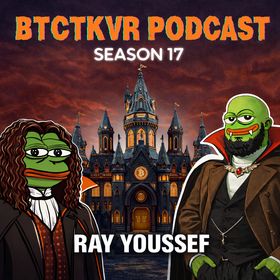
S17 E12: Ray Youssef on the Mexico Arrest & Life After NoOnes
The audio keeps playing while you browse the site.
Read the transcript21,532 words, every line links to the minute it was said
Ask this episode
Ray Youssef does not do quiet exits. In his telling, he walked out of Monerotopia in Mexico after giving a Malcolm X inspired speech, went looking for guacamole and fish tacos, and was met by three cars and roughly twenty Mexican officers. He says he was deported without extradition paperwork, flown commercially to Los Angeles with agents, arrested by federal marshals, and held in Santa Ana before a judge rejected the prosecution’s attempt to keep him detained for the duration of the case. The result, for now, is life in New York with an ankle monitor, travel limits, device monitoring, drug testing, no access to privacy wallets, and a trial fight he says he is ready to take all the way.
This is Youssef’s account, and it should be read that way. He says the case began in Sacramento, was effectively abandoned there, and is now being driven from Washington. He says the first four charges are outside the statute of limitations, while the fifth rests on a $200 bitcoin transaction made by an agent. Reporting around the case describes a narrower prosecutorial theory: that Paxful, under Youssef, failed to maintain required anti money laundering controls and was used for illicit flows. The court record is where those two stories collide.
Disclosure: NoOnes has sponsored Bitcoin Takeover. This episode also mentions Cake Wallet, Braiins Hashpower, Bitcoin.com News, SideShift.ai, and LayerTwo Labs. The episode’s Cake Wallet Zcash giveaway went to Swiftly Bow and Monero Africa, both chosen because they treated the contest like study rather than airdrop farming.
From MoneroTopia to Santa Ana
The arrest scene is the strongest part of the episode, and Ray Youssef knows it. He describes giving an hour long presentation modeled on the speech Malcolm X gave in Cairo shortly before his assassination, then walking half a block from the venue before three cars jumped the curb and twenty officers from Mexico’s SSPC and immigration services closed in. He frames the moment with his usual theatrical timing: “I thought I had a little more time than that.”
What happened next is the part that raised eyebrows even among his own lawyers. He claims there was no extradition process at all. His visa was cancelled, he was deported rather than extradited, placed on a commercial American Airlines flight with two Mexican agents, and arrested by federal marshals upon landing at LAX. From there he was booked into Santa Ana, where his bunkmate, he says, was serving 25 years to life on drug charges. Deportation in lieu of extradition is not unheard of, but his characterization of the procedure as a kidnapping orchestrated by Washington is a claim the court filings will either support or dismantle.
The Five Charges and the $200 Transaction
Youssef’s account of the indictment is specific enough to be checked, which is useful. He says he was charged under seal on five counts, that the first four relate to conduct whose statute of limitations expired three years ago, and that the government bridged the gap with a fifth charge: an undercover agent purchased $200 worth of bitcoin on Paxful and sent it to bedpage.com, an escort advertising site, which prosecutors present as proof of an ongoing conspiracy. He describes the lead count as “conspiring to not have an effective compliance program,” a formulation his lawyer called unprecedented.
He also claims the case originated with a Sacramento prosecutor who argued that Paxful existed only to launder money, that this prosecutor left for a compliance job at Coinbase, and that no one else in the Sacramento office wanted the file. The implication is that only a politically motivated DC apparatus kept it alive. External reporting confirms the Eastern District of California connection and the AML failure theory, and notes that Paxful as a company previously settled civil and criminal penalties, including a $4 million fine. What remains genuinely contested is Youssef’s personal culpability, and that is what the trial would decide.
The Sealed Indictment and the Question of Timing
One detail deserves attention regardless of where you stand on Youssef. He says the indictment was sealed and the arrest warrant issued in secret, in the hope that he would return to the United States unaware. He never did. Instead, he traveled to Mexico for Monerotopia, and he believes the timing of the deportation, days after his speech, was no coincidence.
He situates all of this against the political backdrop of an administration that publicly promised to end regulation by prosecution, and a Deputy Attorney General memo saying the same. His argument is simple: other crypto cases were dropped, his was not, and neither were the cases against several other developers. Whether that pattern reflects prioritization, politics, or prosecutorial inertia is a fair question, and it is one reason this episode matters beyond one man’s legal troubles.
Life Under Pre-Trial Conditions
The ankle monitor makes two appearances on camera, and Youssef treats it as both evidence and prop. It reports his location to a pre-trial officer. Beyond it, he describes an initial set of release conditions he calls absurd: full device monitoring, drug testing, alcohol restrictions, a proposed curfew, and a ban on touching privacy wallets. His attorney, he says, had only seen such conditions in cases involving sexual offenders. A second judge struck most of them down.
The privacy wallet ban has one direct consequence for the show: the customary one Zcash guest gift from Cake Wallet could not be accepted, because Zcash on Cake Wallet falls under his restrictions. He delivered the refusal in his Pinky and the Brain voice, which tells you something about how he is processing the situation. He does not drink, smoke, or use drugs, so he treats the testing regime as a joke at the prosecution’s expense. He is less amused by what he calls the real strategy: detention in Sacramento County, pressure over two or three years, and a plea extracted from exhaustion.
NoOnes After Ray
The immediate practical question is NoOnes. Youssef says he resigned quickly because his presence in the United States could be used to argue jurisdiction over the company. He claims the company was restructured last year, runs with a loyal mission driven team, and no longer needs him as a daily operator. The public line from NoOnes has matched the separation: Youssef is out of management, and the company says his legal matters are personal and unrelated to the platform.
The more interesting part is what he thinks made NoOnes durable. He talks less like a founder protecting a brand and more like a coach trying to leave behind players who can run the system without him. Every meeting, he says, was meant to explain not only what had to be done, but why it had to be done in that order, history lessons included.
That is also his answer to the old Paxful comparison. In his version, Paxful failed because it was American and because he chose the wrong co-founder, a mistake he compares to choosing the wrong spouse. NoOnes, he argues, was built outside that blast radius, with no shared authority and no single point of failure wearing a suit.
Users, Volume, and the Bitcoin Anomaly
He returns to the numbers. NoOnes, he says, is smaller than Paxful in raw registered users, around two and a half million versus Paxful’s roughly thirteen million at the end, but larger by volume and far more active, since most Paxful accounts were dormant. The user base is split roughly between Africa, Southeast Asia, and the rest of the world. Paxful’s Time 100 listing from 2022, which I looked up during the conversation, credited it with onboarding more than nine million people, many of them in Nigeria and El Salvador.
On the day we spoke, the newly renamed transparency dashboard, formerly the CEO dashboard, showed about $3 million in peer-to-peer volume over twenty four hours. The asset split is the anomaly: bitcoin at roughly 65 percent, USDT at 34 percent, USDC near 1 percent, and every other supported asset combined below 1 percent. Youssef claims every other P2P venue runs at 99.9 percent USDT. His explanation is cultural rather than technical: the old Paxful traders carried their bitcoin loyalty across, spent a decade adapting their accounting to volatility, and see supporting bitcoin as part of the mission rather than a business inconvenience.
Make Money Feel Like a Game
The product philosophy is classic Youssef: make finance feel like a game, not by adding cartoon graphics, but by tightening the feedback loop. Games keep players engaged because every action produces a visible reaction: gold collected, experience gained, progress toward the next level always displayed. He wanted users moving money in unfamiliar systems to always know where they stand, what happened, and what comes next, because that constant feedback is what makes a new financial tool feel safe.
The anecdote he tells is instructive. The team first made NoOnes look like a game, complete with 8-bit nostalgia, while the feedback loop lagged behind. His correction was to drop the aesthetic and keep the mechanics. The site now looks more professional, and the team has started shipping its own ideas, the transparency dashboard rebrand among them. He describes watching that happen with the pride of a parent, and it supports his broader claim: the real product was never the app, but a team capable of innovating without him.
Stablecoins, Sanctions, and the Iranian Workaround
The stablecoin discussion adds a dimension most coverage of Youssef misses. He warns that USDT and USDC remain freezeable issuer liabilities and notes that Chinese users have lost billions to frozen Tether. In his view, stablecoins can be useful bridges, but they are not the destination for people trying to escape capital controls, banking exclusion, or sanctions pressure.
I added the Iranian angle from personal experience: pre-war remittances into Iran moved through exchange desks with limits around a hundred dollars a week, and one of the more creative sanctions workarounds was airdrop farming. Iranians registered for every token distribution available, swapped the proceeds into USDT or bitcoin, and only then accessed something resembling the global economy. Many of those “million player” web3 games are, in part, sanctions escape infrastructure wearing a costume. Youssef’s broader point stands regardless of his legal situation: peer-to-peer rails matter precisely where the official ones are weaponized or absent.
Crypto’s Political Prisoners
The conversation then widens to the roster of cases he considers the same war. Keonne Rodriguez of Samourai Wallet heading to prison for five years, William Lonergan Hill, Roman Storm of Tornado Cash awaiting sentencing, Roman Sterlingov serving twelve and a half years over Bitcoin Fog, Joby Weeks past six years of house arrest awaiting sentencing, and Ian Freeman, the Free Talk Live host who orange pilled Roger Ver. Youssef faces five charges carrying up to five years each, which he notes could total twenty five years on conduct a decade old, tied together by a $200 agent transaction.
My own read, which I offered on the show, is that speech played a role in several of these prosecutions. Samourai’s account tweeted about Russian oligarchs laundering bitcoin, language that invited scrutiny, while Wasabi’s more careful marketing and quick shutdown let its contributors walk away. I have discussed that contrast at length in my privacy episode with Rockstar Dev and Max Hillebrand. Youssef’s version of the same observation is sharper: how many P2P marketplace CEOs quote Malcolm X on stage? Prosecutors will deny that rhetoric matters. The pattern of who ends up indicted suggests it does not hurt to be boring.
The Test of Wealth and the Road to Trial
Youssef says he will not plead to anything, would reject even a last minute misdemeanor offer, and wants the not guilty read into the record. He expects the next court date around May 1st and believes dismissal is possible if a judge examines the charges closely. He credits the American judiciary for exactly that possibility, a nuance that cuts against his deep state framing, and he acknowledged it when pressed: in most countries, he would not be on a podcast right now.
He declined any interest in counter-suing, citing the DOJ’s 98 percent conviction rate and preferring to spend the money on schools. He also confirmed he remains a US citizen, which simplifies nothing in his view, since he believes the veneer of due process has already been stripped. His theological framing of the ordeal, Ramadan as the season of his hardest tests, the “test of wealth” as the one 99.9 percent of people fail, is central to how he presents himself now. Whether you find it sincere or strategic, it is at least consistent with a man who drives a Mini Cooper, rents a small Airbnb, and walks everywhere in New York.
The Solana Exploit and the Medina Morning
There is a credibility point that critics should not dodge. I raised it near the end: the Solana bridge exploit that hit NoOnes and cost roughly $8 million, disclosed weeks after the fact following ZachXBT’s investigation. Youssef says he learned about it in Medina, in the moment his forehead left the prayer carpet, and covered the loss from his own funds the next day. No customer lost money.
That does not settle the legal case, and the delayed disclosure deserves the criticism it received. It does complicate the lazy version of the story in which every founder accused of wrongdoing is automatically accused of stealing from users. Figures like Nick Carter publicly called him a scammer. The reimbursement record cuts the other way.
The Story of Moses and al-Khidr
The spiritual centerpiece of the episode is a ten minute retelling of the Quranic story of Moses and al-Khidr, “Mr. Green” in Youssef’s phrasing, from the chapter of the Cave. Moses, the wisest man alive, is told there is one man wiser and travels to learn from him, on the condition that he never question what he sees. Three events follow: al-Khidr smashes a hole in a poor ferryman’s boat, kills a charismatic young man, and orders Moses to rebuild a wall for a host who refused them hospitality. Moses fails the condition each time.
The explanations arrive at the end. A tyrant was seizing intact boats for his war fleet, so the damaged boat survives and the ferryman corners the market afterward. The young man was destroying his believing parents, whose future child would carry their faith. And beneath the wall lay the inheritance of two orphans, hidden until they grew strong enough to defend it.
Youssef’s point is not subtle: calamity can be preparation, and judgment without context is usually vanity. He is clearly telling the story about himself, the deportation included. Listeners will decide for themselves whether that is wisdom or self-mythology. As a piece of narrative craft, delivered from memory with genuine warmth, it is the most memorable stretch of the episode.
The Monerotopia Speech and the Three Pillars
I asked him to summarize the speech that preceded his arrest. His framework is what he calls the FMM: financial, monetary, and media. As long as humanity operates on platforms controlled by others, he argues, resistance is theater, so believers must build parallel pillars of their own, with NoOnes as his contribution to the financial layer. He described Islam as the antidote to supremacism and criticized what he called supremacist currents in other religions, praised Eastern Orthodox Christianity for holding a monotheist line against Rome, framed the present as end times, and called for an army of ten thousand people running the same operating system in decentralized fashion.
These are his views, quoted here for completeness, and they are the most contested part of the episode. I pushed back on air against one comparison he made to 1933 Germany, and I would push back again in print. His argument that racial and national identity are reactive traps, and that only a belief system lets you resist without being reactive, is the strongest version of his position. The apocalyptic vocabulary surrounding it will lose many listeners, and some of his characterizations of other faiths will lose more.
What Comes Next
Ray Youssef is not treating pre-trial life as downtime. He lists a structured water reactor he wants to launch in New York, a self-designed RPG he calls the most based game ever made, a fashion line, and a 3D printed car. He says he is funding his own defense, is talking to Netflix about a series covering the other prosecuted developers, and may publish the indictment on a personal site.
Asked where he would go if acquitted, he ruled out Dubai and mused about Muslim or Orthodox Christian countries. I pitched Romania, he countered with the EU problem, we landed on Serbia, and I renewed my standing offer of an in-person car interview like the one I did with Tyler Spalding in S17 E2.
His closing pitch was characteristically immodest and characteristically effective: everything Elon Musk was purported to be, he actually is, minus the rockets and the subsidies. A man facing twenty five years on paper who describes his ankle bracelet as worth it for a shot at the Night of Power is either performing serenity or genuinely possessed by it. After two hours, I still cannot fully tell, and I suspect that ambiguity is load-bearing.
Closing Thoughts
Ray Youssef’s closing message is not really about Paxful or NoOnes. It is about parallel systems: financial rails, monetary tools, and media channels that cannot be switched off by one jurisdiction. He wants leaders who create other leaders, believers who can resist without being reactive, and ten thousand people who have downloaded the same operating system and can act in decentralized fashion.
Strip away the apocalyptic vocabulary and the demand is familiar to anyone who has watched Bitcoin grow up: if peer-to-peer money is going to matter outside conferences, it has to survive prosecutors, banks, stablecoin issuers, custodians, and founders. Youssef’s wager is that the machine moved against him because the model worked. The state’s wager is that AML law still applies even when the founder speaks in revolutionary language. The rest of us are left with the uncomfortable middle: a useful P2P business, a founder with a talent for mythmaking, and a case that will test where compliance failure ends and political theater begins.
Listen to Ray Youssef on Spotify, Apple Podcasts, YouTube & More!
Time stamps:
0:00 Intro
0:46 Introducing Ray Youssef
2:07 Ray steps down as CEO of NoOnes
3:10 The arrest and deportation in Mexico
6:29 US charges and legal proceedings
11:11 Motivations behind the prosecution
17:08 Conditions of release and the ankle bracelet
21:02 NoOnes status and company structure
25:43 NoOnes vs Paxful user numbers
28:41 Product design philosophy
31:39 The warchief look and the FMM framework
36:04 Ray’s legal restrictions (no privacy wallets)
37:20 Cake Wallet giveaway winners
41:37 NoOnes P2P volume and asset breakdown
44:46 USDT, USDC and sanctions workarounds
47:36 Other crypto developers and political prosecution
50:14 Trial outlook and US citizenship
57:07 The judicial system and hope for dismissal
59:49 Intimidation tactics and the test of wealth
1:03:22 Charity, faith and Pascal’s wager
1:04:07 Counter-suing and DOJ conviction rates
1:06:52 The story of Moses and al-Khidr
1:19:23 Lessons from the story
1:21:12 Ramadan and resilience
1:23:35 Transparency and a potential Netflix series
1:25:34 Political prisoners in crypto
1:29:46 Leadership, education and building in Africa
1:33:31 Faith as the foundation of leadership
1:35:32 Empowering teams and creating leaders
1:37:35 Human potential, creativity and alignment
1:39:59 Spiritual warfare and end times
1:41:45 The Malcolm X speech at Monerotopia
1:47:53 Doctrine, monotheism and resistance
1:50:06 Prophecy and Christ consciousness
1:53:52 Bitcoin, justice and community
1:57:44 Monerotopia memories and the arrest location
2:00:42 Spiritual adversaries
2:02:13 Mugshot and merchandise ideas
2:02:52 How to support Ray and future projects
2:08:51 Post-trial plans and preferred countries
2:11:19 Identity, nationalism and resistance
2:13:22 Faith, productivity and facing adversity
2:13:49 Closing remarks and the Solana reimbursement story
Verify this episode
This is the SHA-256 fingerprint of the MP3 as published here, timestamped in the Bitcoin blockchain with OpenTimestamps. If one byte of the file changes, the fingerprint changes.
- SHA-256
2db3aa71d748cfb71fa89ebf5e00a0d9907e14fb5971b1d275fba9d6ae5f4bd5- Proof
- 2026-03-07_s17_e12_ray_youssef_on_fighting_for_the_global_south.mp3.ots · all episode hashes (proof)
- Status
- Anchored in Bitcoin block 974,312
How to check it yourself
- Download the MP3 and the proof into the same folder.
- Run
sha256sum 2026-03-07_s17_e12_ray_youssef_on_fighting_for_the_global_south.mp3(on a Mac:shasum -a 256 2026-03-07_s17_e12_ray_youssef_on_fighting_for_the_global_south.mp3). The result must match the SHA-256 above. - Install the OpenTimestamps client (
pip install opentimestamps-client) and runots verify 2026-03-07_s17_e12_ray_youssef_on_fighting_for_the_global_south.mp3.ots. It hashes the MP3 again and checks the proof against your own Bitcoin node, then prints the block and the date the file existed by. Without a node,ots info 2026-03-07_s17_e12_ray_youssef_on_fighting_for_the_global_south.mp3.otsshows the block height to look up in any block explorer.
Related
S17 E18: Dr. K on Scaling Proof of Work, Soaping the Competition with Quai & Unifying Physics
Dr. K (Karl Kreder), architect of the Quai Network, came back for his second appearance on Bitcoin Takeover to defend his…
S17 E20: Amir Taaki, Harry Halpin & Christopher Cialone on Palantir’s Technofascism, the Roman Storm Trial & the Privacy Arms Race
Some episodes are planned for months. This one happened because Zach Herbert postponed, I panicked, and the universe compensated…
S17 E41: Vik Sharma on Radar, Arbiter & Vibe Coding the Future of Cake Wallet
Seven months ago, Vik Sharma joined Bitcoin Takeover Podcast and effectively declared the privacy wars over, telling the Monero…

Comments
Comments run on my own server. No ads, no trackers.