




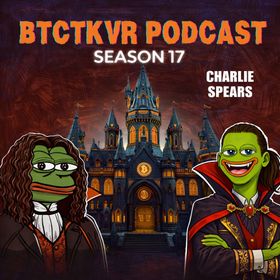
S17 E13: Charlie Spears on Blockspace Media, the Purity Spiral & the Case for Classical Maximalism
The audio keeps playing while you browse the site.
Read the transcript17,306 words, every line links to the minute it was said
Ask this episode
Editor’s note: this conversation was streamed live in mid-March 2026, a week after the US switched to daylight saving time (which is also why we nearly missed each other). The episode was published on March 17, OP_NEXT was scheduled for April 16 in New York City, and one Zcash was worth $267 at the time of recording. It was also the most cursed stream in recent show history: Charlie’s video and audio froze so often that refreshing his OBS input became a recurring segment, and we blamed the spooks every single time.
Some guests you interview because they built something. Charlie Spears you interview because he built the thing that interviews the things. He is the co-founder of Blockspace Media, the company behind The Mining Pod, Bitcoin Season 2, The Gwart Show, and the OP_NEXT conference, and the co-host (with Colin Harper, who was on this show a few weeks earlier) of the Blockspace Podcast. He is also a meetup organizer of nearly a decade, a signed recording artist with millions of streams, and, by his own cheerful admission, a man whose first bitcoin was spent on the Silk Road.
What followed was two hours of the most honest media, mining, and culture talk I have had on this show, punctuated by technical failures that we chose to treat as content.
Not a spook, possibly a Spears
I opened with the only responsible question: is Blockspace a spook operation? Charlie denied it on solid grounds. Yes, his dad did some work for the CIA, but as an independent contractor thirty years ago, and more importantly, spooks have to wear ties sometimes, and you will never catch Charlie dead in one. He is, by his own description, your friendly local Bitcoin meetup organizer in Oklahoma.
As for the other burning question: no, he cannot get me Britney’s autograph. It is Spears family lore that somewhere up the Tennessee branch of the tree there is a connection, but he does not have her phone number. If you do, he asked that you hit him up. I promised to send it offline.
He did, however, own the Bitcoin Season 2 branding, which triggered all the right people. His explanation set the tone for the whole episode: he has been in Bitcoin a very long time, and at some point the mainstream Bitcoin culture took on a life of its own, one he no longer related to. The goal was never to trigger anyone. It just happened to be a free side effect.
Blockspace Media did not come out of nowhere
To outsiders, Blockspace appeared fully formed: a raise, multiple shows running in parallel, a conference series. Charlie traced the actual lineage. The company is downstream of co-founder Will Foxley’s long work in Bitcoin media: Will built up Compass Mining’s media and mining research arm and started The Mining Pod during the very interesting 2020 to 2022 window, then took it independent and tried to form a media company around it.
Running it solo through 2023 nearly broke him. Charlie officially joined in spring 2024, Colin Harper followed that summer, and the three started sprinting in every direction: The Gwart Show (one of the best podcasts in crypto, and I agree), Bitcoin Season 2, The Mining Pod, newsletters, and a conference series.
By the time we recorded, they had condensed The Mining Pod and Bitcoin Season 2 into a single Blockspace Podcast, and were in the first two weeks of evolving from a podcast-first format into a live show with shorter segments and timelier news, modeled on TBPN, one of the genuine success stories of the tech show format. Add syndication of written content through Yahoo Finance, written, video, and podcast distribution through CoinDesk, programming help for various Bitcoin conferences, and video work for Galaxy Digital, and you get a small team producing an implausible amount of output. Which is the point: they intend to keep it small.
The Gwart Show and the big tent
I had to ask whether the Gwart Show is hosted by the actual actress who played Gwart on Silicon Valley (Jared’s love interest in the final season, real name Donald’s, for those keeping score). It is not. The show slightly predates Charlie. Will had an Ethereum podcast with Evan Van Ness in the fall of 2023 that went nowhere, while Gwart was rising on Twitter as one of the most sardonic and incisive critics of broader crypto, and of Ethereum specifically. Will connected early and proposed a podcast. It continues to this day and has driven a surprising share of the defining conversations about Ethereum, capital markets, and Bitcoin itself.
Charlie’s description of Gwart doubles as the Blockspace house philosophy: a bitcoiner who happens to talk about the rest of crypto. A lot of Bitcoiners have exactly one topic, and anything outside it is not merely uninteresting to them but unethical. Charlie finds business activity outside Bitcoin genuinely compelling, and increasingly relevant, because as Bitcoin grows, the cast of economic actors changes. It is no longer the Swan bitcoins who get to decide what Bitcoin is. It is institutions, heterodox cypherpunks, and everything in between.
Swan, Blockworks, and the economics of Bitcoin media
This led us to the strange era, roughly 2022 to 2023, when Swan seemed to monopolize Bitcoin podcasting: producing shows, sponsoring nearly every podcast under the sun, and deploying every influencer with a referral code. I never understood the business model, which I described on air as virtue signaling at a premium, since you could buy the same bitcoin cheaper on Kraken and the KYC process is identical either way.
Charlie was careful here, because Blockspace has published reporting on Swan and he did not want to say anything technically incorrect. What he would say: their annual revenue in one of those years was surprisingly low relative to the mind share they occupied, which raises the question of whether the podcast blitz was a wildly inefficient marketing spend. He also noted that the role of narrative monopolist has simply moved. Today, everything outside our little podcast universe treats Michael Saylor and Strategy’s products as synonymous with Bitcoin.
I confessed my own strategy for media longevity: be endorsed by nobody, outlive everyone. Seven years in, every new trend looks like just another one I will survive. I brought up Blockworks (the company behind Supply Shock, which I could not name on air), who employ actual producers and sound engineers, and offered my honest self-assessment: I can produce perhaps 90% of that quality for about 5% of the budget.
Charlie confirmed this is close to the Blockspace thesis: a very small, very tenured team, efficient across mediums, in an industry where the big newsrooms are being gutted even as the media business itself mutates. In the age of AI, he is not sure “media” will remain a useful term for whatever content becomes in ten years.
AI: workflows, voice clones, and the uncanny valley you may have already crossed
We then spent a long stretch on AI, and it produced some of the episode’s best material. Charlie runs an elaborate Claude Code setup (he burns through nearly all of his 5x weekly credits) and runs Qwen 3.5 locally for side projects. He recently switched from Windows to Linux, and was blunt about why it finally worked: Claude Code handholds him through everything weird that Linux does.
His prediction is that Linux goes through a quiet revolution precisely because the technical friction is being absorbed by agents, which in turn makes freedom-oriented computing accessible to normal people. His frustration is also relatable: he spent a decade becoming an expert on Bitcoin, and now has to rewire his brain to climb the adjacent mountain of compute and AI. It never ends.
The darker part of the conversation was voice cloning. Fifteen seconds of audio is now enough to read entire pages in your voice, and the canonical attack is low effort: someone calls your parents, claims you had an accident, and asks for money. Charlie has already briefed his parents.
As a public person, there is infinite training data on his voice and face, so the family rule is simple: if it sounds crazy, it probably is not him. Safe words help, unless you are supposedly in a coma, in which case the whole scheme collapses. His longer-term hope is boring and correct: better signing devices for all messages, which requires a societal behavioral evolution that people are historically bad at.
His sharpest point was about detection. Many of his progressive friends hate AI and are overconfident in their ability to spot AI content by the glitches: the misbehaving coffee, the vanishing ring, the finger count. Charlie thinks this is entirely the wrong mental model. Very soon, not even experts will discern AI content without additional tooling, and the uncomfortable corollary is that you cannot know whether you have already crossed that valley, because the whole property of the valley is that you stop noticing. Perhaps you are already there.
The robots came for the fun jobs first
I lodged my own complaint: I spent years developing a writing style, and now a model trained on my old articles produces 90% of it in seconds. We always assumed the robots would take the hard labor and leave us the arts. Instead, the arts went first.
Charlie then made a confession that doubles as a business case study: for several months, all Blockspace background music has been produced through Suno, the AI music app, under a commercial license. It beats stock libraries outright, because he can conjure something of exactly the right length and alter it on the fly. And he says this not as a cost-cutting suit but as a signed recording artist: he plays drums, produces, and has a modestly successful music career on the side.
His project with his cousin, More & More (alongside another band, Beach Friends), has five songs over a million streams and around 100,000 monthly listeners on Spotify. The kicker: the entire entity, streaming plus licensing plus commercial deals, earns roughly the salary of an entry-level teacher in Oklahoma. Which is low, and still more than most of his musician friends make. So much for my line that podcasters are failed musicians with 80-view YouTube videos. Some of them are successful musicians, and the economics are still brutal.
The giveaway: one Zcash, one notepad, one legend
Cake Wallet sponsored this episode’s giveaway: one Zcash for Charlie, one for a viewer. The rules: everyone in chat picks a number from 1 to 100, Charlie picks one too and writes it on a notepad before the guesses, so he cannot later favor, say, his cousin Britney. I sent him his ZEC live (shielded, obviously), and at $267 per coin he noted that he was effectively getting paid to appear on the show. Credit where due: the sponsorship came via Vik. I do not think Seth likes me.
The winning number was 98. Nobody hit it exactly, but a viewer named Plastic O2D guessed 99 and took the prize on proximity. The epilogue, revealed at the very end of the show, is that Plastic O2D then declined the prize and told me to keep it, an act of generosity that earns him legend status and means the Zcash will be given away again in a Twitter contest. Watch my feed.
Zcash, or the privacy Bitcoin never got
I chose Zcash for the giveaway because it is what I wish Bitcoin had become: it started as the Zerocash proposal for Bitcoin, after all. Charlie agreed with the sentiment more than I expected. He wishes Bitcoin had native on-chain privacy, does not hold strong opinions about Zcash’s specific model, and laments that so few prominent voices advocate for increasing Bitcoin’s native privacy. My addendum: if all broadcast transactions were indistinguishable, the entire Core versus Knots debacle would have nothing to attach itself to.
The purity spiral
Charlie’s term for the pro-filter camp is the reactionary Bitcoin Puritans, and his diagnosis is the purity spiral: the dynamic by which cults become ever more obsessed with purity and keep expelling deviants, because the movement is no longer oriented toward truth but toward purification. What is now visible to everyone has, in his view, been festering for three or four years.
His important nuance: a hard line against non-Bitcoin tokens is a perfectly reasonable position. The deviation is something else, the habit of ascribing ethics and morality to technologies and activities. Tell a 2010 or 2011 bitcoiner that using a mixing service would one day be considered morally wrong and they would be disheartened, yet here we are.
I offered the historical anchor: the BitDNS discussion between Satoshi and Hal Finney, where the two were entirely open to a separate chain with a separate token, and invented merged mining so it would not be insecure. Namecoin was the first altcoin ever, it was supported by everyone who mattered, and it failed anyway. The hostile culture, I argued, was a rational immune response to the 2017 to 2018 ICO mania and the “Bitcoin is old technology that will be replaced” narrative. It served its purpose and should have been retired by 2021.
Charlie’s twist on this is the most quotable line of the segment: the tragedy is not that Bitcoiners oppose altcoins, it is that the opposition became intellectually lazy. The average shitcoin-hating bitcoiner can no longer articulate why these systems supposedly fail. The standard critique of proof of stake has degenerated into “well, it didn’t work”, which is neither true nor accurate, and the fallback metric is price and market cap relative to Bitcoin.
Which is awkward, I noted, because dominance sat around 56% at the time, with Ethereum near 20% and stablecoins another 10 to 15%. Whatever you think of it, that is market demand, and it is exactly why so many projects are now trying to bolt the EVM onto Bitcoin.
Big tent Bitcoiner
Disclosure, from Charlie: he has angel invested in Botanix, an EVM-on-Bitcoin project, and takes sponsorships from companies in that world. He calls himself a big tent Bitcoiner: he only wants to endorse Bitcoin, but his definition of who is aligned is far broader than most. His historical example is Monero, which used to be nearly synonymous with Bitcoin usage. Using Monero was not taboo until roughly 2018 or 2019; after COVID it became unthinkable in polite Bitcoin company, partly because Lightning was declared perfect. Lightning, he notes, is not perfect. It has trade-offs and a mixed record.
And then the confession, delivered with the statute of limitations comfortably expired: his first bitcoin, about twelve years ago, bought drugs on the Silk Road, and it was awesome. To him, that is what Bitcoin always was, and any technology that lets people buy what they want deserves consideration. These things are tools, they exist on a spectrum, and politicizing them means we lost the plot. I could not resist: it is a spectrum, but then again, we are all on the spectrum. (For more on the Monero side of this story, Riccardo Spagni was on the showshortly after this episode.)
Lightning: yesterday’s payment and five broken Christmases
Charlie had sent a Lightning transaction the day before we recorded, from his own Phoenix channel to load an Arkade wallet, so he is not theorizing. He is a self-described power user: ordinals, raw milk, co-owned cows at his local rancher, an active local meetup he runs with his wife, Cash App point-of-sale onboarding in town. Definitions matter to him (custodial versus non-custodial, L2 versus side system), but with normal people the goal is simply to get them in the door.
His war story is the best indictment of Lightning UX I have heard. Every Christmas, the meetup holds a sat swap where attendees exchange goods for bitcoin. After Lightning launched, he would walk the room through setting up a wallet on the spot. And for five consecutive years, the process he had taught the previous year no longer worked: the wallet was discontinued, the service left the US (Phoenix, Wallet of Satoshi), something broke.
Explaining a new flow every year to the same people creates brutal attrition, and a room full of Bitcoin enthusiasts ends up feeling like complete idiots. Seven or eight years into the future of money, he could not reliably use it twice in a row. He has since recalibrated his expectations to Lightning as a hub-and-spoke settlement layer, including settlement between Arks, and finds it perfectly good at that.
I contributed my own data point: a failed Phoenix-to-custodial payment ten days earlier, which is about as friendly a route as Lightning offers. The joke writes itself at every meetup: this is the future of money, everyone laughs awkwardly, and then we try again on Cash App.
Cash App, Charlie stressed, is a fundamentally different experience, and custodial. “Bank-to-bank intersettlement, just as Satoshi intended,” I offered, which was Ripple’s pitch five years ago. Whatever Ripple is now, I speculated it is some sort of fundraiser for something we do not even know about, a sentence we both agreed was probably better not caught on mic. On scaling: channel factories would be genuinely transformative, and they need CTV or some covenant, otherwise we hit the ceiling on how many channels can exist surprisingly quickly. Even Lightning’s proponents cannot agree on how to fix it. Then again, we could not even agree on what time to start this interview, so expectations should be calibrated.
A word from the sponsors
This episode is sponsored by Cake Wallet, LayerTwo Labs, Bitcoin.com News, SideShift.ai and Braiins Hashpower!
LayerTwo Labs has spent a decade arguing for drivechains and now ships working software: download the client, point it at the Bitcoin signet, and you can actually run an Ethereum sidechain, a Zcash sidechain, a prunable big block sidechain, a Namecoin-style chain, and prediction markets, with a Telegram channel for questions and free signet coins. Bitcoin.com News has completed its orange rebrand and finally learned the difference between BTC and BCH, and it strikes a useful balance between CoinDesk’s institutional dryness and Bitcoin Magazine’s political fever. Cake Wallet keeps adding features even for bitcoiners: silent payments, Tor, PayJoin (which I did in person with Ekrem from Citrea, leaving us both mildly mind-blown), and a Lightning integration via Spark and Breez that leans custodial-ish but exists.
Braiins Hashpower lets you rent roughly a thousand BitAxes’ worth of hash rate for twenty dollars for a couple of hours, and in its first month of existence its renters had already found two Bitcoin blocks, one of them solo. And SideShift remains the answer when someone insists on paying you in a memecoin or a stablecoin: accept it, swap it for Bitcoin, and remember that stablecoins can be frozen by their issuer while bitcoin cannot. Not available in the US, unfortunately, though determined users find workarounds. Wink.
AI is not coming for your hash rate (but something else is)
Given Charlie’s Mining Pod pedigree, I put the grim question to him: large miners are pivoting to AI because it pays better per kilowatt, and home BitAxes will not save network security. Is this existential?
His answer was calm and well argued. He is not worried about miners switching to AI at all; if anything, it is inevitable and probably healthy. Building compute is the most important business of our generation, and AI currently outbids Bitcoin for energy, rack space, and stable jurisdictions. Bitcoin mining has always migrated to the edges, so it will move: to Russia (his words, and his hesitation to broadcast them), Iran, back to China, the Horn of Africa, South America. Given that roughly 40% of hash rate sits in the United States, half of it in Texas alone, some forced geographic diversification is not the worst outcome.
The real existential question has nothing to do with AI. It is whether the Bitcoin network generates enough revenue to sustain its own security: the price must keep appreciating, and on-chain fee income must eventually matter. There has never been a “correct” amount of security; there is only the asymmetry between the cost of mining honestly and the incentive to attack. If the aggregate security budget stagnates while the value secured grows, the imbalance becomes the vulnerability. That is what keeps him up, not data centers.
The social attack nobody priced in
Here we reached the elephant. Satoshi wrote in 2010 that in twenty years there would be either enormous transaction volume or none. Transaction count is currently declining; aggregate value transferred is rising, but Charlie does not think that is the metric that matters. Meanwhile, a vocal subset of users wants to expel the users who actually generate block space demand, in the name of keeping the chain pure for financial transactions that are not happening in sufficient volume.
His framing of the Knots phenomenon deserves to be quoted in paraphrase: economically, the filter camp is irrelevant, because they do not actually change what gets transacted. But they are conducting a social attack on Bitcoin’s future development, because their hostility toward the most influential contributors makes those people withdraw. Look at what was done to Gloria Zhao, he said, and to plenty of others: people who never asked to puppeteer anything simply stop volunteering.
That does not reduce objectionable transactions today; it makes him bearish on the probability of good protocol work tomorrow. (At this point in the stream my video froze again, at the most suspicious moment possible, so for the benefit of the YouTube algorithm: the word in question is spelled K N O T Z I S. There is a difference.)
Charlie was equally candid about his own strained position: he is cautiously critical of the culture around Bitcoin Core, yet constantly forced to defend an obviously reasonable relay policy change against, in his phrase, a chaotic delusional group of Tasmanian devils, which leaves no room for his actual critique. And the critique is substantive: Core has become reactive to the point of doing mainly janitorial work, its culture is disconnected from users, and an ivory tower mindset has formed, built not on malice but on blindness.
Individual, self-custodial usage is trending down while institutional custodianship trends up, and the base layer still lacks the programmable tools that would make magic internet money actually magical. Almost everyone involved is well intentioned. That is precisely what makes it hard to fix.
OP_NEXT: a beer is worth a thousand mailing list posts
Which brings us to the conference. Charlie’s thesis: Bitcoin’s stakeholder groups (Core and non-Core developers, miners, pools, institutions, capital allocators) have drifted into separate silos, which is wonderful for decentralization and terrible for proactive change. The mailing list pretends to Socratic discourse, but the best conversations happen in person, where trust can be built.
A picture is worth a thousand words, and a beer with someone you disagree with is worth a thousand mailing list posts. The goal is not a cabal or a second New York Agreement; it is giving the people at BlackRock (oo, scary BlackRock) and the ETF desks enough touchpoints with builders that they can form an actual risk assessment about CTV, TXHASH, the Great Consensus Cleanup, or the quantum question they all suddenly ask about.
The track record is real. Hunter Beast gave his first BIP 360 presentation at OP_NEXT in November 2024 at Fidelity. The presentation that ignited the modern filter debate was given at OP_NEXT, and the mailing list thread Antoine opened after watching it became the OP_RETURN saga. Jameson Lopp gave a dynamic block size talk at the spring 2025 edition hosted at Strategy, and Greg Sanders presented modeling of L2 scaling limits against block size.
After the Strategy event, CTV plus CSFS looked like the clear favorite with real momentum, and then the filter debate sucked the wind out of everything and made Bitcoin feel like one of the shittiest places to be for a year. OP_NEXT will now be an annual New York conference, intentionally capped at 150 to 300 extremely high-signal attendees. The 2026 edition: April 16. Details at opnext.dev.
The CSAM trap
On the ugliest rhetorical move of the filter war, Charlie did not mince words. Reducing every openness argument to “so you support this?” is the lowest form of rhetoric, identical to the tactics spooks use to shut down freedom technology, and the people deploying it are tools of the state whether they realize it or not. He went further: the obsession of certain movement leaders with vile subject matter, their fluency in terminology most of us had never encountered, is itself grounds for suspicion. Mechanic, as he put it, has some explaining to do.
His tactical advice is worth internalizing: when the other side’s rhetoric consists of wielding disgust, the only counter is to wield disgust back at the obsession itself, because the moment you are on record uttering the sentence “this is worthwhile because it enables freedom technology”, you have already lost the frame. I contributed the historical receipt: back in the early days I inscribed thousands of pieces of the WikiLeaks Afghan war logs onto the blockchain, and the identical debate about hosting illegal content on your node played out in 2011, just at smaller scale and lower stakes.
There is nothing new here. Maxwell, Todd, Wuille, Gavin, and Hearn litigated all of it on IRC, in greater depth than any Twitter pleb has managed since. The difference is that the current iteration runs on feelings.
What keeps me from going fully blackpilled, I admitted, is the BitVM crowd: Robin Linus, Ethan Heilman, Liam Eagen, Jonas Nick, and the rest. And I will repeat my on-record plea to Robin here: launch a token to fund Shielded CSV. State the purpose honestly, let informed adults buy it with open eyes, and deliver what you promise. There is no scam in that, and it beats begging investors for millions. Charlie, for the record, does not care about token launches. Drugs and speculation got him into Bitcoin, and he sees no reason to deny others the same onramp.
Kratter, Hodlonaut, and what was done to Gloria
Since Hodlonaut was predicted to clip the “drugs and speculation” line as proof of our depravity, we addressed the clown gallery directly. Charlie named Matthew Kratter as probably the worst of the bunch: the last fifty videos read like the obsessions of a deranged person, and the falsehoods he has spread about people, Gloria above all, are bottom of the barrel and, in Charlie’s assessment, libel-worthy. I added my grudging professional respect: the man produces huge numbers with zero budget, a browser tab, and a voiceover, and everyone should study his format while rejecting his rhetoric. Being effective does not make you a good person.
On Gloria Zhao stepping back, I admitted my disappointment while acknowledging I cannot blame her. She was doxxed and put in a vulnerable position; her account was hacked at one point and tweeted about Solana, and Charlie’s response to that episode is the correct one: even if she had not been hacked, what exactly would be wrong with tweeting about Solana? She tried humor and openness, and every lesser moment was weaponized. My fear is the lesson the bullies took: that they are effective, that their voices matter. I would have memed and kept the seat. But as the Laura Branigan song goes: Gloria, I think they got your number.
Degens have better hygiene
Charlie’s second confession of the episode: he occasionally trades Solana shitcoins as a side hobby, claims a better P&L than anyone, and notes it is not his primary activity, he does not podcast about it, and he does not run a Solana meetup. He even bought the rug visible in his studio with SOL, as a gift for the cousin he settles up with in crypto.
His point is structural: the rails the degens use are the same rails that power freedom technology, and the average degen uses crypto more self-custodially than the average hardcore bitcoiner. They keep better UTXO hygiene, they distrust exchanges, and they actually use DeFi. Their sins are real (zero self-control, a cavalier relationship with the word “decentralized”), but they are largely self-aware about them, and nobody cares that Solana’s consensus is inferior to Bitcoin’s, because it has never once prevented them from sending money.
The conversation conference stages are not ready for
Here is my thesis, and I stand by it: every altcoin scales Bitcoin. All of it started here: Mastercoin, Omni, Counterparty, and later ordinals. In the first half of 2018, Tether transactions occupied more than 30% of Bitcoin block space, until fee-squeamish bitcoiners effectively pushed USDT onto Ethereum, and from there to Tron and Solana. Now there is an effort to drag Tether back to Lightning, while it sits on Liquid with abysmal volume. Too late: the network effect settled elsewhere. I have written about this at length and will not relitigate the whole essay here.
The consequence is arriving on schedule. The default plan for miner revenue is the money printer doubling the price every four years, but after the gold flippening the upside math thins out, and section 6 of the white paper says the subsidy eventually gives way to fees. Charlie’s survey of the visible solutions found no obvious winner, with one notable exception: drivechains make the most sense to him precisely because they are the only L2 design that pays the miners.
Fees declining for two consecutive years is a strange sentence to utter as Bitcoin approaches its second decade. And the standard retort, that the difficulty adjustment always saves us, misunderstands the critique: the question is aggregate security and attack asymmetry, not whether blocks keep arriving. Bitcoin is not predestined. It is game theory all the way down.
Which produced Charlie’s most memorable sociology: the most dangerous place in Bitcoin is two years after being orange-pilled, welded to the hump of the Dunning-Kruger curve, convinced you have figured it all out. The 2020 cohort got their stimulus airdrop, read three or four orange pill books, watched Jack Mallers speak, peaked emotionally during the El Salvador conference speech, and ossified.
They put on laser eyes and leveraged their houses according to Plan B’s stock-to-flow, a model that ignores demand entirely, has been busted repeatedly, and is always reissued in improved form so its author is always right. He has 2.1 million followers, which raises the uncomfortable question of whether 2.1 million real Bitcoin users even exist. Charlie’s contingency plan, should Blockspace ever find itself with its back against the wall: a proprietary model of his own. Plan C, naturally.
What maximalism used to mean
We closed the loop with the word itself. The original maximalist program was never “Bitcoin is perfect and every proposed change is a scam.” It was: bring everything interesting proven on altcoins onto the most secure, most liquid, best distributed, most persistent (Trace Mayer’s adjective, last heard when he stopped podcasting) chain. The ossified reading crystallized around 2018 as a rhetorical weapon against Bitcoin Cash, and Swan later industrialized the Bitcoin-versus-crypto branding. Now even sidechains get dismissed as shitcoin tech when they come from outside the priesthood, conveniently forgetting that Lightning’s own Joseph Poon went on to co-write Plasma with Vitalik.
Charlie’s definition is more demanding: maximalism means wanting Bitcoin to dominate and proactively working to make that happen. The classical toxic maximalist, my fellow Romanian Mircea Popescu (RIP, probably; there was no body, so we do not know), was acutely aware of everything happening on other systems, because you cannot deliver a lethal critique of something you refuse to understand. Modern maximalism inverted this: ignorance became a virtue, and categorical rejection replaced study.
That is not maximalism, Charlie argued, it is cult behavior. His model of the old school is Shinobi: hates shitcoins, understands exactly how they work, criticizes from knowledge, can be an asshole, is occasionally a hypocrite, all of which is fine. Charlie himself prefers the role of evangelist to that of hostile maximalist. RIP OG maximalism; the few remaining practitioners are no longer the influential voices.
And the final hypocrisy, which both of us have watched for years: the OGs who preached purity at the peak of toxicity while quietly yield farming through DeFi summer. Charlie’s take is sharper and funnier than mere mockery. If you genuinely believe everything goes to zero against Bitcoin, then extracting value from those systems is the coherent maximalist trade, because your counterparties believe in infinity and are wrong.
Skipping the free money, the Yearn farms, the airdrops, even Erik Voorhees’ Venice token that the too-toxic refused to claim and that later became worth real money, is not virtue. It is leaving edge on the table. Though he cautions: it takes real skill and self-control to survive those worlds. You cannot simply sacrifice your ideals and have money rain down. It is maddening work.
Closing thoughts
It is a beautiful symmetry to end on: Blockspace Media and this podcast independently arrived at the same position, an advocacy for openness to experimentation in the spirit of old Bitcoin. The original deal was reasonable: test technologies for years in the wild before importing them. That testing has now happened, and the market demand is proven. Rejecting ideas because of their chain of origin rather than their technical merits is not engineering; it is superstition.
Charlie closed with compliments I will allow myself to keep: he called this show one of the few places with consistently interesting conversations, noted I was the first to interview Casey Rodarmor (a day before Stephan Livera, who got the attention, not that I am still counting), the Amir Taaki interview, and the first Adam Back appearance, with Back, at recording time, having a very bad week on Twitter. A bad trip. Figuratively. Mostly.
Follow Charlie at @cbspears on every conceivable platform and suffix, and catch the Blockspace live stream with Colin every Monday, Wednesday, and Friday at noon Eastern. OP_NEXT is April 16 in New York City; students get in nearly free, and Blockspace was running a ticket plus hardware wallet giveaway on their Twitter at the time. I remain a Trezor maximalist, because open source should mean open source, not the LARP variant. Charlie, diplomatically, will not plant a flag.
Listen to Charlie on YouTube, Spotify, Apple Podcasts & More!
Time stamps:
- 00:00:00– Intro music
- 00:01:08– Welcome: S17 E13 with Charlie Spears of Blockspace Media
- 00:01:37– Are you guys spooks at Blockspace?
- 00:01:48– The dad who contracted for the CIA & why spooks wear ties
- 00:02:15– Owning the Bitcoin Season 2 brand & triggering the right people
- 00:02:39– When mainstream Bitcoin culture took a life of its own
- 00:03:34– The OBS curse begins: attacked by spooks mid-sentence
- 00:04:29– Is Charlie related to Britney Spears?
- 00:04:44– The Tennessee branch of the family tree
- 00:05:04– Blockspace Media did not come out of nowhere
- 00:05:33– Will Foxley, Compass Mining & the original Mining Pod
- 00:06:25– Pulling the trigger: Charlie joins (2024), then Colin
- 00:06:48– The Gwart Show, Bitcoin Season 2 & the newsletter empire
- 00:07:08– Merging everything into the Blockspace Podcast
- 00:07:25– The TBPN model: from podcast-first to live show
- 00:08:00– Syndication: Yahoo Finance, CoinDesk & Galaxy Digital
- 00:08:34– Technical intermission: the input refresh ritual
- 00:09:34– Streamyard vs Streamlabs vs OBS: a strong opinion
- 00:10:54– Is Gwart the actress from Silicon Valley?
- 00:11:27– The Gwart Show origins: Will’s Ethereum podcast with Evan Van Ness
- 00:12:06– The best sardonic critic of crypto
- 00:12:45– A bitcoiner who talks about other crypto: the Blockspace culture
- 00:13:50– The Swan era of Bitcoin podcasting
- 00:14:24– Virtue signaling as a business model: Vlad’s critique
- 00:15:26– Charlie’s careful take: revenue vs mind share
- 00:16:13– Strategy is now synonymous with Bitcoin
- 00:16:47– Vlad’s survival strategy: no endorsements, seven years strong
- 00:17:25– Blockworks, producers & the 90% quality for 5% budget thesis
- 00:18:08– Small teams & the gutted newsrooms
- 00:19:22– Home LLMs, Mac Minis & agent companies in apartments
- 00:19:54– Creativity beats quantity in the age of AI slop
- 00:21:15– Charlie’s Claude Code setup & local Qwen
- 00:22:35– Voice cloning & the call-your-parents scam
- 00:23:31– Briefing the parents: infinite training data
- 00:23:58– Safe words & the coma loophole
- 00:24:09– Signing devices & the behavioral evolution we need
- 00:24:45– Netanyahu videos, finger counts & Will Smith’s spaghetti
- 00:26:36– Overconfident detectors & the wrong mental model
- 00:27:00– Have you already crossed the uncanny valley?
- 00:27:45– Miners pivoting to AI & Vlad’s new Mac Studio
- 00:28:33– Switching to Linux with Claude Code as the guide
- 00:29:44– Rewiring a brain that spent a decade on Bitcoin
- 00:30:20– The robots took the fun jobs first
- 00:31:48– Confession: Blockspace’s music is made with Suno
- 00:33:05– Podcasters as failed musicians
- 00:33:17– More & More and Beach Friends: Charlie the recording artist
- 00:34:02– A million streams & an Oklahoma teacher’s salary
- 00:36:03– The Cake Wallet giveaway: one Zcash for Charlie, one for chat
- 00:36:41– Pick a number from 1 to 100
- 00:37:32– Cake Wallet’s seed reuse feature
- 00:38:07– Sending the Zcash live: $267 per coin
- 00:38:54– Thanks Vik (not Seth)
- 00:39:59– The Zcash dance
- 00:40:18– Zcash as the Zerocash Bitcoin never got
- 00:41:19– Core vs Knots & the reactionary Bitcoin Puritans
- 00:41:52– The purity spiral explained
- 00:43:11– When morality gets assigned to technology
- 00:44:22– BitDNS, Satoshi, Hal Finney & the birth of merged mining
- 00:45:05– How the ICO mania created the hostile culture
- 00:46:11– Why the antibodies should have retired by 2021
- 00:46:26– The dumb altcoin critique: “it didn’t work”
- 00:47:46– Dominance at 56% & the demand that exists
- 00:48:01– EVM on Bitcoin, Botanix & disclosures
- 00:48:55– The big tent Bitcoiner
- 00:49:12– When using Monero stopped being normal
- 00:50:01– First bitcoin: the Silk Road & the expired statute of limitations
- 00:50:48– Tools on a spectrum (and we are all on the spectrum)
- 00:51:16– Fluffy Pony conceding that Monero doesn’t scale
- 00:51:50– Charlie’s last Lightning transaction: yesterday
- 00:52:30– The power user: ordinals, raw milk & co-owned cows
- 00:53:48– Lightning was overhyped: the Christmas sat swap chronicles
- 00:55:08– Five years of processes that stopped working
- 00:56:10– Recalibrating to hub-and-spoke & settlement between Arks
- 00:57:16– Vlad’s failed Phoenix payment
- 00:58:08– More awkward than a declined credit card
- 00:58:20– The Cash App experience & the custodial trade-off
- 00:58:55– Bank-to-bank intersettlement: the Ripple joke
- 00:59:48– Channel factories need CTV
- 01:00:14– We couldn’t even agree on the start time
- 01:01:24– Sponsor break: LayerTwo Labs & drivechains on signet
- 01:02:21– Bitcoin.com News learned the difference between BTC and BCH
- 01:03:03– Cake Wallet: silent payments, PayJoin with Ekrem & Tor
- 01:04:15– Braiins Hashpower: a thousand BitAxes for $20
- 01:05:06– SideShift: swap the memecoin, keep the Bitcoin
- 01:06:12– The winning number is 98
- 01:06:44– Plastic O2D wins with 99
- 01:07:41– Is AI an existential threat to mining?
- 01:08:28– Charlie is not worried: compute is the business of our generation
- 01:09:13– Mining goes to the edges: Russia, Iran, China, Africa
- 01:10:07– The real issue: profitability & the security budget
- 01:11:05– Price appreciation & the asymmetry of attack incentives
- 01:12:52– Satoshi’s either-or: huge volume or none
- 01:13:42– The filter camp’s irrelevance & their social attack
- 01:15:18– What they did to Gloria
- 01:16:06– Spelling it out for the YouTube algorithm
- 01:16:50– Charlie’s careful critique of Bitcoin Core culture
- 01:18:07– Adoption trajectories: individuals down, institutions up
- 01:19:05– The ivory tower & the blindness of the well-intentioned
- 01:20:03– Bitcoin must move forward: the false confidence of inevitability
- 01:20:35– Why OP_NEXT exists: the siloed stakeholder problem
- 01:21:31– A beer is worth a thousand mailing list posts
- 01:22:19– BlackRock needs touchpoints: risk-assessing CTV, TXHASH & quantum
- 01:24:49– OP_NEXT firsts: BIP 360, the filter debate, Lopp & Sanders
- 01:26:57– The vision: a seminal annual conference in New York
- 01:27:38– From Fidelity to Strategy to NYC
- 01:28:30– CTV+CSFS momentum & the year the filter debate ruined
- 01:29:06– The CSAM rhetorical trap
- 01:29:45– Bad faith arguments & the tools of the state
- 01:30:34– The leaders’ suspicious obsessions: Mechanic, explain yourself
- 01:31:33– Wielding disgust back & the sentence you must never say
- 01:32:05– Vlad inscribed the Afghan war logs
- 01:32:36– 2011 called: there is nothing new in this debate
- 01:33:25– BitVM as the last source of hope
- 01:34:23– Robin, launch a token: the honest funding model
- 01:35:10– Drugs & speculation: Charlie’s onramp
- 01:35:31– The Hodlonaut clipping prediction
- 01:35:42– Matthew Kratter: deranged content, impressive numbers
- 01:37:12– Study the format, reject the rhetoric
- 01:37:27– Gloria’s defeat & the doxxing
- 01:38:02– Laura Branigan interlude
- 01:38:58– The hacked Solana tweet
- 01:39:26– Charlie’s Solana side hobby & superior P&L
- 01:40:25– Degens & freedom tech run on the same rails
- 01:40:53– The average degen out-custodies the average bitcoiner
- 01:41:41– The sins of the degens, self-aware edition
- 01:42:28– The rug bought with Solana
- 01:43:04– Every altcoin scales Bitcoin
- 01:43:28– Tether’s 30% of block space & the great expulsion
- 01:44:22– Miner revenue & the money printer plan
- 01:45:38– Drivechains: the only L2 that pays miners
- 01:46:06– The white paper’s Incentive section & two years of declining fees
- 01:46:54– Insider critique vs outsider FUD
- 01:47:10– Why the difficulty adjustment retort misses the point
- 01:47:52– The Dunning-Kruger hump & the 2020 cohort
- 01:49:10– Laser eyes, leveraged houses & Jack Mallers’ peak
- 01:49:29– Plan B’s immortal, always-right model
- 01:50:16– Doxxed by Cory & 2.1 million followers
- 01:50:44– Are there even 2.1 million Bitcoin users?
- 01:52:20– Plan C by Charlie: the contingency model
- 01:52:45– What Bitcoin maximalism originally meant
- 01:53:47– Persistent: Trace Mayer’s forgotten adjective
- 01:54:12– Joseph Poon’s Plasma & the priesthood’s amnesia
- 01:54:21– Charlie’s definition: dominate proactively
- 01:54:50– Mircea Popescu, the classical toxic maximalist (RIP, probably)
- 01:55:46– Studying to critique vs ignorance as virtue
- 01:56:50– Shinobi as the old-world model
- 01:57:23– Evangelist vs hostile maximalist
- 01:58:00– The OGs who secretly farmed DeFi summer
- 01:58:28– Extracting from doomed systems is the coherent maximalist trade
- 01:59:41– The Venice airdrop & the too-toxic to claim free money
- 02:00:18– Speculation takes skill & self-control
- 02:00:50– Closing thesis: openness to experimentation
- 02:02:01– Charlie’s compliments: Casey, Amir & the first Adam Back
- 02:02:50– Back’s bad week (figurative bad trip)
- 02:03:08– opnext.dev, giveaways & student tickets
- 02:04:08– Trezor maximalism vs LARP open source
- 02:04:52– Where to follow: @cbspears everywhere
- 02:05:16– OP_NEXT: April 16, New York City
- 02:05:46– Plastic O2D declines the prize: Twitter contest incoming
- 02:06:11– Goodbye
Verify this episode
This is the SHA-256 fingerprint of the MP3 as published here, timestamped in the Bitcoin blockchain with OpenTimestamps. If one byte of the file changes, the fingerprint changes.
- SHA-256
21a0e2c1bdf87a1301ac5fd413d7e555fecb2790a2c68cfc47f09f11e67c7010- Proof
- 2026-03-17_s17_e13_charlie_spears_on_blockspace_bitcoin_culture_op_next.mp3.ots · all episode hashes (proof)
- Status
- Anchored in Bitcoin block 974,312
How to check it yourself
- Download the MP3 and the proof into the same folder.
- Run
sha256sum 2026-03-17_s17_e13_charlie_spears_on_blockspace_bitcoin_culture_op_next.mp3(on a Mac:shasum -a 256 2026-03-17_s17_e13_charlie_spears_on_blockspace_bitcoin_culture_op_next.mp3). The result must match the SHA-256 above. - Install the OpenTimestamps client (
pip install opentimestamps-client) and runots verify 2026-03-17_s17_e13_charlie_spears_on_blockspace_bitcoin_culture_op_next.mp3.ots. It hashes the MP3 again and checks the proof against your own Bitcoin node, then prints the block and the date the file existed by. Without a node,ots info 2026-03-17_s17_e13_charlie_spears_on_blockspace_bitcoin_culture_op_next.mp3.otsshows the block height to look up in any block explorer.
Related
S17 E17: Lukas Hozda on Building Bitcoin in Rust & Why Mempool Filters Can’t Work
Recorded in a soundproofed room at Braiins headquarters in Prague that once doubled as an ASIC oven (more on that later), this…
S17 E22: Jeremy Rubin on CTV, Char & Relentless Building in an Adversarial Environment
Four years. That is how long I have been chasing Jeremy Rubin for an interview, and it took the Bitcoin 2026 conference…
S17 E23: Hunter Beast & Mark Karpeles on Quantum-Proofing Bitcoin, Satoshi’s Coins & the Ghost of Mt. Gox
This interview took place on April 29th 2026, at the LayerTwo Labs booth at the Bitcoin Conference in Las Vegas with Hunter…

Comments
Comments run on my own server. No trackers, no tracking cookies.