




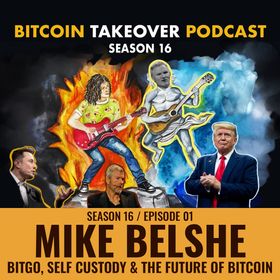
S16 E1: Mike Belshe on BitGo, Self Custody & The Future of Bitcoin
The audio keeps playing while you browse the site.
Read the transcript20,946 words, every line links to the minute it was said
Ask this episode
Read the article: S16 E1: Mike Belshe on BitGo, Self Custody & The Future of Bitcoin
Mike Belshe is the co-founder and CEO of BitGo, and before Bitcoin he worked on Netscape and on the Chrome browser at Google, where he created SPDY, the protocol that became HTTP/2. As a Bitcoin and internet pioneer, Mike draws some really interesting parallels between the two realms, from Tim Berners-Lee and Vint Cerf to how protocols evolve. We talk about MPC versus multisig, Wrapped Bitcoin, scaling layers, the block size wars and Craig Wright, the strategic Bitcoin reserve, seed phrases and wallet recovery, Casa and Jameson Lopp, MiCA, the role of Ethereum, privacy and Lightning fees, and who Satoshi might have been.
This episode is sponsored by LayerTwo Labs, SideShift, Hodling.ch and NoOnes.
Timestamps
- 0:00Intro
- 0:44Welcome: Mike Belshe, live on the first episode of Season 16
- 4:46What does MPC stand for?
- 8:27BitGo, Ethereum and Wrapped Bitcoin
- 11:37From Netscape and Chrome to HTTP/2
- 14:33The Tim Berners-Lee quote behind Mike's interest in Bitcoin
- 18:07Why do we need scaling layers?
- 21:14Sponsor: LayerTwo Labs
- 28:25Zerocoin and Zcash
- 29:50Vint Cerf
- 35:08Sponsor: SideShift
- 35:53The block size wars and SegWit2x
- 41:05Craig Wright
- 44:30The strategic Bitcoin reserve
- 53:05Sponsor: Hodling.ch
- 56:02Seed phrases and hardware wallets
- 1:01:12Recovering funds without passwords
- 1:05:07BitGo versus Casa
- 1:10:46Sponsor: NoOnes
- 1:15:32MiCA and data sharing between custodians
- 1:19:49What excites Mike about altcoins
- 1:24:34Will privacy ever take off?
- 1:29:01The role of Ethereum
- 1:34:05Lessons from TCP/IP and the internet
- 1:35:37A very expensive Lightning payment
- 1:44:38Culture problem or technical problem?
- 1:51:10Satoshi and the early miners
- 1:53:49Was Satoshi a well-intentioned researcher?
- 1:58:12How to follow Mike and BitGo
Verify this episode
This is the SHA-256 fingerprint of the MP3 as published here, timestamped in the Bitcoin blockchain with OpenTimestamps. If one byte of the file changes, the fingerprint changes.
- SHA-256
6cccd9e1b2adf6ec0f502435c1b866895329459b60f8caf1f8398b1549250e58- Proof
- 2025-01-03_s16_e1_mike_belshe_on_bitgo_the_future_of_bitcoin.mp3.ots · all episode hashes (proof)
- Status
- Anchored in Bitcoin block 974,312
How to check it yourself
- Download the MP3 and the proof into the same folder.
- Run
sha256sum 2025-01-03_s16_e1_mike_belshe_on_bitgo_the_future_of_bitcoin.mp3(on a Mac:shasum -a 256 2025-01-03_s16_e1_mike_belshe_on_bitgo_the_future_of_bitcoin.mp3). The result must match the SHA-256 above. - Install the OpenTimestamps client (
pip install opentimestamps-client) and runots verify 2025-01-03_s16_e1_mike_belshe_on_bitgo_the_future_of_bitcoin.mp3.ots. It hashes the MP3 again and checks the proof against your own Bitcoin node, then prints the block and the date the file existed by. Without a node,ots info 2025-01-03_s16_e1_mike_belshe_on_bitgo_the_future_of_bitcoin.mp3.otsshows the block height to look up in any block explorer.
Keywords from the feed: Mike Belshe, BitGo, Bitcoin, Multisig, Self Custody, Privacy, Protocol Development
