




S15 E52: Ben Arc on the Future of Lightning, Bitcoin & Nostr
The audio keeps playing while you browse the site.
Ask the Archive
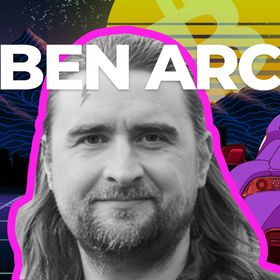
Ben Arc is the man who still owns nostr.com, a domain I keep telling him to sell for a thousand bitcoin. He is also the creator of LNbits, the tinkerer behind a Lightning-powered candy dispenser, and the guy who got the Bowser hardware wallet and a Nostr signing device off the ground. A year after our last conversation about LNbits and Nostr, I wanted to know what he had been building.
The first thing he did was refuse the compliment. "I didn't do all those things," he corrected me within the first minute. Then he spent the next 45 minutes defending the Lightning Network at a moment when almost everyone else seemed ready to bury it, while a guitarist played somewhere in the background.
If you came here for a eulogy for Lightning, you will be disappointed. Ben thinks the job is barely started.
The Gavin Andresen of LNbits
Ben describes himself as a starter, not a finisher. "I think I'm quite good at coming up with a proof of concept, but as a developer I'm not the best," he told me. The Bowser hardware wallet and the Nostr signing device were perfected by Vladan, and LNbits itself grew up thanks to a crew he rattled off with obvious affection: Vladan, Black Coffee, Tal, dni, fiatjaf and others.
He even jokes that his own pull requests now struggle to get into LNbits core, which he considers a sign of health. "You don't want me committing to LNbits core," he laughed, and then reached for a comparison any Bitcoiner will recognize: "I feel like the Gavin Andresen of LNbits." The founder steps aside, the project outgrows him, and that is how it should be.
The trick that keeps him useful is the extension framework. LNbits is designed so that novice developers, and people who were never classically trained, can still ship an extension. I had my own thank-you notes to add here. Black Coffee agreed to list the Bitcoin Takeover magazine in the LNbits shop, printed in the UK and sold for roughly what it costs me to print and ship it. And Vlad Stan, a Romanian LNbits developer, is now firmly on my list of guests to chase.
Five Percent Done
Then I brought out the uncomfortable question. Since we last spoke, Antoine Riard had disclosed Lightning vulnerabilities, node and channel counts had dipped, and the spotlight had moved to Ark, statechains like Mercury Layer and drivechains. Does he still believe in Lightning?
Absolutely, and with a statistic I have not been able to stop thinking about. In his view, "5% of the work has been done to make Lightning functional and already it far surpasses other payment networks such as Visa." The remaining 95% is unglamorous. "Bitcoiners love a panacea," he said, "and the reality is it's blood, sweat and tears."
He gave a concrete example. LNbits used to rely on Ride The Lightning for node management, but the software was so heavy that it crashed their server, so the team built its own node manager into LNbits. "It's crazy to me that after whatever four years," he said, nobody had solved basics like channel balancing and automatic swaps. His rewrite of an old line went like this: it is not about what Lightning can do for you, "it's what can you do for Lightning."
Channel factories were the cornerstone of the very first Lightning hack day he attended, months after mainnet launch, yet barely anyone has worked on them since. The reason is simple: when on-chain fees are low, Lightning feels good enough. That is why Ben, of all people, has a soft spot for ordinals. When the inscription wave pushed fees up and everybody's Lightning node got squeezed, solutions came "out of the woodwork": submarine swaps, Liquid-based rebalancing, serious channel factory talk. His conclusion is almost Darwinian. "We don't tackle scaling Lightning Network properly until on-chain fees are critical."
He also suspects that part of the gloom is manufactured. "There's an incentive to FUD on Lightning," he said, pointing at the money behind ecash, and he flatly rejects the claim that the world must rely on federated mints. "We can have a Lightning node on everybody's phone. Seven billion people have smartphones."
No Trusted Third Parties, Please
Ben's filter for every new scaling proposal is the one Satoshi baked into the whitepaper. "Bitcoin's whole thesis is trying to remove the trusted third party," he reminded me, so it makes no sense to turn around and declare trusted third parties acceptable, as long as we federate them. The entire reason we tolerate "this ridiculous blockchain thing" and the convoluted machinery of Lightning channels is to get rid of the middleman.
"Any proposal or solution which requires a trusted third party, I'm instantly skeptical about," he said. Drivechains get a more nuanced treatment. He likes them, but suspects that if they ever arrive, we would simply end up with a sidechain optimized for Lightning sitting beneath it. Ark, too, could offer channel factory-like behavior. The point is to organize protocol layers in the right order, with bidirectional payment channels on top doing what they do best.
Swaps, Liquid and a Cambrian Explosion
This is where my sponsor read turned into an argument. SideShift, which lets you swap between coins without an account (think of the old ShapeShift), had removed its Lightning option for lack of liquidity, while a memecoin mocking Joe Biden supposedly did more volume. Ben was not impressed by the comparison. In his experience, people paying for things with bitcoin use Lightning, and much of that shitcoin volume is wash trading. "You can't really trust the volume."
He does agree that swap services matter enormously, and LNbits has a direct line into one: dni also works on Boltz. Ben explained how LNbits sits on top of any funding source, from LND and Core Lightning to custodial services, because he was tired of rewriting every project for a different API. The latest addition came from Jackstar, the same developer who built the node management tool, who had messaged him the day before to say the Boltz funding source was finished.
The result is something like Aqua wallet inside LNbits. Your balance lives in Liquid, and Lightning payments are auto-swapped in and out. Fees were around 100 sats per swap at the time, but according to Ben, Michael from Boltz planned to bring them down to about 40, "which then becomes nominal" when you are buying a beer. For an LNbits software-as-a-service install, it means users get Lightning without the team becoming custodians.
Add Galoy's Blink, ACINQ's Phoenixd and Blockstream's Greenlight to the mix, and Ben sees a pattern. "There's been this Cambrian explosion of solutions for Lightning Network," he said, and it happened precisely during the bear-FUD cycle. "If only they had existed like three years ago," running a node on a Raspberry Pi would have been far less painful.
ZK Rollups, Covenants and a Boeing 747 in Flight
Next came a pitch from another sponsor, StarkWare, which wants OP_CAT activated so it can bring ZK rollups to Bitcoin. Ben's take on zero-knowledge tech was warm, with a jab at a certain privacy coin: "It's a shame that Zcash acted so coiny, because it's a good concept." He hopes we eventually get something like Zcash on Bitcoin, perhaps through ZK rollups, perhaps through drivechains.
He is allergic to anyone claiming to define Bitcoin's final form. "The worst thing any Bitcoiner can do is to say I can define what Bitcoin is," he told me. Covenants, in his words, "unlock a whole bunch of new potential ways" of engaging with the network, and the right response is more experimentation and more computer science. I added my favorite ZK party trick: a phone that syncs by verifying a single proof, no Electrum server peeking at your xpub.
When the conversation reached drivechains (yes, Layer Two Labs was also a sponsor), I suggested that Litecoin might test them first, the way it tested SegWit. Ben agreed that "SegWit arguably might not have happened had Litecoin not done it first," and then gave the best defense of conservative development I have heard in a while. Working on Bitcoin is like working on "a Boeing 747 flying through the air," and you are servicing it mid-flight. Break something and everyone falls.
His most interesting point was that drivechains already delivered something useful just by being proposed: they "really highlighted how centralized mining is." Work like Stratum V2 becomes urgent, and he summarized the critics' stance fairly as "nice proposal, but not while mining is so centralized." Thesis, antithesis, synthesis. I told him it was a rather diplomatic answer. He did not deny it.
The Trouble With Mints
I confessed my own discomfort with Cashu. I love Calle, I remember him babbling about Chaumian ecash at a bar and then coding the backbone of Cashu the following week, but promoting custodians as a scaling solution feels like it defeats the reason I got into Bitcoin in the first place.
Ben's answer started with a family history. Calle works on LNbits, and the first Cashu MVP was built from LNbits' fake wallet funding source, essentially "a chopped up LNbits." So ecash, he said, "came out of the womb of the LNbits ecosystem." He thinks it is powerful technology with real use cases such as paid API calls. Then came four words in a row: "However, however, however, however."
His concern is the game theory nobody has worked out. "Who's going to run mints?" If you run a mint, you are effectively producing currency, and jurisdictions tend to dislike that. Ecash is not really pegged to bitcoin either. "I bought a beer in the conference, it doesn't mean the beer is pegged to bitcoin." There is no good proof of reserves, and the privacy that protects users also strips away the double-entry bookkeeping that lets you prove the custodian lost your funds. LNbits support tickets are full of "this didn't seem to happen" moments, and inflation bugs, as Monero has shown, are hard to catch in private systems.
Federation is no magic fix. Ben pointed to Liquid as the expensive way to do it right: members are vetted so they are not geographically clustered, and someone literally flies out with a box of custom hardware to onboard each new functionary. Now picture that being replicated by casual community banks. In his village in Wales, he estimates "maybe three, four people" could realistically operate a Lightning node, so how would a less connected community run a federation of mints? Ecash may still become an important part of the world's economy, maybe even as a federated digital dollar. But dropping trustlessness for convenience, he warned, is a little like "let them eat cake."
A Castle Built on Sand
I then tried to get him cancelled. Name three cryptocurrencies that are not Bitcoin and not complete scams.
He managed two. He likes Monero because people actually use it and because it explores the real problems of private digital money. And he credited Litecoin for the service it did to Bitcoin with SegWit, plus MimbleWimble as "good computer science." That was enough. "I don't need a third, do I?" Ethereum, in his view, is "a castle built on sand," which is exactly the worry he has with ecash: if the foundational assumptions are wrong, all the wonderful work on top can be made redundant.
He kept clear of the ordinals debate, which I told him was pointless since he was already cancelled. His home is payments. "Lightning is where I live," he said, and making nodes easier to run plus exploring micropayments is enough for him. Still, "the world's not binary in software." Good ideas from what he called "the crazy weird outland of shitcoin" usually make their way back to Bitcoin eventually, and that, he agreed, is what drivechains are designed to enable, even if "Bitcoin's not ready for drivechains" yet.
Wrong Jungle
Ben closed the theory part of the interview with a fable. A team is tasked with cutting through a jungle. They are wonderfully efficient, slicing through vines, and just as they reach the destination someone at the back raises his hand and says: "Oh, wrong jungle."
"We can pursue something to incredible work and then figure out we're just actually in the wrong jungle," he told me. That, he admitted, is roughly how he feels about ecash. It is also a decent warning for every Bitcoin project, his own included, and I suspect he knows it.
Where to Start, and What Comes Next
Before pointing listeners anywhere, he added a disclaimer: his opinions are his own, not those of the Nostr community or of LNbits. "They're not from LNbits, they're just from me."
For newcomers, the entry points are simple. LNbits.com links to the GitHub repo and to a hosted version that lets you spin up an instance in minutes, a "good place to experiment." Nostr.org has an explainer video and a long list of clients for your phone or laptop. MakerBits covers the hardware side: ATMs, points of sale, cheap signing devices and hardware wallets, with its own Telegram group and YouTube channel.
His goals for the following year were concrete. He wanted LNbits out of beta, used by "some big institutions to manage their Lightning payments," with a fully hardened core and ten times as many extensions. On Nostr, he wanted themed clients. The old internet was made of forums for golden retriever owners and Oasis fans, until Twitter and Facebook pulled everyone in and stripped those communities bare. "With Nostr, you can have both," he explained: subject-specific clients that still plug into the wider social graph. You can see how that wish played out in our 2025 conversation about LNbits V1.
He ended his answer at the exact moment the guitar player in the background stopped, which I found very poetic. Then he turned the tables and thanked me for the magazines, calling me "a chronicler of Bitcoin and its journey" and telling me not to let the maxi trolls get to me for interviewing fringe Bitcoiners. Coming from someone who keeps handing credit to everyone else, that meant a lot.
Listen to Ben Arc on Spotify, Apple Podcasts, YouTube, and More
Time stamps:
00:00:23 – Introducing Ben
00:01:41 – LNbits Contributors and Collaborators
00:05:01 – Scaling Challenges of Lightning Network
00:06:06 – Bidirectional Payment Channels
00:07:22 – Need for Development in Lightning Network
00:09:32 – Skepticism Towards Trusted Third Parties
00:12:20 – Importance of Swapping Services
00:17:40 – Innovating Lightning
00:18:15 – ZK Rollups and Future of Bitcoin
00:19:49 – Covenants and Computer Science
00:20:21 – ZK Proofs and Mobile Wallets
00:20:51 – Drivechains
00:22:10 – Litecoin's Influence on Bitcoin
00:23:06 – Centralized Mining Concerns
00:24:13 – Community Contributions and Tribalism
00:25:04 – Self-Custody Consulting
00:26:08 – Cashu and Its Implications
00:27:08 – Game Theory and Custodial Solutions
00:29:58 – Mints and Trust Issues
00:33:37 – Ecash and Its Future
00:34:12 – Regulatory Environment for Cryptocurrencies
00:35:02 – Alternative Cryptocurrencies
00:36:50 – Bitcoin's Payment Technology
00:38:58 – Pursuing the Right Focus
00:39:23 – Getting Started with LNbits and Nostr
00:39:37 – Disclaimer on Personal Views
00:40:03 – Exploring LNbits
00:41:18 – Ben's Current Projects
00:41:47 – Acknowledging Team Contributions
00:42:00 – Future Aspirations for Lightning Payments
00:43:00 – Thematic Nostr Clients
00:43:47 – Closing Remarks
00:44:18 – Mutual Appreciation
00:45:09 – Acknowledging Hard Work
Verify this episode
This is the SHA-256 fingerprint of the MP3 as published here, timestamped in the Bitcoin blockchain with OpenTimestamps. If one byte of the file changes, the fingerprint changes.
- SHA-256
c37ec22dae866885b0f7915e9a8e09f8623392b769997069229d08b88ff35bac- Proof
- 2024-08-29_s15_e52_ben_arc_on_the_evolution_of_lightning_bitcoin_nostr.mp3.ots · all episode hashes (proof)
- Status
- Anchored in Bitcoin block 974,312
How to check it yourself
- Download the MP3 and the proof into the same folder.
- Run
sha256sum 2024-08-29_s15_e52_ben_arc_on_the_evolution_of_lightning_bitcoin_nostr.mp3(on a Mac:shasum -a 256 2024-08-29_s15_e52_ben_arc_on_the_evolution_of_lightning_bitcoin_nostr.mp3). The result must match the SHA-256 above. - Install the OpenTimestamps client (
pip install opentimestamps-client) and runots verify 2024-08-29_s15_e52_ben_arc_on_the_evolution_of_lightning_bitcoin_nostr.mp3.ots. It hashes the MP3 again and checks the proof against your own Bitcoin node, then prints the block and the date the file existed by. Without a node,ots info 2024-08-29_s15_e52_ben_arc_on_the_evolution_of_lightning_bitcoin_nostr.mp3.otsshows the block height to look up in any block explorer.
Related
S17 E19: Amaury Séchet on Forking Bitcoin Twice, Quantum FUD & Scars from the Block Size Wars
Two years after our first interview, I decided to invite Amaury Séchet(@deadalnix) to find out what the Greg Maxwell of big…

S17 E22: Jeremy Rubin on CTV, Char & Relentless Building in an Adversarial Environment
Four years. That is how long I have been chasing Jeremy Rubin for an interview, and it took the Bitcoin 2026 conference…

S15 E50: Murch on Popular Bitcoin Myths: Ordinals, OP_CAT, Zero-Conf & the 2140 Panic
Murch of Chaincode Labs and Bitcoin Stack Exchange busts popular Bitcoin myths: ordinals as spam, a captured Bitcoin Core…

Comments
Comments run on my own server. No ads, no trackers.