




Peter Todd Unboxes His Zcash Ceremony Laptop, 10 Years After Sprout
Some relics live in museums. This one lives in a sealed envelope labelled “Burnt compute node remains,” and on October 15th, 2026, I carried it to TABConf 8 in Atlanta so its former owner could open it on camera. The owner is Peter Todd. The relic is the laptop he used as his compute node in the 2016 Zcash Sprout trusted setup ceremony, then cooked with a blowtorch in a Canadian clear cut. Peter sold it to me in 2022 for $1111 in bitcoin, and ten years (minus a few days) after the ceremony, I brought the two back together.
The deal was simple. “He will unbox this on camera to remind people why he did this and what this means,” I explained at the start, “and in exchange for this I’ll donate one Zcash to one of his favorite charities.” What followed was 37 minutes of DVDs, melted plastic, British Columbian sand and very honest opinions. As I said halfway through: “I think this is the weirdest unboxing anyone has ever watched.”
From Zerocoin Critic to Ceremony Participant
Peter is an unusual choice for the job of birthing a privacy coin, and he knows it. Back in 2014 he argued against bolting Zerocoin onto Bitcoin, “for the obvious reason that if we actually add it to Bitcoin, you’re creating this big pool of funds that’s likely to get stolen in a cryptographic break.” His position was never anti-privacy. “The idea of privacy isn’t bad,” he told me. “This type of cryptography just is too new to trust it with that much money, especially when, let’s face it, if Bitcoin dies, we may not get a chance to get another Bitcoin.”
A separate currency was a different story. So when Zooko’s team needed six people to each generate a fragment of the secret behind the zk-SNARK parameters (the “cryptographic toxic waste” that, if reassembled, could print counterfeit coins), Peter said yes. Why him? “Because they knew I was adventurous enough to actually say yes and competent enough that it was worthwhile.” He also claimed the gold medal for paranoia: “Out of all the people who were participating I certainly by far did the most thorough attempt of what was possible on my end to make my part of the ceremony secure.”
He has receipts for that claim. His 2016 write-up, Cypherpunk Desert Bus, opens with a wall of disclaimers and a blunt reminder that “you’re trusting me and five other participants not to collude.” For the official version of how the multi-party computation worked, the Electric Coin Company published The Design of the Ceremony, and z.cash keeps a parameter generation page.
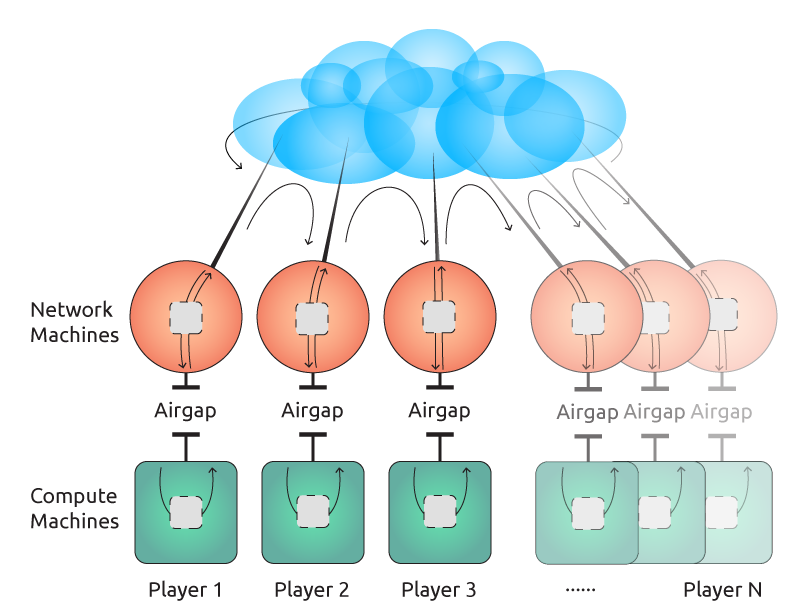 The architecture of the 2016 parameter generation. Image: petertodd.org (2016)
Decoy Flights and a 3,000 Kilometer Drive
Peter’s core strategy was to be somewhere nobody could easily watch. “What’s a better way to do that than just go rent an SUV and drive, well, I think it was about 3,000 kilometers across British Columbia.” He even fed potential spies a red herring: he booked flights to a different part of Canada, then “right at the very last minute, I literally went to the airport and right at the counter” bought a ticket to Vancouver, where “a very long, very boring road” with good cell coverage was waiting.
The laptop itself had to be bought blind. “I couldn’t order it online, I couldn’t purchase it in advance,” he said. “I did just literally keep driving until I saw a computer store.” His blog fills in the shopping list: Zooko had told him he needed a fast Intel i7, so he walked out of a Staples with a brand-new MSI GE62 gaming laptop, one of the few new machines that still came with a DVD burner. When I teased him for buying something so fancy, he corrected me: “There was actually pretty high performance requirements to finish the compute in a relatively fast way.”
The IEEE Spectrum piece by Morgen Peck, The Crazy Security Behind the Birth of Zcash, described his station as “one mobile station” making “a mad dash across British Columbia,” and noted that he “ran all of his computations on a laptop encased in a tin foil-lined cardboard box, while driving across Canada.” Peter’s own quote to the magazine is pure gold: “It was my goal to outdo every other station in Canadian cypherpunk glory.”
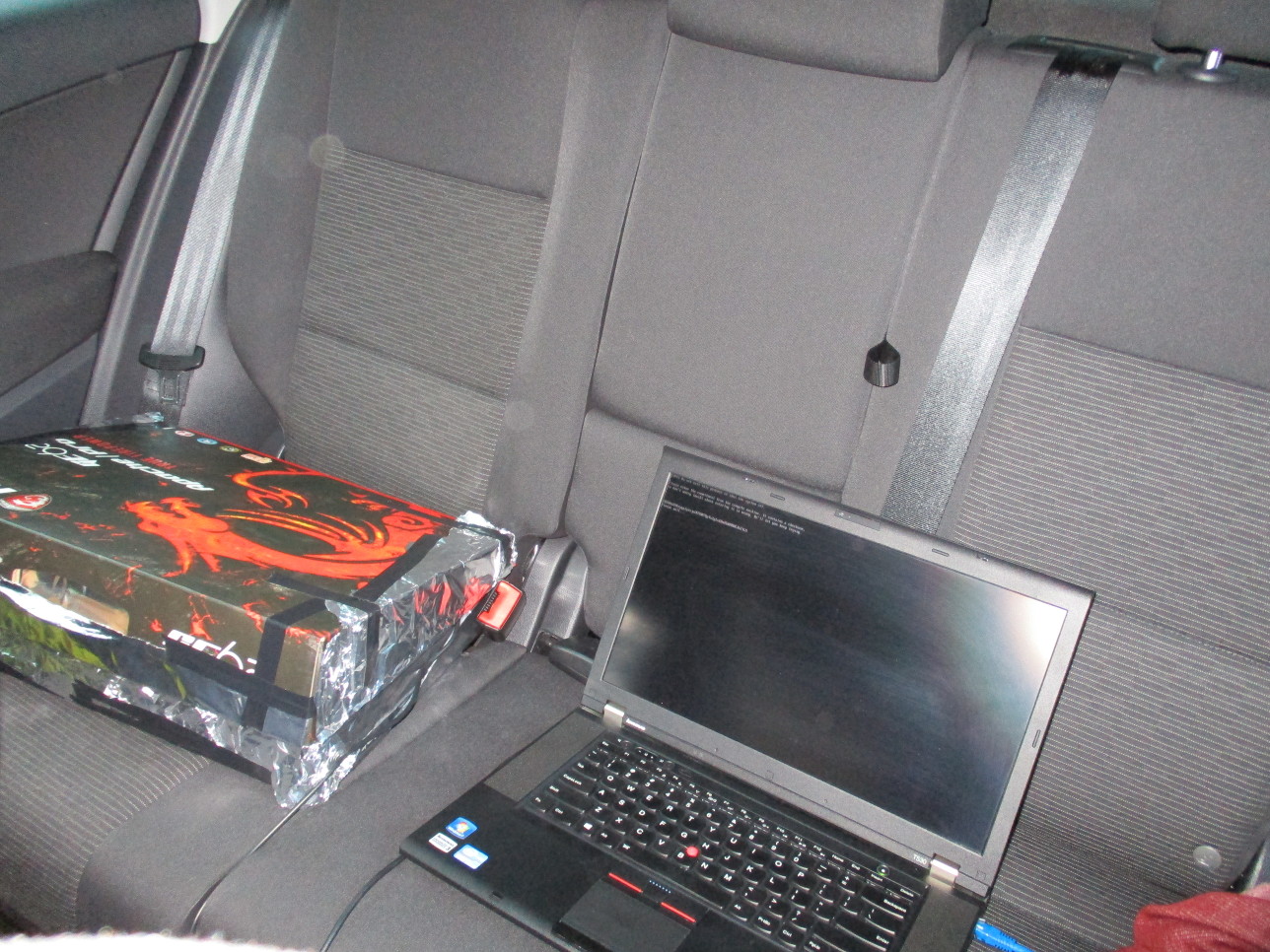 The compute node riding in the back seat. Photo: petertodd.org (2016)
Discs A to F: The Paper Trail Burned in Plastic
The compute node never touched a network. Instead, Peter explained, “we’d have a separate node burning DVD disks with data, move it to the compute node, put it in, do stuff, burn more stuff, then go back. And that was the communication mechanism.” He held up each disc for the camera: “A, B, C, D, E, and then F,” each one a step of the multi-party computation. The beauty of DVDs, in his words, “is it meant you did have a record,” a supposedly read-only audit trail of everything that went in and out. IEEE Spectrum made the same point: the write-once DVDs, “authenticated by cryptographic hashes,” were meant to put any tampering on the public record.
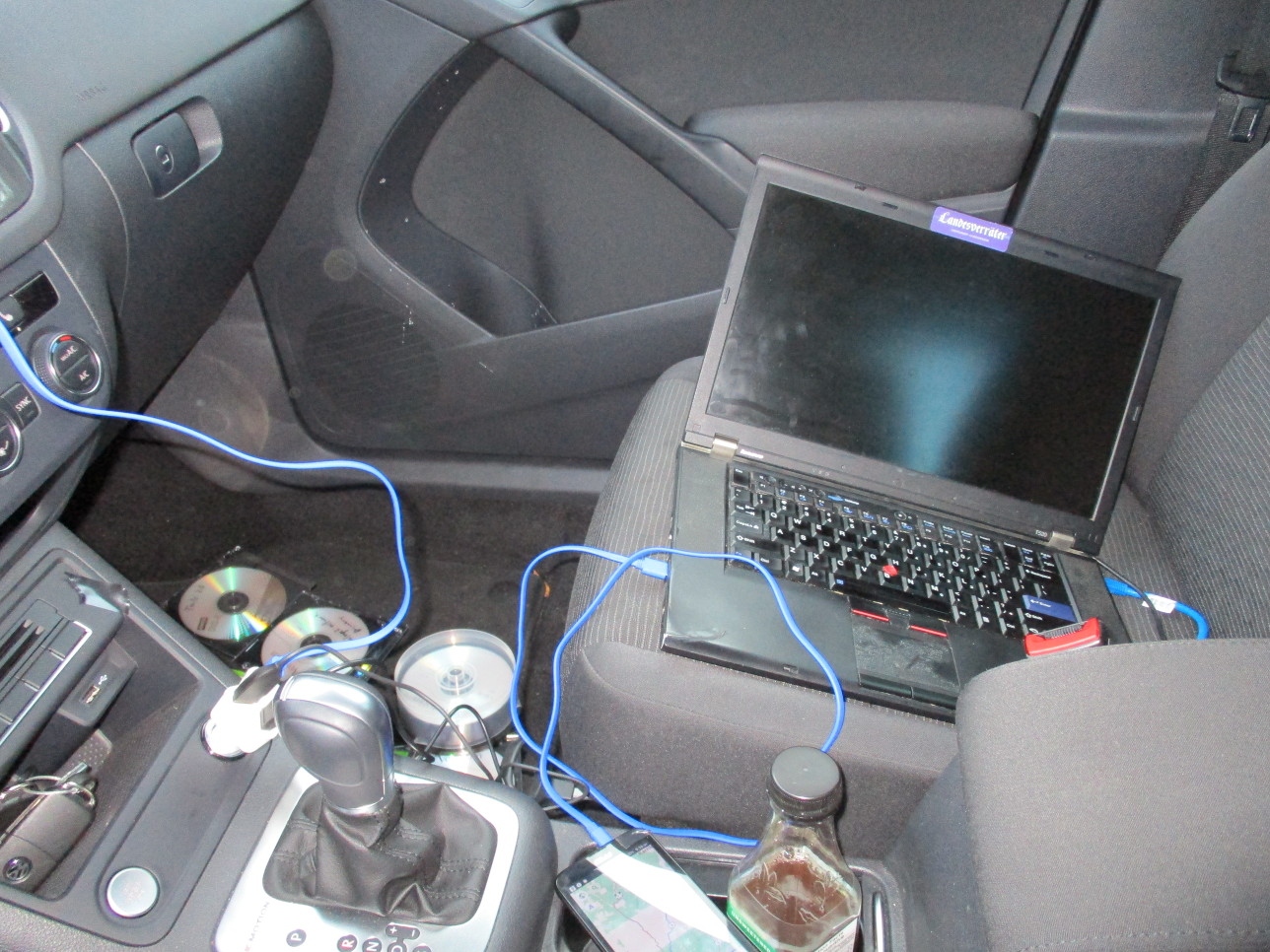 The network node and DVD workflow, mid-road trip. Photo: petertodd.org (2016)
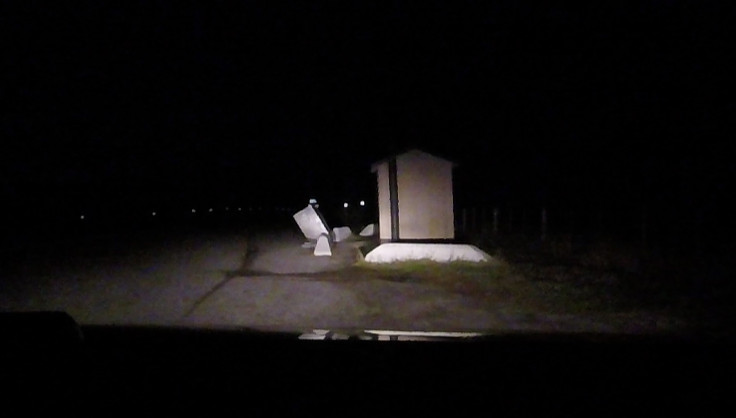 The Disc A stage of the ceremony. Photo: petertodd.org (2016)
Those discs carry a plot twist. I mentioned that Sean Bowe once told me he was interested in buying them, “because you could generate inflation in the Sprout pool using the information on these.” Peter confirmed the gist: Zcash had a flaw where “the information on the audit records could be used to go and basically create fake proofs.” That was the counterfeiting vulnerability the Electric Coin Company later disclosed as remediated. Peter was not impressed by how quietly it was handled: “Mysteriously, the audit records started disappearing. And quite rightfully, people were wondering, what the fuck’s going on?”

Those six DVDs, labelled A through F, still sit inside the envelope you see above. Peter sealed it at 00:11 am on Monday, October 24th, 2016, and signed it. It stayed shut for almost nine years, until I unsealed it at 20:45:14 UTC on Tuesday, June 3rd, 2025, at Zcash block height 2,946,932, and signed it myself.
He also did not spare the build pipeline. Everyone ran the same software from DVD, built on “this very obscure Linux distribution,” a daily snapshot that “wasn’t deterministically built, so anyone with access to that could have easily just backdoored the whole thing.” Same story with a nightly Rust compiler. “Just layers and layers of places where a backdoor could have” crept in, he sighed, before landing the punchline: “But of course, the math was broken.”
A Clear Cut, a Blowtorch and Some Very Cooked RAM
Once the ceremony was verified, the laptop met its end. “I took this laptop out to literally a clear cut,” Peter said, then defined the term for my European ears: “a chunk of forest where they’ve cut all the trees down.” Careful with his wording, he added: “For legal reasons, I won’t say I set it on fire because that would have been illegal. But I did heat it up enough with that blowtorch that every single place data could have possibly hit, that was pretty gone.” His blog confirms the paperwork side: he checked BC fire bans and burning rules first, wore a respirator, and heated the parts in a metal pan with cameras rolling.
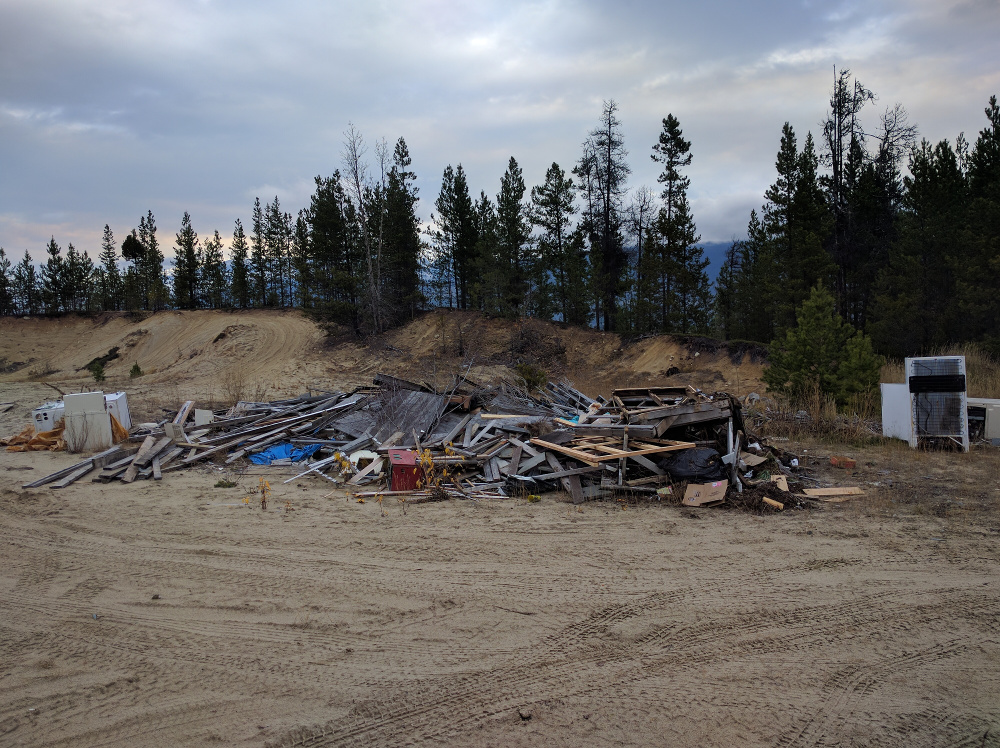 The sandy clear cut chosen for the destruction. Photo: petertodd.org (2016)
When he cracked open the envelope, sealed with packing tape a decade ago, the smell was still there. “It still smells like it was freshly burned,” I noted. “I sealed in the freshness,” Peter replied. Out came pieces of the DVD drive (“the little laser head”), the LCD, the motherboard, and the star of the show, a blackened stick of RAM. Peter gave a quick physics lesson: flash memory traps electrons behind an insulator, and heat sets them free. “There is no way after being literally heated until it was glowing that any data could possibly survive on this. It’s a very cooked piece of RAM.”
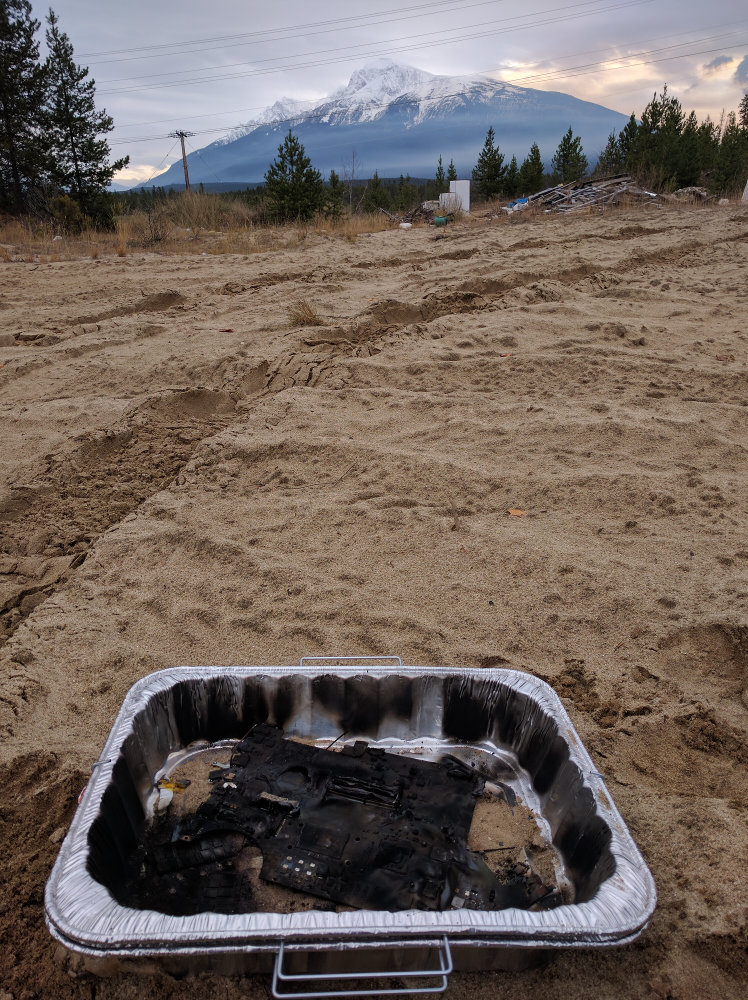 Burnt compute node remains. Photo: petertodd.org (2016)
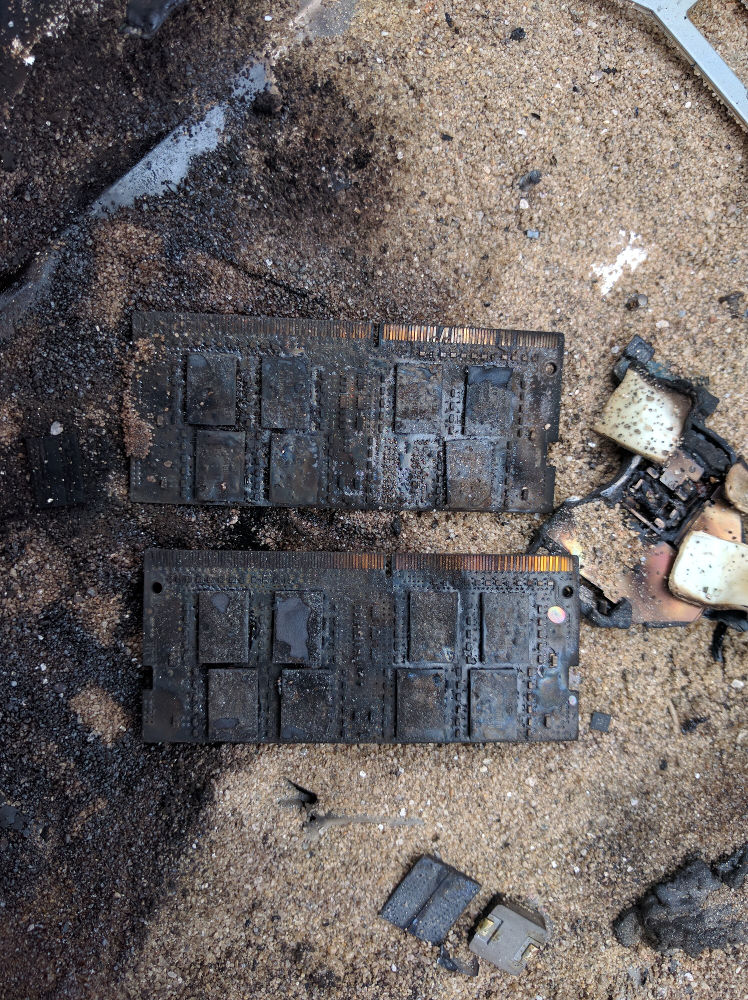 The RAM chips that once held a fragment of the toxic waste. Photo: petertodd.org (2016)
There were bonus souvenirs too. The grit on the circuit board? “That sand that melted into the plastic on the bottom of the circuit board, all the way from British Columbia.” And the keyboard was part of Zcash’s birth: some of the randomness “was generated by literally just mashing the keys,” which Peter insists “is a perfectly good way of generating random numbers.” The lithium cells were the only thing that did not survive the trip home: “If you don’t really want a lithium fire, they kind of suck, so that I just dispose of separately.”
The Anti-Ninja Chair and Ten Years of Footage
My favorite detail from the original write-up is a chair. Peter tilted it against his motel door at night as a homemade intrusion alarm. “The thing I was most impressed with by far was the chair leaning against the door, anti-ninja,” I told him. “What an absolute safety practice we should all be practicing.” Spectrum, for the record, reported that the Boulder station had four security cameras aimed at its offline computer “in the event of a ninja attack,” so ninjas were clearly a shared threat model in 2016.
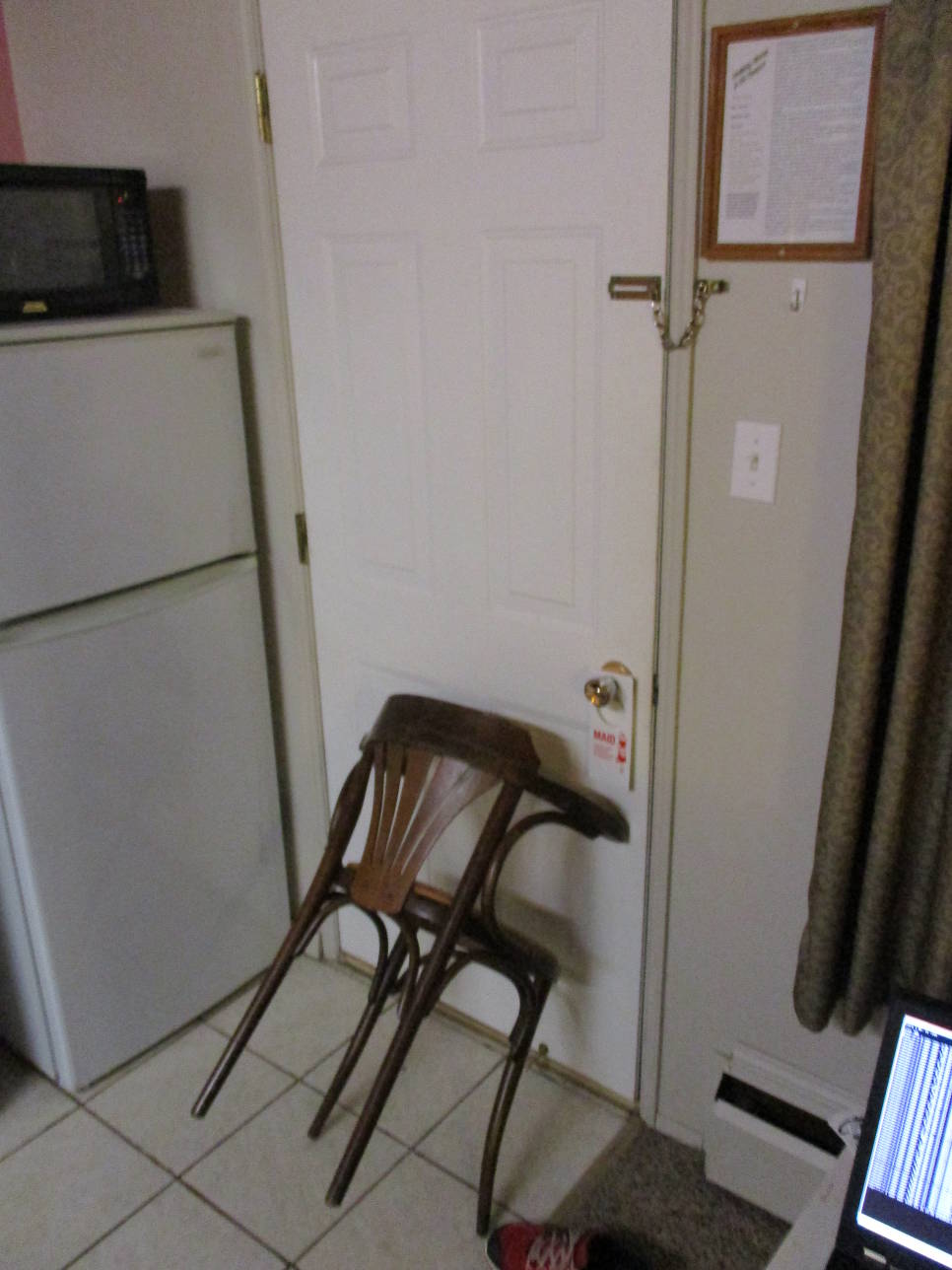 The “anti-ninja device.” Photo: petertodd.org (2016)
Asked whether he remembered the destruction, Peter went one better: “Not only do I have memories, I have footage. I mean, I recorded the entire thing.” Some of it sits on Amazon S3, and he believes he sent a hard drive of documentation to the Zcash team. It was also “a very early use case for OpenTimestamps,” which, as he pointed out, just celebrated its own tenth anniversary.
Why Peter Sold It, and How It Came Back
So why did one of six Sprout compute nodes end up with a podcaster? Peter’s answer was disarmingly practical: “Taking up space in my apartment. I’m not a very sentimental person. I’m happy to accept some Bitcoin in exchange for sending this off to someone who cares more.” That someone was me: in June 2022 I placed the winning bid under Peter’s thread and paid $1111 in bitcoin, and the transaction confirmed on June 14th, 2022, in block 740,751. When I asked whether the reunion made him nostalgic, he did not budge: “I’m not a nostalgic person, man.”
I am the opposite. I took the laptop to Singapore the week before TABConf, and people were thrilled to see it. I also unboxed it during my six-hour S16 E29 interview with Zooko, where “Peter Todd’s Compute Node, Zcash Ceremony and Trusted Setup” got its own chapter. I waved the remains at Eli Ben-Sasson on S15 E36, who called it “a relic from this very important ceremony,” and it came up again with Sean Bowe on S16 E51, the man whose Halo work later removed the need for trusted setups altogether.
The unboxing even inspired a write-up on X from Shielded Mark, titled “BTW, It’s OK that Vlad unboxed Peter Todd’s Zcash ceremony laptop remains”, published in September 2025 after an earlier unboxing session.
For the record: the laptop might be for sale in exchange for a life-changing amount. Otherwise, I am very comfortable holding it in my collection.
Would He Do It Again? And What About Zcash Today?
With hindsight, Peter would mainly have asked the team to wait: “Could you go hold off like another month? Let’s go fix this crypto vulnerability that I magically know about.” But he would join another ceremony, “especially if someone’s paid me for it.” He also gave Zcash its due. Trusted setups, he said back in his 2013 San Jose days, would be “accepted enough in other lower quality systems,” and “Zcash is a great example that even after multiple possibly could have killed the whole coin incidents, still muddled its way through.”
On Zcash in 2026, he was nuanced. Holders are “very underestimating the risks of them losing everything to a crypto break,” yet “Zcash in combination with other privacy techniques is probably a worthwhile add-on.” He praised the anonymity set and called out chain analysis firms (“the history of chain analysis is full of frauds who lie about what their analysis can do”), but warned that the current design “just doesn’t scale.” He credited the Zashi wallet (now Zodl) and its cross-currency swaps for making Zcash interesting to real users.
Compared with Monero, his summary was crisp: “Zcash uses scarier cryptographic assumptions in exchange for potentially better privacy.” With Monero’s ring signatures, “it could have come from one of 20 places, and in many threat models that’s just not that good.”
We closed by settling my end of the bargain live on Georgia Tech’s guest Wi-Fi: one ZEC, memo “10 year anniversary of Zcash Sprout ceremony,” sent to Peter’s Cake Wallet for his fund buying armored vehicles for Ukrainian soldiers. It arrived in about 90 seconds. “That’ll buy one tenth of a truck,” Peter said.
Listen to Peter Todd on Spotify, Apple Podcasts, YouTube, and More
You can also watch the full interview on X or on YouTube.
Time stamps:
- 0:00Unboxing the compute node, 10 years after Sprout
- 1:45From Zerocoin critic to ceremony participant
- 3:41Why Peter was picked
- 4:18Decoy flights and a 3,000 km drive
- 6:30Why it’s called the compute node
- 6:49The discs and the audit-record bug
- 8:10Discs A to F
- 9:36Why Peter sold the laptop
- 10:02The other ceremony participants
- 10:29Software DVDs and deterministic builds
- 12:05Tails as root of trust
- 13:05The clear cut and the blowtorch
- 13:51Opening the burnt remains
- 15:15Very cooked RAM
- 16:30A high-end laptop and BC sand
- 20:05Mashing keys for randomness
- 21:06The motherboard
- 21:39The anti-ninja chair
- 22:51Zcash survived its trusted setup era
- 23:47Donating to Ukraine
- 24:42Ten years of footage and OpenTimestamps
- 25:44Would Peter do it again?
- 26:36The Citrea ceremony
- 27:39Nostalgia
- 27:58Zcash today
- 30:10Zashi, Zodl and swaps
- 31:48Zcash vs Monero
- 33:15Wrapping up
- 33:51Sending 1 ZEC live
Related
It's Only Carbon: Daira-Emma Hopwood, the Zcash Grants Vote, and Forks on Stage in Amsterdam
Eighteen years after Satoshi's Byzantine Generals email, Zcash is arguing about money, not block times. I have two hours of…
S17 E50: Daira-Emma Hopwood on Zcash at 10, Halo and Private Money
At Zcash’s tenth anniversary, Daira-Emma Hopwood explains the ceremony flaw, Halo, the ZSA dispute and the human expertise behind…
S17 E49: Kris Nuttycombe (Zcash at Ten, Hard Forks, Dev Fund, Ossification)
Kris Nuttycombe of ZODL on Zcash at ten: hard forks as a superpower, freezing Sprout, NU7, Tachyon, the Dev Fund, testnet forks…

Comments
Comments run on my own server. No trackers, no tracking cookies.