




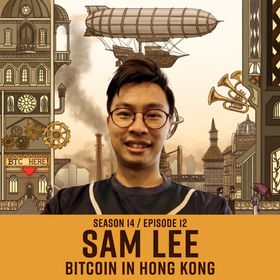
S14 E12: Sam Lee on Bitcoin in Hong Kong
The audio keeps playing while you browse the site.
Read the transcript8,300 words, every line links to the minute it was said
Ask this episode
Sam Lee opened our recording by admitting he is shy. "I'm so shy to do podcasts, to let everyone see my face talking," he said, which is why this one went out as an audio-only livestream. We recorded the day after the September meetup in Hong Kong, in the middle of what the city was calling a once-in-a-century flood.
Sam has organized the Bitcoin Hong Kong meetup since 2019. Leo Weese started it in 2018, and Sam took it over a year later, which means he ran it through lockdowns, vaccine passes and the slow death of the ICO crowd. I wanted to know what a Bitcoin meetup looks like in a city that people from Singapore to Silicon Valley keep describing as either finished or about to become the next crypto capital.
"The COVID policy changed Hong Kong forever"
Sam dates the change to the pandemic. "The COVID policy changed Hong Kong forever," he said, and the meetup is one of the places you can see it. When lockdowns hit, the group moved to Jitsi, and when in-person meetings came back, the organizers took the event to IFC Garden to avoid the vaccine pass requirements that indoor venues enforced.
He also described the news vacuum of that period. "In the COVID time, Hong Kong is very, a little bit boring because there is virtually no news from Hong Kong. Most of the news is from elsewhere," he said. The meetup was one of the few things still generating its own stories.
The crowd changed too. Before the pandemic, the room was full of ICO and trading talk. Afterward, according to Sam, it turned toward Bitcoin philosophy. He added a detail that surprised me: "in Hong Kong, the locals show up less than the people from overseas." The people who fill the chairs are mostly residents who came from somewhere else.
Binance, FTX and a licensed fiat broker
Sam reminded me that some of the best-known names in the industry started in his city. "Some of the very, very famous crypto companies like Binance and FTX, the recently collapsed FTX, were originally founded in Hong Kong," he said, and both relocated over regulatory uncertainty.
The government has since opened a licensed path for retail. HashKey is one of the licensed exchanges where retail users can now trade, and Sam does not think much of the product. "The platform in Hong Kong is like a fiat money trading platform, so it's nothing about Bitcoin, in my opinion." You can see your balance and which coin you hold, but there is no withdrawal of actual bitcoin, so it behaves like a brokerage for price exposure.
I asked about the government's Web3 push, and Sam was skeptical of where it leads. "If they have the technology to roll out Web3 to the mass population, it will be much easier for the government to push the CBDC usage," he said. He also admitted that he used to treat a CBDC as the obvious rival to Bitcoin: "Well, I was thinking that CBDC would be like a very strong competitor of Bitcoin."
Cash for coins at One Satoshi
The practical way to buy bitcoin in Hong Kong, as Sam laid it out, is cash. One Satoshi is a known OTC shop where you hand over notes and receive bitcoin with no ID required. Shops charge around 3%, and the ATMs charge 5 to 10%.
Everything on the street has a camera on it. "All of the OTC exchanges and ATMs, they have cameras on. So if you want to have more privacy, you can put on your mask or put on your cap," Sam said. I laughed, but he was serious, and his own preference is to skip both and deal person to person, which he sums up as "better to do it with the Bitcoin people you know."
He also described what the meetup does with the coins. Small groups use Bitcoin to settle shared payments, though some members remain unconvinced that Lightning is reliable enough for it. Sam's own wallets are Electrum on the desktop and Phoenix and Breez on mobile. He said the setup is deliberately minimal: "So it's very simple, as simple as possible."
Paper wallets and a Russian BC Vault
Sam's storage advice sounded old-fashioned to me, and he knew it. "But for me, I recommend paper wallet," he said. He does own a BC Vault hardware wallet, which came from a Russian friend, but he does not trust open-source hardware to be safe by default. "Open source is not equal to completely safe," he said, and he followed it with practical advice: "don't put all the money to those open source wallets, is my opinion."
I pushed on this from the other side. I showed him the physical copy of Breaking FUD, my magazine with ten essays on common misconceptions, and told him about Ben Arc's DIY hardware wallet built on a LILYGO board (Ben Arc's first visit was S8 E9 on Bowser Wallet, LNBits, and open source development). I also mentioned my own reviews of the Cobo Tablet and Keystone. Sam was not moved, and when I asked about hacking he pointed at shipping instead of firmware: "these devices are marked as general electronics." His point was that nothing in the packaging tells a customs officer there is a wallet inside.
The part of his argument I found more interesting is about concentration. "If you just put all your Bitcoin in the paper wallet or hardware wallet or just one place, even though you have a very good plan, it's still very dangerous," he said. The hardware wallet debate is one I have had many times on the show, including with Lazy Ninja on hacking hardware wallets and with SeedSigner on DIY hardware wallets.
Sponsor reads came up too. Cryptosteel had run an ad with a model in it, and Sam was visibly amused by the casting.
Confiscation talk and a double-edged sword
I asked Sam about the usual doom scenario, where a state decides Bitcoin has grown too large and moves against holders. "may happen if Bitcoin becomes too successful," he said, and then he waved most of it off: "just some conspiracy theory. Not grounded. Not yet."
He is more comfortable with attention in general. Adoption, in his words, is "it's also like a double-edged sword." More people means more regulation, but it also means more demand for what Bitcoin does, and he thinks that demand is broad. "So Bitcoin is something suitable for every level of people."
The mass of people, though, will not use it for coffee any time soon. "The mass won't adopt Bitcoin to use in daily life, because they think that the value of Bitcoin is fluctuating a lot." What he does expect is a boost from outside the banking system: "It will boost the adoption a lot, because it is really, really out of the banking system."
The Western regulatory pressure that keeps landing on exchanges and custodians is, he thinks, mostly a problem for traditional finance rather than for Bitcoiners in his city. "the Bitcoin society is quite less affected by the Western countries," he said. People who hold their own keys and trade face to face do not have much of a compliance department to disturb.
Why not Singapore?
I asked the question Hong Kong residents get tired of hearing: why not leave for Singapore? Sam answered with something between lifestyle and loyalty. "Comparing with Hong Kong, Singapore is not a very good place for many of Hong Kong people who used to enjoy their Western or international lifestyle." He considers it boring, and he is clear that it is not the place that people who love Hong Kong's international mix would choose.
His own reason is simpler. "Because Hong Kong is my home," he said, and he has no wish to leave his family and friends behind.
I also asked him to separate Hong Kong from the mainland, because overseas listeners tend to merge the two. Sam draws the line at speech and property. "I can share my view on Bitcoin online without any interruption," he said, and he added that property rights include "including owning Bitcoin." Foreign websites are open, and anyone can search for a product overseas and order it. He sees the local Bitcoin community as an expression of that: "The crypto and Bitcoin community is, yeah, is representing the openness and freedom of speech and liberty value of Hong Kong."
On who the community is, he gave me a political read: "the people who love Bitcoin, they know what Bitcoin is, and they will value the freedom Bitcoin gives them. And mostly, I think mostly the Bitcoiners are the liberals." And the glue for a meetup is not complicated: "If you can find somebody who likes Bitcoin like you like Bitcoin, you can keep the community up."
Warehouse miners and my correction on green energy
Mining in Hong Kong is small and private, Sam said, a handful of operators running machines in warehouses. He tied it to energy, claiming that "more than half of the Bitcoin mining is using green energy." I stopped him on the number. My view is that the claim, as stated, is not something I can accept, so I corrected it on air, and we left it as a disagreement about the figures.
His broader argument holds on its own terms, though. Miners, he said, give green plants a customer: "With the Bitcoin mining operation, the startup, I mean, the green energy startup can have a better financial position to sustain the green energy plant." For someone who spends his weekends organizing a meetup under a typhoon warning, that is a very practical way to think about it.
The flood eventually drained. The meetup meets again next month at IFC Garden, and Sam, who started this conversation by saying he was too shy to show his face, will be in the middle of it, handing out chairs.
Listen to Sam Lee on Spotify, Apple Podcasts, YouTube, and More
Time stamps:
- 00:00:00– Intro and Sponsors (Wasabi Wallet, Cryptosteel, ShopinBit, Satodime)
- 00:01:15– Welcome Sam Lee of the Bitcoin Hong Kong Meetup
- 00:02:06– Meeting Leo and Hosting the Meetup Since 2019
- 00:03:01– The ICO Craze Before COVID
- 00:03:52– Moving the Meetup Online
- 00:04:49– Why Binance and FTX Left Hong Kong
- 00:05:44– COVID-Era Meetups and Bitcoin Philosophy
- 00:07:53– Vaccine Passes and Outdoor Meetups
- 00:08:41– After the Lockdowns: People Moving Out
- 00:09:39– Is Hong Kong Still Under Lockdown?
- 00:10:46– The Government's U-Turn on Crypto
- 00:12:09– Licensed Exchanges and "Web3"
- 00:13:22– Web3, CBDCs and Adoption
- 00:14:05– Splitting the Bill with Bitcoin
- 00:14:52– CBDCs as a Competitor and Bitcoin's Volatility
- 00:16:31– Lightning Skeptics in the Community
- 00:18:04– What to Expect at a Hong Kong Meetup
- 00:19:16– Locals vs. Expats and HashKey's License
- 00:20:23– Licensed Exchanges Without Withdrawals
- 00:21:16– Different Views in One Community
- 00:22:43– Ad: Wasabi Wallet
- 00:23:37– Hardware Wallets in Hong Kong
- 00:25:38– Keystone and Hardware Wallet Clones
- 00:26:08– Exchanges and Mobile Wallets
- 00:27:38– Shipping Hardware Wallets Through Customs
- 00:28:42– DIY Hardware Wallets on a LILYGO
- 00:31:03– Privacy and KYC in Hong Kong
- 00:31:27– Cash OTC Shops and One Satoshi
- 00:33:24– Bitcoin ATMs and Fees
- 00:34:27– Cameras, Masks and Trading with People You Know
- 00:36:19– Ad: Cryptosteel
- 00:37:05– Metal Backups in Hong Kong
- 00:38:10– Paper Wallet Backups and Open Source Risks
- 00:40:59– Popular Desktop and Mobile Wallets
- 00:42:33– BlueWallet's Changes
- 00:43:36– Wallet of Satoshi and Alby
- 00:44:53– Self-Custody as a Double-Edged Sword
- 00:45:55– Spot Bitcoin ETFs
- 00:47:16– Ad: Satodime
- 00:48:11– Could the Government Confiscate Bitcoin?
- 00:49:49– Green Mining and the Spot ETF
- 00:50:48– If Bitcoin Becomes Too Successful
- 00:52:19– Spend Bitcoin with Friends and Family
- 00:53:21– How Much Do US Events Affect Hong Kong?
- 00:54:56– The ETF Effect on Hong Kong Policy
- 00:56:58– Why Sam Stayed in Hong Kong
- 00:59:40– Hong Kong vs. Mainland China
- 01:02:13– What "Liberal" Means
- 01:03:41– How to Join the Meetup
- 01:05:10– Bitcoin Mining in Hong Kong
- 01:06:42– Mining and Green Energy
- 01:08:43– Breaking FUD Magazine
- 01:09:45– Closing Thoughts
- 01:10:35– Ad: ShopinBit
Verify this episode
This is the SHA-256 fingerprint of the MP3 as published here, timestamped in the Bitcoin blockchain with OpenTimestamps. If one byte of the file changes, the fingerprint changes.
- SHA-256
516b56f668e1de218486aad247a845f297a4367dc20d3a55405ef7bc7a55443e- Proof
- 2023-09-10_s14_e12_sam_lee_on_bitcoin_in_hong_kong.mp3.ots · all episode hashes (proof)
- Status
- Anchored in Bitcoin block 974,312
How to check it yourself
- Download the MP3 and the proof into the same folder.
- Run
sha256sum 2023-09-10_s14_e12_sam_lee_on_bitcoin_in_hong_kong.mp3(on a Mac:shasum -a 256 2023-09-10_s14_e12_sam_lee_on_bitcoin_in_hong_kong.mp3). The result must match the SHA-256 above. - Install the OpenTimestamps client (
pip install opentimestamps-client) and runots verify 2023-09-10_s14_e12_sam_lee_on_bitcoin_in_hong_kong.mp3.ots. It hashes the MP3 again and checks the proof against your own Bitcoin node, then prints the block and the date the file existed by. Without a node,ots info 2023-09-10_s14_e12_sam_lee_on_bitcoin_in_hong_kong.mp3.otsshows the block height to look up in any block explorer.

Comments
Comments run on my own server. No trackers, no tracking cookies.