




S15 E10: Tuur Demeester on His Bitcoin Investment Thesis & The Supra Cycle
The audio keeps playing while you browse the site.
Ask the Archive
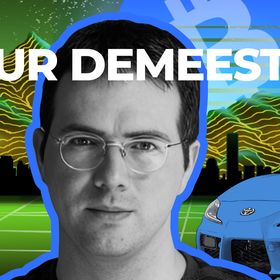
Tuur Demeester is the kind of guest who arrives with a spreadsheet in one hand and a Johnny Cash playlist in the other. Founder of Adamant Capital (and the research shop that still publishes under the Adamant Research banner), Blockstream investor, board-sitter, Austrian-curious cypherpunk tourist: he lives in that awkward hallway between people who price risk for a living and people who still talk about Hal Finney like a neighbor.
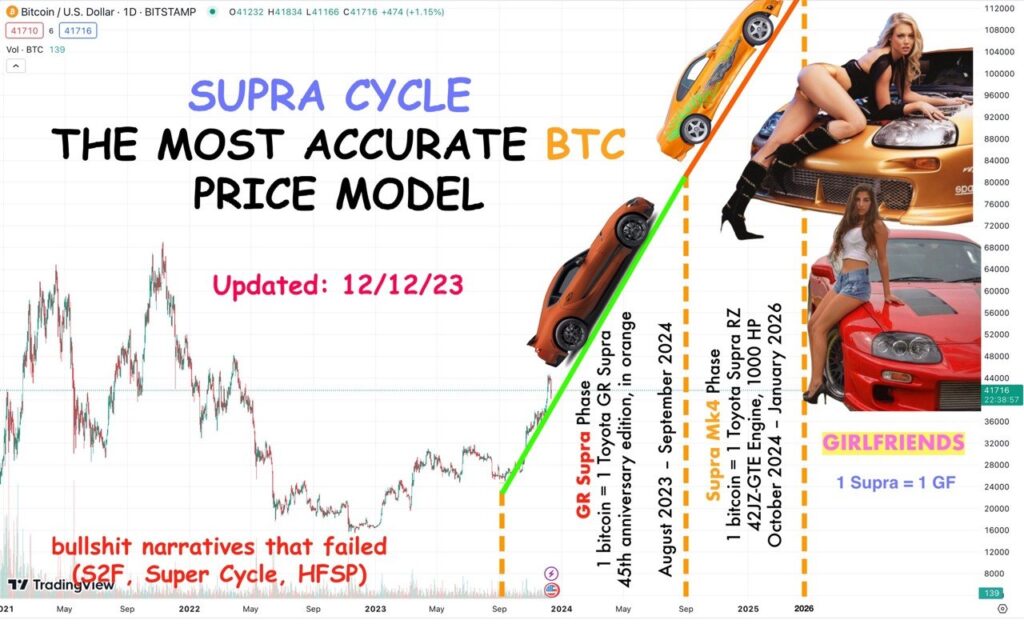
Season 15 of Bitcoin Takeover dropped Netflix-style before Christmas 2023, ten episodes at once, and I wanted a financial analyst on the slate for one very specific reason. I had spent September drawing a silly orange line on a chart that climbed toward 100K, labeling the whole joke the “Supra Cycle,” and I needed someone serious enough to either bless it or bury it.
Tuur did neither. He got it immediately.
Not a Supercycle. A Toyota.
First clarification, before the charts people get excited: this is not the Bitcoin supercycle thesis I wrote about in 2021, the one where the bear market allegedly softens into gentle dips forever. The Supra Cycle is dumber and more useful.
I asked myself what the pleb Lambo actually is. Most of us will never buy a Lamborghini, and even if we could, why sink the whole stack into a car that spends more time in the garage than on the road? Ninety percent of the Lambo experience at ten percent of the price. That search led me to the Toyota Supra: Fast and Furious pedigree, tuner cult, still in production, and if you Google “Supra girlfriend” you will find an entire folklore of photos that existed before I turned any of this into a Bitcoin meme.
The model on my screen was crude on purpose. Around 70 to 80K you get a GR Supra, the limited orange one, which is secretly a BMW under the hood and therefore not perfectly Japanese. Hold longer and you graduate to a 1990s movie-era Supra, the one with an engine so overbuilt that the factory horsepower was a polite lie and the aftermarket can push it past a thousand. Then you get a girlfriend. If you already have a girlfriend, she gets a girlfriend. That last clause is the whole joke: improve your life in public, stop waiting for an imaginary hyperbitcoinization date that may or may not arrive while you are still living in your parents’ basement.
Tuur endorsed it with the enthusiasm of a man who has watched Lambo owners film their own misery. He used to follow a crypto guy who bought one. A third of the updates were joyrides. Two thirds were invoices. One German Autobahn clip ended with the engine exploding and the owner standing on the shoulder narrating the crater. “These things are money pits,” Tuur said. Same category as boats. A trusted sports car, especially secondhand, is almost always the wiser flex.
I asked what happens if price overshoots my crayon model. He said he would steal a page from stock-to-flow and pretend the new line had always been the line. We were learning from other people’s mistakes in real time.
Models That Defeat Themselves
That joke opened the door to a quieter point. Tuur never liked stock-to-flow. A model that stares at supply and shrugs at demand felt wrong to him from the first wave of podcast tours. Apply the same curves to any shitcoin with a different issuance schedule and the spell breaks, which is usually when the priest starts explaining why Bitcoin is the only asset that “counts.”
He treats charts as loose weather, not prophecy. Markets that obsess over a model eventually invalidate it. The four-year cycle will lengthen or shorten the day enough people treat it as law. Self-fulfilling prophecies build bubbles; fundamentals yank them back.
So how do you call a top without worshipping a line?
I told him my haircut test: when the barber or the taxi driver starts pitching an app that prints money and casually mentions quitting their job, I start thinking about selling. Tuur lives in the same camp. Dollar price is a foggy signal. You do not know how much money printing is coming, and one billionaire parking ten billion into Bitcoin can lift the average for everyone without moving real sentiment an inch. Bottoms are easier for him because they feel like nausea. Tops fog the brain for too long. Watch the tourists: Bitcoin tattoos, Uber drivers explaining yield farms, OG whale coins suddenly moving on-chain. Weak hands announce themselves.
We traded our favorite top signals like baseball cards. 2017 GPU mining mania and the fantasy of quitting work to farm Monero clones. 2021 NFTs. Melania Trump dropping a Solana collection. Katy Perry’s coin-finger nail art drifting into early 2018. FTX buying stadium naming rights for a cartoon amount of money. “If too many people start thinking they can get something for nothing,” Tuur said, “that’s the definition of unsustainable.”
Esperanto, English, and Why Copy-Paste Coins Fail
From there the conversation got pleasantly postmodern. If Bitcoin “came from nothing,” why can’t the next narrative token do the same?
Tuur’s answer was network effects dressed as a language lesson. Copying English and changing half the words does not give you English. Forking the Bible does not give you the Church. Esperanto was supposed to be the rational universal tongue assembled from European spare parts. Almost nobody speaks it. It functions more like Klingon: an intellectual flex, not a mother tongue. Latin still owns lawyers and half the Western canon. You cannot out-logic a thousand years of users.
Bitcoin, in his framing, is the organic original. Shitcoins sell the fantasy of a shortcut. Short-term overinflation of expectations (five million dollars in two years, sure) is exactly the kind of exuberance that deserves a financial spanking. Long-term deflation of the unit is a different claim entirely.
I floated the rainbow chart as my own unserious model that accidentally kept working. Tuur’s caution was sharper: if fiat hyperinflates, the rainbow bends into an S-curve and a “million-dollar Bitcoin” might buy a bicycle. Eastern Europeans and Latin Americans already know that joke in their bones. Price targets without purchasing-power context are fan fiction.
Central Banks, Tether, and the Euro’s Midlife Crisis
For all the money printing of the early 2020s, Tuur was grudgingly polite about central bankers. Bonds, inflation-adjusted, had been crushed. The system had not blown up yet. People who wanted off the Titanic still had lifeboats. Wasabi Wallet ads interrupted us right on cue, which felt on brand for a privacy sermon inside a macro chat.
Then he flipped the usual bitcoiner sneer at Tether. Buying short-dated U.S. bonds sounds like heresy until you notice the political armor: you become inconvenient to attack because an attack hits the attacker’s own paper. In Tuur’s playbook, that is what surviving central banks will eventually copy. Foreign exchange reserves melt. Short bonds at least pay something. Profits migrate into hard assets like Bitcoin and gold. The easy decades of falling rates are over. Governments and their central banks will start disagreeing in public.
Europe made him darker. The euro is roughly a quarter-century experiment. He remembers handling the first bills in high school. Exit the euro and you have to invent a national shitcoin in a world that already has a hundred thousand of them. Stay and you inherit the mess. A gold standard is a rock-and-hard-place compromise. A Bitcoin standard, in his view, is the clean escape hatch.
Discovered, Not Invented
I asked whether Bitcoin was discovered more than invented. He said yes, with carpenter details.
He had just read Aaron van Wirdum’s The Genesis Book, timed to publish near the anniversary of the genesis block, and liked how it walks the prehistory: pieces assembled over years until Satoshi locked the furniture together. The chair with four legs was going to emerge somehow. Satoshi still gets credit for the weird specifics, the 21 million, the algorithm choices. Conceptually it feels like a discovery.
That matched a 2019 Adam Back talk I never quite shook: double-spend resistance as a cypherpunk holy grail chased for decades. Thomas Voegtlin of Electrum once told me he had been circling a different design at the same time. Tuur sided with Back’s narrow design-space claim. Twiddle block size, difficulty, issuance too far and the thing stops being Bitcoin. Most altcoins, he thinks, are corner-cutting cosplay that re-centralizes the moment incentives get serious.
Defending Blockstream Without the Cheerleader Outfit
Then I stuck the knife in, because that is the job.
I know he is a Blockstream investor. I also know how easy it is to mock a Bitcoin-only company whose biggest products feel underloved: Liquid limping along after years, Core Lightning competent but not dominant, BOLT 12 still arguing with the neighborhood. How does it feel?
“It’s going great,” he said, and then made the case I wish more maximalists would bother to make.
He only invested around 2021, so he is not a 2014 romantic. He sees Blockstream as a dark horse: mission-focused, research-heavy, forced to survive brutal cycles in a culture of stingy hodlers who want Supras someday and almost never buy software today. Outside mining, Bitcoin companies barely had cash-flow models. Trezor and Ledger chased shitcoins. Coldcard stayed niche. Giving Blockstream slack for staying on mission, for shipping satellite, Liquid, Jade, Lightning stack, mining, and financial products under one roof, felt fair to him. They did not “Barry Silbert” themselves into a conglomerate fireball. Andrew Poelstra and the soft-fork brain trust still count for something even when Twitter wants a quarterly SaaS chart.
My critique stayed specific. Liquid’s marketing celebrating a handful of transactions per block after five years is embarrassing for a sidechain that ate so much oxygen. Third-party wallet support still felt thin, mostly Blockstream-adjacent. Core Lightning is more robust than LND in some operator circles and still loses the popularity contest.
He did not deny the optics. He reframed the product strategy: build for hostile governments and expensive blockspace, then wait. Solana-style chains optimize for speed, hackathons, and vibes until the first real crackdown. Tornado Cash was an early tremor.
Clunky cypherpunk tools look silly in peacetime and indispensable later. His Yahoo-versus-Google analogy was the cleanest version of that argument: Wall Street loved the portal that humans curated; the algorithm looked weird for a decade and then ate the world.
I mentioned Ark experiments landing on Liquid first because covenants already live there, while mainchain still argues about BIP 119. He was fine with that kind of staging. Prove it in the federation sandbox. Do not demand a constitutional amendment on day one.
Ethereum as Snake Oil
If you follow Tuur on Twitter, you already know he does not do polite Ethereum takes.
He used to hedge. Now he treats it as a duty. In his core he believes deception is baked in: cheaper, better money that is neither, a Fool’s gold diversion of capital and developer energy away from Bitcoin, a pollution of the human-rights story with casino memes. He sleeps fine. He does not perform hatred. He does carry disdain.
I tried the sandbox defense: useful ideas that are not ready for Bitcoin should get a playground. He has heard it too many times. Run a testnet. Publish papers. Do open-source science. Do not recruit tens of thousands of underinformed investors into your laboratory and call it noble research. Many of the tricks were already hashed out on Bitcointalk in 2011 and 2012, or fail on theory, and still ship because newbies are fresh meat. Smart people of every age fall for it. Regulators then smear Bitcoin with the residue. Somebody has to play immune system.
Paul Sztorc’s Drivechains got the same filter. Soft forks that rewrite the social contract are not the same as sidechain experiments that leave Bitcoin alone. If you need a constitutional change to run your lab, run the lab elsewhere. He also thinks Sztorc’s communication style burns collaborators, then immediately admitted Luke Dashjr is no charm school graduate either and still ships. The Bible-apostle joke wrote itself: Luke, Paul, Peter. Early days. Some of these names will still be argued about in two hundred years.
BitVM, Pokemon, and Knowing What You Do Not Know
BitVM was the fresh toy of that winter. Developers at Labitconf had told me they could sketch more decentralized sidechains without a soft fork by pushing computation off-chain. Tuur was careful: he is not a sidechain specialist, and he remembers how hard Blockstream tried before settling on a federation as the honest tradeoff. Miner incentive bugs haunt the design space. If you can do it without changing Bitcoin, try. Super Testnet’s bit about unlocking coins by catching Pikachu inside a Game Boy emulator made him laugh, then admit the technical substrate is getting weird enough that he no longer tracks every corner.
His focus has drifted toward Bitcoin the asset, the societal phase change, the sense that the laws of social physics are being rewritten. Layer twos will multiply. Ossification will creep. He knows who to call when a controversy matters. He does not pretend to be the call.
What he likes about his own lane is the refusal to pick only one church. Austrian dogmatists read Bitcoin through their catechism. Cypherpunks want software forever and bristle at ossification. Tuur hangs out in the aisle. Bitcoin, he said, challenges every discipline to get humble: if the thing is walking around violating your law, maybe update the law. Even Austrian money-origin stories took a hit. Digital bearer cash with no prior commodity use-case was not supposed to work. Then it did.
That humility is also the mission statement he gave for the Texas Bitcoin Foundation: build bridges between social sciences, resist the island problem, treat Bitcoin like a new form of life that forces philosophy to catch up. Modernism, postmodernism, relativism, cynicism: people are lost. The multi-decade prize is an integrated worldview that can host a peaceful, diverse, connected society again.
Why Smart People Buy Shitcoins Anyway
My working theory for intelligent shitcoiners is grievance-first reasoning. They hate proof of work, swallow an environmental story, then reverse-engineer a coin that flatters the grievance. Innovation rarely starts as “how do we save the planet.” Cars and computers started as working prototypes. Waste minimization is an afterthought of refinement.
Tuur went somewhere darker and funnier: Marx as the ultimate entitled labor theorist, furious that other people set the price of his work. Build a utopia where your book pays what you think it deserves. Reality says you can write a book and nobody cares.
Subjective value does not care about your feelings. Become rich first if you want to be a philosopher. Voltaire could afford the salon. Rousseau scrambled through patrons and abandoned children to keep writing. Ideas win when money backs them.
Fiat wealth comes from leverage, consumer bubbles, casinos, and grocery empires, then washes into universities. Bitcoin wealth will endow different libraries. He wants half the world’s billionaires in thirty years to be bitcoiners, and he wants that capital pointed at legacies more interesting than a second Lambo.
Dark Gadgets, Bright Subcultures
We drifted into the optimism crash. Early 2000s gadgets felt like progress. Then the microphone in the living room started listening back. Social media hacked attention. Governments grew disfigured on printed money, taxing every transaction instead of the old single-digit rake. Gloom gets blamed on technology when the growth-hormone state may be the uglier parent.
Tuur still thinks a Bitcoin Renaissance is already leaking into the room. Bitcoin culture is funnier and longer-term than the Xanax epidemic he sees in civilian friend groups. Fiat medicine treats symptoms. A harder money culture might eventually fund health approaches that go at roots. Popular music lyrics got sadder; Post Malone as exhibit A. The 1990s still had a wider emotional range. He wants that range back.
El Salvador Pioneers, Argentina Philosophers
Latin America was my two-sided coin.
El Salvador disappointed me: custodial government wallet, no privacy, Visa-citizenship carnival, ordinals theater, Max Keiser LARPing adviser after years of roasting authoritarians. Argentina excited me: Milei talking like a classical liberal who might leave markets alone, Labitconf week before the election, taxi drivers who only knew him as “crazy” and still felt the air move.
Tuur filed El Salvador with early Bitcoin companies like Blockchain.info and BitPay: valuable because pioneering, not because the specific Chivo choices should be copied. Rule of law after the strongman is the hard question. He might vacation there. He is not packing a moving truck.
Milei made him more optimistic for the long term precisely because of the philosophical spine: property rights, government out of the way, a 2019 tweet Jameson Lopp dug up where Milei refused to opine on Bitcoin because he had not studied it. Humility beats opportunistic orange-washing. Stabilize inflation, fire ministries, then see. The inauguration speech reminded Tuur of the rare post-Soviet moments when politicians actually sounded literate in classical liberalism. He would read Milei’s book even if the man never won.
My Buenos Aires sample size was tiny and perfect: six or seven taxi conversations, only two for Massa, and the anti-Milei argument was always “he’s crazy.” Tuur hears viral tweets the same way. You put words to a feeling people already had. That is power.
Playlist for a Parallel Society
I would not let him leave without music.
Oliver Anthony’s “Rich Men North of Richmond” was his modern anthem pick: zero-to-number-one without an album, raw enough to stick. For older bones he reached for Johnny Cash via the Million Dollar Quartet neighborhood and “This Train Is Bound for Glory,” the Woody Guthrie lineage song that lists a merry band by naming everyone who is not allowed on board. No liars, no cheaters. That is how he feels about Bitcoin’s long train: fun, upward, allergic to fraud, happy to watch rage-quitters jump early. “Five Feet High and Rising” was his inflation hymn: the water climbs a foot at a time while TikTok moms with full-time jobs still cannot make rent.
Bob Dylan? Occasional. Nasal. He saw Dylan live in Brussels once and wished he had brought lower expectations. The Traveling Wilburys vinyls, though: Roy Orbison, Tom Petty, Jeff Lynne, Dylan, George Harrison. I confessed I bought records a decade ago instead of Bitcoin. He answered with library cards, burned tape stacks, and a music collection lost to too many moves.
My own map: Chuck Berry inventing the rock vocabulary, Little Richard, 1990s grunge as poetry with distortion, Rimbaud and Verlaine shadows behind the Seattle rain. He was ten when Nirvana hit, chased “more like this,” bought a random metal compilation, and realized emotion was the real differentiator. Soundgarden on Monday, Alice in Chains on Tuesday, Temple of the Dog when the geography of the Northwest still feels like a single studio.
Rage Against the Machine was the obvious bitcoiner band I expected. He likes the debut and rejects the politics. Occupy and Ron Paul 2008 still feed Bitcoin’s emotional OS more than any Nu Metal chorus.
Soft Endings
I admitted I pick fights on Twitter about Liquid versus Rootstock until 3 a.m., then get blocked by Max Keiser, then make up in a dark conference bar months later. Tuur called that family behavior. You fight. You reconnect. You cannot help being stuck with each other.
Big blockers got a soft landing too. Right about a temporary fee pain, wrong and impatient about the cure. Some come around. So do nocoiner. So can anyone who still has a nervous system.
How to follow him, and what makes him proud? Things cooking he cannot announce. Pride in the Texas Bitcoin Foundation. Joy in the companies he advises. Google his name, read the free PDF archive of Adamant Research reports (the public trail still routes through partners like Unchained), and find him on Twitter like the rest of us mortals.
I promised him a ride in the Supra if I ever haul one to a conference. He is a Toyota fan. That felt like the right handshake for an episode that started as a meme about orange cars and ended as a tour through language, sidechains, snake oil, and the strange project of building a culture that can survive its own billionaires.
Listen to Tuur Demeester on Spotify, Apple Podcasts, YouTube, and More!
Time stamps:
00:00:00 – Intro: Season 15 dump & meeting Tuur
00:01:59 – The Bitcoin Supra Cycle & the pleb Lambo
00:06:38 – Crayon models, stock-to-flow, and self-defeating prophecies
00:09:47 – Haircuts, tattoos, Uber drivers & other top signals
00:19:30 – Inflation, central banks, and lifeboats off the Titanic
00:22:50 – Tether’s bond playbook for surviving states
00:23:50 – Euro midlife crisis & the Bitcoin-standard escape
00:25:21 – Discovered more than invented (The Genesis Book)
00:28:35 – Investing in Blockstream without the cheerleader outfit
00:33:29 – Liquid, Core Lightning, and building for hostile times
00:40:21 – Why Tuur treats Ethereum as snake oil
00:42:18 – Testnets versus dumping labs on retail
00:44:16 – Immune system duty & cypherpunk values
00:45:41 – Soft forks, Drivechains, and constitutional changes
00:48:35 – Federations, miner incentives, decentralized sidechains
00:50:50 – BitVM, Labitconf & catching Pikachu for coins
00:51:24 – Bitcoin the asset vs Bitcoin the forever-debate
00:54:49 – Austrians, cypherpunks, and interdisciplinary humility
00:59:30 – Who funds ideas in a fiat world
01:01:51 – Bitcoin billionaires and what to do with the pile
01:03:42 – Surveillance gadgets, social media, oversized states
01:09:29 – A Bitcoin renaissance hiding in plain sight
01:11:15 – Xanax friends, Cold War faces, harder-money health
01:14:46 – El Salvador as pioneer, not template
01:20:15 – Milei’s spine, taxi polls, orange-pilling without LARPing
01:25:26 – Oliver Anthony, Johnny Cash & inflation folk songs
01:31:37 – Dylan misses, Wilburys vinyl, grunge geography
01:35:18 – Occupy, Ron Paul, and Bitcoin’s emotional OS
01:36:38 – Twitter blocks, dark bars, family fights
01:37:39 – Texas Bitcoin Foundation, free reports, Supra IOU
Verify this episode
This is the SHA-256 fingerprint of the MP3 as published here, timestamped in the Bitcoin blockchain with OpenTimestamps. If one byte of the file changes, the fingerprint changes.
- SHA-256
0cb1ccb87f2ebee09033189b87aa1551d116bef91c1b652ff4a2e0e454cc6fa0- Proof
- 2023-12-31_s15_e10_tuur_demeester_on_his_bitcoin_investment_thesis__the_supra_cycle.mp3.ots · all episode hashes (proof)
- Status
- Anchored in Bitcoin block 974,312
How to check it yourself
- Download the MP3 and the proof into the same folder.
- Run
sha256sum 2023-12-31_s15_e10_tuur_demeester_on_his_bitcoin_investment_thesis__the_supra_cycle.mp3(on a Mac:shasum -a 256 2023-12-31_s15_e10_tuur_demeester_on_his_bitcoin_investment_thesis__the_supra_cycle.mp3). The result must match the SHA-256 above. - Install the OpenTimestamps client (
pip install opentimestamps-client) and runots verify 2023-12-31_s15_e10_tuur_demeester_on_his_bitcoin_investment_thesis__the_supra_cycle.mp3.ots. It hashes the MP3 again and checks the proof against your own Bitcoin node, then prints the block and the date the file existed by. Without a node,ots info 2023-12-31_s15_e10_tuur_demeester_on_his_bitcoin_investment_thesis__the_supra_cycle.mp3.otsshows the block height to look up in any block explorer.
Related

S17 E39: Kurt Wuckert Jr on the Big Block Wars, BSV, Craig Wright & the Road Not Taken
Every community has its designated villains, and in Bitcoin’s longest running morality play, Kurt Wuckert Jr has worn the black…

S17 E23: Hunter Beast & Mark Karpeles on Quantum-Proofing Bitcoin, Satoshi’s Coins & the Ghost of Mt. Gox
This interview took place on April 29th 2026, at the LayerTwo Labs booth at the Bitcoin Conference in Las Vegas with Hunter…

S17 E22: Jeremy Rubin on CTV, Char & Relentless Building in an Adversarial Environment
Four years. That is how long I have been chasing Jeremy Rubin for an interview, and it took the Bitcoin 2026 conference…

Comments
Comments run on my own server. No ads, no trackers.