




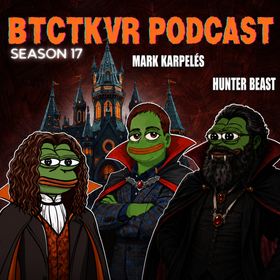
S17 E23: Hunter Beast & Mark Karpeles on Quantum-Proofing Bitcoin, Satoshi’s Coins & the Ghost of Mt. Gox
The audio keeps playing while you browse the site.
Ask the Archive
This interview took place on April 29th 2026, at the LayerTwo Labs booth at the Bitcoin Conference in Las Vegas with Hunter Beast (cryptoquick on Twitter, author of BIP 360, the proposal most likely to make Bitcoin quantum resistant). Mid-sentence, a familiar face wandered into the frame: Mark Karpeles, the man who ran Mt. Gox, the exchange that once handled the overwhelming majority of all Bitcoin trading and then lost 850,000 BTC before most of today’s podcasters knew what a private key was.
The guy writing Bitcoin’s quantum future, sitting next to the guy who taught Bitcoin its most expensive lesson about ”not your keys, not your coins”. You cannot script this. So I did the only reasonable thing: I handed Mark the mic and let the two of them go at it while I enjoyed the rare pleasure of being a spectator on my own show.
Quick housekeeping, as always: this episode was recorded live on the conference floor, so expect background noise, surprise guests, and at least one Yu-Gi-Oh reference. Cake Wallet sent 1 ZEC as a thank-you for Hunter’s appearance, which we had to handle off camera because my phone was out of reach. Nobody paid to be here, and nobody gets editorial approval.
From Marathon to Surmount Systems
Since his last appearance on the show, Hunter has left Marathon (MARA), which is in the middle of an AI pivot, and become CTO of Surmount Systems, a new venture with one mission: make sure Bitcoin is ready for the quantum threat in time. The plan is aggressive. A seed round over the coming month (VCs watching this: his DMs are open), then full speed ahead on June 1st, with what he calls a speedrun approach: not rushed, but not forever either. “I don’t want to be coming back to these conferences year after year and always just talking about this problem and doing nothing,” he told me. “In a way, that’s its own grift.”
His philosophy in one breath: careful, conservative, comprehensive, and evidence-based. May you live in interesting times, indeed.
How Urgent Is Quantum, Really?
I put the question to him directly. Nic Carter’s quantum urgency campaign has clearly worked on the institutions that now hold Bitcoin, and I floated the theory that part of the current market bearishness is institutional cold feet about exactly this. Hunter’s answer was nuanced: the timeframe question is nearly impossible to answer honestly, because quantum computing is a closely guarded, secretive technology, and we assume far too much about how and when Bitcoin’s cryptography might fall.
What he is certain about: the longer the debate drags on without concrete technical specifications going through the BIPs process, the more the FUD gets monetized by the wrong people. He is openly wary of anyone selling an opaque “quantum wallet” that is not open source and has no BIP to point to. Neither of us named the wallet in question, and I will keep it that way here, but his rule of thumb is worth tattooing on the industry’s forehead: “There’s a BIP for that.” BIPs do not just specify consensus changes; they cover application-layer standards too. If someone is advertising a novel cryptographic solution and cannot point to a BIP, what exactly are they doing?
Testing Every Fork Flavor
Surmount’s approach is deliberately inclusive: they intend to work with all the major Bitcoin implementations, Core, Knots, Peter Todd’s Libre Relay (“his work is amazing”), Jimmy Song’s project, and more, and to test every possible activation scenario on testnets until the data proves what is safe to activate in consensus. Hate BIP 110? Do not run a node that activates it. Love it? There will be a flavor for you too. All of the above, well tested, no favorites.
Beyond BIP 360 itself, Surmount will advocate for BIP 54, the Great Consensus Cleanup by Antoine Poinsot, which Hunter considers completely uncontroversial and overdue, and he is explicitly supportive of BIP 110, for a simple reason: if Bitcoin is going to adopt post-quantum cryptography, the bigger transactions it brings should be monetary transactions, not a bunch of JPEGs. More on his Ordinals confession later.
Then he zoomed out to the geopolitical frame: Bitcoin is a direct challenge to nation-state monetary sovereignty, and the two biggest players in quantum computing are not IBM or Google. They are the NSA and the PLA. This is a nation-state technology, built by what he calls deep state spooks who spent 20-plus years and billions of dollars on it, without spending an equivalent amount on the replacement cryptography the rest of us now need. “My career right now is cleaning up after messes the government made,” said the self-described anarchist. “And then we can just move on and do other interesting things with the few precious hours we have on Earth.”
Enter Mark Karpeles
Right on cue, Mark sat down. After the introductions (“Have you been on Mt. Gox?” “A little before my time, but much respect for the lessons we learned”), Mark gave a quick status update on the repayments: most of the bitcoins owed have already been delivered, with the remaining complexity being Russian customers, where the war makes distribution complicated.
I asked the obvious question: what can today’s Bitcoiners learn from what happened back then? Mark’s answer was not “cold storage, duh.” It was transparency: one reason companies hide their problems is the fear of getting bashed for admitting them, and a community that punishes honesty gets concealment instead. Find out why something bad happened, then make sure it cannot happen again. He also reminded everyone how prehistoric the tooling was: no HD wallets, no wallet encryption in Bitcoin at all. We have come a long way.
The Xpub Problem Nobody Wants to Talk About
Here is where the two of them went beautifully, dangerously nerdy, and I let them, because this stuff matters. Hunter asked Mark what he would recommend to avoid repeating past mistakes, and Mark’s answer opened a can of worms: exchanges rely on BIP 32 HD wallets so their servers never need private keys, generating one address per customer on the fly. The problem: the extended public key (xpub) mechanism depends on elliptic curve cryptography. The hash-based signatures we would migrate to, things like SLH-DSA and SPHINCS, are built from one-time signatures and do not support xpub-style derivation at all. No watch-only wallets as we know them, no per-customer address generation without keys on the server. Mark knows this pain firsthand: implementing TSS for Solana, he hit the same wall with ED25519 (also an elliptic curve, as Hunter noted; Bitcoin uses secp256k1).
Their practical advice for the present: self-custody, avoid Taproot addresses because the public key is exposed on-chain, prefer native SegWit (bc1q) as the sensible middle ground, and never reuse addresses. Exchanges sitting on a 100,000 BTC cold wallet with an exposed, reused public key are painting a target on the industry. As Mark put it, the security trick of Bitcoin was always that the address is a hash and the public key stays hidden until you spend. HD wallets made hygiene free. Quantum takes that convenience away.
To Burn or Not to Burn: Satoshi’s 1.1 Million BTC
Then the main event. I framed it honestly: right now there are two prominent approaches, Hunter’s and Jameson Lopp’s (BIP 361), the latter effectively freezing Satoshi’s coins. What does the Mt. Gox guy think?
Mark came out swinging for the freeze. His logic: Satoshi’s earliest coins sit in P2PK outputs, not P2PKH, meaning the actual public keys are already on-chain. The day a cryptographically relevant quantum computer exists, deriving those private keys is trivial, an attacker drains the coins and crashes the market. If Bitcoin’s limited supply is to mean anything, those coins, which everyone assumes will never move, should simply be rendered unspendable. No on-chain move required.
Hunter pushed back with the strongest counterargument: unilaterally burning someone’s coins is a severe violation of Bitcoin’s private property promise, the unspoken social contract. But, and this is the twist, allowing liquidation by theft violates the same promise, just irresponsibly. His alternative, Glass v2, which he says is about to be submitted as a proper BIP, threads the needle: throttle, don’t freeze. Restrict the roughly 1.7 million BTC sitting in P2PK outputs across about 34,000 exposed keys to one coin per block, with the change returned to the original public key. That is 144 BTC per day, taking over 32 years to drain, versus about 3 hours if someone simply has all the keys. Original owners keep the ability to recover their property; a thief gets a slow drip instead of a market-destroying flood.
For scale: about 7 million coins sit behind exposed public keys, but most have moved within the past year; per Wicked Smart Bitcoin’s research, only around 2.66 million are genuinely dormant.
Mark countered with his own variant: do not target Satoshi specifically; define a timeline from the day quantum-resistant addresses exist to the day ECDSA signatures stop being accepted. Hunter worried the phased approach in BIP 361 could take five years, which might be too long. Mark’s reply was the line of the episode: “Five years is way too short. Twelve years after Mt. Gox, people still email me asking if they can get their coins back.” The man has receipts on user migration speed.
They also touched the attack taxonomy from BIP 360: long exposure attacks (all the time in the world against a known key) versus short exposure attacks (sniping a transaction in flight from the mempool, which needs a far more powerful machine). Mark has personally watched mempool snipers go after broken keys. This is not theory.
Spooks, Snowden and the 2027 Deadline
Hunter’s history lesson, delivered with the confidence of a man on constitutionally protected home soil: Edward Snowden leaked the existence of the NSA’s “Penetrating Hard Targets” program in 2013, a quantum computer built specifically to break public key cryptography, funded at around $80 million a year back then. Billions more over decades, black projects, the brightest minds, and no adequate replacement cryptography offered to the public. On NIST, he pointed to Daniel J. Bernstein’s kleptography work exposing attempts to push broken crypto. And the policy kicker: starting January 1st, 2027, no new technology employing elliptic curve cryptography can be sold to the US government, which is awkward for a government flirting with a strategic Bitcoin reserve.
Mark’s contribution was the joke that the NSA can always take Satoshi’s coins next time it needs to finance something off the books, immediately followed by “I want to still be able to come to the US, so I will not comment on this.”Hunter, a US citizen on US soil, exercised his First Amendment rights on behalf of both of them.
Will the Other Chains Make It?
I asked about the chains promising quantum resistance sooner. The verdict: Solana has a plan, Ethereum has a plan, and the plans are not equal. Hunter is more optimistic about Bitcoin and Solana than Ethereum, for opposite reasons. Solana is, at the end of the day, cryptography stapled to Google’s BigTable (his joke about Bitcoin maxis saying “just use a database” writes itself), and its architecture is an order of magnitude simpler to migrate.
But Mark, who actually looked into Solana while running his block explorer website, poured cold water on the throughput story: signatures go from 64 bytes to 600-plus bytes, a tenfold increase, on a chain already growing by dozens of terabytes a month. Building a Solana explorer at all, he found, is not possible without a huge budget.
Ethereum’s problem is different: smart contracts are permissions tied to keys, and in many cases you cannot change a contract’s permissions. Coins will get stuck. Hunter thinks their roadmap tries to accomplish too much, and even three years may be longer than they have. The lesson for everyone: build a good-enough solution you can deploy near-term, not a perfect one that arrives after the threat. Mark has been calling for all chains to take this seriously, with the sobering addendum: no matter what we do, some people will be left behind. For some, it is already too late.
Don’t Smuggle in the Kitchen Sink
Since a signature upgrade is coming anyway, should Bitcoin bundle in other goodies? Hunter’s warning: beware anyone coupling post-quantum cryptography with unrelated functionality changes. His example was Simplicity, the 300-plus-function smart contract language: fine on Liquid, but he doubts the community wants it on mainnet glued to a security upgrade. The clean package, in his view: BIP 54 plus BIP 360, both uncontroversial, and even then, activate 360 without post-quantum spending enabled on day one. Wallets can commit to the new cryptography before it is spendable, and activation follows once MASF or UASF support is demonstrably there. Incremental, conservative, evidence-based.
On block size increases, his position is to try everything else first. His favorite everything-else: BitZip, a single STARK proof aggregated by miners into every block, pushing Bitcoin to perhaps 80 transactions per second, post-quantum, privacy-preserving, dense enough that spam makes no economic sense, with fees flowing to the aggregating miner and no added burden on node runners. Recursive STARKs could go further. Only if all of that proves insufficient should we talk about touching the witness discount, let alone a hard fork.
Activation Politics and an Ordinals Confession
Every consensus change in Bitcoin’s history has activated through a BIP 9 miner-activated soft fork; the UASF threats around Taproot technically never activated before the miners did. Hunter is fine with UASF coupled to MASF as long as incentives align, and he wants to simulate the minimum safe hash rate thresholds before blessing anything, whether CTV, TXHASH, or BIP 110. And then the confession: “Ordinals doesn’t scale. It never was supposed to scale. I contributed to it, and my thinking has evolved.” The mission, he insists, is separating money from state, and JPEGs competing with monetary transactions does not serve it.
On that mission, Mark offered the most underrated take of the episode: Bitcoin has already improved the lives of millions of people who never touched it, by forcing competition into a closed, regulated financial sector. Cash App in the US, its equivalents in Japan, none of that exists without Bitcoin kicking the door open. Hunter agreed, and then things got personal: Bitcoin gave him hope and optimism, and without it he jokes he might be in the hills joining a militia. But when it comes to who actually saved his life, he credits Jesus. You heard it here first, folks.
The Ecash Fork, Judged by the Guy Who Has to Care
I could not resist asking about the Ecash hard fork coming in August, and specifically whether it affects Mt. Gox repayments, since creditors would technically have a new airdrop. Mark’s answer was pure trustee logic: most repayments are already done, so the impact is minimal, but if the fork has real market value, the trustee would be legally required to distribute those assets to anyone still waiting. Worthless forks can be ignored; valuable ones cannot. He welcomes forks generally: let different scenarios play out, and let users decide.
Hunter was gracious about Paul Sztorc: a deep thinker, whose BIP 300/301 would have been ideal in ways BitVM is not, and whose CUSF concept is a genuinely creative contribution to consensus discourse. Both of them plan to claim their Ecash. Mark, of course, holds no bitcoin. Tragic boating accident. His cat ate the coins. The classics never die.
The Real Reason Mark Came to Vegas
Not Bitcoin. Magic: The Gathering. Mark flew to his first-ever US Bitcoin conference primarily to play in a Magic tournament, his first time with physical cards after years on Arena. He lost every match, won a single game across a best-of-three, and had a great time. What followed was five minutes of pure cross-generational nerd chaos: me asking how many cards form Exodia (wrong game, that is Yu-Gi-Oh), Hunter asking if cards can digivolve (also wrong game, that is Digimon), and the genuinely true trivia that Magic: The Gathering is Turing complete, which had Hunter half-joking about Magic-inspired op codes for Bitcoin script. Someone fund this.
Tibane: Killing the Seed Phrase
Mark’s real project, though, is a new wallet called Tibane, and its design philosophy is a direct descendant of everything Mt. Gox taught him. No BIP 39 seed phrase at all. Setup works like a bank account: a password and 2FA on your phone number. Under the hood, the key is split into three shares: one encrypted by your password, one in your phone’s secure hardware and cloud backup, one behind 2FA on his servers. Hack the server, get one useless third.
Lose your phone, restore from backup with your password and phone number. Lose your cloud account, your phone and 2FA still recover everything. His motivation: years of onboarding people in restaurants, where 99% of the time the seed phrase ends up on a napkin, forgotten or photographed.
Hunter endorsed the direction for a chilling reason: in a world of Meta smart glasses, VR headsets with cameras watching everything (he owns a Vision Pro), and eventually brain-computer interfaces, seeing your own seed phrase may one day be enough to lose your coins. The man who spent hours hammering 24 words into a dozen stainless steel washers knows most people will never do that. Mark added that multi-device signature schemes have a post-quantum equivalent, which he has already implemented, though he is careful to say it is not battle-proven yet.
And the name? Tibane was his cat from the Mt. Gox days. The wallet is a tribute. Rest in peace, Tibane.
The Cat Census and the Border Story
For the record: Mark has five cats, Hunter has four, I have one. Discuss.
We closed with Mark’s first-ever trip to the United States, which nearly ended at immigration. “What are you coming to do?” “The Bitcoin conference.” “Doing what there?” “Playing cards.” Silence. Suspicion. Then: “Meeting people, exchanging contacts.” “Oh, networking.” And in he went. He is based in Tokyo, speaks Japanese better than English, and invited Hunter to visit with a personal tour guide included. Vegas as your first American city is certainly a choice, and he says he will be back.
As for Hunter: Surmount Systems, the seed round, June 1st, Glass v2 to the BIPs repo, BIP 54 and BIP 360 advocacy, and a standing offer to work with every implementation. The quantum debate is no longer a conference panel topic. It is a job description.
This episode is sponsored by Braiins Hashpower (rent hash power and mine Bitcoin the fun way), LayerTwo Labs (our gracious booth hosts; evolve or die, test the drivechains today, Ecash arrives at block 964000 in August, details at ecash.com), Orange Rock (no-KYC trading from the Bitcoin.com team, with leverage for the gamblers, which I do not recommend), Sideshift.ai (when someone offers you their Solana memecoin or 10 bucks in USDC, send it to Sideshift and receive real Bitcoin; not available in the US), and Cake Wallet (the gateway drug to Monero with excellent Zcash, and the sponsor of Hunter’s 1 ZEC thank-you gift). Special thanks to all the sponsors for making this freely available to everyone!
Listen to Hunter Beast & Mark Karpeles on YouTube, Spotify, Apple Podcasts & more!
Time stamps:
00:00:00 – Intro music & stream warm-up
00:01:12 – Live from the LayerTwo Labs booth in Las Vegas
00:01:28 – Sponsors: Braiins, LayerTwo Labs, Orange Rock, Sideshift, Cake
00:02:27 – The 1 ZEC thank-you gift from Cake Wallet
00:02:41 – From Marathon to CTO of Surmount Systems
00:03:24 – Cursed to live in interesting times
00:04:31 – Nick Carter, institutions & the quantum FUD trade
00:05:26 – How urgent is the quantum upgrade, really?
00:06:45 – Beware the opaque “quantum wallet” grift
00:08:10 – There’s a BIP for that: wallets need BIPs too
00:09:05 – Core, Knots, Libre Relay: testing every flavor
00:10:01 – Seed round & full speed ahead June 1st
00:12:42 – What is Surmount Systems beyond BIP 360?
00:13:37 – BIP 54: the Great Consensus Cleanup
00:13:50 – Why Hunter supports BIP 110
00:14:10 – NSA & PLA: quantum is a nation-state technology
00:15:37 – Mark Karpeles walks into the interview
00:16:36 – Mt. Gox repayments: mostly done, Russia stuck
00:17:05 – Lessons from Mt. Gox: transparency & prehistoric tech
00:18:05 – The uncomfortable truth about xpubs & quantum
00:20:34 – Hash-based signatures kill watch-only wallets
00:21:35 – ED25519, Solana TSS & key derivation pain
00:23:05 – One address per customer without server keys
00:24:09 – Taproot’s exposed keys & the 100k BTC cold wallet
00:25:24 – Two proposals: Hunter’s vs Jameson Lopp’s
00:25:52 – Mark’s case for freezing Satoshi’s coins
00:26:51 – Hunter’s counter: the private property promise
00:27:55 – Glass v2: throttle P2PK, don’t freeze it
00:29:07 – One coin per block: 32 years to drain
00:29:38 – Mark’s alternative: an ECDSA phase-out timeline
00:30:32 – Five years: too long or way too short?
00:31:13 – 7M exposed coins, 2.66M dormant
00:32:32 – Mempool snipers & broken keys
00:32:59 – Long exposure vs short exposure attacks
00:33:45 – Quantum computers you can buy at home
00:34:03 – Snowden & the Penetrating Hard Targets program
00:34:57 – NIST, kleptography & Daniel J. Bernstein
00:35:09 – The 2027 ECC ban vs the strategic Bitcoin reserve
00:36:03 – The NSA drug money joke & playing it safe
00:37:14 – Will Ethereum & Solana make it in time?
00:38:03 – Solana’s BigTable & 10x signature sizes
00:38:58 – Why a Solana block explorer needs a huge budget
00:39:52 – Smart contracts with unchangeable key permissions
00:41:36 – Good enough now beats perfect in three years
00:42:18 – Don’t couple PQC with unrelated upgrades
00:43:30 – BIP 54 + BIP 360: the uncontroversial package
00:44:37 – Block size increase? Try everything else first
00:44:58 – BitZip: STARK aggregation & 80 TPS
00:46:14 – MASF, UASF & safe activation thresholds
00:48:15 – Ordinals doesn’t scale: a contributor’s confession
00:48:58 – Has Bitcoin already separated money from state?
00:49:50 – Bitcoin gave me hope; Jesus saved my life
00:50:38 – The Ecash fork & the Mt. Gox trustee’s duties
00:53:33 – Claiming Ecash & tragic boating accidents
00:54:17 – Mark’s real reason for Vegas: Magic the Gathering
00:54:58 – Exodia, Digimon & Turing-complete Magic cards
00:57:40 – Tibane: a wallet with no seed phrase
00:58:42 – The restaurant napkin problem
00:59:12 – Why BIP 39 fails in a camera-everywhere future
01:00:13 – Hammering 24 words into steel washers
01:01:01 – tbon.net, app stores & the Tibane launch
01:01:14 – Named after the Mt. Gox cat
01:01:32 – Cat census: five, four & one
01:02:01 – Losing every match & loving it
01:02:32 – First time in the US: the immigration story
01:03:16 – Tokyo, fluent Japanese & a tour guide offer
01:04:04 – Wrap up & thanks
Verify this episode
This is the SHA-256 fingerprint of the MP3 as published here, timestamped in the Bitcoin blockchain with OpenTimestamps. If one byte of the file changes, the fingerprint changes.
- SHA-256
18f091aea4e33851cc4e72455739afe8c22127ed5b1d158d4db1c25284519192- Proof
- 2026-05-10_s17_e23_hunter_beast_mark_karpeles_on_bitcoin_quantum_resnstance_ecash.mp3.ots · all episode hashes (proof)
- Status
- Anchored in Bitcoin block 974,312
How to check it yourself
- Download the MP3 and the proof into the same folder.
- Run
sha256sum 2026-05-10_s17_e23_hunter_beast_mark_karpeles_on_bitcoin_quantum_resnstance_ecash.mp3(on a Mac:shasum -a 256 2026-05-10_s17_e23_hunter_beast_mark_karpeles_on_bitcoin_quantum_resnstance_ecash.mp3). The result must match the SHA-256 above. - Install the OpenTimestamps client (
pip install opentimestamps-client) and runots verify 2026-05-10_s17_e23_hunter_beast_mark_karpeles_on_bitcoin_quantum_resnstance_ecash.mp3.ots. It hashes the MP3 again and checks the proof against your own Bitcoin node, then prints the block and the date the file existed by. Without a node,ots info 2026-05-10_s17_e23_hunter_beast_mark_karpeles_on_bitcoin_quantum_resnstance_ecash.mp3.otsshows the block height to look up in any block explorer.
Related
S17 E22: Jeremy Rubin on CTV, Char & Relentless Building in an Adversarial Environment
Four years. That is how long I have been chasing Jeremy Rubin for an interview, and it took the Bitcoin 2026 conference…
S17 E17: Lukas Hozda on Building Bitcoin in Rust & Why Mempool Filters Can’t Work
Recorded in a soundproofed room at Braiins headquarters in Prague that once doubled as an ASIC oven (more on that later), this…
S17 E13: Charlie Spears on Blockspace Media, the Purity Spiral & the Case for Classical Maximalism
Editor’s note: this conversation was streamed live in mid-March 2026, a week after the US switched to daylight saving time (which…

Comments
Comments run on my own server. No ads, no trackers.