




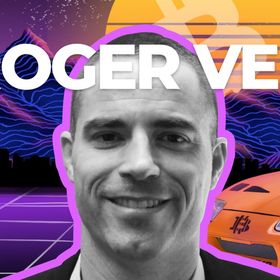
S15 E26: Roger Ver on Hijacking Bitcoin & Freedom Maximalism
The audio keeps playing while you browse the site.
Ask the Archive
I did not think I would say this when I started Bitcoin Takeover in 2019: today’s guest is Roger Ver. Investor in Bitcoin projects. Owner of bitcoin.com. Co-founder credits around Blockchain.com and early Ripple. Also the most polarizing big-block advocate a certain generation of Twitter still treats like radioactive waste.
The recording date was 28 March 2024. Ross Ulbricht’s fortieth birthday was the emotional frame I with which I opened. Roger had donated over a million dollars toward Ross’s legal defense, and Ross was still in prison after roughly eleven years. Equal time on the clock mattered too. About seven years with the Bitcoin project as most people branded it, then seven years focused on Bitcoin Cash. The site blurb called this a reflection and an attempt to bring one of Bitcoin’s greatest early advocates back into the conversation. Roger’s reply was immediate: from his point of view, he never left Bitcoin. He left a ticker.
Roger Says He Never Left Bitcoin
If you read the Bitcoin white paper against what people promote BTC as today, Roger argues, it is not the same project. He has been promoting peer-to-peer cash from day one. Some investments worked. Some did not. That is true of any investor. Co-founding early infrastructure and owning bitcoin.com left him, in his own accounting, fine.
I pushed back the way a historian should. No version of Bitcoin today is a pure photocopy of the white paper. The 21 million cap is not in that document. The modern separation of miners and nodes is not either. Satoshi did not foresee mining pools or blockchain analysis. Generating a new address each receive was supposed to be enough privacy. It was not.
Still, the cultural contrast he wanted on the table was sharper than any white-paper footnote. Before Michael Saylor became the face of Bitcoin, Roger says he was one of the main faces, arguably the main face, telling people taxation is theft and self-custody is the point. Today he hears Saylor tell people to pay their taxes, keep the dollar, be a good boy. That, for Roger, is the opposite of early Bitcoin. He first heard about Bitcoin on Free Talk Live in a Silk Road context. Freedom maximalist, not BTC maximalist, not BCH maximalist. Never a single-coin maximalist of anything.
Baseball Bats and Crutches
Roger’s Blockstream metaphor is not subtle. Smash people’s legs with a baseball bat, then sell them crutches from your crutch factory, then demand thanks because without you they could not walk. In his telling, that is what happened when block size was constrained: Steam, Microsoft, Expedia and other large merchants started accepting Bitcoin and then stopped because transactions became slow, expensive, and unreliable by design, while the same circle pushed Liquid, where (he claims) they earn fees on every transaction.
I gave him the counter-case from my side of the ledger. Low-fee chains (Litecoin, Bitcoin Cash, Dash, Monero, Zcash) and USDT on Tron move real commerce without necessarily pumping price. On-chain forever also means forever surveillance, which is why Wasabi sponsors this show. Roger said I had accidentally proved his point: billions in commerce on other rails is traffic that would have stayed on Bitcoin if the user experience had remained good. Bitcoin Cash would never have needed to exist. Litecoin would not be an e-commerce rail. USDT on Tron would not look as interesting.
Whether that counterfactual is true is a fight for economists and time travelers. On air, Roger treated it as obvious. I treated market price after seven years of split as a free-market verdict. He rejected that framing too: not a free market when ETFs, SEC cases, exchange listings, and privacy bans reshape what average people can even buy. Incumbency and the cool name of Bitcoin, he said, explain more of BTC’s price than inherent merit. Lemmings following lemmings.
Lightning: Flying Saucers Forever Eighteen Months Away
I reminded him he had once been bullish on Lightning. His answer was careful. He probably said nice things about it the way he would say nice things about flying saucers next week. Wonderful if they arrive. Not optimistic. Eighteen months, promised over and over, nine years later still not good, still dominated by centralized hubs, still worse UX than on-chain Bitcoin felt in 2012 or 2013.
I told my own Lightning autobiography: early Litecoin adopter of LN, burned an SSD syncing a node, lost money opening and closing channels chasing routing fees, watched the narrative migrate from sovereign home routers to LSPs and Wallet of Satoshi for small amounts. Goalposts moved. Roger agreed on the goalposts. Wallet of Satoshi, he said flatly, should change its name, because it is a custodial account, not a wallet. Payment channels to a single game or service can cover some of the toy use cases without the full Lightning graph. Wasabi gets credit for trying to bring privacy to BTC, but he guesses the fees dwarf CashFusion on Bitcoin Cash or a Monero transfer.
Mid-interview, Paul Sztorc (yes, the Drivechains guy) sent a sarcastic script for me to read in a serious tone: Lightning is perfect, your payment arrives yesterday, Twitter lightning bolts never lie, Layer Two Labs may or may not support this message. Roger laughed and said most of those claims were historically how Lightning was sold. He called Lightning one of the most hyped vaporware projects in internet history. I offered David Marcus / Libra as a rival for that crown. Roger’s darker version of the same disappointment: BTC sometimes feels like the reverse of what he wanted, more surveillance, more custodians, less control.
On Drivechains specifically, he was polite and cold. Decent idea. Probably will not get adoption on BTC. Hope to be wrong. Ossified community. Not optimistic about much innovative happening there again.
CashFusion, Privacy, and a Chain-Analysis Faceplant
The privacy segment is one of the cleanest parts of the tape. Someone told Roger that chain analysis sees everything on Bitcoin Cash. He asked if they knew CashFusion. They did not.
He withdrew from an exchange, ran a single CashFusion, sent to their address, and asked them to request a chain-analysis report. The report, he says, got absolutely everything wrong. That made him optimistic about BCH privacy.
CashFusion, as he describes it, is CoinJoin with randomized input and output amounts: more combinatorial fog than atoms in the universe. He also said Wasabi people had collaborated with Bitcoin Cash privacy builders. I noted that sounds adjacent to WabiSabi. He did not claim code lineage. He claimed shared appetite for privacy tools.
Monero and Zano get shout-outs later when Ben Arc paid 500,000 sats (0.005 BTC) to ask whether Roger would come back to Bitcoin. Roger thanked him. He would come back the moment he saw BTC as a project with a real chance at more economic freedom for the world. Right now he sees Monero, Zano, Bitcoin Cash, Litecoin as having bigger freedom potential. Zano, in his pitch, is like Monero for tokens: a platform where issued tokens inherit on-chain obfuscation. He expects a wave of privacy tokens. BTC, in his darker mood, is where people are busy building financial prison walls.
Hijacking Bitcoin
The book is the product of the episode. Hijacking Bitcoin was on Amazon pre-order when we recorded, with delivery expected around 5 April 2024. Roger said publisher pushback surprised him. Personal life issues delayed it about a year. Stories are usually told by victors. The big-block side lost the ticker war. He wants both sides heard, and he wants the censorship and dirty tactics of the small-block campaign documented in one place. Neither side was full of saints. One side, in his tally, engaged in far more censorship.
Pre-book color for the tape: the Amir Taaki Segway story (not in the book). Chaos anarchist versus order-without-hierarchy anarchist. Free hugs sign. Segway left powered on, through traffic, into a tree, gyroscopically thrashing, while Amir ran the other way. Roger’s moral: do your own thing, but not in a way that causes problems for others.
Spicier and still not (he thinks) in the book: during the block size wars he scraped Blockstream employee photos and bios from blockstream.com, built slides attributing their own quotes about wanting Bitcoin transactions slow, expensive, and unreliable, and got attacked for using an “unflattering” photo of Greg Maxwell. The photo, Roger insists, was Maxwell’s own chosen bio photo as CTO. Funny to him. Not funny to the people yelling.
On Adam Back, his claim is blunt and should be read as his claim: Back was on board with raising the block size until Blockstream and Liquid created a financial incentive against easy on-chain use. Grassroots demand for bigger blocks was real, he says, until censorship flipped the Overton window for newcomers. His biggest personal mistake: underestimating how effective censorship is. Small blocks, on his empirical reading, made Bitcoin more custodial and more centralized, not less. For a longer map of the fork fossil record that includes this era, see Bitcoin Forks, Described by Dorks and the later magazine piece on Bitcoin Cash: The Big Block Breakaway.
Craig Wright, Checksums, and Forks of Forks
I asked about the Craig Wright mess, the court fights, Jihan, the unpleasant years after joining the Bitcoin Cash camp. Roger’s checksum story is the one people already quote around here. Craig had emailed him about Bitcoin as early as 2011. Around 2016 Roger was briefly convinced Craig was Satoshi.
Skepticism grew through 2017 and 2018. Then, in front of Roger’s eyes, Craig did not know that Bitcoin addresses have a checksum. Roger has not coded since high school, but he knows what a checksum is. Satoshi would have known. Zero doubt after that.
Mark Twain line about fooling a man versus unfooling him. Harder still to admit publicly you were fooled. Roger made a video saying so. Lawsuits followed. He thinks Calvin Ayre is about done funding them, and he offers Calvin the same hard advice he gave himself: admit you were fooled.
On the big-block diaspora: the BCH/BSV split, in Roger’s view, happened because a lot of people were fooled by Craig. On Amaury Séchet and eCash, Roger was dismissive on this tape: nobody pays attention, maybe not even top 100 market cap, a non-player. (Amaury later gave his own multi-hour deposition on this show in S17 E19. Read both. They are not the same story. His first appearance, recorded about a week after this one, is S15 E28.) My cousin-bought-eCash-to-a-dollar story got Roger onto market-cap-versus-price-per-coin education. Incumbency and public ignorance, he said, are part of why Bitcoin still leads.
Civil Conversation, False Pretenses, SegWit Discount
I offered to moderate a future talk with John Carvalho. Seven years after their famous blow-up, both men are older. Ordinals even made some BTC people complain that SegWit made data unfairly cheap, which Roger heard as vindication of the old witness-discount critique: not that fees are too low in absolute terms, but that the SegWit portion is subsidized relative to the resources it consumes. Warren Togami wishing inscriptions paid full freight made Roger feel “more than a little bit vindicated.”
Roger declined Carvalho. Happy to debate anyone all day. Not happy about being invited under false pretenses to an “interview” that was a secret debate with buttons pushed for forty-five minutes. Borat analogy. Apology first, then maybe. Me as moderator: compliment accepted. Conversation with me tonight: enjoyed.
When I said bitcoin.com stopped focusing on Bitcoin because the UX headache got that bad, he agreed: companies stopping use of the product is about as serious a problem as a money can have.
Come Back? BitVM, Once Ever, and a Lambo Sold for Coins
My agenda, which I admitted on air after pretending I had none: convince him the environment changed. Blockstream less hegemonic. Young maintainers talking ZK sync. Ethereum alumni building around limitations. Ordinals as ugly proof that people will use block space. BitVM and permissionless sidechain-shaped dreams. Robin Linus. Rollups. The BCH fork as a necessary evolutionary stress test that made Bitcoin more resilient, even if BlackRock someday tried a banker fork of its own.
Roger agreed with almost all of it, with caveats. Scaling Bitcoin conferences were, in his renaming, Stalling Bitcoin. Lightning-shaped promises of perpetual eighteen months still haunt him about BitVM timelines. On the ticker war: it was razor close which chain kept the Bitcoin name. The white paper, he still insists, does not describe BTC. Did the fight make the thing called Bitcoin today stronger? Probably. “You’re welcome,” though that was not the intent. Intent was peer-to-peer cash for the world by the time he turned forty-five. He thinks we are maybe ten years behind schedule.
His challenge back to me: make the best pitch for the most exciting BTC thing that could still be disruptive, uncensorable cash beyond BlackRock and governments. Long pitch: listen to Season 15. Short pitch: look into BitVM. He asked if anything has a ship date. I said it works but is bare bones until covenants. He was heading to bed around 11pm his time.
Last human detail, because the Supra Cycle joke demanded a Lambo story: a lot of people think he bought a Lambo with early Bitcoin money. He bought his first Lambo around 2007, before Bitcoin existed. Mark Karpelès once said he would buy it if Bitcoin hit $10, then got busy. Roger sold the Lamborghini not long after to buy more Bitcoin, probably 2012. One of the only people, he jokes, who sold a Lambo to buy coins. Does he still hold BTC? Of course. Also XRP from the Ripple era, Dash, maybe a hundred coins and tokens. Never a maximalist.
I closed the way I opened. He is probably the greatest Bitcoin advocate ever. This is a once-not-just-in-a-generation, maybe once-ever chance to onboard humans to better money. He thanked me for the platform. I hoped I would not get cancelled for the most civil Roger interview of the prior seven years. Then I hustled Satochip and Cryptosteel for the Supra fund, because even literary journalism needs a ridiculous closer.
Listen on Bitcoin Takeover audio or watch the YouTube upload. For Roger’s fork quotes in context with hundreds of others, keep Bitcoin Forks, Described by Dorks open. For the later clemency conversation around his case, see S16 E11 with Paul Sztorc.
Time stamps:
00:00:00 – Intro: Roger Ver, Ross Ulbricht’s 40th birthday, seven years BTC / seven years BCH
00:01:44 – “I never left Bitcoin”: white paper vs BTC branding; bitcoin.com, Blockchain.com, Ripple
00:02:31 – White paper gaps; why this interview now; Saylor vs early Roger
00:03:20 – Freedom maximalist, not coin maximalist; Free Talk Live and Silk Road
00:04:05 – Ross donations; get-free-quick vs get-rich-quick; other chains for freedom
00:05:40 – Merchant abandonment; Blockstream baseball-bat-and-crutches metaphor; Liquid
00:06:27 – 2011 confiscation talk; Scaling Bitcoin conferences; BIP101 context
00:08:02 – Low-fee alt commerce, Tron USDT, Wasabi sponsor read
00:09:34 – Roger on displaced BTC commerce; Lightning as flying saucers
00:11:07 – Civil interview ground rules; Vlad’s Lightning routing losses and LSP era
00:14:15 – Paul Sztorc / Drivechains; Roger on Wallet of Satoshi and CashFusion costs
00:17:25 – Ossification skepticism; asking what changed Saylor’s mind
00:18:58 – Mt. Gox scars; 28,000 BTC lost on an earlier exchange; keys not coins
00:20:32 – Early BCH / Monero / Zcash / Dash; financial prison walls worry
00:22:54 – Ossification debate; CashFusion chain-analysis story
00:25:16 – How CashFusion works; Wasabi collaboration note
00:26:02 – Paul Sztorc’s sarcastic Lightning manifesto, read aloud
00:27:34 – Lightning as hyped vaporware; Libra / Marcus aside
00:29:11 – Medium of exchange vs store of value; Expedia still gone; custodian irony
00:31:30 – “Free market spoke” pushback; ETFs, listings, Monero bans; lemming buyers
00:33:49 – Custodian seizure risk; Strike / El Salvador account warning
00:36:07 – 6102 bull narratives; steal-of-value joke; Hodling.ch Swiss custody ad
00:38:25 – Hijacking Bitcoin: delays, publishers, why the book now
00:40:44 – DDoS, bitcoin.org, spam floods; Amir Taaki Segway story
00:43:01 – Greg Maxwell Blockstream photo / quote slides
00:45:17 – Craig Wright checksum story; Calvin Ayre; admitting you were fooled
00:49:10 – Ben Arc question: come back to Bitcoin? Zano privacy tokens pitch
00:51:27 – Paid questions; Algorand/Alium confusion; scammer smear and fireworks felony
00:55:18 – Donating question pot to Ross; Ian Freeman ATM case; write prisoners letters
00:57:42 – BCH vs BSV vs eCash; market cap vs price per coin
00:59:15 – Carvalho rematch offer declined; Ordinals and SegWit discount vindication
01:02:18 – False-pretenses debate with Carvalho; Borat analogy; apology condition
01:04:40 – Companies stopped using Bitcoin; Adam Back / Liquid incentive claim
01:06:59 – Censorship effectiveness; small blocks centralized users into custodians
01:08:31 – Vlad’s come-back pitch: BitVM, covenants, hacker spirit, Ethereum alumni
01:12:29 – BCH as evolutionary stress test; BlackRock fork hypothetical
01:14:03 – Stalling Bitcoin conferences; razor-close ticker war; ten years behind
01:16:22 – Best pitch for disruptive BTC cash: Season 15 playlist and BitVM
01:20:17 – Bedtime; Hijacking Bitcoin.com / Amazon; Supra Cycle and Lambo sold for BTC
01:23:23 – Still holds BTC and many other coins; closing thanks
01:24:08 – Outro: Satochip, Satodime, Cryptosteel, civil interview hope
Verify this episode
This is the SHA-256 fingerprint of the MP3 as published here, timestamped in the Bitcoin blockchain with OpenTimestamps. If one byte of the file changes, the fingerprint changes.
- SHA-256
3e9e24a7238d37a13b1cfb1569958fc74de0b7eb9558764012230f1253130dcd- Proof
- 2024-03-28_s15_e26_roger_ver_on_bitcoin.mp3.ots · all episode hashes (proof)
- Status
- Anchored in Bitcoin block 974,312
How to check it yourself
- Download the MP3 and the proof into the same folder.
- Run
sha256sum 2024-03-28_s15_e26_roger_ver_on_bitcoin.mp3(on a Mac:shasum -a 256 2024-03-28_s15_e26_roger_ver_on_bitcoin.mp3). The result must match the SHA-256 above. - Install the OpenTimestamps client (
pip install opentimestamps-client) and runots verify 2024-03-28_s15_e26_roger_ver_on_bitcoin.mp3.ots. It hashes the MP3 again and checks the proof against your own Bitcoin node, then prints the block and the date the file existed by. Without a node,ots info 2024-03-28_s15_e26_roger_ver_on_bitcoin.mp3.otsshows the block height to look up in any block explorer.
Related
S17 E19: Amaury Séchet on Forking Bitcoin Twice, Quantum FUD & Scars from the Block Size Wars
Two years after our first interview, I decided to invite Amaury Séchet(@deadalnix) to find out what the Greg Maxwell of big…
S17 E26: Calin Culianu, Steve Thurmond & The Phenomenal Big Blockers on Nine Years of Bitcoin Cash
Almost nine years after the big split of the Bitcoin community, it was time. Time to sit down with the people who…

S15 E32: Aaron Day on CBDCs vs Bitcoin, Digital Tyranny & Parallel Economies
Aaron Day on CBDCs as programmable surveillance money, Project Hamilton, ETF confiscation risk, and why he wants parallel…

Comments
Comments run on my own server. No ads, no trackers.