




Bitcoin Cash: The Big Block Breakaway
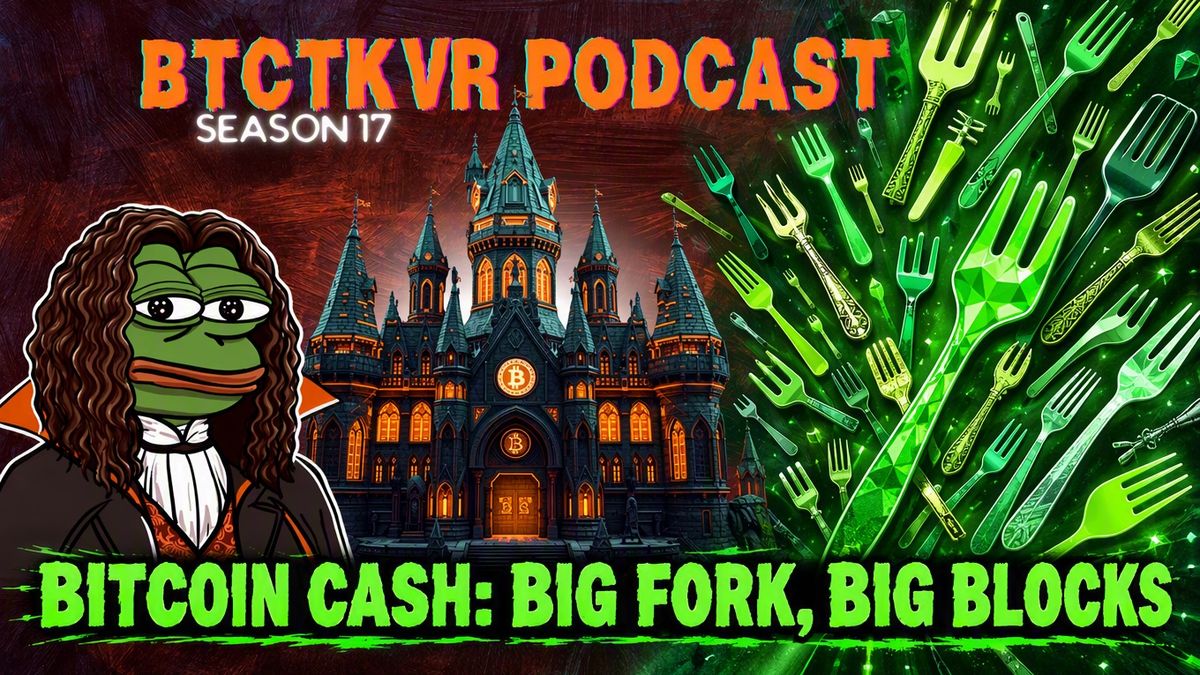
Bitcoin Cash is the primary consequence of Bitcoin’s 2015-2017 block size war. It produced Bitcoin’s first durable chain split, and what nine years of bigger blocks have and have not proved. This article is part of the BTCTKVR: Forks! magazine that will be launched in October 2026 during Tabconf 8 in Atlanta, Georgia.
From the same series, check out the article about all of Bitcoin’s hard forks and soft forks, as well as the piece on BSV.
Every fork in this magazine is built on pain, frustration, anger, and ambitious of achieving something bigger than BTC. Bitcoin Cash has the most famous story arc… and possibly the most fascinating one thanks to the deep lore and years of infighting.
For roughly two years, from 2015 to the summer of 2017, the Bitcoin world argued about a single constant in the code: the one megabyte block size limit that Satoshi slipped into version 0.3.12 in September 2010 without announcing it. One camp wanted the number raised so that Bitcoin could stay cheap to use on chain. The other wanted it left alone and the extra capacity found elsewhere, first through Segregated Witness and then through second layers like Lightning. Neither side could remove the other from the network, so on the 1st of August 2017 one of them left.
I was confused at the time. I landed on BTC like most people, because if you held bitcoin you got both coins and the BTC ticker felt like the safer bet. What I disliked about Bitcoin Cash was the campaign to call itself the real Bitcoin, the way Bitcoin.com quietly became a BCH website and r/btc a BCH forum. It felt like a nasty divorce where both parties grab whatever they can carry and claim they are in the right. Nine years later I sat down with the phenomenal big blockers who stayed after the famous names left, for eight hours and fourteen minutes, and this article is the factsheet I wish I had read before that conversation… but with some elements that I could only learn after having interviewed the ”bcashers”.
Vital statistics
Market figures are a snapshot from 17 September 2026 and will be stale by the time this is printed. Treat them as a scale reference, not a quote.
|
FIELD |
VALUE |
|---|---|
|
Ticker |
BCH |
|
Category |
UTXO hard fork: a new chain that inherits Bitcoin’s entire history up to the split |
|
Split date |
1 August 2017, by flag day (median time past 1501590000, 12:20 UTC) |
|
Last common block |
478,558, header time 13:16:14 UTC, mined by BTC.com with a |
|
First BCH-only block |
478,559, mined by ViaBTC roughly six hours later, about 1.9 MB in size |
|
Proof of work |
SHA-256d, same as Bitcoin, so the same machines can mine either chain |
|
Supply |
21 million cap, same subsidy and halving schedule; BCH halved on 8 April 2020 and 4 April 2024, ahead of BTC each time, with the next around 2028 |
|
Children |
Bitcoin SV (split 15 November 2018) and Bitcoin ABC, later eCash / XEC (split 15 November 2020). Both get their own articles. |
|
Market cap |
About $4.44 billion, roughly 0.29% of Bitcoin’s $1.53 trillion; CoinGecko rank 23. Peaked at rank 2 in 2017, fell to 35 in December 2018, briefly re-entered the top 10 in early 2026 |
|
Price |
About $221; all-time high about $3786 on 19 or 20 December 2017 depending on the exchange feed; all-time low about $75 on 15 December 2018 |
|
Mining security |
Difficulty about 0.33% of Bitcoin’s on the same date; Coin Dance showed BTC 4.4% more profitable to mine when I checked (it had said 16% the day before, so this swings hourly) |
Why it split: the politics
The short version is that Bitcoin’s social layer failed to reach consensus, so the code did it instead.
The long version starts with the whitepaper’s subtitle, “A Peer-to-Peer Electronic Cash System.” The large block camp read those words literally: if fees rise to the point where a coffee costs more to send than to drink, Bitcoin has stopped being cash. Their proposals came in waves. Bitcoin XT (BIP101, Gavin Andresen and Mike Hearn) wanted 8 MB blocks doubling every two years until 2036. Bitcoin Classic settled for 2 MB. Bitcoin Unlimited abandoned fixed numbers altogether in favor of “emergent consensus,” where miners pick their own limits and the market sorts it out. None of them reached activation on the main chain.
Calin Culianu, who was there on fork day and now maintains the node software most of the network runs, told me that the forking conversations had been going on since 2015, “the same way frustrated BTC developers talk about forks today.” Asked why BCH did not simply adopt Gavin’s BIP101 schedule, he gave the most honest answer I have heard on the subject: “Any group of rebels is going to be reacting to the thing they rebelled against. You try to meet them halfway.” The big blockers spent two years proposing compromises to plug holes that Core kept finding in their arguments, and the coin they eventually launched carried the scars of that negotiation rather than the purity of the original idea.
The small block camp saw something different in those proposals: a precedent for miners and businesses changing the money’s rules by agreement among themselves, which they regarded as the worst possible governance model for a system meant to resist exactly that. SegWit, a soft fork that raised capacity by moving signatures out of the base block, was their answer. Large block advocates called it an accounting trick that handed the roadmap to Core developers and made second layer networks the only path forward.
Three events in 2017 turned a debate into a deadline:
- The New York Agreement (May 2017). Digital Currency Group convened miners and businesses representing, by their count, over 80% of hashrate. The deal, branded SegWit2x, promised SegWit first and a 2 MB base block hard fork three months later. Many large block advocates distrusted it from the start; small block developers refused to sign at all. The 2x half was suspended on 8 November 2017 and never happened. It is often conflated with Bitcoin Cash, wrongly: BCH launched in August as a hedge against exactly this outcome, and only after SegWit2x collapsed did the NYA’s big block constituency migrate to it.
- BIP148, the user-activated soft fork. Node operators pledged to reject any block that did not signal SegWit from 1 August 2017. Whether or not it had the economic weight to succeed, it made 1 August the day everyone was planning around.
- The UAHF. Bitcoin ABC, led by Amaury Séchet, published a user-activated hard fork specification in June 2017 as a counter to BIP148: if the UASF chain would reject non-signaling blocks, the UAHF chain would reject SegWit and raise the block size instead. What began as a contingency plan turned into a launch. Culianu recalls that the project briefly had no name at all (“Bitcoin user activated hard fork” was the placeholder) before Bitcoin Cash crystallized in July, in direct reaction to the UASF branding. ViaBTC listed futures before the split, and the ticker moved from BCC to BCH once it became obvious that BCC already belonged to a Ponzi scheme.
Roger Ver, one of Bitcoin’s earliest investors and the owner of the Bitcoin.com domain, became the fork’s most visible advocate. The people who built the chain are tired of hearing that he created it. “It never really was Roger’s coin,” Culianu said. “He threw some money at it, so did Jihan, so did Bitprim in Argentina.” Jihan Wu’s Bitmain, then the dominant ASIC maker, was broadly aligned with large block politics, though how much hashrate the company actually pointed at BCH in those first weeks is disputed to this day and I would not print a number. Exchanges credited existing bitcoin holders with an equal balance of BCH, which is why the split is often described as an airdrop even though nobody sent anything to anyone.
What changed at the fork: the technical delta
Four rules separated block 478,559 from anything Bitcoin would accept, and they were designed so the two chains could never be reunited by accident.
- Bigger blocks by consensus. The fork block had to be larger than 1 MB, which is why the first BCH block was deliberately padded to about 1.9 MB. Nodes had to start with an “excessive block” limit of at least 8 MB.
- Replay protection. Every BCH signature must use
SIGHASH_FORKID, with a signature hash adapted from BIP143. A transaction signed for one chain is invalid on the other, so a coin spent on BCH stays put on BTC and vice versa. Ethereum Classic had skipped this a year earlier and paid for it. Bitcoin Cash did not. - The Emergency Difficulty Adjustment. If fewer than six blocks appeared in twelve hours, difficulty dropped by 20%. This kept the minority chain alive when miners left for BTC, but it also created a lucrative oscillation: miners piled in when difficulty was low, mined a burst of fast blocks, then left when it rose. The side effect is still visible: BCH is 1,490 blocks ahead of Bitcoin as I write, which is why its halvings arrive weeks before Bitcoin’s.
- No SegWit. Not a missing feature but a statement of intent: capacity would come from the base block, not from a witness discount.
The roadmap since
Bitcoin Cash upgrades by scheduled hard fork, historically twice a year and since 2021 every 15 May. Every one of these would be impossible on Bitcoin without a chain split. That is precisely the point. Since the CHIP process (Cash Improvement Proposals) was introduced in 2020, fifteen CHIPs have been implemented.
|
DATE |
CHANGE |
BITCOIN, FOR CONTRAST |
|---|---|---|
|
13 Nov 2017 |
EDA replaced by a new Difficulty Adjustment Algorithm (rolling 144-block window) |
Kept the 2016-block retarget it has had since 2009 |
|
15 May 2018 |
Block limit raised to 32 MB; several Satoshi-era opcodes re-enabled (OP_CAT, OP_SPLIT, OP_AND, OP_OR, OP_XOR, OP_DIV, OP_MOD, OP_NUM2BIN, OP_BIN2NUM); OP_RETURN data raised to 220 bytes |
1 MB base plus 4 million weight units; OP_CAT still disabled, revival proposed as BIP347 |
|
15 Nov 2018 |
Canonical Transaction Ordering (CTOR); OP_CHECKDATASIG; minimum transaction size of 100 bytes. The nChain camp rejected this upgrade and became Bitcoin SV |
Transactions stay in topological order |
|
15 May 2019 |
Schnorr signatures for CHECKSIG and CHECKDATASIG; a rule allowing coins accidentally sent to SegWit-style addresses to be recovered |
Schnorr arrived in November 2021, inside Taproot only |
|
15 Nov 2019 |
Schnorr for CHECKMULTISIG; MINIMALDATA enforced in consensus |
No equivalent |
|
15 May 2020 |
SigChecks (a new limit on signature operations per block); OP_REVERSEBYTES |
No equivalent |
|
15 Nov 2020 |
ASERT difficulty algorithm (aserti3-2d), designed by Jonathan Toomim. Bitcoin ABC’s Infrastructure Funding Plan was rejected by the majority and ABC’s chain became BCHA, later eCash |
No equivalent |
|
15 May 2021 |
Unconfirmed transaction chain limit removed; multiple OP_RETURN outputs allowed |
Core relaxed its own chain limit only as policy |
|
15 May 2022 |
64-bit script integers; native introspection opcodes that let a script inspect the transaction spending it |
Covenant proposals such as OP_CTV remain unactivated |
|
15 May 2023 |
CashTokens: fungible and non-fungible tokens as consensus primitives; P2SH32 (32-byte script hashes) |
Tokens exist only as metaprotocols (Ordinals, Runes, Taproot Assets) on top of consensus |
|
15 May 2024 |
ABLA, the Adaptive Blocksize Limit Algorithm: the limit grows with sustained demand, with a 32 MB floor |
No adaptive block size, and no proposal for one under serious discussion |
|
15 May 2025 |
Virtual machine limits rewritten (CHIP-2021-05) and arbitrary-precision integers in script (CHIP-2024-07 BigInt) |
No equivalent |
|
15 May 2026 |
Loops and reusable functions in the script VM. Developers now describe the BCH VM as explicitly Turing complete. A one-minute block time is under discussion for a future upgrade |
No equivalent |
A necessary clarification about Schnorr: Bitcoin Cash shipped Schnorr signatures two and a half years before Bitcoin did, and its advocates like to point this out. Fair enough. But BCH Schnorr is a drop-in replacement inside the existing CHECKSIG opcode. Bitcoin’s Taproot is a new output type in which a single key and an entire tree of alternative scripts are indistinguishable on chain until spent. They share a signature algorithm and almost nothing else. Likewise CashTokens and Ordinals are not two answers to the same question: one is enforced by every node, the other is a convention that nodes ignore.
Now here is a necessary clarification about OP_CAT. People in BTC still say with a straight face that Satoshi was right to disable it and that it would destroy the chain. Culianu’s account of why it was disabled is worth recording: “Satoshi was balancing twenty plates at once. Some things he just got rid of because he couldn’t deal with the consequences of a cat bomb.” A script that doubled a string repeatedly could exhaust a node’s memory, and in 2010 the quickest fix was to remove the opcode. BCH’s answer since 2025 is to price every VM operation and cap the total per input, so no single opcode can blow up a node regardless of what it does. Robin Linus, the creator of BitVM, messaged me during the live stream: “Tell the BCH guys that I, the officially crowned king of Bitcoin script wizards, am jealous of all their neat opcodes and wish we had them too.” He used a stronger adverb.
How Bitcoin Cash differs from Bitcoin today
On scaling philosophy. Bitcoin Cash bets that on-chain capacity should always exceed demand so that fees stay near zero and the fee market never really forms. Bitcoin bets that scarce block space and a fee market are what pay for security once the subsidy runs out, and pushes small payments to Lightning and other layers. Coin Dance’s number on the day I checked was that a Bitcoin transaction cost about 359 times more in dollar terms than a BCH one. The number is real. So is the counter-argument that a chain nobody needs to pay to use is a chain nobody is paying to secure. Culianu’s reply to that, for the record: with enough volume, “the price could drop 99% and the miners would still be totally secure.” With current volume, that sentence is a hypothesis.
Why 32 megabytes and not BSV’s gigabytes? “It’s like a sweet spot number,” Culianu said. “Decent block propagation, validation time, acceptable orphan rate. An engineering question.” ABLA exists so that the number never has to be a political question again: the limit is now a consensus rule that follows demand, which is, as one of the developers put it, the block size wars made impossible to repeat.
On security. Because the proof of work is identical, BCH’s security budget is a function of its price. At roughly 0.3% of Bitcoin’s difficulty, the cost of renting enough SHA-256 hashrate to attack it is a rounding error for a large pool. On 15 May 2026, the day of the network upgrade and with most of the developer community gathered in Ljubljana, somebody tested that. Bitcoin Core had disclosed a long-standing crash bug on 5 May; an attacker mined two deliberately malformed blocks against BCH within thirty minutes, spending an estimated 3,000 to 10,000 USD in hashrate on the assumption that the fork had inherited the bug. It had not. BCHN had removed the offending line years earlier as a code smell. The blocks were rejected as invalid, the network noticed nothing, and BCH crashed about 25% over the following days on a wall of short positions that may or may not have been related. It is the first documented hostile attack on the chain itself, as opposed to a split from within.
On decentralization. Bitcoin Cash’s supporters point to multiple independent node implementations (Bitcoin Cash Node, BCHD, Knuth, Verde, Bitcoin Unlimited historically) and argue that no single team controls the protocol. Critics reply that 32 MB blocks, let alone ABLA’s headroom, would price hobbyist nodes out if the chain ever filled them. The BCH answer to “can you people even run nodes?” (a question I once watched a maximalist ask two BCH visitors at a conference in Frankfurt) is that the premise is wrong: SPV was in the whitepaper, UTXO commitments are on the roadmap, and Bitcoin Core itself skips signature checks on historical blocks through assumevalid. Two years ago I synced a Bitcoin Core node in 7 hours 40 minutes and a BCH node in 2 hours 20 minutes on the same MacBook Pro. The BCH chain is currently the smaller one, because it has had less traffic. Both facts cut like a twofold blade that nourishes irrational tribalism.
On adoption. BCH has stayed listed on every major exchange since 2017 and survived two hostile splits with its ticker intact. Real spending pockets exist: Townsville in Australia, Argentina, and the Philippines, where Paytaca is onboarding merchants and users together after St. Kitts showed what happens when you onboard only the merchants. Europe’s crypto payment rails, GoCrypto included, were killed by MiCA’s licensing regime rather than by technology. What has not materialized is demand at scale: measured throughput has spent most of nine years far below what the block limit allows, so the capacity argument has largely been tested in theory.
Who is who
The builders
- Amaury Séchet (“deadalnix”), lead developer of Bitcoin ABC and the engineer behind the UAHF. He launched Bitcoin Cash, but currently he no longer steers it. His Infrastructure Funding Plan, an 8% coinbase tax routed to his own team, split the community in 2020, and his chain is now eCash XEC. The people who worked with him describe the episode with something less than fondness. “The Greg Maxwell of big blockers,” Culianu called him.
- freetrader, pseudonymous lead maintainer of Bitcoin Cash Node (BCHN), the client that carried the majority through the IFP split and remains the reference implementation for BCH today.
- Calin Culianu, BCHN developer since fork day, author of the Fulcrum Electrum server (used by Cake Wallet among others, and now serving BTC and Litecoin as well) and a maintainer of the Electron Cash wallet. His stated mission: “complete Satoshi’s work,” get the chain technically ready to be global money if the moment ever comes, and keep the culture non-toxic. He sold all his BTC for BCH after the fork and says he has no regrets, which at current prices is a statement of principle.
- Jonathan Toomim, independent developer whose ASERT difficulty algorithm replaced the 2017 DAA in November 2020.
- Jason Dreyzehner, the designer behind much of the recent VM work (limits, BigInt, introspection) and the quantum-resistant vault constructions. Rarely gives interviews.
- Rosco Kalis, creator of CashScript, the high-level contract language that started as a 2019 university project and now underpins most BCH DeFi. Spends most of his time in the Ethereum world and is candid that “the UTXO model is harder to build on.”
- Jason Cox, Bitcoin ABC release manager in the 2017 to 2020 era, now associated with the eCash line.
- General Protocols (AnyHedge, the first BCH DeFi contract in 2020, and the EXO template stack), Riften Labs (Cauldron DEX), Kyle (FundMe.cash, Bitcoin Cash University), Kallisti (Selene wallet), and, without any claim to completeness, Axel Gembe, Dagur Valberg Johannsson, Andrea Suisani and Fernando Pelliccioni of Knuth.
The money and the mouthpieces
- Roger Ver, “Bitcoin Jesus” to his fans, who spent years evangelizing Bitcoin before becoming BCH’s most tireless promoter through Bitcoin.com. Arrested in Mallorca in May 2024 on 10 year old US tax charges, three weeks after publishing the book Hijacking Bitcoin; now under a gag order. Still friendly to the project, by the developers’ account, but no longer funding it.
- ViaBTC (Haipo Yang), which mined the first BCH block, ran the first BCH futures market and gave the chain its first weeks of hashrate.
- Jihan Wu and Bitmain, the industrial weight behind the large block camp in 2017, influence more often asserted than measured.
- Craig Wright, Calvin Ayre and nChain, allies in 2017 who became the opposing army in the November 2018 hash war and left with Bitcoin SV. I asked Culianu how it felt to have a man claiming to be Satoshi on his side. “It felt bad. It felt weird.” He described the post-fork community as “a ragtag band of rebels” who tolerated Wright because he said the right things about Core, and considers the association, along with the infamous wine glass photograph, the single most damaging thing that happened to the big block cause in its early years.
- Steve Thurmond, a BTC maximalist from 2011 to 2023 who switched sides, and the creator of Cash Stamps, paper wallets loaded with a couple of dollars of BCH that he hands to strangers and leaves on top of urinals. Not a developer and cheerful about it. His conversion story, from a man who used to spend bitcoin at Overstock and Newegg until the fees made it pointless, is possibly the most common one you will hear in the big block community.
- The exchanges, whose decisions decided both later splits: in November 2018 and again in November 2020, the chain that kept the BCH ticker was the one Coinbase, Binance, Kraken and the rest said it was.
- r/btc, the subreddit that became the large block camp’s home after r/bitcoin’s moderators began removing XT fork advocacy in 2015. Political color, not technical authority, but the two forums shaped the tone of everything that followed. Several current BCH figures told me the Reddit era was so bitter that they initially left the community and only came back later, “in a hazmat suit.”
The two forks that came after
Bitcoin Cash’s own history repeats the pattern that created it.
On 15 November 2018 the ABC roadmap (CTOR and OP_CHECKDATASIG) collided with nChain’s Satoshi’s Vision client, which wanted 128 MB blocks and the original opcodes restored with no other changes. Both sides mined their own chain from block 556,767 and, for a few days, threatened to attack each other’s. The ABC chain kept the ticker. The SV chain became Bitcoin SV. Culianu now says CTOR “didn’t need to happen” and did not need to be pushed through against nChain’s objections; the change was ostensibly about faster block propagation via Graphene, but in his reading it was as much about forcing the nChain people out. Steve Thurmond calls CTOR BCH’s own humiliation ritual, while noting that ABLA is not in the whitepaper either.
On 15 November 2020 the fight was over money rather than opcodes. Bitcoin ABC wrote its Infrastructure Funding Plan into consensus at what Culianu describes as “the eleventh hour,” redirecting 8% of every block reward to a development address without any community process. Bitcoin Cash Node and the other clients refused. “We quickly scrambled to form another dev team, told all the miners which software to install, and he got the boot.” Hashrate and exchanges followed BCHN; ABC’s chain traded as BCHA and rebranded as eCash (XEC) on 1 July 2021, with 1 BCHA redenominated as 1,000,000 XEC. Several people told me this was the split that made them give up on BCH for a while. The price hit an all-time low of about 75 USD a month after the BSV split and was ranked 35th by market capitalization. Both fork chains have their own articles covering this issue.
What Bitcoin Cash proved
Regardless of what you think of the coin, the experiment produced results that the rest of this magazine keeps returning to:
- A contentious chain split with proper replay protection can produce a durable, liquid asset. Every later Bitcoin fork copied BCH’s
SIGHASH_FORKIDapproach or something like it. - The market decides tickers, not developers. Twice, the BCH name went to the chain exchanges chose, and the losing side had to rebrand.
- Scheduled hard forks are a viable governance model, at least for a chain small enough that its stakeholders can coordinate. Six consecutive May upgrades have gone off without a split since 2021, and the community’s own claim, that no figurehead remains to decapitate, has been tested twice and held.
- Bitcoin borrowed from it. Jeremy Rubin told me his CTV and CSFS proposals were inspired by an existing BCH opcode called CHECKDATASIG. The WabiSabi paper behind Wasabi Wallet 2.0 cites CashFusion, which shipped on BCH first. Bitcoin Core is working toward UTXO commitments, which BCH has argued for since the node debate began. And in September 2018, at the absolute height of the fork wars, a BCH developer known as Awemany found a live inflation bug in Bitcoin Core (CVE-2018-17144, introduced by a block validation optimization) and disclosed it responsibly. Bitcoin’s 21 million owes a debt to a big blocker. Core has never had a reciprocal disclosure agreement with BCHN, and Culianu is no longer sure he would be so polite a second time.
- Big blocks alone do not create demand. This is the finding that BCH’s own advocates find hardest to argue with, and the one that Bitcoin’s small block camp cites most often.
Will BCH flip Bitcoin?
This magazine’s scorecard asks this question for every fork, so let’s answer it plainly. At about 0.3% of Bitcoin’s market value and about 0.3% of its difficulty, Bitcoin Cash is not on a trajectory to overtake Bitcoin… and nothing in its present market structure suggests otherwise. Even its most committed developers do not claim it is. Culianu’s own theory of victory is that the people he calls “the money printer people” will be too busy fighting other fires to bother with a chain this small, and that being under the radar is a feature for now: “It would actually be really dangerous if BCH got to number two right now.” A flip would require a reversal in hashrate allocation, fiat rails and social consensus of a kind that no protocol upgrade can deliver on its own. Where BCH’s claims do hold up is narrower and real: it is cheaper to use, it has features Bitcoin has declined to adopt, and it is still here, which is more than most 2017 forks can say. The ultimate test of an open source project is whether people keep joining after the big money and the famous names leave. By that measure it passed. Treat flip talk as advocacy, then treat survival as the accomplishment.
Scorecard inputs
Facts only; the scores come in the ratings section.
|
CRITERION |
EVIDENCE |
|---|---|
|
Technical ambition |
8 MB to 32 MB to adaptive; CTOR; Schnorr in 2019; native tokens; introspection; unbounded integers; loops. Deliberately non-SegWit, non-Taproot |
|
Political radicalism |
Contentious split against the SegWit majority, then two further contentious splits within its own camp |
|
Adoption |
Continuous listing on all major exchanges since 2017; market cap about 0.29% of BTC (17 Sept 2026); merchant pockets in Australia, Argentina and the Philippines; European rails lost to MiCA |
|
Scalability claims vs measurement |
Fees consistently a fraction of Bitcoin’s; sustained throughput far below the block limit for most of its history |
|
Decentralization |
Several independent node implementations; counterweight of higher node costs at full capacity and historically concentrated advocacy |
|
Security model |
Same SHA-256d assumptions as Bitcoin at about 0.33% of the difficulty; no merge mining; first hostile attack attempt in May 2026 failed; structurally exposed to rented hashrate |
|
Long-run viability |
Active CHIP process and annual upgrades; developers still joining post-2020; repeated splits and nine years of relative decline against BTC |
|
Speculative context |
Upside: payments and CashTokens applications if on-ramps deepen. Downside: permanent minority-hash status, brand lock-in to BTC, split fatigue |
Sources
UAHF Technical Specification and the 2017 to 2026 upgrade specifications (upgradespecs.bitcoincashnode.org); mempool.space API for block 478,558 (header time 1501593374); CoinDesk and Bitcoin.com News coverage of 1 August 2017; reference.cash for the May 2023 upgrade; CoinGecko API and coin page for market data, 17 September 2026; Coin Dance BCH statistics, 17 September 2026; Decrypt on the November 2020 split; bitcoinabc.org on the BCHA to XEC rebrand; bitcoincashnode.org team page; Internet Archive capture of bitcoincash.org from December 2017; Bitcoin Takeover Podcast S17 E26 (27 May 2026), interviews with Calin Culianu, Steve Thurmond, Rosco Kalis, Kallisti, FiendishCrypto, Kyle and others.
This essay is part of BTCTKVR: Forks!, my free 2026 magazine about Bitcoin forks. Start with What the Fork?! for the overview, or hear the guests argue it in their own words in Bitcoin Forks, Described by Dorks.
Related

S17 E26: Calin Culianu, Steve Thurmond & The Phenomenal Big Blockers on Nine Years of Bitcoin Cash
Almost nine years after the big split of the Bitcoin community, it was time. Time to sit down with the people who…
S17 E19: Amaury Séchet on Forking Bitcoin Twice, Quantum FUD & Scars from the Block Size Wars
Two years after our first interview, I decided to invite Amaury Séchet(@deadalnix) to find out what the Greg Maxwell of big…
S17 E39: Kurt Wuckert Jr on the Big Block Wars, BSV, Craig Wright & the Road Not Taken
Every community has its designated villains, and in Bitcoin’s longest running morality play, Kurt Wuckert Jr has worn the black…

Comments
Comments run on my own server. No ads, no trackers.