




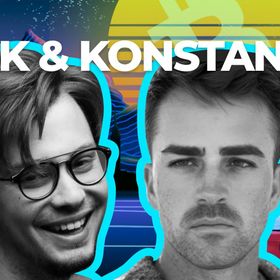
S15 E35: Nick Schteringard & Konstantin Wünscher on OpenDelta, Runes & the Synthetic Dollar
The audio keeps playing while you browse the site.
Read the transcript9,752 words, every line links to the minute it was said
Ask this episode
Runes had been alive on Bitcoin for about a week when I went live with two founders who wanted to park a dollar on top of it. Not a stablecoin, mind you. They were very firm about that. Nick Schteringard and Konstantin Wünscher built OpenDelta around USDO, which they call a synthetic dollar: Bitcoin collateral, a short futures position against it, and a token that is supposed to stay worth one buck while the orange coin does its usual rodeo.
Both of them came out of Lightning. Konstantin ran a Lightning company. Nick built Lightning payment infrastructure and had been on the show before with his friend Slava to talk about Stroom Network. So this episode turned into two conversations braided together: how you make a dollar out of derivatives, and why two Lightning veterans decided to build a product that does not need Lightning to succeed.
"I Don't Consider Our Project a Stablecoin"
I opened with the rude question. Why does Bitcoin need another stablecoin when Tether has lived on the Omni Layer for years? Konstantin flipped it. He does not consider Omni-era Tether to be a Bitcoin stablecoin, and he argued that "there aren't actually any right now that anyone is using."
Then came the vocabulary lesson. A stablecoin, in his definition, keeps a one-to-one tie between a real-world dollar and a crypto token. OpenDelta does something else. "In our case it's synthetic because there's actually a complete disconnect between the real dollar and our synthetic dollar," he explained, because the stability "is created through the derivatives markets of Bitcoin." No bank account full of greenbacks, no Treasury bonds in a vault. Just math and futures.
He was also honest that nothing pegs itself forever. Any such token "is not always guaranteed to be a one-to-one peg," and certain conditions have to hold for it to work.
Delta Neutral, or How to Stop Worrying About Volatility
So how does the peg hold? OpenDelta takes Bitcoin and uses it to collateralize what Konstantin called "a delta neutral position" in the Bitcoin futures market, which "basically means that you are not exposed to the price of Bitcoin." Nick gave the cleaner version: they hold spot BTC and a short against it. "If spot is rising, the short position is losing and vice versa." His summary was gloriously blunt: "we don't care about volatility that much."
I tried to scare them. What if Bitcoin drops 50% in a day because BlackRock dumps or Michael Saylor sells his bags? Konstantin shrugged. "That's still fine." Even a 75% drop is fine. The short side prints profit when price falls, so they accumulate more Bitcoin as collateral. The real failure mode is Bitcoin going to roughly zero, at which point the protocol would need "more Bitcoin than they actually are in existence." His verdict on that scenario: "all things considered, not very likely."
He also leaned on the size of the market they tap into. Bitcoin futures volumes run into the hundreds of millions, institutions trade them, and "it's not just retail anymore."
Why Runes, and Why Now
Konstantin, a self-described longtime Bitcoin user, saw a gap in the ordinals and inscriptions crowd. You can only trade those assets against BTC. "Sometimes you want to capture some of your PnL or your profit in something that is less volatile than Bitcoin," he said, and he wanted to trade an inscription against "a Rune that is a stable Rune." It did not exist, so they built it.
Nick had a more personal arc. At his Lightning infrastructure company, "I was always thinking that once we have a stablecoin on Lightning, this thing will fly." He waited. It did not pop up. Meanwhile the attention moved elsewhere: "the whole demand and the whole attention of users for now is within the inscriptions, ordinals, whether you like it or not." Runes, which share the UTXO model with Lightning, might eventually bridge the two worlds. So might RGB, "whatever that is, I don't know." For now, "we're following the demand."
When I pointed out that Tether on Tron is cheap and already has the network effect, Nick had a one-liner ready: you can't currently trade ordinal or Rune assets against Tether on Tron, because "there is no cross-chain DEX that allows you to do so."
Miners, Merchants and the Bitcoin Bill
Konstantin's favorite use case was not degens at all. Back in his Lightning days, payment processors and merchants kept asking to hedge their Bitcoin. Miners too. They earn BTC, have real-world bills, and "they don't necessarily want to go sell the Bitcoin somewhere for Tether or USDC." He compared the ideal flow to Stripe: send a few sats, get locked against the dollar price, done. No "DeFi magic, which no one really understands."
Nick added the yield angle. Miners often keep part of their reserves in fiat and like to earn interest via T-bills. That is easy if you live in the US or Canada. Plenty of miners elsewhere are cut off from banks or simply don't want to touch fiat rails. For them, USDO could act "as a Bitcoin bill": dollar stability with yield coming from the funding rate on the derivatives exchange. Konstantin later pitched it as a "Universal dollar savings account" that pays "a few percent interest" while you stay on Bitcoin. Funding for this, by the way, came from a $2.15 million pre-seed round that OpenDelta announced on its blog, and CoinDesk covered the raise too.
Degens, Meme Coins and Customer Acquisition
I asked whether they worried about the reputation of Runes, given that the early crowd proudly calls itself degen, etches Dickbutt descendants, and threatens to airdrop junk onto the OCEAN mining folks who hate the whole thing. Nick refused to clutch pearls. "I don't think that being degen is a crime," he said. People trading assets "probably going to zero in a few weeks" are making adult choices.
His reframe was pure startup pragmatism. Look at Solana, he said: meme coins drove its user growth. "I would treat these meme coins and this worthless assets trading as a customer acquisition strategy." Some people win, some lose, and a few stick around, buy Bitcoin and maybe end up on Lightning.
Then he confessed something that gets you uninvited from certain conferences. He, like the hardcore HODLers, does not want to spend his Bitcoin. "I'm not ready to pay in Bitcoin for anything," he admitted, because he expects it to appreciate. So he needs something else to pay with, and he sees "no reason why they could not live on Bitcoin itself."
Falling Out of Love with Lightning
This was the part that stung. The same day we recorded, news broke that Phoenix would stop serving US customers, and I shared my own sad Lightning story. In the routing gold rush after Alex Bosworth bragged about routing income, I ran a node on a Raspberry Pi 4 over Tor and earned about 30 sats a month. Not even enough to open one channel.
Konstantin did not sugarcoat it. Running a Lightning business is "incredibly hard." Routing income is "a myth, at least right now," the user base is small and doesn't move big volume, and every viable model "boils down to volume." What survives? Infrastructure providers, on-ramps, off-ramps and brokerages. Anything more sophisticated is "incredibly unattractive to entrepreneurs." His goodbye was tender: "I'm still a big Lightning fan," but "in the end I folded."
Nick disagreed on routing. He says professional routers can make "like 1.5 to even 4% per month," depending on market cycles. His problem was the ceiling. He signed a big payment processor with billions in on-chain volume, ran the numbers, and realized he'd need at least ten such clients for a real business. "There are no 10 companies like that in the world." That's when he met Konstantin and they pivoted to something "Bitcoin-centric" that doesn't depend on Lightning.
He still has a favorite horse, though. Nick is "a big fan of David Marcus" and Lightspark, whose Universal Money Addresses he described as "reinventing PayPal on top of Lightning." He gave Breeze a nod too. I am less romantic. As I said on air, Lightning has been an 18-month project for about six years now. If you want a deeper dive into scaling layers that compete with it, my S15 E16 write-up with Paul Sztorc covers the whole menu.
Wallets, Fees and Other Layers
On user experience, Konstantin was upbeat. Xverse, UniSat, Magic Eden and OKX Wallet already support Runes, and sending one "feels pretty much like sending Bitcoin." The big win is that "it doesn't require anyone to leave Bitcoin." No channels, no liquidity juggling, and "there's transaction certainty, which you don't have in Lightning."
What about $10 transfers that cost $10 in fees? He thinks the fee scare is overblown. People on Bitcoin mostly move bigger chunks, like ordinals worth a few hundred dollars, so "paying $5 is not really that big of a deal." Microtransactions will come later, likely through other layers. Nick added that the ordinals hype actually produced better Bitcoin wallets, closer to the Phantom-style experience Solana users enjoy.
On expansion, Konstantin promised to go slow, talk to the many layer twos, and follow the users. A layer with an EVM would let smart contracts mint and redeem USDO autonomously. On Runes, it's a bare token they issue themselves.
Why Always the Dollar?
After reading the Layer Two Labs ad in the requested monotone voice (Paul Sztorc approved it, or did he), I asked why every stablecoin is pegged to the US dollar. Konstantin had data: they tried a synthetic euro, and demand was "maybe 1% of what people wanted" compared to dollars. Nick went macro. The dollar is the world's reserve currency, global trade runs on it, and "it's hard to keep a lot of units in your head." I'm still waiting for my British pound or Indian rupee stablecoin.
I also pitched them a Satodime card as cash for Runes: tap, check the balance, hand it over. Konstantin liked it for emerging markets but immediately went into security-audit mode, asking where the private key lives and whether someone standing beside you could read it. Tamper-evident chip, I explained. Pricey for emerging markets, nice as a birthday gift.
The Supra Cycle and Being Technically Correct
We wrapped with my favorite meme. Nick admitted he learned "the Supra meme" from my Twitter. The idea: wait until one Bitcoin buys one Toyota Supra. Forget the Lambo. "90% of the Lambo at 10% of the Lambo price." I drew a line on a chart, and it's been more accurate than all the Fibonacci astrologers. It predicts 80K by September.
On the money, Konstantin said raising for Bitcoin projects was "incredibly hard" a year earlier and is easier now, and "you can't do this as a one-man show." I warned them the market will call USDO a stablecoin no matter what. Nick didn't budge: "We are purists in that way, we want to be technically correct." Fair enough. If the money and the market follow technical correctness, these two have a head start.
Listen to Nick Schteringard & Konstantin Wünscher on Spotify, Apple Podcasts, YouTube, and More
Time stamps:
00:00:32 - Introduction to Open Delta 00:01:09 - Need for Another Stablecoin? 00:01:57 - Defining a Stablecoin 00:03:30 - Maintaining the Peg 00:06:39 - Managing Reserves 00:08:06 - Risks of Bitcoin Price Drops 00:09:22 - Deployment on Runes 00:12:11 - Demand for Dollar Stability 00:13:59 - Advantages Over Existing Solutions 00:18:10 - Targeting New Bitcoin Users 00:18:44 - Discussion on Miners' Use Cases 00:20:01 - Wasabi Wallet 00:21:51 - Concerns about Runes Protocol Reputation 00:24:17 - Synthetic Dollar and Meme Coins 00:26:43 - Challenges of Lightning Network 00:28:43 - Business Models in Lightning 00:32:54 - Routing Fees and Profitability 00:34:54 - Building a Bitcoin-Centric Product 00:37:02 - Reinventing Transactions on Lightning 00:38:16 - Hope for Lightning's Future 00:39:19 - Introduction to Hodling 00:40:29 - Exploring Other Networks for Stablecoin 00:42:22 - Wallet Compatibility with Synthetic Dollar 00:44:10 - Emergence of Convenient Bitcoin Wallets 00:45:21 - Impact of Transaction Fees on Adoption 00:48:30 - Stablecoins Pegged to the Dollar 00:52:05 - Future of Other Stablecoins 00:53:01 - Innovative Cash Solutions with NFC Technology 00:55:39 - Introduction to Redeemable Assets 00:55:56 - The Supra Cycle Concept 00:56:16 - Price Predictions and Models 00:57:22 - Discussion on the Supra 01:00:19 - Challenges of Launching Open Delta 01:00:31 - Funding and Development of Open Delta 01:01:29 - Market Perception of Open Delta 01:01:53 - Technical Correctness and Market Success 01:02:29 - Nick's Previous Projects
Verify this episode
This is the SHA-256 fingerprint of the MP3 as published here, timestamped in the Bitcoin blockchain with OpenTimestamps. If one byte of the file changes, the fingerprint changes.
- SHA-256
bf3b3490a1b0368c5fd41bd44179b9db642d087500da612d6999fb5b7c781cf5- Proof
- 2024-05-17_s15_e35-_nick_schteringard_konstantin_w_nscher_on_opendelta_runes_-_14.05.2024_00.25.mp3.ots · all episode hashes (proof)
- Status
- Anchored in Bitcoin block 974,312
How to check it yourself
- Download the MP3 and the proof into the same folder.
- Run
sha256sum 2024-05-17_s15_e35-_nick_schteringard_konstantin_w_nscher_on_opendelta_runes_-_14.05.2024_00.25.mp3(on a Mac:shasum -a 256 2024-05-17_s15_e35-_nick_schteringard_konstantin_w_nscher_on_opendelta_runes_-_14.05.2024_00.25.mp3). The result must match the SHA-256 above. - Install the OpenTimestamps client (
pip install opentimestamps-client) and runots verify 2024-05-17_s15_e35-_nick_schteringard_konstantin_w_nscher_on_opendelta_runes_-_14.05.2024_00.25.mp3.ots. It hashes the MP3 again and checks the proof against your own Bitcoin node, then prints the block and the date the file existed by. Without a node,ots info 2024-05-17_s15_e35-_nick_schteringard_konstantin_w_nscher_on_opendelta_runes_-_14.05.2024_00.25.mp3.otsshows the block height to look up in any block explorer.
Related
S14 E18: Lisa Neigut & Calle on Scaling Bitcoin & Free Open Source Software
During the 10th edition of Hackers Congress at Paralelni Polis (HCPP), I’ve had the pleasure to meet Lisa Neigut and Calle. The…
Breaking ChatGPT’s Bitcoin FUD #6: Limited Use Cases
According to ChatGPT, Bitcoin only accommodates a limited number of use cases, and this fact will consequently limit its adoption…
S13 E3: Casey Rodarmor on Ordinals, Inscriptions & Bitcoin Culture
Ordinal inscriptions are all the rage. They obsoleted the concept of NFTs by offering artists a permanent way to display their…

Comments
Comments run on my own server. No ads, no trackers.