




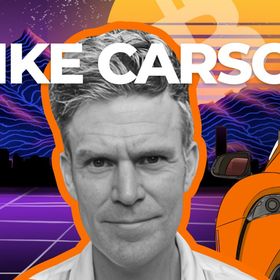
S15 E51: Mike Carson on Impervious, Spaces Protocol & Owning Your Name on Bitcoin
The audio keeps playing while you browse the site.
Read the transcript10,247 words, every line links to the minute it was said
Ask this episode
I opened this livestream with a disclaimer nobody asked for: my guest was Mike Carson, not Mike Garson, the piano player who toured with David Bowie. This Mike plays a different instrument. He runs Impervious, he founded the domain drop-catching service park.io, he once held three ICANN-accredited registrars, and he is now the CEO of Friendster, the social network that came before Facebook, Hi5 and everything else we wasted our teenage evenings on.
Mike has spent the better part of a decade inside the plumbing of the internet's naming system, and he came out of it with one stubborn conviction: names should be owned the way bitcoin is owned. His answer is Spaces Protocol, a naming system anchored to Bitcoin with no token, no premine and no foundation. When we spoke on August 21, 2024, it was running on testnet4 and he hoped to reach mainnet "in the next month or so."
He also started by calling the Bitcoin Takeover his favorite Bitcoin podcast, which is the fastest way to get invited back. I arrived about 30 minutes late to my own show, so I suppose we were even.
Why Bother With Digital Identity?
I came in playing the cynic. We already have a beautiful KYC system, right? You upload your ID, everyone knows who you are, and your social security number is sitting on some darknet forum anyway. Why decentralize any of this?
Mike reframed the question. What Spaces really handles is naming: usernames, user IDs, domain names. "Bitcoin was a revolution for money," he told me, and money is the one thing Bitcoiners agree must be decentralized. But naming sits right next to it. Cities have names, companies have names, websites have names. "You can't just refer to a city by like geo coordinates," and you cannot run the web on raw IP addresses either. Right now, almost every name we use lives under someone else's control.
His path here started with domains, not Bitcoin. After park.io he founded Impervious to work on Handshake, a Bitcoin fork with its own blockchain, and later on ENS. Both experiences convinced him the job belonged on Bitcoin, for two reasons. First, it is "by far the strongest proof of work blockchain," so why put decentralized names anywhere else? Second, Bitcoin itself needs a naming system. He pointed to Matt Corallo's BIP 353 for human-readable payment instructions, which currently leans on DNS, and DNS is "completely centralized."
So the team spent a year focused entirely on Spaces, with one design ideal repeated like a mantra: "100% cypherpunk." No separate chain, no token, no premine, no foundation, and a light footprint, without "clogging up all the block space."
Namecoin's Squatters and the Lessons of the First Altcoin
I could not resist the history lesson. Back in 2010, the decentralized DNS conversation produced Namecoin, and Satoshi encouraged its creators to build a separate, merge-mined chain instead of stuffing names into Bitcoin. Today I am not even sure anyone still maintains the domains people bought on Namecoin, and the idea has found its way back to Bitcoin.
Mike gave Namecoin its due. The fact that the very first altcoin was about names "shows like the importance of naming," and Spaces was built "on the shoulders of all these other" projects. In 2010, a name system on Bitcoin simply could not scale to hundreds of millions of entries, so a separate chain made sense. But he cited an academic paper on why Namecoin failed, and its conclusion was distribution. You could register tens of thousands of names for very little, so the whole namespace got squatted and real users could not get anything useful.
ENS got a fairer review than I expected from a Bitcoin builder. Mike said it has been "super successful in a lot of ways," doing hundreds of millions of dollars a year in registrations. His problems with it are structural: everything sits under a single top-level domain, .eth, and verifying Ethereum yourself is hard enough that most people end up trusting an RPC provider.
Hundreds of People Between You and Your Name
This is where the conversation got political, in the best sense. If you buy a domain at GoDaddy, Mike explained, "there's like literally hundreds of people who have access to your domain name," from the registrar to the registry to ICANN and every employee in between.
His favorite example is .cat, the top-level domain for Catalonia. During the independence push, Spanish authorities raided the registry's offices, .cat domains were taken down, and, as he recalled it, a technical lead was arrested for sedition. And it is not only domains. "If they can do it to the president, they can do it to anybody," he said, pointing at Donald Trump's removal from Twitter.
The argument mirrors the one every Bitcoiner already knows by heart. People say their bank works fine. "Why should there be banks in between and everybody else in between you and your money and why should there be people in between you and your name," Mike asked. "There should not be."
Security is the second half of the case. He mentioned the 2024 Squarespace incident, in which attackers hijacked domains and crypto companies lost user funds. Then there is HTTPS itself, which depends on certificates from trusted third parties. In his words, your traffic ends up "signed with somebody else's keys, really."
At Bitcoin Takeover, With No Dot
Then came the part I actually cared about: how do I get my name? I warned listeners on air that if anyone squats on my handle, I will hunt them down, because someone already owns bitcointakeover.com and wanted far too much for it.
Mike walked me through the design. There are top-level spaces and subspaces, and only the top level touches Bitcoin. To claim one, you open an auction with a Bitcoin transaction and place bids on-chain. There is no dot. The syntax looks like @bitcointakeover, and the owner can then hand out subspaces underneath, sell them, give them away or keep them all.
To keep Bitcoin's blocks free for money, the number of top-level spaces is capped at roughly ten per day, "like 3,600" a year. The winning bid is burned: "it's just gone forever," and none of it goes to Impervious. They considered sending it to miners, but that got complicated, and burning was the cleanest cypherpunk option.
Squatting gets the same treatment. Auctions last ten days, and "any bids in the last day extend the auction by one day," which makes last-second sniping very hard. Namecoin's ghost was clearly sitting at the design table.
Zero-Knowledge Proofs Instead of a Fee Spike
My natural worry was that every subdomain would be another on-chain transaction, and that a domain craze would push up fees for the people who use Bitcoin for remittances. Mike shut that down quickly. Subspaces are managed off-chain in a tree, and ownership is proven with zero-knowledge proofs. The team has a proof-of-concept tool on their GitHub that uses RISC Zero to produce a succinct proof, which could be committed on-chain to attest to changes.
The numbers explain why. There are about 300 million registered domain names on the internet today, and "you can't have that on bitcoin." So Bitcoin carries the scarce top layer, everything else scales off-chain, and no consensus change is needed. "It's running just as Bitcoin is now," he said, yet it remains anchored in that block space for its security. I told him it sounded even lighter than OpenTimestamps, which is about as non-contentious as non-monetary Bitcoin use gets.
Typing @bitcointakeover into Chrome is a different story. The team has focused on the protocol first. Names will point to data stored on a peer-to-peer network: DNS records, an onion address, a Nostr identity or a BIP 353 payment address, all verifiable against the name's key with a quick proof check. Browser support would come after mainnet. Impervious already built one browser for this, Beacon, which Mike described as the first to resolve ENS names through real DNS instead of a redirect, and the first to support DANE, so "you have the keys, nobody else has the keys to encrypt that traffic."
I argued that redirects are fine for vanity, but they do not "defeat the Hydra." If every decentralized name just forwards to an ICANN domain, you are only an interface to the system you wanted to replace. The real win is people building native sites and apps on these names.
Truckers, Venmo and Human-Readable Money
The first killer use case Mike sees is payments. He brought up the Canadian truckers' protest, when GoFundMe decided not to pass the donations on. With a human-readable name, you could tell people to send bitcoin to something like "truckers at fund," with no platform in the middle. And the owner of a top-level space does not need to set anything up: with the current Spaces wallet, anyone can send bitcoin straight to @bitcointakeover.
He also referenced a Lyn Alden interview about combining Nostr and Lightning into something that works like Venmo, except "it's Venmo without the usernames." Add Spaces, and you get a decentralized Venmo.
My own question about identity got a more cautious answer. I said a single Bitcoin address as someone's identity feels limited and leaky. Mike agreed that pinning a name to a reused address has privacy issues. What a naming protocol really does is tie "a name to a key," so you can prove ownership, and he mentioned silent payments as the kind of tool that can work with a space name. The darker side came up two years later, when members of the Spaces team joined my TABConf 8 livestream and warned that a well-known address bound to a findable person invites wrench attacks.
Block Space Has Value Beyond Money
I predicted that some Bitcoiners would complain once Spaces went live, the same way they complain about ordinal inscriptions: this is a money network, so get your JPEGs off it. Mike answered with the philosophy behind the whole project. What makes Bitcoin special, to him, is its block space, "this truly decentralized" ledger secured by the most proof of work in the world. "Money is the first killer app" that used it, and a very important one. But naming deserves a place there too, and he does not think it takes anything away from money, especially with a footprint this small.
He has been touring BitDevs meetups, and the reaction surprised him. Some attendees who openly dislike how ordinals use block space told him Spaces is "the only thing built on bitcoin that I see that has value."
I also pointed out that Paul Sztorc is building BitNames, a Namecoin-style sidechain for his drivechain vision, and that sidechains could take the high-volume names Bitcoin's base layer cannot carry. (Paul explains the bigger picture in my S15 E16 conversation about scaling.) Spaces takes a different route by scaling with proofs instead of a new chain.
First Inning of Decentralized Naming
I was honest with him. I remembered emoji domains being pitched after a Bitcoin Group episode in 2021, at the peak of NFT mania, with no browser support and pure speculation behind them. I never heard about them again.
Mike knows the skepticism well. When he brings this up with domain industry veterans, they roll their eyes: "oh another blockchain solution to naming." But he has worked with ICANN and with registries such as .io and .ai, he got into Bitcoin in 2013, and park.io ran one of the first 50 nodes on the Lightning Network. His conclusion is that domains are digital assets and belong on a blockchain. "There's no way we're gonna live in a world in like 20 years from now where" every name is centralized, he said, and he self-funded the first year of Spaces because of that belief.
He is not dogmatic about winning, which I liked. "We're still like in the first inning of this decentralized naming stuff," he said, and if something better comes along, he will be interested in that instead. ENS revenue and Unstoppable Domains' reported billion-dollar valuation show the market already sees value. He believes the solution that finally works should be built on Bitcoin.
He also sees a market for names. Short, memorable spaces like @bitcoin will be valuable, the same way short domains and Twitter handles are. A graphical wallet was in progress to replace the command line, and Impervious planned a service that lets the owner of a top-level space sell subspaces, generating the zero-knowledge proofs for them. Imagine owning @bitcoin and selling mike@bitcoin or vlad@bitcoin.
Friendster, Hi5 and the Fun Internet
Breaking monopolies is hard. GoDaddy advertises at the Super Bowl, and here in Romania even the small registrar I use resells names governed by the central .ro authority. Network effects decide these fights, and Mike knows it from the other company he runs.
His Friendster story is pure domainer instinct. park.io was a drop-catching service, writing scripts to grab valuable domains in the fraction of a second after they expired. When friendster.com expired, someone else caught it, Mike bought it from them, and he picked up the abandoned trademark too.
We wandered into nostalgia: Google+ and its circles arriving about eight years after Friendster, and Hi5 in Romania, where everyone learned a bit of HTML to get an animated page with a song playing in the background. "The internet used to be more fun," I said, and he agreed. And then the idea clicked for me: Friendster users who do not care about Bitcoin might come for the names, and once regular people show up, Bitcoiners will follow. That is a growth path most protocol builders do not have.
Before we wrapped, I asked him to recreate the hair from his Twitter profile picture. He told me someone once said he had "the best hair in the domain name industry," which made us, by his math, "two of the best hair guys on a pod." You can find him by visiting cypherpunk.com, which redirects to his X profile, a domain flex if I have ever seen one.
From Testnet4 to Mainnet
About 400 people listened live, and I told them to grab testnet4 coins from a faucet and start bidding. Mike pointed everyone to the Spaces explorer to watch auctions, to @spacesprotocol on X, and to the project's Telegram for questions.
Looking back from October 2026, the mainnet did happen. When Spaces came onto my TABConf 8 livestream, the team said it had launched on mainnet about a month earlier, with roughly 3,700 top-level spaces and about 120 @bitcoin handles. The auction limits and burned bids Mike described are live today. As for me, I am still going to find whoever owns @bitcointakeover if it is not me.
Listen to Mike Carson on Spotify, Apple Podcasts, YouTube, and More
Time stamps:
00:00:41 – Introduction to the Podcast
00:02:44 – Importance of Digital Identity
00:05:25 – Overview of Spaces
00:06:38 – Development of Spaces
00:08:38 – Historical Context of Domain Names
00:10:02 – Challenges with Namecoin
00:12:49 – Censorship and Domain Ownership
00:13:52 – Technical Limitations of Ethereum
00:17:27 – Value of Impervious Spaces
00:18:33 – Functionality of Spaces
00:19:58 – Auction Mechanism Explained
00:21:05 – Sponsor Introduction
00:22:26 – Concatenation Opcode Discussion
00:23:29 – Domain Access Query
00:23:43 – Decentralized Naming System Details
00:25:25 – Integration with Existing Systems
00:25:58 – Data Storage Capabilities
00:27:02 – Browser Integration Possibilities
00:28:28 – Redirecting vs. Building
00:29:33 – Squatting Prevention Measures
00:30:35 – Human-Readable Payment Addresses
00:32:50 – General Purpose Naming Integration
00:33:22 – Open Source Development
00:33:55 – Sidechains and Domain Names
00:35:00 – Scaling Bitcoin Discussion
00:36:08 – Self-Custody Consultancy
00:37:09 – Digital Identity Importance
00:38:03 – Potential of Naming Protocols
00:40:00 – Marketplace Potential for Spaces
00:40:27 – Value of Domain Names
00:41:07 – User Interface Development
00:42:13 – Selling Subspaces
00:42:50 – Concerns About Domain Services
00:43:26 – Past Domain Protocols
00:44:07 – Importance of Decentralized Naming
00:48:24 – Challenges of Competing with Established Services
00:49:36 – Community Support for Decentralized Projects
00:50:59 – Bitcoin Address Integration
00:54:14 – Zero Knowledge Proofs for Scalability
00:56:08 – Security and Decentralization of Block Space
00:57:19 – Community Adoption of Spaces Protocol
00:58:16 – Expected Launch Date for Spaces Protocol
00:59:42 – Overview of Other Projects
00:59:46 – Building for Handshake
01:01:04 – Focus on Spaces
01:01:09 – Following Spaces Updates
01:02:55 – Personal Branding and Friendster
01:03:06 – Domain Name Industry Insights
01:04:49 – Bringing Back Friendster
01:06:00 – Friendster's Historical Context
01:07:15 – Nostalgia for MySpace and Hi5
01:08:04 – Onboarding Users to Bitcoin
01:09:41 – Final Thoughts and Encouragement
Verify this episode
This is the SHA-256 fingerprint of the MP3 as published here, timestamped in the Bitcoin blockchain with OpenTimestamps. If one byte of the file changes, the fingerprint changes.
- SHA-256
ac5d0f090a5ec7a5a923ba3ee2867ab7d657c96e40f81469e4889d470cd998e5- Proof
- 2024-08-22_s15_e51__mike_carson_on_impervious_spaces_domains_on_bitcoin.mp3.ots · all episode hashes (proof)
- Status
- Anchored in Bitcoin block 974,312
How to check it yourself
- Download the MP3 and the proof into the same folder.
- Run
sha256sum 2024-08-22_s15_e51__mike_carson_on_impervious_spaces_domains_on_bitcoin.mp3(on a Mac:shasum -a 256 2024-08-22_s15_e51__mike_carson_on_impervious_spaces_domains_on_bitcoin.mp3). The result must match the SHA-256 above. - Install the OpenTimestamps client (
pip install opentimestamps-client) and runots verify 2024-08-22_s15_e51__mike_carson_on_impervious_spaces_domains_on_bitcoin.mp3.ots. It hashes the MP3 again and checks the proof against your own Bitcoin node, then prints the block and the date the file existed by. Without a node,ots info 2024-08-22_s15_e51__mike_carson_on_impervious_spaces_domains_on_bitcoin.mp3.otsshows the block height to look up in any block explorer.
Related
S15 E49: Edan Yago on BitcoinOS, Permaware & Scaling Bitcoin with ZK Rollups
Edan Yago explains BitcoinOS, BitSNARK and the first ZK proof verified on Bitcoin mainnet, why rollups beat sidechains, and why…
S17 E13: Charlie Spears on Blockspace Media, the Purity Spiral & the Case for Classical Maximalism
Editor’s note: this conversation was streamed live in mid-March 2026, a week after the US switched to daylight saving time (which…
S15 E18: Orkun Kılıç on Citrea, The First ZK Rollups on Bitcoin
Orkun Kılıç is a Turkish developer who co-founded Chainway Labs – a team of coders that tries to bring ZK rollups to…

Comments
Comments run on my own server. No ads, no trackers.