




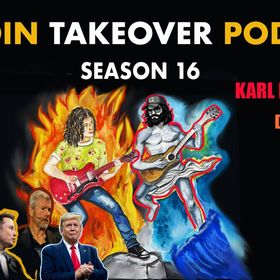
S16 E39: Karl Kreder (Dr. K) on Scaling Proof of Work, Bitcoin & Quai
The audio keeps playing while you browse the site.
Read the transcript52,840 words, every line links to the minute it was said
Ask this episode
Karl Kreder says he is "in it for the ideology" and then tells you he is not in it for the tech, which is odd to hear from a man with a PhD, a stint at ConsenSys, a hardware wallet company behind him (GridPlus, maker of the Lattice1) and an NSF-funded research project called BlockReduce that became the skeleton of Quai Network. "I'm not in it for the tech. I am in it for the ideology," he told me. "To be perfectly frank, I am an ideologue."
I had him on for six hours and seventeen minutes, which makes this one of the longer sessions I have ever recorded. He arrived "excited to have a marathon discussion," and he meant it. Quai launched mainnet in January 2025, and the hashrate went from about 3 terahash on day one to roughly 1.3 to 1.4 terahash when we spoke, so I came with questions about that and a few more about whether a proof of work coin this complicated needs to exist next to Bitcoin at all. The conversation took in GPUs versus ASICs, merge-mined chains that validate each other, a messaging app that expires after three weeks, a wallet demo that went down in public, and a flight next to Vitalik Buterin that Karl says cost him a fortune.
The Quai Network side of the show is easy to describe. The part where Karl tries to convince me that most Bitcoin nodes are decorative took a lot longer.
"The Enemy Is the Government and the Bankers"
Karl's pitch starts with politics, not block times. The first thing he said about what draws him to this space was "the concept of separating money from the state." He thinks the power in money does not come from the issuer: "the power of the money doesn't come from the government, the power of the money comes from the people. It's just we allow ourselves to put value in the money that's issued by the government."
His view of the adversary is blunt. "The enemy is the government and the bankers," he said, and he frames the whole project as "an existential fight about human freedom. And that's why I've spent time on figuring out how to scale proof of work." In his telling, a chain that cannot handle popular applications loses to whatever can: anything that is not built for scale, he said, "given any sort of popular application, will fall down under use."
He also had a line about gold: "What is gold but a Neanderthal version of proof of work?" And he does not think a scaled-up proof of work chain should stop at payments. "If you can be money, then you're a better system for doing derivatives, you're a better system for doing stocks, you're a better system for doing anything that's built upon money."
I was not fully on board, and I said so more than once over the evening. My position was closer to the stance I took with other proof of work builders: why not just use Bitcoin? That group included the Proof of Work Alliance panel with Charles Chong, Summer Meng and Spencer Yang. Karl's answer was that Bitcoin is a settlement layer and the world needs something that behaves like TCP/IP for value, "the perfect manifestation of proof of work, which becomes the TCP/IP value."
Economic Consensus, Social Consensus
The sharpest way Karl split the world was by what actually secures a chain. "It's really economic consensus versus social consensus," he said. In proof of work, you spend energy and the history is expensive to rewrite. In proof of stake, he argued, "for very little cost, you can mutate anything that's in the chain, as far back as you can coordinate a plurality of stakers."
That is a familiar Bitcoin-adjacent argument, and I have heard it from plenty of people, including Vitalik Buterin himself in our conversation about Bitcoin and Ethereum. What Karl added was the anecdote about how he came to hold the view. Years ago he sat next to Vitalik on a flight. By the time the plane landed, Karl had decided not to invest in Ethereum. He told me what he said to his wife when he got home: "I get off the plane and my wife goes, how was your flight? How was the guy? I'm like, it was cool. But that guy's way too autistic to ever succeed."
He is not shy about what that decision cost him. "I would have had 2,000 Bitcoin when it went to market," he said of the number of ETH-equivalent coins he skipped, and he laughed at himself about it. He also described being pushed out of crypto communities for refusing the party line: "you get kind of pushed out of these communities if you don't go along with the heterodoxy." I told him I knew the feeling. At one point I described myself as "that guy who's telling jokes behind the church, you know, like telling jokes about the priest behind the church."
Why GPUs, and Why I Argued With Him
I pushed back hard on the hardware. Quai uses ProgPoW, a GPU-oriented algorithm, and Karl's reasoning is geopolitical as much as technical. "So we see GPUs as a more geostrategically resilient hardware to use as the security mechanism for the network," he said. His example was the way a state can block a shipment of ASICs: "it's much easier for them to limit accessibility to an ASIC by just simply not letting you import it."
I told him GPUs are not exactly decentralized either, since the market is an Nvidia and AMD duopoly. His reply was about incentives: "Nvidia doesn't limit the supply of GPUs or favor the supply to only certain people because they're using them themselves to mine." He also had an engineering reason for avoiding the heaviest memory-hard approaches, saying that some designs make it so it "takes too long to verify a single hash," which hurts a network trying to scale across shards.
Would Quai ever change the algorithm if GPUs got captured? Karl said no, barring catastrophe: "Unless there's sort of like a true existential threat to the system, I don't think we'd be changing the algo." That fits with his broader philosophy for the protocol, which he phrased as "It's not meant to have a roadmap, it's not meant to change."
I do not think the Nvidia and AMD point went away. Anyone who rents hash knows how fast a "decentralized" algorithm can be pulled into a few warehouses, a corner of proof of work I had already gone through with Marko Tarman in S16 E15 on NiceHash and Proof of Work Mining.
Merge Mining on Steroids: How Quai Scales
The design is a hierarchy. A prime chain sits at the top, regions below it, and zones below those. These chains are merge-mined, and the clever part is that they validate each other reciprocally. Karl said it came to him while he was on mushrooms, discussing consensus scaling with a friend. He treats the story as a straightforward origin, not a confession.
The numbers he quoted: the shard limit is 255, and he talked about getting "that sub-penny fee structure to take you north of 50,000 transactions per second." He was clear about the cost. "But it's interactive," he said, meaning that cross-shard movement is not instant. Settlement is fast, but "the trade-off in scaling the system isn't settlement time. It is the time to re-spend money that is sent across shard." That re-spend delay is 40 seconds with four shards and rises to roughly 90 minutes at global scale.
I asked how this compares to unstructured DAGs like Kaspa. Karl was polite about it: "I don't think that they are correct in their approach, and that's perfectly fine." His own take is "not an unstructured DAG, which actually allows for smart contracting." He then asked me a question I could not answer on the spot: "Would Kaspa's consensus be faster if you maximize the graph anti-chain?"
He also gave a speed-of-light caveat that I liked: "If anyone ever tells me that something is happening faster than 400 milliseconds in a distributed system, you should just stop talking to them."
Proof of Entropy Minima and the Workshare Fix
The consensus rule is called Proof of Entropy Minima, or PoEM. Instead of comparing difficulty targets, it weighs the work a block actually achieved. Karl walked me through the math on stream: "every time you begin to mine a block, there's a certain number of possibilities of the outcome. And if you're using a 256-bit hash, the possibilities of the hash outcome are 2 to the 256." A block with a lucky hash has "reduced 63.268495 bits of entropy from the system," and that value "is as unique as a hash," which is how ties get avoided. He added a line I appreciate from an engineer: "we don't have any sort of secondary consensus or math or anything funny."
It also targets selfish mining. His argument is that under workshares, "you can't make more money by withholding blocks or shares unless you have over about 42% of the hash." And it addresses what he called the red balloon problem, the incentive to withhold transactions, because in his model "it's actually more profitable for everybody not to share transactions."
He compared the Bitcoin situation unfavorably. Without shares, he said, an attacker can be "effectively able to reorg six blocks" on some chains, and the fix is simple: "implement workshares and this goes away." Pools that behave badly are harder to handle in Bitcoin "because you can't get them to pay shares."
I asked about block size, since that argument has been done to death in Bitcoin. His answer was that "block size is like 5% of this problem."
"You Could Take Probably 95% of Bitcoin Nodes Offline"
This was the part where he tried to start a fight, and I took the bait. Karl argued that most Bitcoin nodes do nothing for the network. "I would argue you could take probably 95% of Bitcoin nodes offline right now and nobody would notice," he said. The ones he is thinking of he called "leeches in the system," meaning nodes that do not process, index or ingest transactions in any meaningful way.
I defended personal nodes on privacy grounds, which is the standard Bitcoiner answer. If I run my own node, I do not have to leak my addresses to somebody else's server. Karl did not budge much. I have gone through the privacy question with Super Testnet in S16 E6 on Monero vs Lightning Network Privacy, and I still defended running a personal Bitcoin node for privacy.
Karl's privacy design for Quai goes in another direction. Messages and payments travel mixed together, so "everyone can like walk by the message board, nobody knows who's talking to whom we never associate our IP addresses, because it's mixed in not only with all chain traffic, but all the messaging traffic." That is the idea behind Talking, an anonymous messaging app that uses auto-pruned sub-Qi denominations he called Qits. They expire after three weeks.
Two Tokens: Quai and Qi
Quai has two coins. Quai is account-based and EVM-compatible, so smart contracts live there. Qi is UTXO-based and pegged to energy. "Qi we refer to as an energy dollar," Karl said, designed to be "which you're fine spending because it doesn't have increasing future expected value." The point is that Qi is not meant to be a hoard.
Supply is not fixed in the Bitcoin sense. Karl's estimate is "somewhere between 12 and 17 billion" Quai, a range because the issuance depends on activity.
I asked the question I ask everyone with a new coin: how was this launched, and was it fair? Karl challenged the premise. "the concept of fair is like always an interesting one," he said, and later, when I came back to it: "we live in an unfair world." He leaned on the price chart as his answer to the market's mood, which he did not defend as rational: "Because the market is not acting rationally."
Karl also pointed out that the odds against any single miner are tiny and that Quai is designed to be accessible: "one in 80 billion." I was not sure what to do with that number in the moment and said so.
A Wallet Demo That Fell Into the Ether
At the start of the stream Karl wanted to show the 3D visualizer, so we played some techno music through it. I told him it looked like a 1990s strategy game, and he took that in stride. Then came the wallet demo for Blip. It failed live. Karl blamed his VPN: "It was an OPSEC problem on my phone," and when I asked where the money went, he said "Apparently into the ether."
He recovered using the Pelagus desktop wallet, and the second attempt worked. Viewers sent me 8 Quai and 400 Quai through an on-screen QR code, which I can confirm was a nice surprise. Karl also dropped a keyword on air: "workshares" was the secret word for a 20 Quai tip through Kipper.
On the architecture of the wallet, Karl explained that Blip has no backend and currently connects to trusted RPC endpoints. Quai nodes already support NiPoPoWs, which would allow trustless data queries once the client SDK is upgraded. He framed a related piece as "an issuer interface that's just a proxy for the blockchain." The design target for usability is not a crypto native. He said "I kind of use my mom as like the design point for mass adoption."
He also got into who builds this stuff. His list of the people needed was less about cryptographers and more about "an embedded controls person or an electrical engineer." And on the temporary nature of centralized patches, he said one of them "was never supposed to be a permanent fix."
Satoshi's Keys, Hyperinflation and What Comes Next
Late in the evening we drifted onto Satoshi. Karl said "if I were Satoshi, even if I had access to those keys, I would have burned that a long, long time ago. Because I think he wanted to achieve something." That is a bit of speculation about a man nobody has met, and I will leave it as the thought of a guy who has clearly spent time imagining himself in that chair.
We also had a long argument over hyperinflation. Vlad and Karl debated why the post-2020 predictions of runaway dollar collapse did not come true, and neither of us walked away with the other's view.
As for what comes next, Karl's priorities are the ones he kept returning to. He wants workshares in production, because he sees them as the mechanism that lets decentralized pools, selfish mining resistance and the red balloon fix work together. He wants the Blip client upgraded so it can use the NiPoPoW support the nodes already have, replacing the trusted RPC endpoints. He plans to keep building out Talking, the anonymous messaging app on Qits. And he plans to keep GPU mining on ProgPoW, with no algorithm change unless "a true existential threat to the system" shows up. He also said he will stay available: "I'm a perfectly open book."
For liquidity, he pointed to SideShift.ai as one path for swapping into and out of Quai. And he mentioned that proving this out at scale is the whole job: "That's proof of work. Decentralized proof of work at scale."
Karl came back for a second conversation about scaling proof of work in Season 17.
Listen to Dr. K on Spotify, Apple Podcasts, YouTube, and More
Time stamps:
- 00:00:00– Intro & Welcome
- 00:03:00– Discussion Length Challenge
- 00:04:00– Dr. K's Bitcoin Background
- 00:06:00– Wallet Security & Lattice1
- 00:08:00– Scaling PoW Networks
- 00:11:00– PoW vs PoS Debate
- 00:13:00– Fair Launch & Distribution Issues
- 00:15:00– Quai Launch & Hash Rate
- 00:17:00– GPU Mining & ProgPow
- 00:20:00– ASIC Manufacturers
- 00:23:00– NiceHash & AI Integration
- 00:26:00– Quai Network Inspiration
- 00:29:00– Electronic Cash Necessity
- 00:32:00– Quai Scale to Replace Visa
- 00:34:00– Decentralization & No Roadmap
- 00:38:00– LayerTwo Labs Ad & DriveChains
- 00:40:00– Hierarchy for Validation
- 00:42:00– Payment Platforms Limits
- 00:44:00– Scale Beyond Current L1s
- 00:46:00– Monetary History & Gold
- 00:50:00– Self-Custody Challenges
- 00:52:00– Kaspa Differences & DAG
- 00:54:00– Bitcoin Love & Improvements
- 00:56:00– BSV Technical Limits
- 00:58:00– Consensus as Limit
- 01:00:00– Wolfram Physics Project
- 01:02:00– Scale Analogy & Consensus
- 01:04:00– Quai Node Hardware
- 01:06:00– Systemically Important Nodes
- 01:08:00– Bitcoin Privacy Issues
- 01:11:00– CoinJoin & Deniability
- 01:13:00– Good vs Bad Nodes
- 01:15:00– Economic Surplus Incentives
- 01:16:00– Bitcoin.com News Ad
- 01:19:00– Government as Enemy
- 01:21:00– Digital Paths & Freedom
- 01:23:00– Bitcoin as Linux & Tribalism
- 01:25:00– Legit Coins Assessment
- 01:26:00– EVM Compatibility Reasons
- 01:34:00– Why Choose EVM
- 01:35:00– Programming Languages
- 01:37:00– Simplicity Language
- 01:38:00– EVM as Standard
- 01:40:00– Bitcoin Changes Proposal
- 01:42:00– Quai Mainnet Visualization
- 01:45:00– Sharding Coordination
- 01:46:00– PoEM Consensus Mechanism
- 01:49:00– Chain Work & Withholding
- 01:52:00– Work Shares Explained
- 01:54:00– Miner Shard Choice & Balance
- 01:57:00– Privacy in Sharding
- 01:59:00– Settlement Time Trade-Off
- 02:00:00– Ethereum Usage Stats
- 02:03:00– Qi Token & Energy Dollar
- 02:12:00– Quai Deflationary Supply
- 02:16:00– Qi Privacy Properties
- 02:24:00– Node Incentives & Markets
- 02:27:00– Kipper Tipping App
- 02:31:00– Blip Pay Wallet Demo
- 02:40:00– EVM Big Deal
- 02:43:00– Quai Launch Reception
- 02:47:00– Industry Reviews
- 02:49:00– PoW Sampling Theory
- 03:02:00– Kipper Demo
- 03:07:00– Multiplatform Kipper
- 03:12:00– Qi Denominations & Pruning
- 03:14:00– Messaging via Qi
- 03:15:00– PWAs Advantages
- 03:19:00– Neo PoW Explained
- 03:21:00– Data Provider Agnostic
- 03:23:00– Transaction Propagation
- 03:26:00– Global TPS Demand
- 03:28:00– Interchange Integration
- 03:31:00– Direct Crypto POS
- 03:33:00– Node Requirements in Sharding
- 03:35:00– Kaspa Attention Reasons
- 03:38:00– ASIC Future in Quai
- 03:41:00– Trilemma & Tetralemma
- 03:43:00– Hierarchy Trade-Offs
- 03:47:00– Security Notes
- 03:50:00– Resource Markets
- 03:52:00– Quantum Resistance
- 03:57:00– Work Shares Uses
- 04:00:00– Decentralized Pools (Dools)
- 04:02:00– Quai Simplicity
- 04:07:00– Tree Chains Comparison
- 04:09:00– Homogeneous Security
- 04:10:00– Vitalik Story
- 04:18:00– Qi Details
- 04:24:00– Dool Mechanics
- 04:27:00– Work Shares Info
- 04:29:00– 2000 Viewers Milestone
- 04:31:00– Monero Reorgs & Qubic
- 04:34:00– Transaction Censorship
- 04:37:00– Red Balloon Problem
- 04:38:00– Selfish Mining
- 04:42:00– Liquidity Arc
- 04:44:00– Culture Challenge
- 04:46:00– Regional Trends
- 04:48:00– State Bloat vs Consensus
- 04:51:00– Storage Scaling
- 04:54:00– Propagation Time
- 04:56:00– 400ms Lower Bound
- 04:58:00– Interplanetary Transactions
- 05:00:00– Reference Resolution
- 05:05:00– Propagation & Consensus
- 05:07:00– Independent Samples
- 05:08:00– Price Pump
- 05:10:00– Ideology & Tech
- 05:11:00– Bitcoin Scaling Limits
- 05:12:00– Gold as PoW
- 05:14:00– Self-Custody
- 05:17:00– Yield & MSTR
- 05:20:00– Pandemic Inflation
- 05:22:00– Dollar Future
- 05:24:00– Bitcoin Heterodoxy
- 05:25:00– Maximalism
- 05:29:00– Cult Dynamics
- 05:30:00– Mises & Rothbard
- 05:32:00– Roger Ver
- 05:36:00– Saylor Infiltration
- 05:37:00– Memes & Philosophies
- 05:38:00– Leader Emergence
- 05:39:00– CIA Speculation
- 05:40:00– Who is Satoshi?
- 05:41:00– Code Quality
- 05:42:00– Burning Keys
- 05:43:00– Martti Malmi Insights
- 05:44:00– Satoshi Is Not NSA
- 05:45:00– 21m Is Arbitrary
- 05:46:00– Early Changes
- 05:47:00– Block Size Temp
- 05:48:00– Economics Assumptions
- 05:49:00– Satoshi Scaling
- 05:52:00– Tech Optimism
- 05:53:00– Industry Honesty
- 05:56:00– Sharding Complexity
- 05:57:00– PoW Scalability
- 05:58:00– Consensus Efficiency
- 05:59:00– Sharding Compat
- 06:00:00– Memes as Rhetoric
- 06:02:00– Hoskinson Cult
- 06:03:00– Fake Engagement
- 06:04:00– Steam Adoption
- 06:07:00– Overstock & Patrick Byrne
- 06:10:00– Design Philosophy
- 06:11:00– Frustrated Devs
- 06:12:00– Talent Exodus
- 06:14:00– Follow Dr. K
- 06:15:00– Message to Yonatan
- 06:16:00– Quai vs Kaspa
- 06:17:00– Closing Remarks
Verify this episode
This is the SHA-256 fingerprint of the MP3 as published here, timestamped in the Bitcoin blockchain with OpenTimestamps. If one byte of the file changes, the fingerprint changes.
- SHA-256
616dc3dd170ce1d25e5d77ee11f5feed24d99418b5c5ac958522f33278656124- Proof
- 2025-08-18_s16_e39_dr_k_karl_kreder_on_scaling_proof_of_work_bitcoin_quai.mp3.ots · all episode hashes (proof)
- Status
- Anchored in Bitcoin block 974,312
- Timestamped
- After release. The episode came out on 18 Aug 2025, but this proof was made on 3 Nov 2026 and anchored in block 974,312, so it proves this exact file existed by 3 Nov 2026, not on the release date.
How to check it yourself
- Download the MP3 and the proof into the same folder.
- Run
sha256sum 2025-08-18_s16_e39_dr_k_karl_kreder_on_scaling_proof_of_work_bitcoin_quai.mp3(on a Mac:shasum -a 256 2025-08-18_s16_e39_dr_k_karl_kreder_on_scaling_proof_of_work_bitcoin_quai.mp3). The result must match the SHA-256 above. - Install the OpenTimestamps client (
pip install opentimestamps-client) and runots verify 2025-08-18_s16_e39_dr_k_karl_kreder_on_scaling_proof_of_work_bitcoin_quai.mp3.ots. It hashes the MP3 again and checks the proof against your own Bitcoin node, then prints the block and the date the file existed by. Without a node,ots info 2025-08-18_s16_e39_dr_k_karl_kreder_on_scaling_proof_of_work_bitcoin_quai.mp3.otsshows the block height to look up in any block explorer.
Related

S17 E18: Dr. K on Scaling Proof of Work, Soaping the Competition with Quai & Unifying Physics
Dr. K (Karl Kreder), architect of the Quai Network, came back for his second appearance on Bitcoin Takeover to defend his…

S16 E45: Shai Wyborski on Bitcoin, Kaspa & Proof of Work Research
This turned out to become the longest episode in the history of the Bitcoin Takeover podcast… yet: 8 hours and 39 minutes,…

S17 E19: Amaury Séchet on Forking Bitcoin Twice, Quantum FUD & Scars from the Block Size Wars
Two years after our first interview, I decided to invite Amaury Séchet(@deadalnix) to find out what the Greg Maxwell of big…

Comments
Comments run on my own server. No trackers, no tracking cookies.