




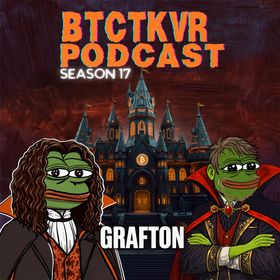
S17 E29: Grafton Clark on Vibe Coding, Privacy & Bitcoin Culture
The audio keeps playing while you browse the site.
Read the transcript21,271 words, every line links to the minute it was said
Ask this episode
Some podcast episodes are about a product, a protocol, or a company. This one is about a feeling: the feeling that the internet used to be a playground, that Bitcoin used to be a social club, and that both of those things might be coming back — just not in the way you expected. I sat down with Grafton Clark, best known in the Bitcoin space for his work at SatoshiLabs (Trezor) and as Head of Growth at Vexl, in the Braiins podcast studio in Prague. His dog couldn’t make it, but his stories certainly did.
Grafton is no stranger to the Bitcoin Takeover universe: he wrote the closing article for the Breaking FUD magazine, a piece about onboarding one of his good friends to Bitcoin through long gaming sessions. The method was simple: play Call of Duty for three hours, and somewhere between calling each other stupid names and killing each other, you start having the deep conversations that actually break the FUD. That experiment happened three or four years ago, and it raised a question that frames much of our conversation: in an age where people ask Grok whether something is true, are we still writing for humans, or for the AI that will summarize us?
Grafton has a refreshingly honest relationship with AI. He remembers being unimpressed at first — ChatGPT couldn’t even handle basic scheduling for his team, and he dismissed it as a magic trick. But something changed. Now he describes a resurgence of the internet, the same feeling he had as a 16-year-old writing HTML and PHP in Notepad. And he’s putting his money where his mouth is: “I don’t want hardware anymore.
I don’t want to buy an iPhone anymore. What I want is someone to sell me the hardware with nothing on it, no OS, and let me see what I can make with it.” He claims he could replace Discord in a weekend — not to scale it to millions of users, but because he cares about his own problem.
If he builds his little community tool on Nostr and ten friends join via their keys, that’s a success. That ethos, he argues, is what Nostr is actually for: a playground of maybe 300 users that feels like the early internet, where you don’t need hosting services or permission to create.
His confidence isn’t theoretical. Frustrated that no app could stream his self-hosted library of live concert recordings to his Apple Watch over cellular while running, he simply built one. In three days, he had a working app in TestFlight. He paid the $99 Apple developer fee, never bothered with the App Store, and now uses it on every run.
“I don’t care if anyone else uses them. I like them, I’m having fun, and it solves a problem for myself.” His setup is a Mac Mini M4 Pro running an OpenClaw instance organized like a private Discord: every project gets its own channels with persistent context, bugs get screenshotted into a channel where the bot opens GitHub issues automatically, and everything is self-hosted.
His advice for people disappointed by LLMs is blunt: stop treating the chat window like an oracle, and ask it to build you the tool instead of doing the repetitive task itself. That’s how he tamed his giant live-music archive: a custom app where he drops an entire year of concerts, and it cleans, tags, and organizes everything beautifully on his server.
Naturally, the professional programmers are not amused, and we get into the vibe coding debate. Grafton’s response is disarmingly cheerful: “Does everyone else think they’re really good at vibe coding? Is it like the same people who think they’re really good at driving?” He doesn’t claim to be a great driver. He just likes to drive — and occasionally floors it on the Autobahn. For the record, he drives a little Škoda, and every time I see a Toyota Supra in Prague, I think of him.
The conversation then turned to the Cake Wallet Zcash giveaway, which became an impromptu history lesson. I explained why Zcash matters: the Zerocash protocol was proposed for Bitcoin in 2014, rejected as not ready due to the trusted setup, and launched as a Bitcoin fork that kept the 21 million supply and even offered auditable transparent addresses alongside shielded ones — design choices that make no sense unless the goal was to prove the tech for Bitcoin’s benefit. Grafton saw the irony immediately: Bitcoiners were told “it’s not ready for Bitcoin yet, let it mature on another chain, and once it’s mature we’ll bring it over.”
That was the whole idea of maximalism. Somewhere along the way, it mutated into a religion where Bitcoin is perfect and nothing may be added. He then trolled me by pulling up a Monero address for the giveaway, which led us into a genuine comparison of the two privacy stacks: Monero’s ring signatures (one-of-16 sender ambiguity) built largely from Blockstream research like Bulletproofs, Dandelion and confidential transactions, versus Zcash’s zero-knowledge approach where the world can only see that a transaction happened — nothing about sender, receiver, or amount.
From there we arrived at the cultural heart of the episode: the HODLing problem. Grafton is fortunate to live somewhere he can spend Bitcoin easily and replace it peer-to-peer without KYC, and he has a hard time taking “Bitcoiners” seriously when they’ve never spent a sat. I put it more violently: if you don’t use Bitcoin as money, it’s a Ponzi — just something you speculate on, hoping to dump your bags on the next wave of buyers.
Grafton took aim at the Michael Saylors of the world who tell you to skip Bitcoin pizza day and buy fiat pizza instead: “What the hell is the point of it? The entire point of Bitcoin pizza day was that it became real. Has Saylor ever walked into our conferences and purchased a coffee with Lightning?” Saylor’s “Bitcoin is Manhattan” quote came up, as did my Roger Ver card: find “digital gold” in the white paper.
(The only mention of gold is about mining; the abstract describes electronic cash for internet commerce.) Grafton wrote in my own magazine about buying a Nintendo Switch with Bitcoin in 2017. Did it become the most expensive Switch ever purchased? Yes. Does he regret it? No — because every time he looks at it, it legitimizes Bitcoin for him. And without people actually buying and selling, there is no market at all.
Then came what I consider the emotional core of the episode: privacy. Grafton resurrected an expression everyone forgets: “dance like no one’s watching.” He dances around his house to music, badly, joyfully — and he wouldn’t if he knew the neighbors were watching with binoculars. The “I have nothing to hide” camp, we agreed, is really a call to compliance: the same person who says it would never hand you their unlocked phone.
Privacy isn’t about hiding wrongdoing; it’s about the freedom to be silly, to create without judgment, to give your dog a voice that no one else will ever hear. In an era that turned the Hawk Tuah girl into a celebrity overnight and normalized total overexposure, “it’s none of your business” has become a radical statement — and maybe we should normalize saying “I have everything to hide.”
We drifted through the generational and cultural landscape: millennials as the lucky cohort that saw the end of the analog world, the rise of digital, and now AI; the craving for vinyl, film cameras, and mechanical imperfections (which is exactly why AI writing gives itself away — it’s too perfect, so people prompt it to misspell); Futurama as bedtime philosophy; Idiocracy as documentary; doomscrolling apps for Wikipedia; and the Super Bowl’s most powerful ad — a tense montage of every other commercial’s demands (“more, more, more”) cutting to a silent girl in a field under the stars, paid for by a Jesus campaign. Grafton isn’t a doomer about AI, but he is worried about voice-cloning scams targeting our parents (a podcast appearance is more than enough training data) and the fact that a billion-record KYC database like IDMerit can sit on the internet with no password at all.
That brought us to one of the most important threads of the episode: KYC doesn’t protect anyone — it kills. Grafton has reached his breaking point with it: it enables far more crime than it prevents, from the French tax-office data that ended up in kidnappers’ hands to the man burned under a bridge in Austria for his bitcoins. Criminals now pass KYC trivially with AI-generated identities; the innocent comply, and it’s their blood that gets shed.
Coinbase insiders take bribes, Binance records get sold, and yet people keep handing over their birthdates because that’s the account they opened in 2017. His alternative is the project he helped build: Vexl, the nonprofit, Tinder-style app for trading Bitcoin face-to-face, with cash, within your network of friends and friends-of-friends — the way peer-to-peer was actually intended. Meanwhile, MiCA is quietly killing European merchant adoption: the Slovak music shop, the Romanian camera and electronics stores where I bought my podcasting gear and laptop for bitcoin — all dropped Bitcoin payments once licensing costs dwarfed the thousand euros a month in BTC revenue. The cypherpunk answer is cash and Bitcoin; the regulator’s answer is a permission slip.
And underneath it all, the thread that ties the episode together: community. Grafton grew up in small-town Mississippi, where church was Wednesday and Sunday, until Hurricane Katrina decimated his hometown in 2005 and scattered its people. He knows what it looks like when a community dies — and what it looks like when one forms, whether that’s kids building forts in the woods with machetes (they called it Terabithia), deadheads selling grilled cheese out of car trunks to make gas money to the next show, or Bitcoiners at meetups trading guanciale for sats.
His answer to “does Bitcoin fix this?” is a qualified yes — if you stop holding in your basement waiting to be rich. Go to meetups. Earn it, spend it, tip with it. The most enriching things he’s done in Bitcoin are the friendships — people like Obi Nwosu (Kenobi), whom he met at events and now talks to every single day. His mentor Juraj Bednar taught him the value-for-value approach: don’t lecture the plumber about Bitcoin; just thank him with a tip in sats.
And if your friends don’t care? “Live your best life. I bought coffee today with Bitcoin. I tip in Bitcoin. I enjoy it. Looks fun, right?” Bitcoin, after all, is the revenge of the nerds — the kids who were mocked for learning something dorky are now doing better than the quarterbacks. Just maybe leave the cowboy boots at home if you live in Prague — or take the opposite lesson from Pablo at Bull Bitcoin, who discovered that wearing cowboy boots through US immigration gets you waved through every time.
Grafton’s parting message: be curious, play with the tools, argue about things (that’s healthy), but don’t forget to be a human and talk to real humans. Privacy is the major concern of the AI era — people confess things to chatbots they’d never type into Google, because it feels like no one is watching. Someone always is. Protect your parents with a family passphrase, protect yourself by caring about these tools before you need them, and go spend some Bitcoin at your local farmers market.
This episode is sponsored by Cake Wallet (now with Zcash, Lightning, swaps & gift cards), Bitcoin.com News, LayerTwo Labs (try drivechains on signet this weekend), and Sideshift.ai (get paid in stablecoins, receive Bitcoin). Special thanks to Braiins for letting us use their studio in Prague!
Find Grafton as “satsdisco” on Twitter and Nostr, and check out his open-source experiments at satsdisco.com.
Listen to Grafton Clark on YouTube, Spotify, Apple Podcasts & more!
Time stamps:
- 00:01:36– Intro: Grafton Clark on freedom of transactions & cash
- 00:02:45– Breaking FUD: onboarding a friend through gaming & Call of Duty
- 00:04:13– Are we writing for humans or for AI to summarize?
- 00:06:40– The internet’s resurgence & discovering Nostr (300 users?)
- 00:08:42– Digital ID & age verification fears
- 00:09:03– The “Cool For Free” network: Grafton’s teenage free-iPod hustle
- 00:10:30– Cake Wallet Zcash giveaway setup
- 00:11:14– “I don’t want hardware anymore”: build your own tools
- 00:13:04– Building an Apple Watch live-music app in 3 days
- 00:14:28– Roadstr, meshtastic mesh networks & freedom tech with Juraj Bednar
- 00:17:27– The vibe coding debate: “I just like to drive”
- 00:18:45– Grafton’s Škoda, Supras & the 100,000 likes challenge
- 00:21:18– Grafton’s setup: Mac Mini M4 Pro, OpenClaw & self-hosting
- 00:24:25– Taming a giant live-music library with AI tools
- 00:26:35– Learning vs. regurgitating: AI, education & making your own opinion
- 00:27:38– Bitcoiners love to argue: Knots vs. Core over dinner
- 00:29:28– Why a Zcash giveaway? The Zerocash-on-Bitcoin history explained
- 00:31:03– “That was the whole idea of maximalism”
- 00:31:48– The Monero address troll
- 00:33:20– Sending 1 Zcash via Cake Wallet
- 00:34:22– No CEO, no HR: why Satoshi disappearing legitimizes Bitcoin
- 00:36:08– Zcash vs. Monero: comparing the privacy tech
- 00:37:46– The culture problem: HODLing vs. spending
- 00:41:03– Hot take: “If you don’t use Bitcoin as money, it’s a Ponzi”
- 00:41:47– Michael Saylor, pizza day & the Manhattan quote
- 00:42:57– Pokemon cards & what makes a “real” Bitcoiner
- 00:44:21– Buying a Nintendo Switch with Bitcoin: no regrets
- 00:45:35– “Find digital gold in the white paper”
- 00:47:36– Satoshi never envisioned KYC
- 00:49:14– Privacy means “dance like no one’s watching”
- 00:52:08– The Hawk Tuah girl & normalizing overexposure
- 00:55:25– Brands as verbs: Google, Venmo & Gen Z’s “ask chat”
- 00:58:05– Millennials, analog cravings & LLM imperfections
- 01:00:01– Futurama, robot delivery bots & moving to a farm
- 01:02:09– Impostor syndrome & the meaning of work
- 01:03:46– UBI, Idiocracy & the doomscrolling generation
- 01:05:31– The Super Bowl’s most powerful ad
- 01:07:35– Is today’s propaganda any different from the old monoculture?
- 01:08:44– AI voice-cloning scams & protecting your parents
- 01:11:24– IDMerit’s billion-record leak & living life in public
- 01:13:08– Building forts in the woods, kids’ dreams & role models today
- 01:18:26– Building an empire from the bedroom: EA & the N64
- 01:19:47– Grafton’s mom, the video game champion
- 01:22:18– Community, church & Hurricane Katrina
- 01:25:58– Work from home vs. real socialization
- 01:27:46– “Is this still a Bitcoin podcast?” Does Bitcoin fix community?
- 01:31:01– Spend it, earn it: value for value & Juraj Bednar’s lesson
- 01:34:31– Why onboarding friends so often fails (& Dentacoin)
- 01:38:08– Bitcoin is the revenge of the nerds
- 01:40:16– Mississippi roots, high school reunions & cowboy boots in Europe
- 01:46:04– Sponsor: Bitcoin.com News
- 01:47:26– Sponsor: LayerTwo Labs & drivechains on signet
- 01:48:17– Sponsor: SideShift.ai for stablecoin payments
- 01:49:33– Vexl: peer-to-peer, face-to-face Bitcoin trading as intended
- 01:51:37– KYC kills: kidnappings & “kill your customer”
- 01:54:35– Coinbase & Binance KYC leaks
- 01:55:19– Why Saylor doesn’t represent every Bitcoiner
- 01:57:02– Why base-layer privacy ends the Knots debate
- 01:58:05– AI eating Bitcoin mining & US hash rate concentration
- 01:59:50– The tools exist: buying Bitcoin without KYC has never been easier
- 02:02:27– MiCA is killing European Bitcoin merchant adoption
- 02:06:33– Grandpa’s secret $20 bill & why cash matters
- 02:08:07– Switzerland, Alexis Roussel & the constitutional right to a human
- 02:11:05– Privacy as the major concern of the AI era
- 02:12:18– Where to find Grafton: satsdisco.com & open-source projects
Verify this episode
This is the SHA-256 fingerprint of the MP3 as published here, timestamped in the Bitcoin blockchain with OpenTimestamps. If one byte of the file changes, the fingerprint changes.
- SHA-256
9c8a2edf0dc44dadf572d4262d7bd4eece33a3a6ff296ce9ffff64444aec9404- Proof
- 2026-06-20_s17_e29_grafton_clark_on_vibe_coding_privacy_bitcoin_culture.mp3.ots · all episode hashes (proof)
- Status
- Anchored in Bitcoin block 974,312
How to check it yourself
- Download the MP3 and the proof into the same folder.
- Run
sha256sum 2026-06-20_s17_e29_grafton_clark_on_vibe_coding_privacy_bitcoin_culture.mp3(on a Mac:shasum -a 256 2026-06-20_s17_e29_grafton_clark_on_vibe_coding_privacy_bitcoin_culture.mp3). The result must match the SHA-256 above. - Install the OpenTimestamps client (
pip install opentimestamps-client) and runots verify 2026-06-20_s17_e29_grafton_clark_on_vibe_coding_privacy_bitcoin_culture.mp3.ots. It hashes the MP3 again and checks the proof against your own Bitcoin node, then prints the block and the date the file existed by. Without a node,ots info 2026-06-20_s17_e29_grafton_clark_on_vibe_coding_privacy_bitcoin_culture.mp3.otsshows the block height to look up in any block explorer.
Related
S17 E18: Dr. K on Scaling Proof of Work, Soaping the Competition with Quai & Unifying Physics
Dr. K (Karl Kreder), architect of the Quai Network, came back for his second appearance on Bitcoin Takeover to defend his…
S17 E24: Zach Herbert on Passport Prime, KeyOS & the End of Air-Gapped
Some interviews you plan for weeks. This one I planned around a box. Two weeks after Zach Herbert handed me a Passport…
S17 E25: Milan De Reede on Nano GPT, AI & Vibe Coding
There is something poetic about recording an episode at the Bitcoin Conference in Las Vegas, the edition where the mining stage…

Comments
Comments run on my own server. No trackers, no tracking cookies.