




S17 E32: Perry E. Metzger on Bitcoin in 2008, Cypherpunk Culture & AI Optimism

The audio keeps playing while you browse the site.
Read the transcript16,858 words, every line links to the minute it was said
Ask this episode
Perry E. Metzger is the man who ran the cryptography mailing list where the Bitcoin whitepaper was first announced, and also the man who shut down the first ever online discussion about Bitcoin. Both of those things are true, and he owns them: as he told me during S17 E32 of the Bitcoin Takeover Podcast, when he shows up at certain conferences, people still come up to him and say “you’re the guy who killed the first Bitcoin thread”, and the answer is yes.
But the Metzdowd mailing list is far from being Perry Metzger’s most notable contribution to cypherpunk culture. Perry has been on the internet since 1983, right after the TCP transition, back when his university’s machine room had a single sheet of paper with a map of every computer on the network.
He wrote the documentation for PGP 2.0 while Hal Finney wrote much of the code and Phil Zimmermann took most of the legal flak. He runs metzdowd.com to this day. He co-authored a graphic novel about computer architecture for middle schoolers. And these days he spends most of his time as chairman of the Alliance for the Future, a 501(c)(4) that lobbies in Washington against the people who believe AI is going to kill everybody.
We started at the beginning, which is much earlier than 2008. Perry found cryptography as a young teenager by wandering through his local library and pulling David Kahn’s The Codebreakers off a shelf — the same book, he later found out, that had hooked Whitfield Diffie. Decades later he met Kahn in person and asked him whether he’d had any idea what his little history book was going to do to the world. He hadn’t. The other document Perry credits as the ancestor of everything we now call cypherpunk is Chuck Hammill’s From Crossbows to Cryptography, a talk that turned into a paper and got passed around by his friend Russell Whitaker in the early 90s.
Hammill’s thesis was that cryptography is the crossbow of the modern era: the crossbow ended the age of the knight because a peasant could learn to use one in an afternoon, and cryptography does the same thing to anyone who wants to violate your privacy. Perry never met Hammill, who has been dead for years, and doesn’t know what else he did. As he put it, you never have any idea which of the things you do will have lasting impact on the world.
The cryptography mailing list itself exists because the Cypherpunks list got too loud. Perry wanted a moderated place where people could discuss protocols instead of endlessly arguing, so every post had to be approved, and he was heavy-handed about keeping politics out.
Which is exactly what happened on November 7th, 2008, when he wrote the line I read back to him on air: “I’m a rabid libertarian myself, but this isn’t the rabid libertarian mailing list.” Ten days later he called an end to the bitcoin discussion altogether, on the grounds that people should go write papers instead of rehashing the same arguments. He does not remember the exact posts. He does remember that he shut it down because it was spinning.
The honest part of the conversation is that he didn’t think Bitcoin was special at the time. His words: there wasn’t any particular reason to believe this was going to be a more successful proposal than the previous thirty or fifty. He also said, several times and without hedging, that he had been completely wrong about the most fundamental thing: until 2008 he did not believe a decentralized fiat currency, decoupled from every existing fiat currency, was even possible.
He thought you needed a state, a central bank and a monopoly on force to make one work. What he now considers the real contribution is not the money at all, but the first workable solution to Byzantine agreement over a ledger with no central trust.
We disagreed about why 2008 was the moment. My argument is the financial crisis and the Chancellor headline in the genesis block. His is that people had been discussing denationalized money and privacy-preserving payments in these exact circles for fifteen years and longer: Hayek, Chaum’s blind signatures, solvency proofs for financial institutions, hashcash, bit gold. So the political appetite was old news. What was new, in his view, was that everyone suddenly had a computer in their pocket. He remembers wearing a pager at Lehman Brothers and having to run and find a payphone when something broke. Mobile internet, not the bailouts, is his answer.
He also remains a proof of work skeptic, and for a reason I hadn’t heard framed that way before. His background is financial services, and he sees the history of money over the last few centuries as one long plunge in transaction costs: from the elaborate machinery required to pay a foreign supplier in the 19th century, to the corner stores of his childhood that still kept house ledgers of who owed what, to credit cards, whose actual revolution was letting you pay an intermediary to make the credit risk of dealing with strangers disappear.
Proof of work, he argues, adds a floor of cost to transactions that can never be removed from the system, which is why he finds proof of stake more interesting. I pushed back with drivechains: merged-mined sidechains for everything, where the marginal cost to a miner is running a node. He conceded the stack will eventually do whatever we want it to, while pointing out that nobody has yet built anything that handles Visa’s Christmas rush at Visa’s prices. He also remembers buying sandwiches in New York with on-chain bitcoin, and notes that this doesn’t happen anymore.
On quantum, he’s more dismissive than anyone else I’ve had on the show recently. The current world record for cleanly factoring a number on a quantum computer is 21, which any schoolchild can tell you is three times seven, and we need to get from five-bit numbers to something like 4000 bits before anyone should panic.
What does worry him is governance: if Bitcoin ever genuinely needed to change its signature scheme, the process would be, in his words, mostly bloodshed and screaming and people shaking their fists at each other. He worked on Tezos years ago purely because of its on-chain voting mechanism, and he was blunt that the project has “failed to thrive” while insisting the idea was good. He also thinks SegWit was a minor technical change that should never have produced a war.
The best segment for the historians is the walk through the actual November 2008 replies. James A. Donald said it wouldn’t scale. Ray Dillinger said there was no demand for bitcoins and that new currencies take decades to catch on. Perry’s verdict on both: completely correct, and completely irrelevant. John R. Levine, who Perry knows better as the guy who ran a mailing list for compiler authors, worried about bad actors bringing hash power.
Nico Williams suggested identity for participants, which Perry immediately recognized as a callback to earlier ecash designs where your anonymity holds if and only if you don’t double spend, and where the act of double spending reveals enough information to identify you. He called it a neat primitive. He also confessed he has never read most of the Bitcoin codebase, because he hates C++.
Then there’s the part about the logs. There are none. The cryptography list has a deliberate policy of automatically disposing of that information, so there are no IP addresses, no headers, nothing that would help anyone unmask Satoshi. Perry has had a succession of reporters and book authors come after him for it, and he considers the whole hunt a stupid thing to be doing, since whoever Satoshi is obviously wanted their privacy.
His favourite story from that period is the one about the reporter whose intentions were obvious the moment they called: Perry deliberately tortured them with hours of irrelevant and boring topics before mentioning, at the very end, that all the logs had been automatically deleted years ago. They excused themselves very quickly.
He felt good about it, because he’d kept them from bothering anybody else for an entire afternoon. As for how you’d know the real one came back: they would be in possession of certain public keys. If Craig Wright had ever had one of those, nobody would have questioned him.
The last third is AI, which is where he actually spends his time now. He runs mostly frontier models rather than local ones, lives in the command line with Codex CLI, and is currently building his own programming language for one purpose only: making formal verification easy. His thesis is that we’ve been in a continuous computer security crisis since the Morris Worm in 1988, and that now that programmer time has collapsed in price, mathematically proving software correct might finally be affordable. He mentioned in passing that a formally verified Bitcoin implementation would be a very neat project, and that a conversation about doing exactly that went nowhere years ago.
His advocacy work is aimed at the doomer camp, and there’s a personal edge to it: he ran the Extropians mailing list, he has known Eliezer Yudkowsky since he was a teenager, and he now finds shitposts he wrote decades ago for amusement coming back at him as serious arguments for why AI will end the world. That’s the second time in one interview he made the same point about loose talk… you never know which throwaway thing you said will still be shaping the world twenty years later. He also mentioned that Robin Hanson’s first article on idea futures, the ancestor of every prediction market we have today, was originally discussed on that same list.
Small artifacts from the rest of the conversation: his first computer was a PDP-8 at his high school with four kilowords of memory and an ASR-33 teletype, a machine he estimates would have cost $80,000 in today’s money; he bought himself an original IBM PC with money saved from odd jobs; he played with Bitcoin for about five minutes early on and walked away because there was nothing to do with it, and nobody ever sent him a coin; and the book he keeps plugging is Science Comics: Computers – How Digital Hardware Works, published by Macmillan, which he insists is excellent for erosion control in your backyard or for stabilising a table with a short leg, and which arrived at the publisher roughly ten years late.
This episode is sponsored by Sideshift.ai, Cake Wallet, Orange Rock, LayerTwo Labs, and Braiins Hashpower. Special thanks to all the sponsors for making this freely available to everyone on the internet!
Listen to Perry E. Metzger on YouTube, Spotify, Apple Podcasts & more!
Time stamps:
- 00:01:38Intro & sponsors: the man who ran the list where Bitcoin was announced
- 00:02:20Alliance for the Future & why it’s a 501(c)(4)
- 00:02:48Naomi Brockwell, the Ludlow Institute & the erosion of privacy
- 00:04:17On the internet since 1983: the TCP transition
- 00:05:20When a map of every computer online fit on one sheet of paper
- 00:06:22Two PhD dropouts compare notes
- 00:07:04Why the cryptography list split off from Cypherpunks
- 00:08:36Finding David Kahn’s The Codebreakers in the library
- 00:09:40Chuck Hammill & From Crossbows to Cryptography
- 00:11:20Cryptography as the great equalizer
- 00:12:19Tim May, the Silicon Valley meetups & becoming an internet crank
- 00:13:41David Chaum, blind signatures & proving solvency
- 00:14:55The crypto wars, PGP & European chat control
- 00:16:25Writing the PGP 2.0 documentation while Hal wrote the code
- 00:17:12Zimmermann’s dead pixels metaphor & the same speech every time
- 00:18:00“A stupid idea”: web of trust cross-signatures
- 00:19:48Why the cryptography list was moderated from day one
- 00:21:00When everything on the internet went over the wire in the clear
- 00:22:01In one sense, the cypherpunks won: most traffic is encrypted
- 00:23:08Clipper chip, and disagreeing about CPU backdoors
- 00:24:12Hayek, the denationalization of money & a 15-year conversation
- 00:25:20Satoshi posts to the mailing list
- 00:26:25Genesis block politics vs. the technical merits
- 00:27:33“I didn’t believe a decentralized fiat currency was possible”
- 00:28:38What actually stabilizes a currency: networks of obligations
- 00:30:33Why he still thinks proof of work is the wrong design
- 00:31:17The centuries-long plunge in transaction costs
- 00:32:28House accounts, credit cards & outsourcing credit risk
- 00:33:39The cost floor PoW can’t remove & the case for proof of stake
- 00:34:00The real breakthrough: Byzantine agreement with no central trust
- 00:35:00Smartphones, not the bailouts, made 2008 the right moment
- 00:36:10Pagers, payphones & working at Lehman Brothers
- 00:37:38Sponsors: SideShift, Braiins, LayerTwo Labs, Cake Wallet, Orange Rock
- 00:41:10Can sidechains ever handle the Visa Christmas rush?
- 00:42:57Buying a sandwich in New York with on-chain bitcoin
- 00:43:42Zero-knowledge proofs would have looked like magic 30 years ago
- 00:44:44Quantum skepticism: the world record is factoring 21
- 00:45:59How would Bitcoin ever change its signature scheme?
- 00:46:47Tezos, on-chain voting & “it has failed to thrive”
- 00:47:16SegWit should never have caused a war
- 00:49:41Tim May on why Bitcoin caught on, and why SET was boring
- 00:52:21James A. Donald: “it doesn’t scale” — correct and irrelevant
- 00:54:53Ray Dillinger: there is no demand for bitcoins
- 00:56:38Hash puzzles protect the agreement, they don’t create value
- 00:58:43John R. Levine, Sybil attacks & hash power concentration
- 00:59:49Nico Williams & the ecash trick where double spending unmasks you
- 01:01:09Ray Dillinger and Hal Finney auditing the original code
- 01:01:33“I’ve never read the Bitcoin code because I hate C++”
- 01:02:26Cake Wallet giveaway: pick a number from 1 to 100
- 01:04:17Formal verification, the Morris Worm & the security crisis since 1988
- 01:06:16The November 7th 2008 edict, read back to him
- 01:07:46Zooko advertises his own list & blogs about Bitcoin first
- 01:09:16The mailing list keeps no logs, on purpose
- 01:10:00Torturing a reporter for several hours before telling him
- 01:11:36How you’d recognize the real Satoshi, and why Craig Wright wasn’t
- 01:12:32Science Comics: Computers & a manuscript ten years late
- 01:15:35The Bitcoin Year One comic book
- 01:17:20Metzger, Dowdeswell & Company: where metzdowd comes from
- 01:18:57Why the mailing list is still online after 30 years
- 01:21:33The I Love You virus t-shirt
- 01:24:19Running local models & what the hardware actually costs
- 01:26:11Whisper, YouTube transcripts & the diarization problem
- 01:29:23Why he founded an AI advocacy organization
- 01:30:07Where the anti-AI and anti-data-center money comes from
- 01:31:14Ralph Merkle, Khufu & Khafre & knowing when to move on
- 01:34:45The PDP-8, the ASR-33 teletype & four kilowords of memory
- 01:36:29Saving up for an original IBM PC
- 01:38:14Five minutes with Bitcoin, then walking away
- 01:40:32Coming back because clients started asking questions
- 01:42:14Nobody ever sent him a coin
- 01:43:44His current stack: Codex CLI, GPT-5.x & the command line
- 01:46:38Zooko, Tahoe-LAFS & underappreciated projects
- 01:48:03Arguing with the doomers in Washington
- 01:50:19The Extropians list, Robin Hanson & idea futures
- 01:52:06The number reveal & where to follow Perry
Verify this episode
This is the SHA-256 fingerprint of the MP3 as published here, timestamped in the Bitcoin blockchain with OpenTimestamps. If one byte of the file changes, the fingerprint changes.
- SHA-256
2c74d856294ceeb6281e2307d476d38f4349351a0f5d63af29d71b0a846267d6- Proof
- 2026-07-22_s17_e32_perry_e_metzger_on_bitcoin_in_2008_cypherpunk_culture_ai_optimism.mp3.ots · all episode hashes (proof)
- Status
- Anchored in Bitcoin block 974,312
How to check it yourself
- Download the MP3 and the proof into the same folder.
- Run
sha256sum 2026-07-22_s17_e32_perry_e_metzger_on_bitcoin_in_2008_cypherpunk_culture_ai_optimism.mp3(on a Mac:shasum -a 256 2026-07-22_s17_e32_perry_e_metzger_on_bitcoin_in_2008_cypherpunk_culture_ai_optimism.mp3). The result must match the SHA-256 above. - Install the OpenTimestamps client (
pip install opentimestamps-client) and runots verify 2026-07-22_s17_e32_perry_e_metzger_on_bitcoin_in_2008_cypherpunk_culture_ai_optimism.mp3.ots. It hashes the MP3 again and checks the proof against your own Bitcoin node, then prints the block and the date the file existed by. Without a node,ots info 2026-07-22_s17_e32_perry_e_metzger_on_bitcoin_in_2008_cypherpunk_culture_ai_optimism.mp3.otsshows the block height to look up in any block explorer.
Related

S15 E19: Alexei Zamyatin on Build on Bitcoin & Layer 2s
Alexei Zamyatin is a (recovering) academic cryptographer who co-founded the Build on Bitcoin project – an initiative which…
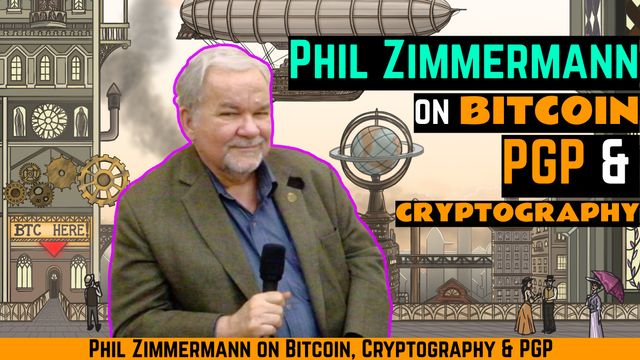
S14 E15: Phil Zimmermann on Bitcoin, Cryptography & PGP
Without Phil Zimmermann, Bitcoin couldn’t get invented. I know that this is a bold statement, but there are two main ways in…

Bitcoin Public Key, Receiving Address, UTXO: What’s the Difference?
Public keys, receiving addresses, and UTXOs are three concepts with which even some of the most seasoned bitcoiners sometimes…

Comments
Comments run on my own server. No trackers, no tracking cookies.