




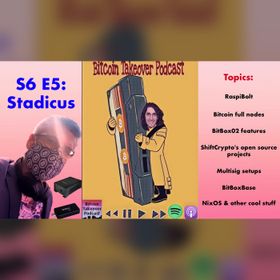
Stadicus on Full Nodes, the BitBox02 and Multisig Setups (S6 E5 Full Article)
The audio keeps playing while you browse the site.
Read the transcript13,963 words, every line links to the minute it was said
Ask this episode
Before plug-and-play nodes were everywhere, a lot of us learned to run Bitcoin from one guide: the RaspiBolt. Its author, Stadicus, describes himself in a way I've always liked. "I would call myself a Bitcoin minimalist, but a full node maximalist."
When we recorded in September 2020, he was in charge of products at Shift Crypto, the Swiss company behind the BitBox02. The original show notes summarize our talk. This article covers the main points, from his node philosophy to the multisig mistakes that can cost you everything.
Don't Rely on Third Parties
His motivation was simple. "I want to not rely on third parties to tell me what happens on the blockchain. Running my own node was pretty obvious to me." So he set up Bitcoin Core, documented each step, and the RaspiBolt became "a pretty good, well-documented setup" with Lightning and an Electrum server.
He was modest about it. "I wouldn't really call it an implementation. It's just like writing a guide and stringing together really great products that I have not really built." But it taught people "how to not be afraid of the Linux command line, how to do everything yourself."
The method is the point. "You don't rely on any scripts. You don't rely on any user interface. You configure everything yourself." At the same time, "I cheer for every full node that is more plug and play, the more the better."
One thing that set his guide apart: "for me the full node, the Bitcoin full node, was always at least as important as the Lightning client." He wanted to verify his own transactions, even with a hardware wallet.
What Happened to the BitBoxBase
At Shift Crypto, he designed the BitBoxBase, a full node built on the RockPro64 because the Raspberry Pi 3 wasn't powerful enough. It shipped to beta testers, "with a glass top, with a screen," and an adapted BitBox02 inside.
So why was it paused? "Maybe we took on too much at the time. Hardware is also pretty expensive to develop." And "the market that is going to buy a product like that is still super niche." The team chose focus and put the Base on hold to concentrate on the BitBox02. I respect that kind of honesty from a startup.
He was also excited about another project: "nix-bitcoin," which "aligns the most with my own like convictions" because it puts "everything security related first, on-chain first."
Open Source, Reproducible Builds and Secure Chips
Shift Crypto describes itself as "a Swiss open source hardware security company." Stadicus made a point many people miss. "You can open source everything you want, but if you then release binaries that are not reproducible, nobody can tell for sure that these are actually built from this source."
On secure chips, he described the BitBox02 design. "If I lay my hardware wallet, the BitBox02, around somehow, and somebody would steal it, I wouldn't want him to be able to access my private keys." So the device uses a secure chip, but "the secure chip never learns any secrets." Even if it were malicious, "the absolute worst case would be that we just fall back to the regular open source security model."
He also praised the competition. "A monopoly is never healthy. It makes you fat and self-confident." He mentioned Trezor being "awesome in taking disclosures." His colleague Marco had just disclosed a Trezor vulnerability the day before we recorded.
Simplicity Is Security
This was my favorite idea from the episode. "I often say that simplicity is also part of security." He prefers hardware wallets to elaborate setups like taking Wi-Fi cards out of laptops. "You should always try to make sure that if you get hit by a bus tomorrow, your heirs are still able to retrieve the funds."
He remembered his first Ledger. "I had no clue what these 24 words were." It took him "at least half an hour to just write down these words. And that was a very, very scary moment for me." He doesn't want newcomers to start out that scared, which is why the BitBox02 also supports microSD backups. "The SD card is like the same as a paper backup," and you should have more than one.
Free Speech Money Needs Your Own Node
Most new users, he said, don't realize "that they're not really participating directly in the Bitcoin network." Their wallet asks someone else. "And this is not, I think, what Bitcoin is all about." For him, "it's really free speech money."
That's what "Don't trust, verify" means in practice, and privacy is part of it. A wallet that asks a third party reveals "all my addresses, all my account balances."
At the time, a very popular Bitcoin podcaster was telling people it was fine not to run a node, and I called that attitude "defeatist." I was even thinking about making "a five-minute guide on how to download Bitcoin Core." Stadicus was more generous. "I get what Peter is saying, and to some extent he's right. It's still probably too hard to run a full node." Especially "with a hardware wallet. But it's definitely doable." He liked the idea of a short guide, which "is really something that a lot of people would follow."
Still, he's realistic. "I doubt everybody will ever run a Bitcoin full node at home." His alternative is nice. "I'm the tech guy, obviously, in my extended family, and I would happily run a Bitcoin full node for all of them." Share a QR code or a link, and "they can just connect to your node."
Bitcoin as the Linux of Money
I asked whether Bitcoin was falling behind. His answer is one I still think about. "What if Bitcoin is just the Linux of operating systems? It's the best, it's the most stable, most secure, the whole internet runs on it, but users just run Windows." Linux "runs most of mobile phones without people actually knowing it," and he'd be okay with that, as long as you can still be "a self-sovereign participant."
He thinks Lightning "screams to be run on mobile phones," backed by a full node and maybe a watchtower. He liked Jack Mallers' Strike, which let you "pay in Lightning, but without having Lightning," and he saw the RaspiBolt's future as "an educational project" and a backend appliance.
The Multisig Traps
The most important part for anyone doing multisig came near the end. Imagine a 2-of-3 Electrum setup with three hardware wallets and three seed backups. "You lose one hardware wallet. You still have the backup, but you lose a hardware wallet. Your funds are gone forever." Those seed words alone aren't enough. You also need the setup information for the other cosigners, which is why "the backup itself is already heavily underestimated."
Receiving is risky too. Malware can show you an address the attacker controls, and "it's almost impossible to verify this address" on most hardware wallets. "This issue is only addressable if the hardware wallet itself knows who the cosigners are." The BitBox02 stores that cosigner information, so even if a multisig coordinator wallet were compromised, "you would be able to detect that."
I mentioned seeing someone on Twitter do "a 16 out of 16 multisig. And that's kind of crazy." Stadicus's whole philosophy is the opposite: make it simple enough that you and your heirs can't get it wrong.
What Makes This Episode Worth Listening To
Stadicus is someone who builds things for others and then explains exactly how they work. If you run a node or plan to set up multisig, listen to the last half hour.
You can find him at stadicus.com, where he publishes his PGP keys. You can also read the full transcript, the original show notes, or visit Stadicus's guest page.
Listen to Stadicus on Spotify, Apple Podcasts, and More
Time stamps:
- 00:02:13– Bitcoin minimalist, full node maximalist
- 00:04:46– Stringing together great products
- 00:05:30– Do everything yourself
- 00:07:41– Full node first
- 00:10:21– Building the BitBoxBase
- 00:14:04– Too much at the time
- 00:21:08– nix-bitcoin
- 00:27:38– Reproducible builds
- 00:28:58– The secure chip never learns secrets
- 00:32:44– Simplicity is security
- 00:38:18– Free speech money
- 00:40:10– Don't trust, verify
- 00:42:14– Is running a node too hard?
- 00:44:27– Too hard, but doable
- 00:46:24– Running a node for your family
- 00:54:38– Bitcoin as the Linux of money
- 00:58:48– Strike and Lightning on mobile
- 01:08:04– A monopoly is never healthy
- 01:17:01– His first Ledger
- 01:18:59– SD card backups
- 01:24:12– The multisig backup trap
- 01:27:25– Verifying cosigners
- 01:34:04– RaspiBolt as an educational project
Verify this episode
This is the SHA-256 fingerprint of the MP3 as published here, timestamped in the Bitcoin blockchain with OpenTimestamps. If one byte of the file changes, the fingerprint changes.
- SHA-256
a91aa0d83a0103f491835844ca5a26f5560abe1fff3e196387ef9bde53d2f1c2- Proof
- 2020-09-03_stadicus_on_full_nodes__bitbox02__multisig__more.mp3.ots · all episode hashes (proof)
- Status
- Anchored in Bitcoin block 974,312
- Timestamped
- After release. The episode came out on 3 Sept 2020, but this proof was made on 3 Nov 2026 and anchored in block 974,312, so it proves this exact file existed by 3 Nov 2026, not on the release date.
How to check it yourself
- Download the MP3 and the proof into the same folder.
- Run
sha256sum 2020-09-03_stadicus_on_full_nodes__bitbox02__multisig__more.mp3(on a Mac:shasum -a 256 2020-09-03_stadicus_on_full_nodes__bitbox02__multisig__more.mp3). The result must match the SHA-256 above. - Install the OpenTimestamps client (
pip install opentimestamps-client) and runots verify 2020-09-03_stadicus_on_full_nodes__bitbox02__multisig__more.mp3.ots. It hashes the MP3 again and checks the proof against your own Bitcoin node, then prints the block and the date the file existed by. Without a node,ots info 2020-09-03_stadicus_on_full_nodes__bitbox02__multisig__more.mp3.otsshows the block height to look up in any block explorer.
Related
S6 E5: Stadicus on Full Bitcoin Nodes, BitBox02 & Multisig Setups
Stadicus is a god of Bitcoin full nodes. In this episode he talks about RaspiBolt. sovereignty, & his work at ShiftCrypto.
S8 E1: Benma on BitBox02
Benma is one of the people who get very little praise for their work, but do something that makes everybody’s bitcoins more…

S4 E2: ShiftCrypto’s Douglas Bakkum & Jonas Schnelli on the BitBox02 Hardware Wallet
Douglas Bakkum & Jonas Schnelli talk about the BitBox02 hardware wallet and their mission at ShiftCrypto.

Comments
Comments run on my own server. No trackers, no tracking cookies.