




Jonas Nick, Peter Todd and Alekos Filini on Bitcoin Development (S6 E9 Full Article)
The audio keeps playing while you browse the site.
Read the transcript9,976 words, every line links to the minute it was said
Ask this episode
This episode was supposed to be a simple interview with Jonas Nick at the 2020 Hackers Congress in Prague. I couldn't travel, so I joined remotely, and Max Hillebrand hosted on site. Halfway through, Max spotted Peter Todd and Alekos Filini and pulled them onto the panel. "Oh, there's Peter Todd. Oh my god."
The result was one of the most technical conversations I've recorded, and one of the most fun. The original show notes have the summary. Here's what each of them said.
Everyone Can Be a Wizard
Max introduced Jonas as a "Blockstream cryptographer and wizard of Bitcoin, even though he doesn't have a long beard." Jonas wasn't comfortable with the wizard label. Blockstream had "more than 60 people," and the label has a downside: "people don't want to apply because they think you need to be a wizard to be at Blockstream. But I think the answer to that is everyone can be a wizard."
Schnorr and Taproot, Explained Simply
Jonas's starting point: "what we're doing right now in Bitcoin isn't very efficient. And there are ways to make it more efficient. And these ways aren't very contentious in the community. So we should just do them."
The first is a new signature encoding. "Right now signatures are more than 70 bytes and by having a new encoding scheme we can reduce that to 64 bytes." Public keys shrink too. Compressed keys are 33 bytes, but the first byte is "just a single bit saying on which side of the curve the corresponding point is," so it can go.
Then there's MuSig, where "we are able to aggregate public keys into a single public key," which helps multisig a lot. Today a Lightning channel puts "Alice and Bob's public key in the chain. And that shows the world that this is like a multisig setup, which is bad."
Taproot goes further. Coins often have spending policies, sometimes called smart contracts, but you rarely need to reveal the whole policy. Taproot hides it inside a public key. "You have one default path, and if it's spent with the default path, then it looks like a normal payment." If you need the backup path, "for example, something like after time T, after your son is 18," only that path is revealed.
The benefit is twofold. It "allows us to have smaller transactions, which are cheaper," and "also makes Bitcoin more fungible, because then we don't have to show the whole policy to the world."
When we recorded, the cryptography had just been merged, and the Taproot pull request was still in review. Jonas was "relatively confident," pointing to testing strategies like mutation testing. Taproot activated in November 2021.
He also made a point I liked. Bitcoin development seems slow, and "that's true, I think, and that's a good thing, but that only concerns the base layer. I think everything else moves very quickly."
Alekos and BDK
Alekos described the Bitcoin Dev Kit, "a project started by Steve Myers," which had merged with his Magical Bitcoin library. He wanted Taproot for privacy. "If you wanna do like a very complex wallet, you're gonna have a very specific on-chain footprint." In a CoinJoin, if "I'm the only one with a, I don't know, three of five multisig," you stand out. Taproot helps everyone look the same.
nix-bitcoin
Jonas also maintains nix-bitcoin. "I'm the maintainer because I started it, and people verify my signature when they update nix-bitcoin." He wanted "the most systematic way to set up a Bitcoin node," and NixOS fit, though "it has a steep learning curve."
The selling points were tests and reproducibility. "I think we have by far the best tests of any node project." And "at least it's reproducible. So you know if there's an issue with one of your dependencies, you at least know exactly what dependencies you have." Users don't need to understand Nix: "You just have to change a configuration file, and that's mostly it."
Lightning and Buying a Beer
What excited them most? Alekos was fascinated by "Lightning in general, like the whole ecosystem." Peter, who built OpenTimestamps, said Lightning had something his own projects lacked. "OpenTimestamps works, but it doesn't have the same satisfaction as, you know, buying a beer." He'd "used Lightning, what, three times today, to actually do useful things and it works."
Jonas wanted "a usable multisig," "not just for geeks and without any danger of somehow not finding your coins anymore." He was also excited about "dual funding in Lightning," where "both parties provide inputs to the funding transaction."
Peter also pointed out a privacy angle most people miss. Lightning channels can be stranger than they look. Two businesses "can operate a channel with a negative balance, as in I actually owe you money," which is "just, you know, fancy accounting." If big routing nodes make those arrangements, the network sees connections that "don't actually match what's on the chain." For chain analysis, that's "yet another way that you're losing, you know, you're losing data." Behind a channel, "maybe it's a bridge to Tether for all you know."
CoinJoin Is About Efficiency Too
Peter opened with a twist. "I'm the guy who actually came up with the name CoinJoin, so I'll be kind of the first to go say, you know, CoinJoin isn't that important compared to things like Lightning." But he saw an underrated benefit: "if you and I need to go make a payment and we can arrange a CoinJoin, well, we can avoid the header on the transaction." Done right, CoinJoins can save money.
Max explained Wasabi's choice of large anonymity sets and denomination pools, and Jonas mentioned WabiSabi, which could even be used to build "really efficient anonymous Bitcoin banks."
MimbleWimble and the Drunk Fine Arts Graduate
I asked about Litecoin's plan to add MimbleWimble through extension blocks. Peter's answer was about auditability. With more complex cryptography, "a bug in that is economically relevant." His standard: "could a drunk fine arts graduate go and figure out how to go audit this? Because I'm a fine arts graduate."
With MimbleWimble, "I could not do that for Mimblewimble. And I mean, frankly, no one really can. All they can really do is just audit the math." In regular Bitcoin, "it's so easy to go audit the amounts." Litecoin went on to activate its MimbleWimble extension blocks in 2022.
How to Contribute to Bitcoin
My last question was what it takes to become a Bitcoin Core developer, and why anyone should pursue it. The answers were refreshingly honest.
Alekos: "I think too many people see making commits on Core as some kind of achievement, like a validation." Peter agreed: "Go find something within the entire ecosystem that makes sense for you." Five years earlier, Core was most of the work. Now "it's just one part of many."
Peter's own example: his CheckLockTimeVerify patch "was probably like five lines of code, maybe 50 lines of tests. And what was it, two years or something of like politics?" And "most of what I contributed to Bitcoin Core was not writing code. It was peer review and analysis."
Jonas: "most important, as you've already said, is passion. And the second thing is luck," because funding is limited. You need patience and grants, and if you do it in your free time, "that's great too." His final advice: "don't freak out about it and burn out."
What Makes This Episode Worth Listening To
You get three developers thinking out loud a year before Taproot activated. Most of what they hoped for has since shipped. And that last answer about burnout is worth hearing for anyone in this space.
You can read the full transcript, the original show notes, or visit the guest pages for Jonas Nick, Peter Todd, Alekos Filini and Max Hillebrand.
Listen to Jonas Nick, Peter Todd and Alekos Filini on Spotify, Apple Podcasts, and More
Time stamps:
- 00:00:10– Live from HCPP
- 00:03:35– Everyone can be a wizard
- 00:04:49– Making Bitcoin more efficient
- 00:05:32– MuSig
- 00:07:40– Reviewing Taproot
- 00:13:28– Smaller and more fungible
- 00:15:40– After your son is 18
- 00:16:37– Lightning channels and multisig
- 00:19:57– Slow base layer, fast everything else
- 00:21:31– 32-byte public keys
- 00:24:48– Bitcoin Dev Kit
- 00:27:54– nix-bitcoin
- 00:34:23– Reproducible
- 00:37:47– Buying a beer with Lightning
- 00:39:18– Usable multisig and dual funding
- 00:41:21– Synthetic Lightning channels
- 00:43:42– Who named CoinJoin
- 00:48:00– Standing out in a CoinJoin
- 00:53:24– The drunk fine arts graduate test
- 00:59:20– You don't need commits in Core
- 01:01:52– Five lines and two years of politics
- 01:02:49– Passion, luck and patience
Verify this episode
This is the SHA-256 fingerprint of the MP3 as published here, timestamped in the Bitcoin blockchain with OpenTimestamps. If one byte of the file changes, the fingerprint changes.
- SHA-256
a677ac1308a001675b790a3eb88e2026b5e86d42f2f8ce8b6d88e9c934afc91d- Proof
- 2020-10-07_s6_e9_jonas_nick__peter_todd__alekos_filini_on_bitcoin_development_and_more.mp3.ots · all episode hashes (proof)
- Status
- Anchored in Bitcoin block 974,312
- Timestamped
- After release. The episode came out on 7 Oct 2020, but this proof was made on 3 Nov 2026 and anchored in block 974,312, so it proves this exact file existed by 3 Nov 2026, not on the release date.
How to check it yourself
- Download the MP3 and the proof into the same folder.
- Run
sha256sum 2020-10-07_s6_e9_jonas_nick__peter_todd__alekos_filini_on_bitcoin_development_and_more.mp3(on a Mac:shasum -a 256 2020-10-07_s6_e9_jonas_nick__peter_todd__alekos_filini_on_bitcoin_development_and_more.mp3). The result must match the SHA-256 above. - Install the OpenTimestamps client (
pip install opentimestamps-client) and runots verify 2020-10-07_s6_e9_jonas_nick__peter_todd__alekos_filini_on_bitcoin_development_and_more.mp3.ots. It hashes the MP3 again and checks the proof against your own Bitcoin node, then prints the block and the date the file existed by. Without a node,ots info 2020-10-07_s6_e9_jonas_nick__peter_todd__alekos_filini_on_bitcoin_development_and_more.mp3.otsshows the block height to look up in any block explorer.
Related
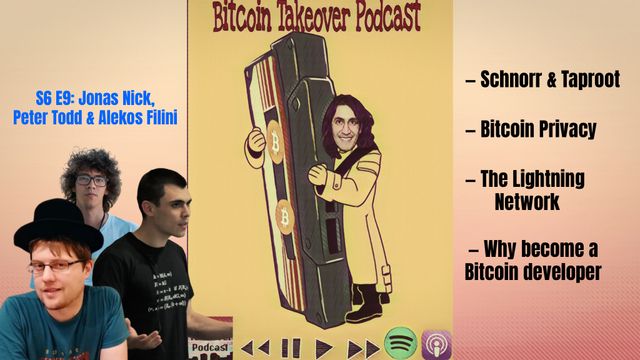
S6 E9: Jonas Nick, Peter Todd & Alekos Filini on Bitcoin Development
Jonas Nick (@n1ckler), Peter Todd (@peterktodd), and Alekos Filini (@afilini) talks about Bitcoin development. Some major topics…

S15 E58: Liam Eagen, Robin Linus & Jonas Nick on Shielded CSV, Private Client-Side Validation & the Future of Bitcoin Privacy
Liam Eagen, Robin Linus and Jonas Nick explain Shielded CSV: private client-side validation with ZK proofs, BitVM bridges…
S17 E19: Amaury Séchet on Forking Bitcoin Twice, Quantum FUD & Scars from the Block Size Wars
Two years after our first interview, I decided to invite Amaury Séchet(@deadalnix) to find out what the Greg Maxwell of big…

Comments
Comments run on my own server. No trackers, no tracking cookies.