




Stepan Snigirev on Specter DIY and Open Source Security (S8 E11 Full Article)
The audio keeps playing while you browse the site.
Read the transcript15,679 words, every line links to the minute it was said
Ask this episode
Ben Arc introduced me to Stepan Snigirev, and I'm glad he did. Stepan builds Specter, the multisig-friendly desktop wallet and the Specter DIY hardware wallet. He also wrote the small Bitcoin libraries that projects like the Bowser run on. He doesn't tweet much, but he ships code constantly.
We talked about how Specter started, PSBT, the trade-offs of DIY hardware, secure elements, multisig, quantum computing and why a physicist ended up in Bitcoin. The original show notes have the short version.
Gluing Bitcoin Core and HWI Together
Specter Desktop came out of a need. The team was prototyping Specter DIY and needed a wallet to go with it. Stepan liked Bitcoin Core as software: "a great daemon, great implementation, very well tested, very well code reviewed." The interface was another story. "Especially if you try to do it with the hardware wallet, then it is even worse. So you can't really do it from the GUI."
So they did "the simplest thing ever. We take Bitcoin Core, we take HWI, the work that was already done, and we put them together, like glue them together, and put a nice web interface on top of it." Support for the major hardware wallets came fast, thanks to Andrew Chow's HWI. "You just take PSBT, you feed it into HWI, and you get all the communication with your hardware wallet."
Back then, multisig software was thin. "Basically you had only options like Electrum, or nothing really else."
Why PSBT Matters
I asked why PSBT became so important. His answer was refreshingly plain. "The great thing about PSBT is not that it is a great standard or whatever," but that it was finally a standard. Before, every vendor had its own format. Now "we have a standard that everyone can implement and then with minimal effort get integrated in the whole ecosystem." You can even use an old Android phone with Electrum as an air-gapped signer.
The Two Sides of DIY
Stepan was honest about building your own wallet. "It's like a two-sided coin." The upside: "you get off-the-shelf components, so you avoid supply chain attack. At least nobody knows that you're building a hardware wallet."
The downside is the moment you flash it. "If your computer is compromised at the moment when you are uploading the firmware to the hardware wallet, then your hardware wallet can become malicious as well."
That's why Specter DIY uses a secure bootloader. It "locks the firmware on the microcontroller such that only correctly signed firmware by developers can be uploaded there, and it cannot be read out." Without one, if you plug the device in, "you can read out everything from it."
It also costs more than other DIY options. The discovery board "is around 50 bucks," a QR scanner "another 40," and an extension board or card reader "another 20," so "in total it ends up in the order of 100, 150 or so."
Pick Your Own Security Model
This is the part I like most about Specter DIY. "We really try hard to maintain in Specter DIY is to give the user the choice of the security model." You can run it in amnesic mode, so "whenever you turn off the device, it forgets the key." You can store an encrypted secret on the SD card, which "makes the whole thing like kind of two-of-two." Or you can use a secure element.
On secure elements, he doesn't pretend to see more than his users do. "We don't have access to the code, low-level code that is running on the secure elements." The decision stays with you: "you need to decide yourself how exactly you want to store your secret."
He's excited about Tropic Square's open source chip and its plan to start with "just the key storage under the PIN code." His take: "you don't overcomplicate the whole thing. So you start small."
Exchange, Software, Hardware, Multisig
Stepan's path for a normal person starts where most people start, on an exchange, "even though it is a terrible idea." Then a software wallet, then a hardware wallet "as soon as possible."
For small amounts, he thinks a phone beats a laptop, because "mobile operation systems have a better isolation between the apps." He'd avoid second-hand phones, though. "You don't know who did what to your phone."
Then comes multisig. "A few years ago, I did a research on the attacks on different hardware wallets, and what I found out is that over a year there were like more than 20 different attacks." His rough guide: "hardware wallets should come after you reach a few thousand k. Then when to go to multisig is probably when you go to 100k or so, and then you definitely want multi-vendor multisig."
What about Shamir? His dream is to split a normal BIP39 phrase into Shamir shares, but the two aren't compatible today. And stacking them is too much. "Shamir on top of multisig, I think, is overkill and overcomplicating things. So I would say that either you do Shamir or you do multisig."
Quantum Computing, From Someone Who Built One
Stepan worked in quantum physics, so I had to ask. Is a quantum attack on Bitcoin possible? "Ever possible? Yes. When is another question." Breaking elliptic curves needs "thousands of qubits, millions of operations." At the time, state-of-the-art machines worked "with 5 to 10 qubits." In his words, "there are like two or three orders of magnitude before we could tackle the problem."
He warned against rushing post-quantum schemes into Bitcoin. Many of them "are not resistant against classical computers." But "nothing stops us from adding another signature scheme into Bitcoin. We are adding Schnorr signatures now, right?"
Schnorr also feeds his idea of a next-generation device: several different secure chips in one wallet, each holding a Shamir share. "With Schnorr you can actually combine the signatures. So you don't need to combine the shares themselves."
Why He Left Physics
He was missing "an immediate reward." In fundamental research, "you don't even have a chance to see it applied in the wild." He was also modest about his own talent. Next to Adam Back, Pieter Wuille and Andrew Poelstra, "they are on a completely different level. But still, on my level, I can do something useful. And this is really inspiring."
Bitcoin was personal too. "I was buying Bitcoin, and then soon after that, Russian ruble crashed by a factor of two, so I kind of saved all my money this way." That's also where the hardware came from: "I don't trust anyone else, including like Trezor, Ledger and so on. So I decided, okay, I will better make something by myself."
Open Source Grows by Being Used
Stepan admires how much scrutiny Trezor gets. "Trezor has the largest number of disclosed attacks and mitigations on them." He wants the same for Specter's libraries, and it's happening. "Bowser is using the Arduino library that we developed. SeedSigner is using our Python, MicroPython library that we developed."
Money comes from enterprise. "When you are doing open source, it's hard to monetize that." That work led to Miniscript support in the hardware wallet, which means "in principle we already support any kind of scripts, including timelocks and Lightning Network."
Next on his list: CoinJoin support in hardware and MuSig after Taproot (which activated in November 2021). That one needs teamwork. "We need to stop fighting with each other, but actually collaborate."
What Makes This Episode Worth Listening To
You hear a real security engineer explain trade-offs without selling you anything. Stepan tells you what DIY gets you and what it costs, when multisig makes sense, and why quantum isn't a reason to panic. If you're thinking about building your own wallet, start here.
You can read the full transcript, the original show notes, or visit Stepan Snigirev's guest page.
Listen to Stepan Snigirev on Spotify, Apple Podcasts, and More
Time stamps:
- 00:02:58– How Specter Desktop started
- 00:05:04– Gluing Bitcoin Core and HWI
- 00:06:20– Multisig wallets back then
- 00:09:49– Why PSBT matters
- 00:12:48– The two sides of DIY
- 00:13:29– Supply chain vs flashing risk
- 00:18:32– Secure bootloader
- 00:19:47– What Specter DIY costs
- 00:24:24– Choose your security model
- 00:27:30– Secure elements you can't inspect
- 00:31:57– Tropic Square's first step
- 00:38:35– From exchange to hardware wallet
- 00:41:24– 20 attacks in a year
- 00:46:54– Shamir or multisig, not both
- 00:47:43– Quantum computing
- 00:52:46– Post-quantum risks
- 00:55:40– Schnorr and a next-gen wallet
- 00:59:53– Why he left physics
- 01:09:03– The ruble and his first bitcoins
- 01:11:20– Phones vs laptops
- 01:14:43– When to move to multisig
- 01:16:54– Avoid used phones
- 01:29:52– Trezor's disclosed attacks
- 01:30:43– Bowser and SeedSigner on Specter libraries
- 01:32:37– Funding open source
- 01:37:42– Miniscript
- 01:39:56– CoinJoin, Taproot and MuSig
Verify this episode
This is the SHA-256 fingerprint of the MP3 as published here, timestamped in the Bitcoin blockchain with OpenTimestamps. If one byte of the file changes, the fingerprint changes.
- SHA-256
d6da2af1924261c13a7ec026c5b4c8d07522306a0f17e0c8d097d664e0b8849b- Proof
- 2021-06-05_btctkvr_s8_e11_stepan_snigirev_specter_wallet_revised_2.mp3.ots · all episode hashes (proof)
- Status
- Anchored in Bitcoin block 974,312
- Timestamped
- After release. The episode came out on 5 Jun 2021, but this proof was made on 3 Nov 2026 and anchored in block 974,312, so it proves this exact file existed by 3 Nov 2026, not on the release date.
How to check it yourself
- Download the MP3 and the proof into the same folder.
- Run
sha256sum 2021-06-05_btctkvr_s8_e11_stepan_snigirev_specter_wallet_revised_2.mp3(on a Mac:shasum -a 256 2021-06-05_btctkvr_s8_e11_stepan_snigirev_specter_wallet_revised_2.mp3). The result must match the SHA-256 above. - Install the OpenTimestamps client (
pip install opentimestamps-client) and runots verify 2021-06-05_btctkvr_s8_e11_stepan_snigirev_specter_wallet_revised_2.mp3.ots. It hashes the MP3 again and checks the proof against your own Bitcoin node, then prints the block and the date the file existed by. Without a node,ots info 2021-06-05_btctkvr_s8_e11_stepan_snigirev_specter_wallet_revised_2.mp3.otsshows the block height to look up in any block explorer.
Related
S8 E11: Stepan Snigirev on Specter DIY & Free Open Source Software
Stepan Snigirev is the creator of Specter, a project which spawned one of the most popular software wallets for multisig setups…
Construire soi-même son Hardware Wallet, Partie II
Construisez votre propre PiTrezor, Specter DIY, SeedSigner et Bowser Wallet Il existe deux principales catégories de hardware…
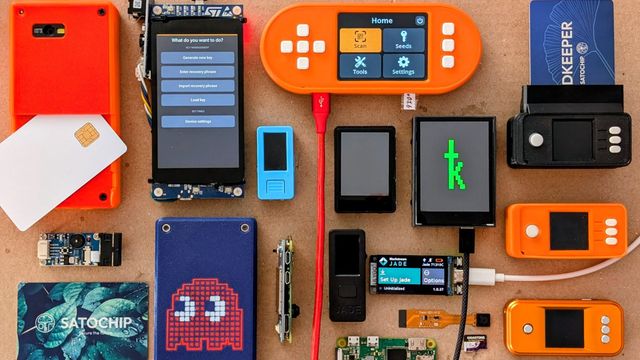
The DIY Signing Device Revolution is Just Beginning
This is a guest post by Keith Mukai about the first-ever gathering of the Specter DIY, SeedSigner, and Krux teams (plus Satochip…

Comments
Comments run on my own server. No trackers, no tracking cookies.