




Zcash: The Privacy Moon Math Bitcoin Was Afraid to Include
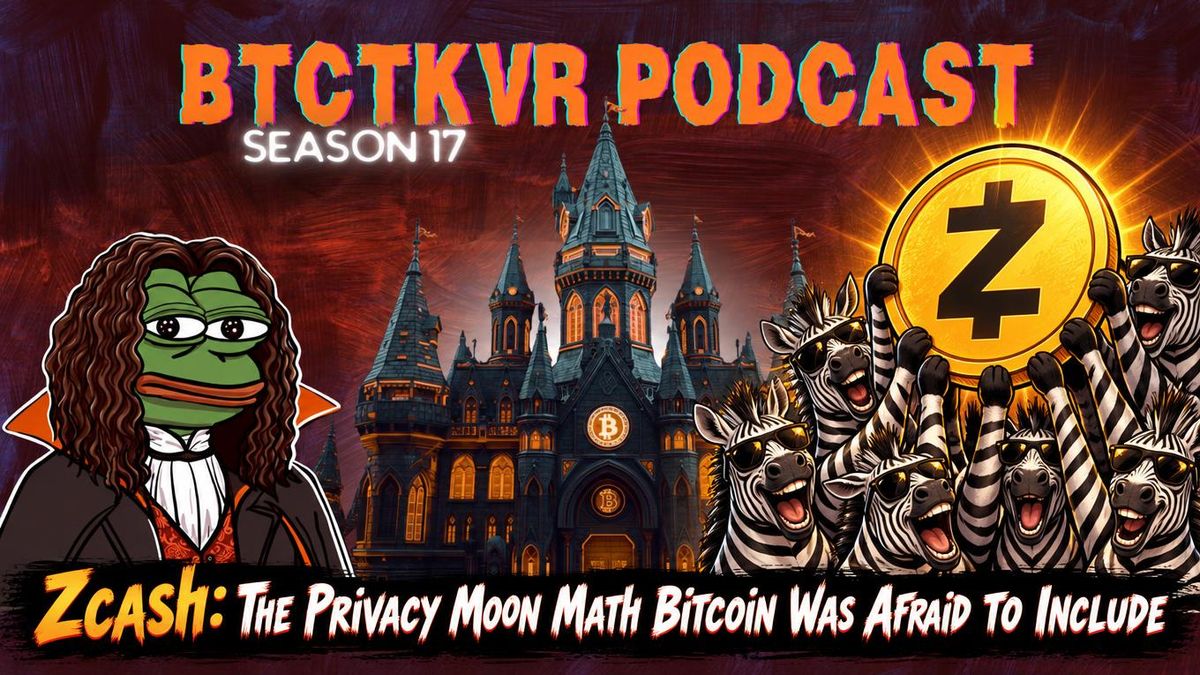
In the spring of 2013, cryptographers at Johns Hopkins University created Zerocoin in order to make Bitcoin private. But the Bitcoin Core developers said no, and mostly for understandable reasons. Three years later the researchers copied Bitcoin’s code, added the moon math themselves, and launched a separate chain. Ten years, two inflation bugs that most likely weren’t exploited and one torched laptop later, Zcash is the most promising codebase fork of Bitcoin shipped so far, and the clearest record we have of what private money really costs.
On a Sunday in May 2013, a nervous PhD student from Johns Hopkins walked onto the stage at the Bitcoin 2013 conference in San Jose. He apologised for being flustered: he had come straight from San Francisco, where his paper was about to be presented at the IEEE Symposium on Security and Privacy, one of the most selective venues in computer security. His name was Ian Miers. The paper was called Zerocoin, and he had about twenty minutes to tell a room full of early Bitcoiners that their favorite internet money was not as private as they believed.
He opened with a joke about copying. Making digital money that cannot be copied is nearly impossible, he said, and “if you think about how easy it is for a fourteen-year-old kid to pirate the latest Justin Bieber album, and you consider that a twenty-dollar bill is probably worth considerably more than Justin Bieber, you have some idea about the scope of the problem.” Then he made his point: Bitcoin was not anonymous at all.
It was pseudonymous, and pseudonyms leak. Two shops that see you under different names eventually notice that both names drive home to the same house. Data miners would link Bitcoin addresses the same way. Miers argued that this made Bitcoin worse than a bank account: “At least in the case of the bank, it was the bank and whoever they told that knew your stuff. Your neighbors didn’t, your family didn’t, your co-workers didn’t.” On Bitcoin, everyone would know.
His solution borrowed from David Chaum, the father of digital cash, and took away the bank. You would lock bitcoins into an “opaque envelope” recorded on the blockchain. Later you would prove, using a zero-knowledge proof, that you owned one of the envelopes in the pool, without revealing which one. He even had a way to explain it to children: you can prove you know where Waldo is by laying a huge sheet of paper with a small hole over the picture, so Waldo shows through the hole and nothing else does.
Miers was candid about where it might end up. “How does this get adopted as part of Bitcoin? Okay, that’s like the ideal, and not that likely,” he said. “As part of some alternative currency, maybe. Or it becomes its own alternative currency, that actually has the claim to fame that it’s really anonymous? I don’t know.” He described himself as living in “not quite an ivory tower. The roof leaks. It’s not that tall, but close enough.”
Then the questions started. As Zooko Wilcox remembered it to me in S16 E29 of the Bitcoin Takeover podcast, Peter Todd stood up first, and his question “was more of a statement”: “The Bitcoin Core developers are not going to integrate a hard forking, experimental, inefficient protocol upgrade into Bitcoin right now.” The room microphones barely caught it, but Miers’s reply survives on the recording: “Yeah, that’s a perfectly reasonable point.” Then someone asked about denominations. If everyone has to mint coins of the same fixed size, wouldn’t a payment of an unusual amount stand out? “That would be trivially traceable,” Miers admitted.
Within those twenty minutes was nearly the whole history that follows: the cryptography, the doubts, Bitcoin’s refusal, and an academic’s correct guess that the idea would have to leave home to survive.
The summer Bitcoin almost got private
For a few months in 2013, Zerocoin looked like Bitcoin’s future. Bitcoin Magazine, co-founded by a nineteen-year-old Vitalik Buterin, put it on the cover of its July 2013 issue: “Zerocoin: Bitcoin Privacy, Perfected.” It sat on newsstands next to an interview about the first Bitcoin ATM.
In August, Greg Maxwell posted CoinJoin to Bitcointalk. It was a far humbler technique: several users combine their payments into one transaction so an observer cannot easily tell whose coins went where. It needed no change to Bitcoin at all. Maxwell’s thread, which later hosted a CoinJoin bounty fund, is often remembered as a rejection of Zerocoin. It was really a mix of admiration and frustration:
“As a crypto and computer science geek I’m super excited by Zerocoin: the technology behind it is fascinating and important. But as a Bitcoin user and developer the promotion of it as the solution to improved privacy disappoints me.”
His objection was about engineering, not principle. Zerocoin “requires a soft-forking change to the Bitcoin protocol, which all full nodes must adopt, which would commit Bitcoin to a particular version of the Zerocoin protocol. This cannot happen fast, probably not within years, especially considering that there is so much potential for further refinement to the algorithm at lower costs.” CoinJoin, as he framed it, was what Bitcoin could do now, until something like Zerocoin was ready.
Someone else was paying attention. Hal Finney, the first person after Satoshi to run Bitcoin and the recipient of its first transaction, had always cared about privacy. In 1993 he wrote an essay called “Protecting Privacy with Electronic Cash.” In 1998 he demonstrated a zero-knowledge proof program of his own at the Crypto conference in Santa Barbara.
One of his earliest tweets about Bitcoin, in January 2009, read: “Looking at ways to add more anonymity to bitcoin.” By 2013 ALS had taken almost all his movement; he wrote with eye-tracking software. When I went through the accounts his profile followed, I found the people working on Zerocoin and Zerocash, and Zooko Wilcox among them. In the last months before he died, in August 2014, one of the most important people in Bitcoin’s history was watching the work that would become Zcash.
Explainer: Zerocoin versus Zerocash
Zerocoin proved that zero-knowledge privacy could work on a Bitcoin-style ledger. Zerocash made it practical.
| Zerocoin (May 2013) | Zerocash (May 2014) | |
|---|---|---|
| Authors | Ian Miers, Christina Garman, Matthew Green, Aviel Rubin (Johns Hopkins) | Eli Ben-Sasson, Alessandro Chiesa, Christina Garman, Matthew Green, Ian Miers, Eran Tromer and Madars Virza |
| What it hides | Only the link between the coin you deposit and the coin you withdraw | Sender, recipient and amount |
| Amounts | Fixed denominations; an unusual amount gives you away | Any amount, and you can pay directly inside the shielded pool |
| Payments | Mix in, then spend as an ordinary visible bitcoin | Private payments from one person to another |
| Proof size | Tens of kilobytes (Miers quoted about 40 KB in San Jose) | 288-byte proofs; transactions under 1 KB |
| Speed | About a second to mint; about half a second each to make and check a proof in the prototype | Verification in under 6 ms; making a proof took minutes on 2014 hardware |
| Setup | A trusted RSA modulus whose factors nobody may know | A circuit-specific trusted setup whose secret must be destroyed |
| Cryptography | Older, well-studied RSA assumptions | Newer pairing-based assumptions, which skeptics called “moon math” |
The jump came from zk-SNARKs, a newer kind of proof that the four extra authors had been making efficient, building on systems such as Pinocchio and BCTV14. Instead of special-purpose proofs for each step, Zerocash used one general-purpose proof that a whole hidden transaction followed the rules. “Zerocash sort of threw SNARKs at the problem,” Sean Bowe told me in S16 E51. The trade-off was that Zerocash needed a trusted setup and newer cryptographic assumptions, and those were exactly the parts Bitcoin’s developers trusted least.
Zooko was in San Jose that weekend too. A two-person startup called Coinbase offered him a job as its security chief at a folding table, and he turned it down. He did not see Miers’s talk, but he says the Hopkins group and the four SNARK researchers met there; Ben-Sasson gave his own talk on succinct proofs at the same conference. In Zooko’s words, “the four scientists met the three scientists and joined forces and became the seven scientists.”
Satoshi’s unfinished wish
The idea was older than all of them. In August 2010, someone on Bitcointalk suggested that zero-knowledge proofs might help Bitcoin. Satoshi replied that it was hard to see how they would apply, but added that if a solution could be found, a much better, easier, more convenient implementation of Bitcoin would be possible. “And then four months after he posted that, he disappeared from the internet forever,” Zooko told me. “And then three years after that, these scientists, who didn’t include me, found a solution.”
Zooko had been waiting longer than most. In the 1990s he worked at David Chaum’s DigiCash in Amsterdam, chasing a decentralized version of Chaum’s cash in his spare time. “I was trying to invent Bitcoin for like 15 years unsuccessfully before Satoshi invented Bitcoin,” he said. When Zerocoin appeared, “my eyes lit up, and I said to myself, this is the first thing that could actually work.”
He saw Bitcoin’s transparency as a deep design flaw: “You can’t use Bitcoin for anything without unwillingly disclosing your current assets and all of your past transactions and all of your future transactions.” He also liked the name: “the word zero in the name Zerocoin is named after zero-knowledge proofs, which are named after leaking no information about you.”
In early 2014, Matthew Green presented Zerocash at the Real World Crypto conference. Zooko was first at the microphone. “This is great. This is awesome. Best thing ever,” he said. “But what about that trusted setup thing?” Green’s answer, a recorded ceremony and a destroyed computer, did not satisfy him, and he kept pressing. A few weeks later Green called and asked him to help turn Zerocash into a real currency. When the company appeared on AngelList in 2015, Wired reported its pitch in one line: “Bitcoin is HTTP for money. We are HTTPS.”
Were Bitcoin’s developers right?
On the narrow question, yes, and the decade since has proven it.
If Bitcoin had soft-forked Zerocoin in 2013, it would have inherited a protocol in which researchers found a cryptographic flaw in April 2018 that let an attacker destroy honest users’ coins, create coins from nothing, or steal them. If it had adopted Zerocash in 2014, it would have inherited the flaw in BCTV14 found in March 2018, which made counterfeiting possible for anyone who noticed some extra numbers in the setup transcript. It would also have been exposed to the 2026 Orchard bug, which sat undetected for four years. And it would have had to run a trusted setup and ask every Bitcoiner to believe the secret had been destroyed.
Bitcoin has had inflation bugs of its own, in 2010 and 2018, but in both cases anyone could see and count the damage. In a shielded pool, a counterfeit coin looks like every other coin. Peter Todd made the point again in 2026: “The privacy of Zcash makes inflation exploits far more dangerous.”
Even Zcash’s builders concede the point. “Bitcoin Core probably [was] right,” Josh Swihart said in S15 E62. “The cryptography was too novel at the time.” Sean Bowe never expected Bitcoin to say yes: “If you ever interacted with the Bitcoin developers back then, they were absolutely not going to ever add something like that.”
Why someone still had to try
Bitcoin’s caution was right for BTC. But someone had to run the experiment, because a paper cannot tell you two things: whether the technology survives contact with real money, and whether anybody wants it.
The first question is about refinement. Ideas get better when they are shipped. Bowe describes the trap Maxwell was pointing at: a conservative chain waits for the perfect version, and “a new paper’s going to come out and say, oh, I have a way to do it ten times faster and with better trust assumptions.” Zcash took the opposite view. “We’re willing to take what we have that we know works and change the protocol completely to implement it, as fast as we can safely,” he said.
Nearly every improvement he made came from fixing real problems in a live system: proofs fast enough for phones, setups with 87 participants instead of six, and finally Halo, which needed no setup at all. “You can be clever and everyone can praise you for your papers, and that’s great for your resume, but it doesn’t actually do anything,” he told me. “Shipping is crucial.”
The second question is about demand. A testnet gives you no answer, because nobody’s money is at stake. Zcash spent years as a technology everyone admired and almost nobody used. Then wallets made shielding the default, and the numbers changed. By late September 2026, according to CoinDesk, about 4.9 million ZEC, roughly 29 percent of issued coins, sat in shielded pools, and one week recorded about 63,000 shielded transactions, the busiest since 2022. Those numbers show demand that no academic paper could have measured.
Bitcoin itself learned something too. In S16 E51 I told Sean that when I asked Peter Todd to name altcoins he considered legitimate, he named Litecoin, Monero and Zcash. The technology was “actually interesting,” he said, “and they have made great progress.” In September 2026, researchers at [alloc] init published “Shielded Bitcoin,” a proposal for Zcash-style encrypted payments on Bitcoin that needs no consensus change. The idea Bitcoin declined in 2013 is being proposed again, partly because Zcash shipped it first.
The box under my bed
For me, this story became personal through a cardboard box sealed with duct tape.
In 2021, at the height of the NFT craze, I bought a collectible from Peter Todd for $1111 in bitcoin: the remains of the laptop he used in October 2016 to help create Zcash’s first shielded pool. It is one of six computers in the world that took part in the ceremony that launched Sprout. As far as I know, it is the only one sold to a collector. The processor is gone; Todd destroyed it on purpose.
What remains is a cooling fan, a heat sink still smeared with thermal paste, a gutted hard drive and a set of Verbatim DVDs. One envelope reads “burnt compute node remains,” sealed by Todd on 26 October 2016. Another is labelled “final MPC compute node, test burn #1, #2, Tails,” sealed “at midnight on Monday, October 24, 2016.” He drew his pen across every seal, so that opening one would break the line.
“On one hand amateurish, but rigorous,” I said on air while I cut it open with a pen. I kept it sealed under my bed for years, waiting for someone who could explain it properly. In S16 E29 I opened it on camera, with Zooko there to explain it.
The DVDs are the important part. Under Zooko’s rules, each ceremony computer had its Wi-Fi and Bluetooth removed and was never plugged into a network. The only way data could get in or out was a disc burner. “The six discs you have there,” Zooko told me, “are the only six messages that emitted from that compute node between the time it was random-purchased at the store and the time it was destroyed.” They let anyone check that the parameters Zcash nodes used were the ones the six participants actually produced.
For two years, those discs were dangerous. In March 2018, the cryptographer Ariel Gabizon found that the BCTV14 proof system behind Sprout had told the ceremony to generate some extra elements it never needed. Those elements ended up in the ceremony transcript, which was simply all six participants’ DVDs joined together, and they were enough to forge proofs.
Anyone who had the transcript, and understood what was in it, could have created counterfeit Sprout coins. According to Sean Bowe, one of the discs in my box, probably D or F, contains that data. From Zcash’s launch on 28 October 2016 until the Sapling upgrade on 28 October 2018, information that could break the money supply existed on optical discs scattered around the world, including the ones that later sat under my bed.
Eran Tromer had warned about exactly this. In 2016 he argued against publishing the transcript at all. “I was like, ah, Eran, you worry too much,” Zooko said. “I was totally wrong and Eran was totally right.” Once the flaw was found, the team deleted the public transcript.
Bowe encrypted what was probably the last complete copy and handed the key to Zooko, so that reaching it would take both of them. Then a small group fixed the problem in secret for eleven months. The Sapling upgrade moved Sprout onto a different proof system with new parameters, so the old elements could no longer forge anything.
ECC disclosed the flaw in February 2019. Afterwards, Bowe had to rebuild the transcript as a historical record from the participants’ discs. Todd declined to help. A videographer who had filmed the ceremony turned out to have downloaded the missing discs, some of them corrupted, and it was just enough. Since 2018, my DVDs have been a museum piece rather than a weapon.
There is no evidence the flaw was ever exploited. A rule Zcash had in place from launch, the turnstile (later formalised in ZIP 209), sets a hard limit: coins can leave a shielded pool only through the transparent side, so each pool’s balance is public, and no pool can pay out more than it ever took in. New deposits into Sprout were disabled by ZIP 211 in the Canopy upgrade in 2020, and the pool has since dwindled to about 25,600 ZEC. “There’s no way it was exploited, I think,” Bowe said, “and if it was, there’s a cap on the impact.”
That box is also where this year’s other project begins. I am making a documentary, Zcash: From Zidelined to Zillions, built from footage of my Bitcoin Takeover interviews with Zooko, Sean Bowe, Josh Swihart, Kris Nuttycombe and others, including the unboxing. It will be released around Zcash’s tenth anniversary, on 28 October 2026.
Vital statistics
Market data from 17 September 2026 (CoinMarketCap, CoinGecko); shielded data from 25 September 2026.
| Field | Value |
|---|---|
| Ticker | ZEC |
| Category | Codebase fork of Bitcoin Core with its own genesis block; no shared history and no airdrop to Bitcoin holders |
| Origin | Zerocoin (May 2013) and Zerocash (May 2014) papers; Johns Hopkins, MIT, Technion and Tel Aviv University |
| Genesis | 28 October 2016; the tenth anniversary is 28 October 2026 |
| Proof of work | Equihash (200, 9); ASIC-mined since 2018. ViaBTC held about 73 percent of hashrate in October 2025 |
| Blocks | 75 seconds (150 seconds before Blossom, December 2019); 2 MB limit |
| Supply | 21 million cap, Bitcoin-style halvings; about 16.9 million issued (protocol specification) |
| Shielded pools | Sprout 2016 (about 25,600 ZEC, closed to deposits), Sapling 2018, Orchard 2022 (withdrawal-only since July 2026), Ironwood 2026 |
| Shielded supply | About 4.9 million ZEC, roughly 29 percent of issued coins; about 63,000 shielded transactions in the week to 25 September (CoinDesk) |
| Trusted setups | Six participants (Sprout, 2016); 87 contributions (Powers of Tau, 2018); none since Orchard (Halo 2, 2022) |
| Counterfeiting bugs | Two found and fixed (BCTV14 in 2018, Orchard in 2026); no known exploitation; a turnstile on every pool |
| Proof system today | Halo 2, with Ironwood’s balance integrity machine-checked in more than 2,700 Lean theorems |
| Upgrade pace | Roughly yearly network upgrades; about 18 months from idea to mainnet for past pools, according to Sean Bowe |
| Latest upgrade | NU6.3 Ironwood, block 3,428,143, 28 July 2026 |
| Development funding | 20 percent of block subsidy: 8 percent to Zcash Community Grants, 12 percent to a coinholder-controlled fund (ZIP index) |
| Nodes | Zebra (Zcash Foundation) and Zakura; zcashd retired in July 2026 |
| Market | About $22.7 billion market cap (about 1.48 percent of Bitcoin’s), CoinMarketCap rank 9; price about $1340 |
The ceremony
The zk-SNARKs of 2016 needed public parameters, and making them produced a secret by-product. “I decided to call the secret the toxic waste,” Zooko said. Anyone who kept it could print unlimited shielded ZEC without detection. It could not reveal anyone’s transactions; it could only counterfeit. The fix was a multi-party computation. “There’s these six different chemicals, and if you mix all of them together in the same room, they turn into this horrible toxic waste,” Zooko explained. “So what we’re going to do is keep the six precursors separate from each other and not allow them to mix.” If even one participant destroyed their share honestly, the waste could never be assembled.
Why six? “The protocol took hours, and if we had more people it would take more hours, and we couldn’t fit it into one weekend.” Zooko recruited eight or nine, then told all but six at the last moment that they had been decoys, there to distract hackers. He gave three of the six pseudonyms. Every participant had to buy a new computer in person and never let it out of sight, a practice Edward Snowden taught him called “random purchase.”
When Zooko visited Julian Assange in the Ecuadorian embassy, Assange’s advice was to “double down on the air gapping part.” Zooko’s own station was filmed around the clock by cameras bought used in Denver, because “you couldn’t buy a camera that didn’t have Wi-Fi in 2016.” The journalist Morgen Peck watched on site and wrote it up for IEEE Spectrum; her reporting also became Radiolab’s “The Ceremony”.
The six stations over the weekend of 22 and 23 October 2016 were:
- Zooko Wilcox, in Colorado.
- Peter Van Valkenburgh of Coin Center, who cut his RAM apart with tin snips.
- Derek Hinch of NCC Group.
- Andrew Miller.
- “John Dobbertin,” revealed in 2022 as Edward Snowden.
- Peter Todd, who ran his computation in a car driving across Canada and then burned the machine with a propane torch. “It was my goal to outdo every other station in Canadian cypherpunk glory,” he wrote in “Cypherpunk Desert Bus.”
Sean Bowe, then 23, coordinated the whole thing and, at one point, pasted a 4chan meme into the group chat by mistake: “I found out it was Edward Snowden much later. I was like, ah crap, that’s embarrassing.”
Todd later disowned his part, writing that the setup should not be “called a multiparty computation, which makes my involvement pointless.” His worry was the software: “There are lots of ways someone could have surreptitiously changed it.” Bowe’s reading: “It lent legitimacy to Zcash that he didn’t want to lend.”
Three pools and the end of the ceremony
Sprout (2016) was the proof of concept. “You couldn’t run it on a mobile device,” Zooko admitted. Making a transaction “used up all your RAM and heated up your CPU for like 40 seconds.”
Sapling (2018) made shielded payments work on phones, with parameters from the 87-contribution Powers of Tau ceremony that Bowe designed.
Orchard (2022) ended the ceremony entirely. Bowe, working with Jack Grigg and Daira-Emma Hopwood, found Halo in 2019, the first practical way to build recursive proofs without a trusted setup. Bowe says the removal was almost a side effect: “I would have actually been totally happy with Halo at first if it didn’t solve the trusted setup problem.” Halo 2 became Orchard’s foundation. Six years after Peter Todd’s torch, nobody had to destroy anything.
How Zcash differs from Bitcoin
| Bitcoin | Zcash | |
|---|---|---|
| Relationship | Original chain | Fork of Bitcoin Core’s code; separate genesis |
| Privacy | Transparent ledger | Optional shielded pools that hide sender, recipient and amount |
| Supply audit | Add up the UTXO set | Transparent supply plus a turnstile on each pool |
| Proof of work | SHA-256d | Equihash |
| Blocks | About 10 minutes | 75 seconds, 2 MB |
| Upgrades | Rare soft forks | Scheduled network upgrades, roughly yearly |
| Funding | Donations and companies | 20 percent of block subsidy |
| Nodes | Bitcoin Core, Libbitcoin | Zebra, Zakura |
Who pays for Zcash
For the first four years, 20 percent of every block subsidy went to founders, investors, staff and the Zcash Foundation. This was the Founders’ Reward, about 10 percent of the eventual supply. Critics called it a premine. Zooko calls it the reason Zcash kept improving: “We could have stopped in 2016, but that would have been a pretty meager contribution to mankind compared to what we’ve got today.” The Dev Fund that followed (ZIP 1014) split the 20 percent among the Electric Coin Company (ECC), the Zcash Foundation and a grants programme.
At the 2024 halving, Josh Swihart, who had taken over as ECC’s chief executive in December 2023, refused to renew ECC’s share. “I didn’t think for a public good it was appropriate for any organization’s addresses to be baked into the chain, nor to be guaranteed funding,” he said in S17 E28. Today 8 percent goes to Zcash Community Grants and 12 percent to a lockbox that coinholders have controlled since NU6.1 in November 2025.
In January 2026, after a dispute with the board of the Bootstrap Project, ECC’s nonprofit parent, the entire ECC team left. “Within a week” they had formed the Zcash Open Development Lab (ZODL), a for-profit that earns 50 basis points on in-wallet swaps. ECC is being wound down. Shielded Labs, where Zooko now leads product, is developing Crosslink, a hybrid of proof of stake and proof of work, and the Network Sustainability Mechanism.
The critics
Riccardo Spagni, the former Monero lead, told me in S17 E8 that he considers Zcash a “scam” in the same sense as Ethereum. He meant a project built by “technically competent people who make stupid decisions when it comes to architecture or design… in full knowledge.” His core argument is that privacy should be on by default: “You shouldn’t wait for scaremongering to happen to turn the switch on. The switch should be on from the get.”
On the funding: “If it was just researchers creating a thing that they hoped would become a model for Bitcoin, why did they raise money?” Zcash’s builders reply that a shielded transaction hides among the entire history of its pool, while a Monero ring signature hides among a handful of decoys. Zooko adds that “you cannot add privacy to money in flight, you can only add privacy to money at rest.”
The Orchard crisis of 2026
On 29 May 2026, Taylor Hornby, a security researcher working with Shielded Labs, reported a soundness bug in Orchard’s circuit. It had been live since 2022 and could have allowed coins to be minted inside the pool. A soft fork paused Orchard, and NU6.2 restored it on 3 June. ZEC roughly halved in price, and holders withdrew about 800,000 ZEC. Swihart defended disclosing everything in S17 E28: “It eroded some trust in the shielded pool, because people can’t see inside. But it increased the trust of the teams.”
Explainer: Ironwood and Tachyon
Ironwood (NU6.3, 28 July 2026) moved shielded funds to a corrected pool and made the old Orchard pool withdrawal-only. That turns the migration into an audit: every coin leaving Orchard passes the turnstile. It also comes with a machine-checked proof in more than 2,700 Lean theorems that the pool cannot create undetectable counterfeit coins. “Zcash’s new formal verification efforts eliminate undetectable counterfeiting bugs from the new Ironwood pool,” Bowe wrote. It also adds quantum-recoverable notes.
Tachyon is Bowe’s plan to scale private money in three parts:
- Oblivious synchronization. An outside service tracks the chain for your wallet without learning anything about it.
- No in-band secrets. Payment details travel directly between sender and recipient instead of being stored on chain.
- Shielded aggregation. A block’s shielded transactions are folded into a single recursive proof.
Validators could then delete old spending records instead of keeping them forever. “If privacy can’t scale now, then nothing can,” Bowe said in S16 E51. “So it’s math, and it’s also vibes.” Most of Tachyon is not live yet.
Who is who
- Ian Miers, Christina Garman, Matthew Green and Aviel Rubin, who designed Zerocoin at Johns Hopkins.
- Eli Ben-Sasson, Alessandro Chiesa, Eran Tromer and Madars Virza, who joined them to create Zerocash.
The builders
- Zooko Wilcox-O’Hearn, Zcash’s founder.
- Nate Wilcox, his brother and business partner.
- Sean Bowe, who coordinated the ceremony and leads Halo and Tachyon work.
- Daira-Emma Hopwood and Jack Grigg, protocol designers.
- Ariel Gabizon, who found the 2018 flaw.
- Josh Swihart, head of ZODL.
- Kris Nuttycombe, wallet and SDK engineer.
- Taylor Hornby, who found the 2026 Orchard bug.
The ceremony
- Peter Todd, Edward Snowden, Peter Van Valkenburgh, Derek Hinch, Andrew Miller and Zooko Wilcox, with Morgen Peck as witness.
The skeptics
- Greg Maxwell, Peter Todd and Riccardo Spagni.
The watcher
What Zcash proved
- Zero-knowledge proofs can secure real money. “There wasn’t a public product that used general-purpose zero-knowledge proofs, in any industry, that had ever shipped before Zcash,” Bowe says.
- Trusted setups can be retired. It took six years to go from six participants to none.
- Bitcoin’s caution was justified. Privacy hides bugs as well as payments.
- Turnstiles and formal proofs can restore trust in a private money supply.
- Experiments answer questions papers can’t. These include whether the cryptography holds up and whether people want it.
Will it flip Bitcoin?
No, and it does not really try. Zcash is worth about 1.5 percent of Bitcoin, its mining is less distributed, and its governance has been turbulent. Its claim is narrower and harder to dismiss: it is the privacy upgrade Bitcoin was offered in 2013, actually built, broken twice, and rebuilt around a mathematical proof. If Bitcoin ever decides it wants shielded payments, it will benefit from more than a decade of research data and hard fork in the field of zero knowledge proofs.
So adding it today is much safer than adding it in 2014 because the understanding of the technology is better and there are more experts around the world who can verify the code. Unfortunately, it appears that Bitcoin is stuck from a technical evolution point of view… which lends much more legitimacy to projects like Zcash and enables them to flourish in the markets where BTC is no longer competitive. So there is room for a battle for users and network effects, but it seems unlikely that ZEC will flip BTC any time soon.
Scorecard inputs
| Criterion | Evidence |
|---|---|
| Technical ambition | First production zk-SNARK currency; Halo 2; formally verified Ironwood; Tachyon |
| Political radicalism | Challenges Bitcoin’s transparency; permanent development funding; the 2026 ECC rupture |
| Adoption | Rank 9; about 29 percent of supply shielded; exchange friction |
| Scalability claims vs measurement | 75-second blocks live; Tachyon gains are design targets |
| Decentralization | Several organizations, two node implementations, concentrated ASIC pools |
| Security model | Equihash, turnstiles, two fixed bugs without known exploitation, Ironwood proof |
| Long-run viability | Ten years of shipping; chain-funded development; organizational churn |
| Speculative context | Upside: private payments, quantum-ready design. Downside: regulation, complex cryptography, governance conflict |
Sources
Bitcoin Takeover Podcast
- S16 E29: Zooko on Ecash, Bitcoin & Zcash
- S16 E51: Sean Bowe on Bitcoin, Zcash, Scaling & Privacy
- S15 E62 (Josh Swihart and Kris Nuttycombe), S17 E8 (Riccardo Spagni), S17 E26 (Bitcoin Cash developers) and S17 E28 (Josh Swihart), all in the podcast archive
- Bitcoin Forks, Described by Dorks, the timestamped quote archive
Papers
- Miers, Garman, Green and Rubin, “Zerocoin: Anonymous Distributed E-Cash from Bitcoin”, IEEE S&P 2013
- Ben-Sasson et al., “Zerocash: Decentralized Anonymous Payments from Bitcoin”, IEEE S&P 2014
- Pinocchio and BCTV14
- Gabizon, “On the security of the BCTV Pinocchio zk-SNARK variant”
- Bowe, Grigg and Hopwood, “Recursive Proof Composition without a Trusted Setup” (Halo)
- Biryukov and Khovratovich, “Equihash”
- Back et al., “Enabling Blockchain Innovations with Pegged Sidechains”
Primary posts, talks and documents
- Ian Miers, “Zerocoin: A New Anonymous eCash Extension for Bitcoin”, Bitcoin 2013, San Jose
- Zerocoin Project talks and press
- Greg Maxwell, “CoinJoin: Bitcoin privacy for the real world”, August 2013
- Satoshi Nakamoto on zero-knowledge proofs, August 2010
- Hal Finney, “Looking at ways to add more anonymity to bitcoin” and “Bitcoin and Me”
- Bitcoin Magazine Issue #12, July 2013
- Peter Todd, “Cypherpunk Desert Bus”
- Zcash parameter generation
- ECC, “Zcash Counterfeiting Vulnerability Successfully Remediated”, February 2019
- Zcash protocol specification, ZIP index, ZIP 209, ZIP 211 and ZIP 1014
- Upgrade pages: Sapling, Blossom, Canopy, NU5 and NU6.1
- ECC on the 2023 leadership change and the 2024 halving
- Project Tachyon, “Ironwood verification complete”
- Sean Bowe, “Tachyon: Scaling Zcash with Oblivious Synchronization”
- Halo 2 book, Zebra and Shielded Labs NSM
- Bitcoin’s own bugs: the 2010 value overflow incident and CVE-2018-17144
This essay is part of BTCTKVR: Forks!, my free 2026 magazine about Bitcoin forks. Start with What the Fork?! for the overview, or hear the guests argue it in their own words in Bitcoin Forks, Described by Dorks.
Further context, November 2026
Where this essay sits
This essay is the magazine’s account of Zcash, which began as a privacy design Bitcoin did not adopt. It is left as written. Fork Wars is about the 2015–17 block-size war and later UTXO splits of Bitcoin; it does not retell Zcash’s history, and this update does not import one. Takeover guests talking about Zerocash, Zcash and related privacy work are collected in Bitcoin Forks, Described by Dorks. The magazine home is BTCTKVR: Forks!.
Related
S17 E49: Kris Nuttycombe (Zcash at Ten, Hard Forks, Dev Fund, Ossification)
Kris Nuttycombe of ZODL on Zcash at ten: hard forks as a superpower, freezing Sprout, NU7, Tachyon, the Dev Fund, testnet forks…
S17 E28: Josh Swihart on Zcash’s Comeback, the Orchard Bug & Forking the Company
Twenty months ago, Josh Swihart came on this show to talk about Zcash at its darkest hour: Binance was threatening delisting over…

S16 E29: Zooko on Ecash, Bitcoin & Zcash
On August 11th 2010, Satoshi Nakamoto famously said on the Bitcoin Talk forum: “This is a very interesting topic. If a solution…

Comments
Comments run on my own server. No trackers, no tracking cookies.