




Bitcoin SV: Big Blocks All the Way
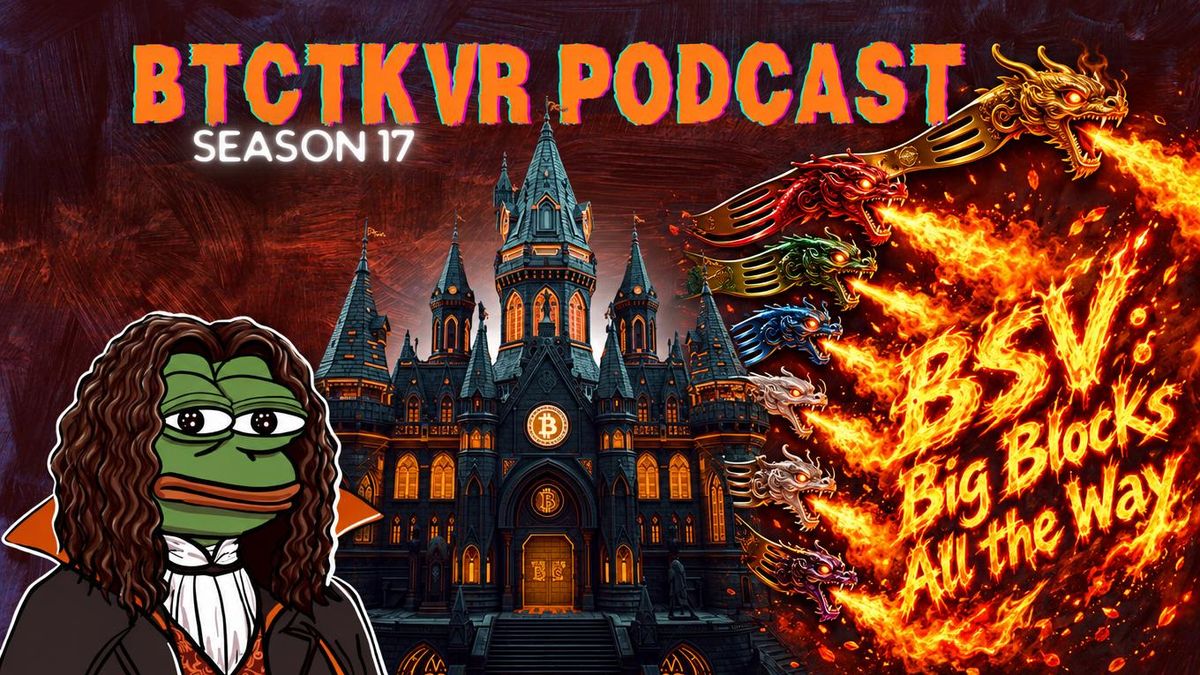
How the big block camp split in two, why the losing side kept building, and what a chain with no limits and a confiscation rule has actually proved
If Bitcoin Cash was the fork everyone argued about, Bitcoin SV is the fork everyone agreed to stop mentioning. In most of the industry it survives as a punchline: the coin of the man who could not prove he was Satoshi, delisted from the exchanges that matter and kept alive by a gambling billionaire’s patience. That summary is what most people know about BSV. But it not the whole story, and a magazine that claims to be exhaustive about forks cannot skip the one that took the big block idea further than anyone else dared.
On Bitcoin Takeover Podcast S17 E39, I invited Kurt Wuckert Jr to talk about it for the same reason I have invited Roger Ver, Amaury Séchet and Paul Sztorc over the years: you cannot understand where Bitcoin is today without understanding the roads it refused to take, and Kurt has been walking the big block road for nearly a decade. He was a big blocker before Bitcoin Cash existed, a Bitcoin Cash supporter before BSV existed, and a BSV miner after the rest of the world stopped paying attention. Halfway through our three hours and forty minutes, Hodlonaut posted that the stream was “exhibit 837 on the absolute decay of culture and principles in the Bitcoin space” and insulted me in a way that I will not print. I mention this because it is the cost of writing this article at all, and because it tells you something about the subject: nine years after the first split, the BSV question still cannot be raised in polite company. So let’s raise it.
BSV Facts
Market figures are a snapshot from 17 September 2026 and will be stale by the time this is printed. Treat them as a scale reference, not a quote.
|
FIELD |
VALUE |
|---|---|
|
Ticker |
BSV |
|
Category |
UTXO hard fork of a hard fork: it inherits Bitcoin’s history to block 478,558 and Bitcoin Cash’s history to block 556,766 |
|
Split date |
15 November 2018, the day of Bitcoin Cash’s scheduled upgrade (median time past 1542300000) |
|
Last common block |
556,766, header time 17:52:01 UTC, mined by SVPool with a |
|
First BSV-only block |
556,767, mined 25 minutes later by Mempool, 13.6 MB and 68,705 transactions |
|
Lineage |
BTC (2009) to BCH (1 August 2017) to BSV (15 November 2018). Exchanges kept the BCH ticker on the Bitcoin ABC chain and listed the nChain chain as BSV |
|
Proof of work |
SHA-256d, same as Bitcoin and Bitcoin Cash; the same machines can mine all three |
|
Supply |
21 million cap, same subsidy and halvings; about 20.09 million issued at the time of writing because the chain is roughly 1,500 blocks ahead of Bitcoin |
|
Market cap |
About $321 million, roughly 0.021% of Bitcoin’s $1.53 trillion and about one fourteenth of Bitcoin Cash’s; CoinGecko rank 133 |
|
Price |
About $16; all-time high about $490 on 16 April 2021 |
|
Mining security |
Difficulty about 0.021% of Bitcoin’s on the same date, implying roughly 195 petahashes against Bitcoin’s 964 exahashes |
|
Node software |
Bitcoin SV Node (SV Node), C++ descendant of Bitcoin ABC; Teranode, a microservices rewrite released publicly by the BSV Association in October 2025 |
Why BSV Split: The Politics
The Bitcoin Cash article in this issue describes the first civil war of the big block camp, the one against Bitcoin Core. This is the second one, fought inside the camp, fifteen months after the first ended.
By mid-2018 Bitcoin Cash was upgrading on a fixed schedule, and the November upgrade written by Bitcoin ABC contained two changes that nobody outside the ABC team had asked for: canonical transaction ordering (CTOR), which sorts the transactions in a block by hash instead of by dependency, and a new opcode, OP_CHECKDATASIG, that lets a script verify a signature over arbitrary data. ABC said CTOR would enable faster block propagation.
Craig Wright’s nChain said it was an unauthorized redesign of a protocol that should have been frozen, and in August 2018 announced its own client, Bitcoin SV, “Satoshi’s Vision,” which would reject both changes, raise the default block size from 32 MB to 128 MB and restore more of the opcodes Satoshi had disabled in 2010. Calvin Ayre’s CoinGeek pool and his media outlet of the same name backed it. The rhetoric escalated quickly to threats of mining empty blocks on the other side’s chain, which is where the phrase “hash war” comes from.
Kurt was on the BCH side of that argument until the night it happened, hosting a Bitcoin.com sponsored meetup in Chicago. His account of why he switched is the most specific one I have heard, and I will present it as such. He believes the split was planned by ABC and not by nChain, and he offers three pieces of evidence. First, the SV node had existed for barely five or six weeks and shipped without replay protection or any of the tooling a faction intending to secede would prepare; when the chain split, SV-side wallets and apps broke and their developers scrambled. Second, the SV-aligned pools had been signaling for about ten days by diverting real hashrate at real cost, while the hashrate that tipped the ABC side appeared, in his telling, in the final hour. Third, and this is the part that is a matter of code rather than memory, Bitcoin ABC shipped a patch in the middle of the fight that treated blocks as final after ten confirmations, which made a reorganization by competing hashrate mechanically impossible regardless of who had more of it.
Andreas Brekken was live on the Bitcoin.com stream when that patch went out and, according to Kurt, reacted with the line of the night: “Ooh, we fucked up.” Kurt’s gloss is harsher. “We’re not having a hash war. This was all a ceremony.” He watched twenty blocks confirm and went to bed at two in the morning. The next day, he says, the two sides felt like a breakup only one party had packed for: Ryan X. Charles, an early Coinbase engineer, unsure whether to turn Money Button into a BSV wallet; Steve Shadders and Daniel Connolly at nChain deciding to make the split permanent because cooperation had clearly been declined; and his friends on the Bitcoin Cash side cracking champagne on stream. “I thought this was a competition among people who disagreed but respected each other. It turns out it was a coup against people that you hate and don’t want to talk to anymore.”
Amaury Séchet has given his version during S15 E28 of the Bitcoin Takeover Podcast, and it differs in the ways you would expect: CTOR was engineering, the SV people were disrupting an agreed upgrade process, and a man claiming to be Satoshi had become impossible to work with. Both versions agree on one thing. The conflict was not, at bottom, about transaction ordering. Kurt: “It’s really interesting that it wasn’t technical per se and it was more about a bunch of people not liking each other.” The numbers on day one, as Bitcoin.com News reported them, were about 8.9 exahashes for ABC against 3.5 for SV, with the ABC chain more than fifty blocks ahead within a day. BitMEX Research’s fork monitor estimated both sides were mining at a loss for the privilege.
Then came the part of the story that shaped BSV’s market access more than any block size ever did. In April 2019 Craig Wright sent libel threats to Peter McCormack and to the pseudonymous Hodlonaut, with CoinGeek offering a reward for Hodlonaut’s identity. Changpeng Zhao responded by delisting BSV from Binance on 15 April, effective 22 April, with a tweet calling Wright a fraud. Kraken polled its users and followed, closing trading on 29 April and withdrawals on 5 June. ShapeShift and the Blockchain.com wallet dropped support the same week. Coinbase never listed it.
Kurt’s most interesting observation on this was his praise for, of all people, Paolo Ardoino of Bitfinex, who kept BSV listed on the grounds that price discovery requires more than one venue. His broader point deserves a hearing even from people who cheered the delisting: “Corporations sue each other all the time, but the CEOs don’t stop having dinner. NASDAQ is not going to cut somebody out because you called him an asshole on the internet and then sued.” Crypto did. Kurt’s diagnosis is that the industry was still a village pretending to be a decentralized market.
I will add some personal notes too: I consider Hodlonaut a friend. The doxing campaign against him was disgraceful and the Oslo trial, which he won in October 2022, broke something in him. Kurt photographed him in that courtroom on a CoinGeek press pass and published the pictures. On my show, without being cornered, he repeated a public apology he had written before: that he was cavalier, that he added pressure to a man with a family, that he tried to shake Hodlonaut’s hand after the trial and was refused with a raised palm. He also said Hodlonaut’s recent writing on Bitcoin Core’s funding is spot on. Cypherpunks write code. They should not have to meet in courtrooms.
What Changed at the Fork: BSV’s Technical Delta
Unlike the 2017 split, the November 2018 divorce did not introduce a new signature scheme or fork ID. Both chains kept SIGHASH_FORKID from the UAHF, which means a transaction valid on one was, for a while, often valid on the other. So users split their coins by spending them with chain-specific opcodes rather than by wallet software doing it for them. The separation came from four mutually invalid rules.
- No canonical ordering. SV nodes kept the topological ordering Bitcoin has always used and rejected CTOR blocks; ABC nodes rejected non-CTOR blocks. This alone guaranteed the chains could not reconverge.
- No OP_CHECKDATASIG. SV treated the new opcode as invalid. Bitcoin Cash’s later CashTokens and DeFi stack grew out of this opcode; BSV chose a different path to the same capabilities.
- More restored opcodes. OP_MUL, OP_INVERT, OP_LSHIFT and OP_RSHIFT came back, and the limit on operations per script rose from 201 to 500.
- 128 MB by default, as policy. This is the point most often misreported. The 128 MB figure was a configuration default in the SV client, not a consensus ceiling, and that distinction turned out to be the whole BSV philosophy in miniature. Kurt put it plainly: “The most important thing about BSV is that we don’t have a hard block size limit, we don’t have a hard script limit. It’s up to the operator.” Gorilla Pool, his company, runs its own policy settings and has accepted a single 350 MB transaction because someone asked. Fourteen months later, Genesis made this the law of the chain.
The Roadmap Since
Bitcoin SV upgrades rarely, and when it does the changes are large. In between, the chain’s history is written in court dates and delistings as much as in block heights… so this table records both.
|
DATE |
WHAT HAPPENED |
NATURE |
FOR CONTRAST |
|---|---|---|---|
|
15 Nov 2018 |
Split from Bitcoin Cash at 556,767; CTOR rejected; four opcodes restored; 128 MB default |
Consensus |
BCH activated CTOR and OP_CHECKDATASIG the same hour |
|
3 Jan 2019 |
New logo chosen by Twitter poll: upright B, superscript SV, in “dragon gold” |
Branding |
Nothing to contrast; Bitcoin has never had an official logo |
|
15 to 22 Apr 2019 |
Binance delists; Kraken, ShapeShift and Blockchain.com follow within days |
Market |
BCH stayed listed everywhere |
|
24 Jul 2019 |
Quasar: default block size raised to 2 GB |
Configuration only, no consensus change despite the “protocol upgrade” label |
BCH: 32 MB limit |
|
4 Feb 2020 |
Genesis at block 620,538: block size becomes a miner-configurable consensus cap; max transaction 1 GB; script limits replaced by a stack-memory rule; P2SH outputs made invalid; OP_CLTV and OP_CSV become no-ops; original nLockTime restored; OP_2MUL, OP_2DIV, OP_VERIF, OP_VERNOTIF disabled |
Consensus, the largest change in the chain’s history |
BTC and BCH both still use P2SH and the timelock opcodes |
|
Dec 2021 |
Kleiman v Wright verdict: Wright cleared of most claims but ordered to pay $100 million to W&K Info Defense Research |
Legal |
No contrast |
|
Feb 2022 |
TAAL mines block 725,511 at about 3.87 GB, with fees exceeding the subsidy |
Milestone |
BTC’s blocks are 4 million weight units; BCH’s largest are tens of megabytes |
|
11 Nov 2022 |
Confiscation transactions: a new transaction class that can move consensus-frozen coins under a whitelisted court order, with a 1,000-block maturity |
Consensus |
No other Bitcoin fork has anything comparable |
|
14 Mar 2024 |
COPA v Wright: UK High Court rules Wright is not Satoshi Nakamoto, did not write the whitepaper, did not write the original code |
Legal |
No contrast |
|
Dec 2024 |
Wright found in contempt for a fresh £911 billion claim; twelve-month sentence, suspended |
Legal |
No contrast |
|
14 Oct 2025 |
Teranode released publicly by the BSV Association, claiming over one million transactions per second on a distributed test network |
Software |
Claim, not measured mainnet throughput |
|
7 Apr 2026 |
Chronicle at block 943,816: original transaction digest algorithm restored alongside BIP143; script numbers up to 32 MB; malleability rules relaxed for version 2 transactions; the four opcodes Genesis disabled are re-enabled, plus OP_SUBSTR, OP_LEFT, OP_RIGHT and the numeric shifts |
Consensus |
No equivalent |
A necessary clarification about “restoring Satoshi’s protocol.”: this is the phrase BSV’s advocates use for Genesis and Chronicle, and it is half true. Many of the opcodes Satoshi disabled in the weeks around the August 2010 overflow bug, the one that minted 184 billion bitcoin in block 74,638, are back, and the limits he added in a hurry are gone. Kurt’s history here is accurate and worth quoting: “He gave us an invention, then turned off 80% of it, and nobody ever tinkered with it. What happens if we tinker with it?”
But Genesis also removed things that were never Satoshi’s to begin with and that both other Bitcoins still rely on. P2SH, the pay-to-script-hash format from 2012 that every multisig wallet uses, is invalid on BSV. The CLTV and CSV timelocks, the primitives behind Lightning channels and most modern covenants, are no-ops. This is a selective redesign with a strong point of view, not a bit-for-bit replay of 2009. Consequently, this article treats it as such. Kurt’s claim that “all but two” disabled opcodes are now live is broadly right after Chronicle; the practical question is what people build with them.
How BSV Differs from Bitcoin in 2026
On scaling philosophy. Bitcoin bets on scarce base blocks and second layers. Bitcoin Cash bets on a large, algorithmically growing base block. BSV bets on no limit at all, with miners deciding what they will accept, and it is the only one of the three that has actually mined gigabyte blocks on mainnet. Kurt’s pitch is that this makes second layers unnecessary rather than impossible: “You can open a channel that works quite a bit like a Lightning channel except that it lives in Bitcoin script. No quote-unquote L2 necessary.”
He extends this to privacy: script templates for ring signatures and zero-knowledge proofs exist, and a wallet could in principle generate a proof per transaction. These are claims about what the script system permits, and I could find the templates but not a production wallet doing it. His critique of Bitcoin Cash’s ABLA is the mirror image of the BCH team’s critique of him: “You want to build the perfect robot. But an honest node is a node operated by an honest person. If there’s a lot of traffic, you can just raise the limit on your node. That’s a one-line change.” The BCH answer, that a one-line change every node operator makes independently is how you get a chain split, is the entire history of this section of the magazine.
On security. At 0.021% of Bitcoin’s difficulty, BSV is protected by roughly 195 petahashes… which a single large pool could redirect on a whim. The chain has been hit before: in mid-2021 it suffered a series of block reorganizations that the Bitcoin Association attributed to a deliberate attacker. The response, coordinating honest miners to invalidate the attacker’s chain, previewed the coordination-based security model that later became explicit in the confiscation rules. The hash war itself is the precedent for miners spending money to lose: BitMEX’s fork monitor estimated both camps mined at a loss in November 2018.
On decentralization. There is one node implementation that matters, SV Node, plus Teranode from the same association. Mining is concentrated; TAAL, Calvin Ayre’s company, is visibly the largest miner on Coin Dance samples, and Kurt’s Gorilla Pool is among the few independents. BSV’s defenders answer that this is the design: Satoshi’s writings describe nodes as professional operations and users as SPV clients, and a chain optimized for gigabyte blocks was never going to be validated on a laptop. Critics answer that a chain whose largest miner, largest media outlet and largest funder are the same person has decided the decentralization question already.
On adoption. I asked the impolite question directly: is anyone here besides Calvin Ayre? Kurt’s answer was candid in both directions. “To say that it’s just Calvin is unfair, but it would be wrong to say that Calvin is not the most significant person that’s put money into BSV.” He estimates Ayre’s total across mining, nChain and the ecosystem in the hundreds of millions, and notes that nChain, which once employed around three hundred people, is considerably smaller now.
The independent roster he offered: Twetch, a social protocol built by a friend of his and named for “tweets etched,” relaunching on the open Bitcoin Schema protocol that also powers Tree Chat; Tokenovate, run by a London Stock Exchange alumnus, hashing the state of institutional trading books to the chain so counterparties can verify them with proof of work; his own Gorilla Pool selling data provenance to what has become the AI integrity market; and a presentation he says he gave on the seventieth floor of a large New York bank about running its around-the-clock settlement on BSV tokens, which he acknowledges people on X did not believe. Someone recently wrote the entire Monero codebase into the chain, and Kurt’s framing of that is the purest statement of the data-ledger thesis: “We have a database that can accept really contentious software and host it forever, and nobody can take it down.” What is measurable is that BSV trades on second-tier exchanges only, that its market cap is a rounding error against Bitcoin’s, and that the enterprise deals are announced far more often than they are audited.
The Confiscation Question
This is the section that makes BSV genuinely different from every other coin in this magazine, and it deserves more care than the usual one-line dismissal.
Since November 2022 the BSV protocol includes a transaction class that can move coins without a valid signature. The mechanism, as documented in the protocol specification and as Kurt described it, works like this. A court order is obtained in some jurisdiction and digitized. Nodes receive it and decide, individually, whether to honor it; the coins are first frozen by consensus, then a confiscation transaction identified by an OP_RETURN carrying the protocol ID cftx and a hash of the order is whitelisted, and it becomes valid at a specified height.
The output cannot be spent for a further 1,000 blocks. Kurt’s counsel told him that Gorilla Pool, a Florida LLC, could not legally act on an order that had not been domesticated in Florida, and that agreeing to one would itself be theft. “So we have the ability to essentially vote no, and we signal that to the network.” His conclusion after reading the Network Access Rules that govern the process: “Frankly, the way it’s designed, I don’t think it will ever happen or ever be used.” As of this writing, he is right. No confiscation transaction has been mined.
His defense of the idea is that Bitcoin’s immutability was always social. Satoshi coordinated a rollback in 2010. Pieter Wuille coordinated one in 2013, phoning miners to downgrade during the Berkeley DB split. “If nodes agree to any state of the network, that’s the state of the network.” He adds that the system has already passed the hardest test anyone could design for it: the person with more leverage in BSV than anyone alive, a man half the community believed was Satoshi, went to court to have coins recognized as his, and the court said no. “It doesn’t matter how strong your cult is. If your proof isn’t proof, that’s the whole conversation.”
My objection is the one I read him from the whitepaper’s abstract: the network forms “a record that cannot be changed without redoing the proof of work.” A confiscation transaction changes the record without redoing anything. Kurt agreed that this is what he dislikes about it, and compared it to the alert key, a pragmatic emergency power that Satoshi built and that later ended up in the hands of Mark Karpelès before Core removed it. My second objection is procedural. Courts deal with land and contracts; a judge presented with forged evidence about dormant coins whose owner is dead or silent has no cryptographic way to detect the lie, and there is no appeal from a mined block. Kurt’s answer is that the threshold, the liability written into the rules for anyone who abuses them, and the sheer cost of domesticating orders in every mining jurisdiction make abuse “infinitesimally close to zero.” We left it there. The reader can weigh a tool that has never been used against a principle that has never been violated on the other two chains, and decide which they trust more.
The Satoshi Question
No BSV article can avoid it, so here is the record, followed by the two positions.
Craig Wright was named as Satoshi Nakamoto by Wired and Gizmodo in December 2015 and confirmed it himself in May 2016, with a private signing session that persuaded Gavin Andresen, who later said he had been “bamboozled.” In December 2021 a Florida jury in Kleiman v Wright rejected most of the estate’s claims but ordered Wright to pay $100 million to W&K Info Defense Research. In August 2022 he won his libel case against Peter McCormack and was awarded one pound, because the judge found he had given deliberately false evidence.
In October 2022 the Oslo District Court ruled for Hodlonaut. On 14 March 2024, in COPA v Wright, Mr Justice Mellor declared that Wright is not the author of the whitepaper, not the author of the original software, and not Satoshi Nakamoto; the written judgment followed in May, injunctions barring him from repeating the claim followed in July, and in December 2024 he received a twelve-month suspended sentence for contempt after filing a new £911 billion claim in defiance of them. He has since largely disappeared from public life; Kurt says he is farming somewhere in Southeast Asia and posting photographs of oversized cucumbers.
Kurt still believes he is Satoshi, “within an order of magnitude.” His case rests on people rather than keys: around fifteen interviews with family, colleagues and former partners of Dave Kleiman, several of whom, he says, corroborate Wright’s story while despising him, and none of whom will speak publicly. He believes Wright had the idea and a team of roughly five did much of the implementation, that Wright is lying about parts of the story, and that the alternative, a man choosing the hardest possible path to a scam when a hundred-million-dollar ICO advisory role was available for the asking, makes less sense. He has never had Wright on his own show and has declined to appear alongside him. “It has never been about Craig. It has always been about the Bitcoin experiment for me.”
My position is that stories are not data, and the data points the other way. Martti Malmi, who worked with Satoshi, told me on this podcast it was not Wright. Perry Metzger, who ran the cryptography mailing list, told me the same. Thomas Voegtlin, who wrote Electrum, checked his download logs for the day of the Andresen signing session and found nothing. A man I met in person last year told me one of the addresses Wright claimed in court was his, mined in 2010, and that he stayed silent because he knew Wright would lose anyway. Satoshi’s writing has been matched stylometrically to Nick Szabo’s, though Kurt’s counter, that Szabo appeared not to know Bitcoin script could be made Turing complete when he sat next to Wright on a 2015 panel, is a fair one. And the simplest test remains available: sign with a genesis-era key, as Charlie Lee did for Litecoin, or send a coin from one of the addresses. I offered to accept one on air. The offer stands.
Both of us agree on one thing, and it is the thing this article needs. Kurt: “If Craig never showed up on the scene and the rest of the Bitcoin civil war played out the way it did, we’d be sitting here on a BSV-looking chain anyway.” The big block experiment, the unbounded script, the enterprise data ledger, were all ideas before Wright and would have found a chain without him. What he brought was the money, the patents, the lawsuits and the toxicity, and whether that was a net positive for the chain that carries his initials is a question its own supporters answer quietly in the negative. “He’s been a massive asset and a huge albatross.”
Who is who
The principals
- Craig Wright, the public face of Satoshi’s Vision, nChain’s former chief scientist, and the reason the chain exists in its current form. Claims to be Satoshi Nakamoto; declared by the UK High Court in 2024 not to be. No longer active in the ecosystem.
- Calvin Ayre, the online gambling billionaire behind CoinGeek, the media outlet and the mining pool, and TAAL, the largest miner. The single most significant funder of BSV since 2018, by his supporters’ own admission.
- nChain, the research and patent firm that built the SV node and employed Wright; at its peak around three hundred people, now considerably fewer after the leadership turmoil of 2023 and 2024.
- Steve Shadders and Daniel Connolly, the technical director and lead developer who made the split permanent and shipped Genesis.
- Jimmy Nguyen, founding president of the bComm Association, later the Bitcoin Association, and the man who announced the dragon gold logo on the tenth anniversary of the genesis block. Historical figure; he left the association in 2022.
- The BSV Association, the Swiss non-profit that now governs the protocol under managing director Ásgeir Óskarsson; rebranded in June 2025 and released Teranode in October 2025.
- Kurt Wuckert Jr, CoinGeek’s chief historian, co-founder of Gorilla Pool and of Open Protocol Labs, which maintains Bitcoin Schema and the Sigma identity protocol. Chicago born, Florida based, jiu-jitsu practitioner, Smashing Pumpkins fan, which is where he and I found common ground. A former BTC maximalist’s nightmare guest and, on the record, one of the few people in this space who will apologize in public.
- Ryan X. Charles, early Coinbase engineer and founder of Money Button, the wallet that chose BSV after the split; later one of the community members who publicly said he had been fooled by Wright after COPA.
- TAAL, SVPool, Mempool and CoinGeek, the pools that mined the first SV blocks and, in TAAL’s case, the record-sized ones.
The other side of the war
- Amaury Séchet, Bitcoin ABC’s lead developer, whose CTOR upgrade and ten-block finalization patch decided the hash war. Kurt calls him “a backstabbing psychopath”; the Bitcoin Cash community that expelled him two years later uses similar language, for different reasons.
- Roger Ver, whose Bitcoin.com pool tipped the ABC side and who released a video days before the split explaining why he had concluded Wright was not Satoshi. Wright’s UK libel suit against him was thrown out on jurisdictional grounds in 2019.
- Changpeng Zhao, whose delisting tweet started the April 2019 cascade.
- Hodlonaut and Peter McCormack, the two men Wright sued for saying he was a fraud, who both won, at a personal cost that the winners in this story tend not to mention.
- COPA, the Crypto Open Patent Alliance, which brought the case that ended the identity question in law. Its members include Jack Dorsey’s Block.
- Arthur van Pelt, the researcher whose years of documentation of Wright’s forgeries fed the COPA case. Kurt’s summary of him, unprompted: “We have the Smashing Pumpkins in common.”
What Bitcoin SV Proved
Whatever you think of the chain, it produced results the rest of this magazine keeps returning to.
- Gigabyte blocks can be mined. Dan Kaminsky described them at a hacker congress in 2011. BSV mined a 3.87 GB block in 2022. Whether anyone needs them is a separate question, but “impossible” is no longer an available argument.
- Exchange politics can override engineering. BSV’s fiat rails were destroyed in one week in April 2019 by a lawsuit and a tweet, not by a bug or a fee spike. Every fork that came after has had to think about that.
- Policy can replace consensus. BSV is the only chain in this issue where block size is a per-miner setting, and it has run that way since 2020 without the chaos its critics predicted, largely because so few miners are involved. The experiment is real; the sample size is small.
- Confiscation machinery can exist without being used. Four years of a legal recovery process on chain and zero uses is a data point for both sides of the immutability debate.
- Ideas leak. Wright spent 2016 and 2017 telling Bitcoin developers that script was more powerful than they believed. Robin Linus and Super Testnet proved a version of that claim on BTC with BitVM in 2023. Kurt’s point, that “if you can’t learn from somebody just because you don’t like them, that’s your problem,” is uncomfortable and not wrong.
- Hold your forks. Kurt follows Daniel Krawisz’s advice and keeps his oldest coins unsplit, entitled to every branch of the tree, so his portfolio never votes in his arguments. With two more Bitcoin forks arriving this year, it is the best practical advice in this entire issue.
Will it Flip Bitcoin?
No, and nobody in the BSV camp I spoke to claims otherwise. At 0.021% of Bitcoin’s market value and roughly the same fraction of its hashrate, fourteen times smaller than the Bitcoin Cash it split from, with no top-tier exchange access and a court record rejecting its central founding claim, Bitcoin SV is not on any trajectory toward monetary relevance. Kurt himself does not accumulate it: “I don’t hoard a big stash of BSV because I think it’s going to the moon. For me it’s about business.” His theory of the chain is that it is a substrate for data and contracts, and that the price is a distraction. On the evidence, that is the only defensible theory left. Treat flip talk as advocacy. Treat the fact that the chain is still producing blocks, upgrades and court filings eight years after being written off as the accomplishment, and treat the question of whether that is a good use of a few hundred million dollars as one for Calvin Ayre.
Scorecard inputs
Facts only; the scores come in the ratings section.
|
CRITERION |
EVIDENCE |
|---|---|
|
Technical ambition |
Uncapped, miner-configurable blocks since 2020; 1 GB transactions; near-total opcode restoration; original sighash restored in 2026; gigabyte blocks demonstrated; Teranode throughput claims unverified on mainnet |
|
Political radicalism |
Hash war against the majority client; identity litigation as strategy; P2SH and timelocks removed; confiscation primitives added. The most radical governance posture in this issue |
|
Adoption |
Second-tier exchanges only since April 2019; market cap 0.021% of BTC (17 Sept 2026); enterprise announcements louder than audited usage; a handful of independent builders alongside one dominant patron |
|
Scalability claims vs measurement |
Multi-gigabyte blocks and high transaction counts appear on explorers; sustained organic demand and fee revenue remain small; “Visa scale” and million-TPS figures are test-network claims |
|
Decentralization |
Single reference implementation plus Teranode from the same body; mining concentrated around TAAL; largest miner, media outlet and funder share an owner |
|
Security model |
Same SHA-256d assumptions at about 0.02% of Bitcoin’s difficulty; 2021 reorg attacks answered by miner coordination; structurally exposed to rented hashrate |
|
Long-run viability |
Continued protocol releases (Genesis 2020, Confiscation 2022, Chronicle 2026, Teranode 2025); dependence on one patron; brand permanently shaped by Wright litigation |
|
Speculative context |
Upside: enterprise data and settlement use if fiat rails return and the legal overhang fades. Downside: exchange exile, patron risk, and Bitcoin Cash already holding the big-block-cash position with far better listings |
Sources
WhatsOnChain API for blocks 556,766, 556,767 and 620,538 (header times, miners, sizes); BSV protocol upgrade history at protocol.bsvblockchain.org, pinned to SV Node v1.2.2 chainparams; CoinDesk and Bitcoin.com News coverage of 15 and 16 November 2018; BitMEX Research fork monitor, November 2018; CoinDesk on the Binance delisting, 15 April 2019; Kraken support notice on the BSV delisting, April 2019; CoinGeek and bComm Association announcement of the BSV logo, 3 January 2019; CoinGeek on block 725,511; CoinDesk and the UK Judiciary written judgment in COPA v Wright, March and May 2024; BSV Association press releases on the June 2025 rebrand and the October 2025 Teranode release; CoinGecko API for BSV and BTC market data, 17 September 2026; mempool.space for BTC difficulty, 17 September 2026; Bitcoin Takeover Podcast S17 E39 with Kurt Wuckert Jr (23 August 2026) and S15 E28 with Amaury Séchet.
This essay is part of BTCTKVR: Forks!, my free 2026 magazine about Bitcoin forks. Start with What the Fork?! for the overview, or hear the guests argue it in their own words in Bitcoin Forks, Described by Dorks.
Related
S17 E39: Kurt Wuckert Jr on the Big Block Wars, BSV, Craig Wright & the Road Not Taken
Every community has its designated villains, and in Bitcoin’s longest running morality play, Kurt Wuckert Jr has worn the black…

S15 E32: Aaron Day on CBDCs vs Bitcoin, Digital Tyranny & Parallel Economies
Aaron Day on CBDCs as programmable surveillance money, Project Hamilton, ETF confiscation risk, and why he wants parallel…
S17 E10: Mark Karpelès on Mt. Gox, the 1Feex Fortune & His Plan to Hard Fork Bitcoin
Mark Karpelès is the one name in Bitcoin that needs no introduction and always gets one anyway. The former CEO of Mt.…

Comments
Comments run on my own server. No ads, no trackers.