




Dr. Maxim Orlovsky on RGB and Client-Side Validation (S12 E7 Full Article)
The audio keeps playing while you browse the site.
Read the transcript6,079 words, every line links to the minute it was said
Ask this episode
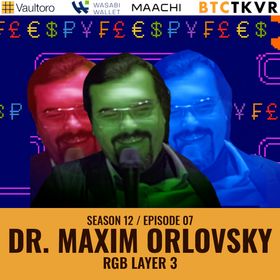
I recorded this one in a coworking space in Riga, next to Dr. Maxim Orlovsky. He's a doctor twice over. One of his degrees is a PhD in neuroscience. And he spends his time on RGB, a smart contract system that sits on top of Bitcoin and Lightning.
Maxim jokes constantly, and he warned me he'd keep "constantly mixing the serious stuff" with jokes. Underneath the humor is a serious idea, and I wanted it explained properly. The original show notes have the short version.
What RGB Stands For
My first question was simple. Red, green, blue? "Oh, no, no, no, absolutely not," he said. "It's clearly the really good thing for Bitcoin." Then he admitted the truth. "I was joking. Of course, it's about RGB. The original thing was about the colors." The joke stuck as a meme: "you can think about RGB being really good for Bitcoin and not the colors as a kind of joke."
The colors point to colored coins, the early idea of putting other assets on Bitcoin. RGB started as "a colored coin, so that's why RGB is a colors, but on the Lightning."
Client-Side Validation
I asked how RGB differs from Counterparty or Omni. Maxim went back to the source: "Peter Todd's research on timestamps."
Between 2014 and 2016, everyone wanted to pull the blockchain out of Bitcoin and use it for everything. Peter Todd was skeptical, because a blockchain doesn't scale. "The whole idea of blockchain that everybody does everything and that everybody does everything doesn't scale."
So Peter Todd "invented this concept of client-side validation." Maxim's version: "only parties involved in a certain contract have to" validate it. His example was a coffee. "If we have an agreement of something, like, I owe you a coffee this evening. Why people around us have to validate that proof?"
Why does Bitcoin need a blockchain, then? Because "money is the smart contract across all the people." He was clear that he was being provocative on purpose. "Of course, Bitcoin is a very good thing, a very advanced thing. And blockchain in Bitcoin is quite useful." But the chain is "non-scalable, public, non-really preserving privacy," so you use it only where you have to.
How It Differs From Lightning
Is Lightning client-side validation? Not quite. "Lightning still relies on the global consensus." It "uses client-side data, not validation." If someone cheats in a Lightning channel, "you have to appeal to the court or the blockchain." With client-side validation, "if you see that I violated the contract, you don't need any other party for you to prove that I violated the contract."
From Colored Coins to Smart Contracts
Maxim credited the founders openly. "It was Peter Todd as a primary father of the idea, and then Giacomo Zucco came and shaped it into a product-type protocols thing." Giacomo "was constantly asked how we can do proper coins on Bitcoin, proper tokens on Bitcoin." So "they did a prototype in 2016."
The market wanted something specific. Maxim put it plainly: "the market has demand for financial contracts."
His own path was winding. He "came to Bitcoin in 2013," helped start a Ukrainian Bitcoin Foundation, and later wanted to "put machine learning on blockchain." He even considered an ICO, which he now calls stupid. What changed his mind was censorship. "All the computation is monopolized by large cloud companies like Amazon and Google and IBM, Microsoft." He wanted "a distributed computational system that can run very high load computing like machine learning."
That didn't scale on other chains, so in 2019 he joined RGB. He didn't want just tokens. "Let's put my time and everything that I have into trying to convert RGB into a smart contract system, not just coins on Lightning." Together with Giacomo, they formed what became the LNP/BP Standards Association, building "layer two and layer three technologies" on Bitcoin "as it is, on top of Lightning, maybe modifying Lightning, but not requiring any soft forks from Bitcoin."
Not everyone liked the new direction. "This idea had a very strong opposition from many in the Bitcoin sphere, including Giacomo himself. He admits that." Many just wanted tokens like stablecoins on Bitcoin.
Funding was a rollercoaster. "In one year, we came to the crisis where I was continuing doing it as a smart contracting thing, but nobody actually needed that. So we switched to a different model where I was funding it from my pocket for another year or so." Then new funders "recognized the need of smart contracting" and kept it going.
No New Tokens
The design principle is strict. They build complexity in higher layers "without introducing tokens when it is not needed. And the fact that it is always not needed, literally always."
The pieces include RGB, data storage and an upgraded Lightning "supporting Taproot, multi-peer channels, and everything, Schnorr signatures," PTLCs and more, which they call Bifrost. The goal: "you finally can do everything that you can do with Ethereum, and even more, in a scalable way on top of Lightning, on top of Bitcoin, without introducing a new token."
Why Bitcoin Needs Contracts
Maxim said Bitcoin alone isn't enough for him. "I'm not satisfied with just having Bitcoin as a money. I need contracts. I need contracts. I need shares of the companies. I need loans."
He used a baker. If he sells bread today, "he need to be sure that he would be able to buy this wheat tomorrow at the price that contains his margin. And that's how future contracts appeared." A circular economy, in his view, can't run "without the smart contracts."
Interfaces Aren't the Point
I asked why RGB wasn't getting traction. Maybe it needed a nice interface? He compared it to TCP/IP. "The protocol level is not about the user interface, user experience or anything like that. It's about scalability, privacy, censorship resistance."
He also said he built it for himself. "I was doing this system for myself. That's why I put my money into this as well."
Demand for Censorship Resistance
Maxim liked a point Giacomo made on a Baltic Honeybadger panel that year. Whether it's tail emission, fees or the block subsidy, "the only thing that is important. Is there a market demand for censorship resistant solution?" If there is, "the Bitcoin block space will be used and paid for."
The same goes for RGB. "If there is no demand for censorship resistance, neither censorship resistant money will be in demand nor censorship resistant smart contracts."
Where RGB Stood in 2022
"It's not ready to be used by users," he said. "We released the protocol and the reference implementation this July after three years of development." Think of it "as a Bitcoin Core, even without the" wallet and interface. Next came user tools, built "in the way that will promote the proper usage."
To follow along, he pointed to GitHub, a Telegram group, a YouTube channel and developer calls "each two weeks." He was also honest about money. "We all run out of costs and we are actually looking for the funding." It wouldn't be an investment. Donors would get only "the satisfaction that they contributed to Bitcoin being developed."
He even had a joke ready for that: a "fungible collectible" for everyone who funded RGB. I told him I was looking forward to Rare Pepes on it. "That would be the second asset we will do."
What Makes This Episode Worth Listening To
Under the jokes, this is one of the clearest explanations of client-side validation you'll hear. Maxim gives credit to the people who came before him and makes a strong case that most contracts don't need a global ledger. Just know when he's joking, because he does it a lot.
You can read the full transcript, the original show notes, or visit Maxim Orlovsky's guest page.
Listen to Dr. Maxim Orlovsky on Spotify, Apple Podcasts, and More
Time stamps:
- 00:01:07– A PhD in neuroscience
- 00:01:52– Really good for Bitcoin
- 00:02:17– The colors
- 00:02:56– Peter Todd's research
- 00:04:29– Blockchain doesn't scale
- 00:05:54– Client-side validation
- 00:06:43– The coffee example
- 00:07:49– Money is a contract across everyone
- 00:08:25– Bitcoin needed a blockchain
- 00:09:52– Is Lightning client-side validation?
- 00:10:36– Validating your own contract
- 00:11:07– Client-side data
- 00:15:36– Demand for financial contracts
- 00:16:20– The 2016 prototype
- 00:17:33– From medicine to Bitcoin
- 00:18:14– Censorship and cloud computing
- 00:21:59– LNP/BP Standards
- 00:22:40– No new tokens
- 00:23:07– Opposition, even from Giacomo
- 00:24:04– Funding it from his pocket
- 00:25:10– Bifrost
- 00:28:21– Protocols aren't interfaces
- 00:28:58– I need contracts
- 00:29:33– The baker and the wheat
- 00:31:06– Demand for censorship resistance
- 00:31:58– No demand, no freedom
- 00:33:15– Not ready for users yet
- 00:34:10– How to follow RGB
- 00:34:55– Looking for funding
- 00:35:30– A fungible collectible
- 00:37:33– Rare Pepes
Verify this episode
This is the SHA-256 fingerprint of the MP3 as published here, timestamped in the Bitcoin blockchain with OpenTimestamps. If one byte of the file changes, the fingerprint changes.
- SHA-256
3e2957a54c9097de323f0c0ca1816b10e393de107e173431d0ec2697f4bf7edf- Proof
- 2022-11-02_s12_e7_maxim_orlovsky_on_rgb_layer_3.mp3.ots · all episode hashes (proof)
- Status
- Anchored in Bitcoin block 974,312
- Timestamped
- After release. The episode came out on 2 Nov 2022, but this proof was made on 3 Nov 2026 and anchored in block 974,312, so it proves this exact file existed by 3 Nov 2026, not on the release date.
How to check it yourself
- Download the MP3 and the proof into the same folder.
- Run
sha256sum 2022-11-02_s12_e7_maxim_orlovsky_on_rgb_layer_3.mp3(on a Mac:shasum -a 256 2022-11-02_s12_e7_maxim_orlovsky_on_rgb_layer_3.mp3). The result must match the SHA-256 above. - Install the OpenTimestamps client (
pip install opentimestamps-client) and runots verify 2022-11-02_s12_e7_maxim_orlovsky_on_rgb_layer_3.mp3.ots. It hashes the MP3 again and checks the proof against your own Bitcoin node, then prints the block and the date the file existed by. Without a node,ots info 2022-11-02_s12_e7_maxim_orlovsky_on_rgb_layer_3.mp3.otsshows the block height to look up in any block explorer.
Related
S12 E7: Dr. Maxim Orlovsky on RGB Layer 3
Maxim Orlovsky is the main developer of RGB: a layer 3 protocol that’s built on top of Bitcoin’s Lightning Network. Contrary to…
Breaking ChatGPT’s Bitcoin FUD #6: Limited Use Cases
According to ChatGPT, Bitcoin only accommodates a limited number of use cases, and this fact will consequently limit its adoption…
S17 E11: John Carvalho on Bitcoin Depression, Lightning Derangement & the Atomic Economy
John Carvalho was the second guest in the history of this podcast, way back in season one, episode two, when he was…

Comments
Comments run on my own server. No trackers, no tracking cookies.