




eCash (ECX): Paul Sztorc Forks Bitcoin to Prove a Point
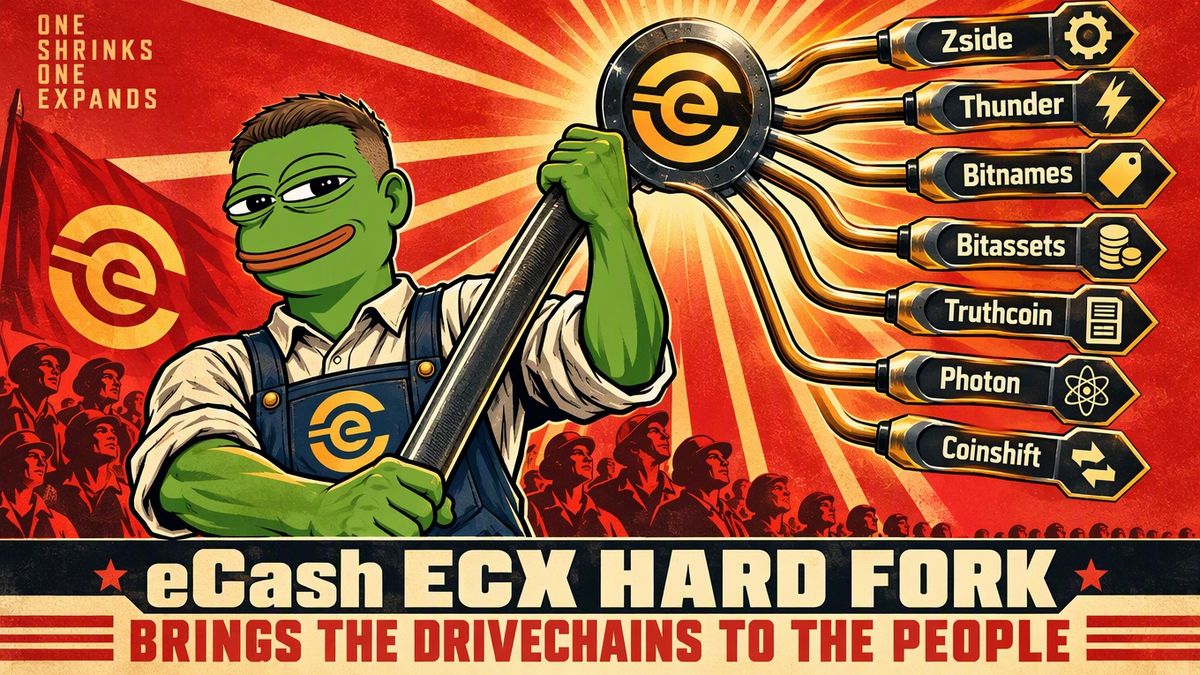
After eleven years of trying to convince Bitcoin to adopt Drivechains, the man who invented them stopped asking. His eCash fork copies Bitcoin’s ledger, adds as many sidechains as miners are willing to support, reallocates half of Satoshi’s stash, and goes live on Halloween 2026. In many ways, ECX is the most ambitious of all fork in this magazine… and the one Bitcoin developers should watch most closely.
I have known Paul Sztorc since 2018, and I have had him on Bitcoin Takeover podcast about 11 times without ever repeating the same interview talking points. So I have watched his work grow and improve over time. What I like about Paul is that he is focused on being technically correct, cares about finding the truth, but still finds the time to use funny or interesting metaphors to describe his ideas. When someone objects on the grounds of vibes or personal disagreements, Paul brings the conversation back to objective facts. He doesn’t get emotional about technology and he is willing to be proven wrong. Which is something that’s truly rare in the space.
Paul Sztorc first described Drivechains in 2015, formalized the concept as BIP-300 in 2017 and BIP-301 in 2019 alongside his friend BitAxe, and spent the following decade arguing for them in blog posts, conference talks, and podcasts. Then he started a company named LayerTwo Labs, used the money to pay his harshest critics (Peter Todd and Luke Dashjr) to do professional reviews of his ideas, and then funded developers to build the piece of software that lets miners activate BIP300 without asking permission from Core (CUSF, or the Core Untouched Soft Fork).
None of it turned out to be fruitful. BIP-300 is still a Draft. So in April 2026, Paul formally announced he was done waiting, and that he would fork Bitcoin himself.
This is the short version of the story about the new eCash, whose ticker is ECX. It is also the story of a friend who has been right about a remarkable number of things and has too often made it hard for people to notice or acknowledge.
Disclosure: LayerTwo Labs, Paul’s company, sponsors the Bitcoin Takeover podcast and this magazine. I have tried to hold this article to the same standard as the others in the issue. You can judge whether I succeeded.
Vital statistics
Data as of 28 September 2026. The permanent chain does not exist yet, so most of these figures describe the rehearsals.
| Field | Value |
|---|---|
| Name and ticker | eCash, ECX (practice coins on Alpha and Beta: pECX) |
| Not to be confused with | eCash (XEC), Amaury Séchet’s Bitcoin Cash fork; Cashu and Fedimint ecash; David Chaum’s 1990s eCash |
| Category | UTXO hard fork of Bitcoin, built to activate BIP-300 and BIP-301 natively |
| Announced | 24 April 2026, on X, originally for a single fork near block 964,000 in August |
| Staged launch | Announced 8 August: Alpha, Beta, then a permanent Mainnet |
| Alpha | Forked from Bitcoin block 963,647 on 23 August 2026; first Alpha block 963,648 at difficulty 1, coinbase tag /layertree-ecash/ |
| Beta | Fired 19 September 2026, around Bitcoin block 967,680 |
| Mainnet | Around Bitcoin block 973,728, on or about 31 October 2026, the whitepaper’s 18th anniversary |
| Distribution | Every Bitcoin address at the Mainnet snapshot receives ECX 1:1; no claim, no form, no registration |
| Proof of work | SHA-256d, with a one-time difficulty reset to the minimum at the fork |
| Node | ecash-com/bitcoin, forked from Bitcoin Core v31.1, plus the bip300301_enforcer companion |
| Sidechains at launch | Seven Options: Thunder, zSide, BitNames, BitAssets, Truthcoin, Photon, CoinShift |
| Replay protection | Opt-in and one-directional: ECX transactions with nLockTime = 499999999 |
| Satoshi’s coins | 220 hard-coded transactions reassign part of the Patoshi-pattern coins on the ECX ledger only; about 600,000 stay, about 500,000 go to pre-launch investors |
| Alpha hashrate | About 5 PH/s in late August, about 9.7 PH/s on 17 September, roughly 0.001 percent of Bitcoin’s |
| Market | No tracked price. CoinMarketCap has an “eCash (ECX)” page with self-reported supply; pECX trades informally |
Eleven years of asking
To understand the fork you have to understand how much time Paul spent developing the idea and trying to promote it in the developer circles.
He first rose to Bitcoin prominence through prediction markets. In 2014 he published the Truthcoin whitepaper, later renamed Bitcoin Hivemind: a way to run betting markets whose outcomes are decided by a decentralized vote instead of a trusted oracle. In order to scale, it needed a home that was not the Bitcoin main chain. Nobody would let a prediction market clutter Bitcoin’s base layer, and rightly so. Drivechains were envisioned as that home. A sidechain would hold BTC, run whatever rules its users wanted, and send the coins back to the main chain when they were done, with Bitcoin’s miners acting as the custodians.
In December 2022 Paul, CryptAxe and former Kraken executive Austin Alexander launched LayerTwo Labs with a $3 million seed round to build the software. In 2023 Luke Dashjr, of all people, opened a pull request to Bitcoin Core implementing BIP-300 (#28311). It was closed in March 2024 without being merged. That October the company paid Peter Todd, one of Drivechain’s most persistent critics, to write a detailed technical analysis. He wrote it, but didn’t put much effort into it. Paul eventually spent more time dissecting it than it took for Peter Todd to write it.
By late 2024 Paul had a new plan, which he explained in detail on Bitcoin Takeover Podcast S15 E68: a “Core Untouched Soft Fork,” or CUSF. Miners would run a small enforcer program beside an unmodified Bitcoin Core, and if a majority of hashrate did so, Drivechains would activate without a single line entering Core’s repository. Critics called it a way around peer review. Paul called it the only way left. His explanation of why is still the best summary of Bitcoin’s development pace I have recorded:
“We used to do a soft fork every six months… in the first like seven to eight year period, we did 16. In the second seven to eight year period, we did two. And one was SegWit, 26 months, and then [Taproot] 40 months. So it’s just been getting slower and slower.”
Miners did not run the enforcer. So in April 2026, Paul announced the hard fork.
Right, early, and hard to listen to
I want to be fair to Paul here, because the Bitcoin conversation usually isn’t.
He was right that Bitcoin’s upgrade pipeline was drying up. Taproot activated in November 2021, and nothing has activated since. His own project’s website puts it bluntly: “bitcoin has ossified.” You can argue ossification is a feature and find virtues in a protocol that doesn’t change. But you cannot argue that it isn’t happening.
He was right that people wanted more from Bitcoin than Bitcoin offered. Ordinals, Runes, BitVM, Citrea, Spark, the whole 2024 rush toward “Bitcoin L2s”: every one of them confirmed that users and developers wanted programmability, privacy and scale attached to BTC. Most of them got there through federations or trust assumptions Drivechains were designed to avoid.
He was right about prediction markets. In 2014 they were a libertarian curiosity. By 2024 Polymarket was a household name during an American election. The ecashblog marked the eve of the Alpha with a reunion between Paul and Robin Hanson, the economist whose work started the field. That felt earned.
Paul Sztorc is also right that the argument against Drivechains has often been cultural rather than technical. Peter Todd’s critique was technical, serious, but half-baked and excessively paranoid about miners that otherwise have all the incentives to remain honest actors. But a lot of the debate was disappointingly ideological.
However, Paul does not like it easy. Here is how his own fork’s website explains the decision to leave:
“I would prefer not to. But it’s not up to me. Other people are damaging the Bitcoin project. Core developers have become timid, self-interested, lazy, and corrupt. Miners have abdicated their duty… Bitcoin culture has many entrenched errors, and is probably unfixable at this point.”
It then sums up the cost of the fork: “The downside is small: some drama, plus every Bitcoiner gets some free money.”
That is Paul in two sentences. The first is a shot at the people he spent a decade trying to persuade. The second is a genuinely good point, phrased as a taunt. I have seen people who agreed with every technical argument about Drivechains walk away because of paragraphs like that (or tweets that express a similar attitude). I have also seen Paul be patient, generous and funny for three hours on a microphone. Both versions are real. But only one tends to end up in screenshots.
The Satoshi coins
The detail that made the April announcement explode had nothing to do with Drivechains.
Roughly 1.1 million BTC sit in early coinbase outputs that follow the “Patoshi” mining pattern, and are widely assumed to be Satoshi’s. They have never moved. On the ECX ledger, which copies Bitcoin’s, they would appear exactly as they are. Paul’s plan is to leave about 600,000 of them where they are and use 220 hard-coded transactions, valid without the original signatures, to reassign about 500,000 to investors who fund the project before launch. His justification was that without early capital, eCash would become a “zombie project”: half built, underfunded, and quietly controlled by whoever happened to show up.
Peter McCormack called it “theft and disrespectful.” Paul’s answer was short: “We do not take any of Satoshi’s BTC.” Technically he is correct. Not one satoshi moves on Bitcoin. Jameson Lopp made the same point, while adding that the marketing seemed designed to provoke. But the objection was never really technical. Bitcoin’s culture treats an unspent output as sacred, and Satoshi’s outputs most of all. Rewriting their copy on another chain, even a chain nobody is obliged to use, crosses a line many people did not know they cared about until it was crossed.
There is a quiet irony worth noting. In S17 E19, Amaury Séchet told me that what alarms him most about Bitcoin today is how casually its developers now discuss freezing Satoshi’s coins to defend against quantum computers: “10 years ago people would laugh in your face. But now apparently it is on the table.” On Bitcoin itself, the idea of touching those coins went from unthinkable to debatable in a decade. Paul simply did it first, on his own chain, in the open, and put a price on it.
Alpha, Beta, Mainnet
The original plan was one permanent fork on 23 August. On 8 August Paul changed it to three. His stated reasons: rehearse the software, encourage a market for practice coins to find a price, and keep a way to abort if something went badly wrong. He was frank about the risk of bugs in rapidly written, partly machine-assisted code, which he called “LLM bug chaos.” No Bitcoin fork in this magazine was launched this cautiously. Bitcoin Cash forked in one shot in 2017, and so did everything after it. But then again, none of them were this ambitious in scope either.
Alpha forked just after midnight UTC on 23 August, at difficulty 1. The first week ran on rented hashrate, which pushed difficulty up fast. When the rental contracts ended, difficulty stayed high. By 27 August the network needed about 30.7 PH/s to produce ten-minute blocks and had about 5. The ecashpool.tech mining dashboard’s weather forecast became a community joke: “mostly slow, chance of drift.” Orphan blocks, a production incident, and a lot of arguing about where to point the hash followed.
Then came the part that matters for Bitcoin history. During the Alpha, community-built drivechains were activated under proof of work, and the first withdrawal bundle was proposed on a live BIP-300 chain. For eleven years Drivechains existed only in documents, testnets and arguments. For a few weeks in September 2026, they existed on a chain with real miners and coins that people were willing to buy.
Before Beta, about 150,000 pECX (practice ecash) were burned by holders. Practice coins from Alpha and Beta are meant to be redeemable for permanent ECX at a steep discount. Paul has been quoted describing a ratio of 1,000 pECX to 10 ECX. Beta fired on 19 September on schedule. Mainnet is the only stage that creates permanent ECX, from a fresh Bitcoin snapshot around block 973,728. That snapshot is what gives every Bitcoin holder their coins. The Alpha and Beta snapshots do not count.
How Drivechains work
Here is the idea in plain terms.
A sidechain is a separate blockchain that uses BTC (here, ECX) as its money. To move coins onto it, you send them to a special escrow output on the main chain. The sidechain sees the deposit and credits you. That part is easy.
The hard part is coming back, because the main chain cannot read the sidechain’s rules. Drivechains solve this by making miners the judges. When the sidechain wants to release coins from escrow, it publishes a withdrawal bundle: one transaction that pays out everyone leaving. Main-chain miners then vote on it block by block. Under BIP-300 a bundle needs 13,150 votes of approval within a window of 26,300 blocks, about three to six months. If it gets them, the escrow pays out. If it doesn’t, the bundle expires.
BIP-301 handles the other half. Sidechain blocks are produced by people who bid for the right to have their block hash included in a main-chain block. Miners collect the bid as a fee without running any sidechain software, which is why it is called blind merged mining.
The design choice is the whole argument. There are no fraud proofs and no federation. The coins in escrow are protected by the fact that stealing them would take a majority of miners voting dishonestly, in public, for months, while everyone watches. Supporters say that is the same security Bitcoin already has: miners could always reorganize the chain, and they don’t. Critics, Peter Todd foremost, say it turns miners into custodians of every sidechain, adds a new kind of power and liability to mining, and gives them a reason to consolidate. Both sides are describing the same mechanism. For eleven years they could only argue about it. Now there is a chain where the argument can be tested.
The seven ”official” sidechains
| Slot | Sidechain | What it is for |
|---|---|---|
| 2 | BitNames | Decentralized names and identity |
| 4 | BitAssets | Issuing and trading tokens |
| 9 | Thunder | Large blocks for cheap, high-volume payments |
| 13 | Truthcoin | Hivemind prediction markets, Paul’s original project |
| 98 | zSide | Zcash-style shielded privacy |
| 99 | Photon | Post-quantum signatures and vaults |
| 255 | CoinShift | Swaps between eCash and other coins |
Look at that list and you see Paul’s answer to the altcoin market. Almost every successful altcoin does one thing Bitcoin won’t: privacy, tokens, names, fast payments, quantum resistance. Paul’s claim is that each of those should be a sidechain of Bitcoin’s money instead of a separate coin with its own supply and its own premine. Truthcoin is on the list because the whole journey started there.
Two forks, two philosophies
The summer of 2026 produced two serious departures from Bitcoin within weeks of each other, both led by developers with long grievances, and both airdropping coins to every Bitcoin holder. They are opposites in almost every way.
Luke Dashjr’s BLAKE2b fork is a conservation project. It exists to remove things: arbitrary data, large scripts, Taproot’s extension points, even two thirds of the block size. It changed its proof of work so that Bitcoin’s miners could no longer participate, and within weeks it was drawing up rules to punish the miners it did attract. Its idea of Bitcoin is a narrow one: money, and nothing but money.
Paul’s eCash is a construction project. It keeps SHA-256d so that Bitcoin’s miners can come along. It keeps Bitcoin Core’s code almost untouched so it can keep merging Core’s changes. Everything new goes into optional sidechains that nobody is obliged to use. Its idea of Bitcoin is a broad one: the most trustworthy money, with every useful feature built on top of it.
The two founders overlap in odd places. Luke wrote a Core implementation of BIP-300 in 2023. Both believe Bitcoin Core’s process is broken. Both forked in the same month. But when a large pool arrived on Luke’s chain, his community debated blacklisting its address at the consensus level. Paul’s chain is designed so that miners are paid to be judges. One fork is afraid of what miners might do. The other is betting everything on what they won’t.
The eCash community noticed the contrast, not always charitably. In their chat the BLAKE2b chain was promptly renamed “Lukecoin,” and one member predicted in early September that it “will probably have its own contentious hardfork within a year. Purity spiral.” Within days, the puritan fork was fighting over its biggest pool.
eCash against Bitcoin and Bitcoin Cash
| Bitcoin | Bitcoin Cash | Bitcoin BLAKE2b | eCash (ECX) | |
|---|---|---|---|---|
| Scaling bet | Small base layer, Lightning and other L2s | Bigger base blocks for everyone | Smaller base blocks, money only | Unchanged base layer, opt-in sidechains |
| Proof of work | SHA-256d | SHA-256d | BLAKE2b | SHA-256d |
| New features | Rarely, by soft fork | Yearly, by hard fork | Removes features | Mostly off the main chain, via sidechains |
| Relationship with miners | Miners signal; users enforce | Miners choose the software | Miners distrusted, rewards locked 45 days | Miners judge sidechain withdrawals |
| Relationship with Bitcoin Core | Is Bitcoin Core | Left in 2017 | Left in 2026 | Keeps merging Core |
| Genesis controversy | None | None | Mandatory signaling at 2.53 percent | Reassigned Patoshi coins |
Against Bitcoin, eCash is the road not taken: the same chain, the same rules, the same code, plus the one upgrade Bitcoin declined. If Drivechains work, eCash is the proof. If they fail, it is the warning.
Against Bitcoin Cash, the contrast is sharper, because Paul has always said Drivechains would have made Bitcoin Cash unnecessary. Bitcoin Cash made every user carry bigger blocks. Thunder offers large blocks only to the people who choose them, pegged to the main chain’s coin. The big blockers of 2017 split the network, the community and the brand to get what Paul argues they could have had as a sidechain. Nine years later he is testing that claim with real money.
Why eCash matters, even if it fails
This is the part I hope Bitcoin developers will read.
For a decade, the debate over Drivechains has been about hypotheticals. Will miners steal? Will they collude? Will blind merged mining centralize pools? Will anyone use the sidechains? Will withdrawal bundles of thousands of payouts get through in practice? Every one of those questions is empirical, and until August 2026 there was no data, only testnets and blog posts.
eCash is a free experiment for Bitcoin. It costs Bitcoin nothing: no code change, no activation, no risk to a single BTC. Its node is so close to Bitcoin Core that its accomplishments will be easy to adopt… if there’s ever consensus for it. If miners on eCash honestly approve withdrawal bundles for a year, that is useful feedback for the incentive model.
If the miners try to steal, that is good evidence too. If Thunder attracts real payments, or zSide real privacy users, or Truthcoin real markets, this tells Bitcoin something no amount of mailing-list debates can. And the project’s own FAQ says it will call itself off if Bitcoin activates BIP-300 and BIP-301 first, which makes the whole fork a standing offer as much as an exit.
This is also why the staging matters. Alpha and Beta are the first time a Bitcoin fork has been rehearsed in public, on mainnet hashrate, with a kill switch. Whatever you think of Paul’s opinions, this is a method other developers can borrow.
The name problem
This magazine now covers two coins called eCash. Amaury Séchet renamed Bitcoin Cash ABC to eCash in 2021, and it trades as XEC. Paul owns the ecash.com domain and chose the ticker ECX. The name comes from Milton Friedman’s 1999 remark that the missing piece of the internet was a reliable “e-cash,” and from Satoshi’s first draft of the whitepaper, which circulated as ecash.pdf. When I asked the Bitcoin Cash developers about it in S17 E26, Steve Thurmond called it “a dick move.” Calin Culianu reduced the dispute to one line of Python: "ecash" == "ecash".
The collision is not only an insult. It is a phishing opportunity. Exchanges and wallet providers have already warned about fake “claim your ECX” sites. The rule is simple: if you hold BTC in self-custody at the Mainnet snapshot, you already have ECX under the same keys. Nobody needs your seed phrase. Anyone who asks for it is a thief.
There is one small, strange grace note. In the same S17 E19 conversation, I asked Amaury what he would work on if his eCash didn’t exist. “I probably would have to join Paul and work on Drivechain.”
The risks
Before Mainnet, here is what everyone should know:
- Replay. Protection is opt-in. A Bitcoin transaction broadcast after the split may be valid on eCash too, unless you deliberately split your coins. Paul has said plainly that unprotected transactions will be replayed.
- Security. On the Alpha, the whole chain ran on about 0.001 percent of Bitcoin’s hashrate. Any SHA-256 miner of moderate size could reorganize it. Sidechain escrows are only as safe as the honesty of a majority of that small hashrate.
- Exchanges. If your BTC sits on an exchange at the snapshot, the exchange controls your ECX, and many exchanges have said they will not credit it. Japanese venues including Coincheck, GMO, SBI and Zaif took a cautious line during the Alpha.
- Withdrawal speed. Leaving a sidechain through the main peg takes months by design. Faster exits exist only through services that front you the money, which means trusting them.
- Concentration. One company, one node implementation, one lead, and a genesis distribution that includes about 500,000 reassigned coins held by pre-launch investors.
Who is who
The fork
- Paul Sztorc (“Truthcoin”), author of BIP-300 and BIP-301, founder and CEO of LayerTwo Labs, creator of Bitcoin Hivemind. The public face, the chief strategist and, often, his own sharpest critic’s best material.
- CryptAxe, co-author of BIP-300 and BIP-301 and LayerTwo Labs co-founder, responsible for much of the code.
- Austin Alexander, LayerTwo Labs co-founder, formerly of Kraken.
- LayerTree, the pool tag on the first Alpha block.
- The eCash community, whose running Alpha diaries on ecashblog.com are the best record of the rehearsal, and who are, understandably, not neutral.
The critics and the context
- Peter Todd, whose 2023 analysis, paid for by LayerTwo Labs, remains the most discussed technical case against Drivechains.
- Luke Dashjr, who wrote a Core implementation of BIP-300, then led the rival fork of 2026.
- Bitcoin Core maintainers, who never merged BIP-300.
- Peter McCormack and Jameson Lopp, who led the reaction to the Patoshi reassignment from opposite angles.
- Amaury Séchet, whose eCash (XEC) got to the name first.
What eCash has proved so far
It is early, so this list is short, and honest about that.
- Drive chains can run. Sidechains activated under proof of work and a withdrawal bundle was proposed on a live chain. What eleven years of argument could not settle was brought by a few weeks of rehearsal.
- A fork can be rehearsed. Alpha and Beta showed that a split can be tested on real hashrate before it becomes permanent.
- Difficulty is the first enemy of a minority SHA-256 chain. Rented hashrate arrived, pushed difficulty up, left, and stranded the network at a sixth of the hashrate it needed.
- Genesis choices are forever. Whatever eCash achieves, the reassigned Patoshi coins will be the first thing people mention.
- Hold your forks. Keep your BTC in self-custody before block 973,728 and you will own ECX under the same keys, for free, whether or not you choose to touch it.
Will it flip Bitcoin?
No. Paul doesn’t claim it will either. He says he intends to keep his BTC, and he recommends you do the same. The main net eCash chain does not exist yet, the rehearsal ran on a thousandth of a percent of Bitcoin’s hashrate, and the market for its coins is informal at best.
The better question is whether eCash will change Bitcoin. That depends on what happens after Halloween. If miners judge withdrawal bundles honestly, sidechains find users, and the chain survives its first attempted theft, Bitcoin will have for the first time real evidence about an upgrade it has argued over since 2015. If it fails, Bitcoin will have learned that cheaply too. Either way, after eleven years of being told his idea was dangerous, Paul will finally have data instead of opinions. I suspect he will say so, loudly, and in a way that annoys all skeptics. I also suspect that most of the time, he will be right.
Scorecard inputs
| Criterion | Evidence |
|---|---|
| Technical ambition | Native BIP-300 and BIP-301; seven sidechains at launch; enforcer architecture; staged public rehearsal; continued merging of Bitcoin Core. The most ambitious feature set of any fork in this issue |
| Political radicalism | Fork after a decade of failed soft fork advocacy; reassignment of about 500,000 Patoshi-pattern coins to investors; opt-in replay protection; a name that collides with XEC; a founder who calls Core developers “corrupt” |
| Adoption | Pre-Mainnet; Alpha and Beta live; pECX traded informally; about 150,000 pECX burned; CoinMarketCap page with self-reported supply; major exchanges still cautious |
| Scalability claims vs measurement | Claims: global scale through Thunder and other sidechains. Measured: sidechains activated and a withdrawal bundle proposed on Alpha; no sustained throughput data yet |
| Decentralization | One company, one node implementation, one enforcer; SHA-256d lets any Bitcoin miner join; a concentrated investor allocation at genesis |
| Security model | Main-chain coins protected like Bitcoin’s; sidechain escrows protected by months-long majority miner voting; Alpha hashrate about 0.001 percent of Bitcoin’s |
| Long-run viability | Funded company since 2022; open repositories; public rehearsal culture; stated willingness to stand down if Bitcoin activates BIP-300. Counter-signals: Patoshi stigma, name confusion, thin security at launch |
| Speculative context | Upside: first real evidence for Drivechains, and a free airdrop to every self-custodied holder. Downside: replay losses, exchange non-support, a chain secured by a sliver of Bitcoin’s hashrate |
Sources
ecash.com and its pages Why hard fork, What to expect, How to claim and Coin splitting; ecash-com/fast-facts integration guide; drivechain.info; BIP-300 and BIP-301; truthcoin.info, including “Blockstream’s Big Mistake” (December 2025); ecashblog.com: “eCash ECX Hard Fork 101”, “The eCash Alpha, Days 4 to 15”, “Days 16 to 28”, “Two Bitcoin Forks, Two Philosophies”, and posts on Photon, Truthcoin and CoinShift; eCash Alpha explorer; mempool.space for fork-anchor hashes; Peter Todd, “Drivechains: A Detailed Analysis” (October 2023); CoinDesk on the LayerTwo Labs seed round (December 2022) and the Patoshi reassignment (April 2026); Bitcoin.com News on the announcement and the three-stage launch; CryptoSlate on the Alpha and exchange notices (August 2026); Because Bitcoin on the Patoshi debate; Bitrue on ECX scam warnings; Bitcoin Takeover Podcast S15 E68 and S17 E21 (Paul Sztorc), S17 E19 (Amaury Séchet), S17 E26 (Calin Culianu and Steve Thurmond).
This essay is part of BTCTKVR: Forks!, my free 2026 magazine about Bitcoin forks. Start with What the Fork?! for the overview, or hear the guests argue it in their own words in Bitcoin Forks, Described by Dorks.
Update, November 2026
Mainnet happened
The essay above was written at the end of September 2026. Its vital-statistics table is explicit: data as of 28 September, and “the permanent chain does not exist yet.” Those lines are left as they were. What follows is the launch that had not yet occurred.
Mainnet forked from Bitcoin at block 973,728 on 29 October 2026. The fork was always set by height, not by a clock. The earlier public aim, including on S17 E37, was 31 October, the white paper’s eighteenth anniversary. Bitcoin’s block times slipped, and height 973,728 arrived two days earlier. The project’s own facts sheet, ecash-com/fast-facts, and ecash.com describe a SHA-256d chain, ticker ECX, that credits every Bitcoin address at the snapshot 1:1 and does not alter Bitcoin. They also say, explicitly, “Not XEC.”
Sidechains were not all live in the fork block. The same facts sheet said none would be active at the fork, and that each BIP 300 slot had to be proposed and activated by miners afterwards. A contemporary launch-day account is eCash mainnet launch: the drivechain blockade. A shorter sourced entry is in Fork Wars: eCash (ECX). The other eCash, Amaury Séchet’s XEC, remains a different chain, told in eCash (XEC): The Fork That Taxed Itself.
The announcement interview is still S17 E21. The magazine home is BTCTKVR: Forks!.
Related
S17 E37: Paul Sztorc on the eCash Three Stage Launch, Free Coins & 12 Drivechains
Paul Sztorc now holds the record for the most appearances on this show: eleven. Nobody else has come close, and nobody else…
S17 E10: Mark Karpelès on Mt. Gox, the 1Feex Fortune & His Plan to Hard Fork Bitcoin
Mark Karpelès is the one name in Bitcoin that needs no introduction and always gets one anyway. The former CEO of Mt.…
S17 E38: Keagan McClelland on Lightning Metrics, Covenants, Consensus Politics & Verifying Bitcoin
There is a certain genre of Bitcoin Twitter argument that never quite resolves into a conversation. People trade metrics, memes…

Comments
Comments run on my own server. No trackers, no tracking cookies.