




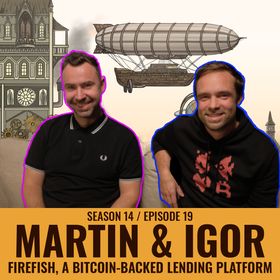
Martin and Igor on Firefish, a Non-Custodial Bitcoin Lending Platform (S14 E19 Full Article)
The audio keeps playing while you browse the site.
Read the transcript6,732 words, every line links to the minute it was said
Ask this episode
I visited the Firefish office in Prague to meet the two co-founders, Martin and Igor. We agreed that their last names don't matter. What matters is the idea, which I described on air as "essentially BlockFi without the company."
You take a fiat loan against your bitcoin, you don't sell it, and nobody takes custody of your coins. Here's how they explained it. The original show notes have the short version.
Bitcoin as Your Private Bank
Igor called it "a new use case for Bitcoin." Most people see Bitcoin as a store of value or a payment system. Firefish treats it "as an asset, as a collateral that you can use as almost like your family or private bank." In other words, "you are using Bitcoin as a super collateral."
Martin framed the dilemma. Say you need money for education, health care or an investment. "Do I sell my Bitcoin, my precious asset, or should I maybe take out a peer-to-peer loan in fiat?" He was clear about the philosophy: "we are not advocating fiat in any sense, actually quite the contrary." The idea is "to be effectively short fiat."
A Marketplace, Not a Lender
Two things matter most. First, "we are a non-custodial platform in the first place, right? So really your Bitcoin is not sent to Firefish, it's not sent to any custodian." It's locked in what Igor called "a very specific, what you could call a smart contract on layer one."
Second, "Firefish is not the provider of the loan." It's "a peer-to-peer marketplace where on both sides you have the borrowers and you have what we call investors." The cash comes "from a particular person or an institution," and at the time it was "settled through a standard bank transfer."
I asked about lenders hoping borrowers default so they get cheap bitcoin. Igor said the market is "pretty competitive," and offering 2% hoping for a default? "Well, good luck. What if I repay, right?" Loans usually run at about 50% loan to value. "If I want to have or want to get $100,000, I would need to deposit or lock $200,000 worth of Bitcoin." So borrowers "think twice" before walking away.
Real users had other goals: "buying a house, buying a car, investing in business," or simply to "get more leverage, buy more Bitcoin." They call it "the Bitcoin-backed everything platform."
How the Multisig Works
I'd heard about the design from Martin Habovštiak, who coded much of it. Martin gave me the short version: "output of the escrow is restricted. It can be only spent in two specific directions." Either "back to the borrower, especially when they repay the loan, or it is spent to the liquidator."
There are five roles: borrower, lender, liquidator, plus "two general roles, payment oracle and price oracle." The contract needs only two kinds of data: whether the loan was repaid, and "data attesting to the price of the Bitcoin at any given time."
"We are locking Bitcoin in a three of three multisig when one of the key is held by a payment oracle, another by the price oracle, and third one by the borrower himself." Then they "create a set of pre-signed Bitcoin transactions that represent each of the states": repaid, defaulted and liquidated.
My favorite part: "the last one is zombie apocalypse transaction that is actually valid from day one. It just has a timelock on it." If the oracles disappear, "you can be sure that you can still recover your Bitcoin from the escrow."
Who Runs the Oracles?
At the time, "both oracles are implemented on our side." But the keys can only do so much. "We can basically send Bitcoin back to borrower or to the liquidator, nothing else." Over time, a DLC scheme for the price oracle "will be definitely better."
Martin also called the design "a little bit of a workaround that allows like similar functionality that covenants would allow." Covenants would let Bitcoin script restrict where an output can go directly.
Who Is This For?
Borrowers are "definitely Bitcoiners like us," plus "institutions who are holding Bitcoin on their balance sheet." The clever part is the other side. "The lender, the investor, like the second side of the transaction, doesn't need to hold any cryptographic materials such as private keys." So traditional finance can "fund Bitcoin-backed loans without touching Bitcoin whatsoever."
Igor compared it to how wealthy people use assets. "They sit on assets and they take loans against their assets because their assets are appreciating over time." For a borrower, it's "a shift in the mindset."
They'd also seen lenders change their minds. Some "never touched anything crypto in general," but after funding loans, "their perception of what Bitcoin is" changed. Martin added that for an institution with no exposure, "Bitcoin is still useful for you. It's securing your transaction with a random person on another side."
The Legal Side
"Our first employee in the company was a lawyer." Both founders come from traditional finance, and "once you're touching the fiat payment system and the fiat world, you really need to be compliant." Each match creates "a bilateral loan agreement," which they spent "months and months" building.
Could Firefish be banned? Igor said they're a software provider: "We are not touching fiat, we are not touching even Bitcoin." For the EU, "we have even a legal opinion that really our setup is clear." Martin was blunter. You run "our Bitcoin library on your site within your browser," and "you are creating this escrow yourself." So "somebody can try to ban us, but honestly, good luck with that."
When a Bank Transfer Gets Stuck
Disputes are about fiat. A lender says they sent the money, the borrower hasn't received it. Igor described "a SWIFT limbo" caused by a wrong code. They built "a resolution procedure" for this, and the cases they'd seen came down to bank details. Worst case, "you can always obviously resort to the legal system."
Open Source Plans
I asked whether users can audit the code. "Our goal is to have the code open source. The design of the protocol is open source now." The implementation wasn't yet, "because it's changing all the time," but "we have audited one version of the code by a specialized security firm." Once things settle, they planned to open it, because "it is part of our security proposition."
KYC, Stablecoins and the Name
At the time there was no KYC and no fees, but "over time actually it's going to be a commercial product. So we will most probably need to do KYC." Igor's point: "Once you touch the banking system, you are not anonymous anymore."
I asked about stablecoins. Martin agreed they'd mean fewer requirements, but "stablecoins are bringing some layer of risk that is hard to comprehend," especially for institutions. "That's why we took the harder part." Honestly, "the Bitcoin part is fun, but the banking part" is the painful part. Stablecoins might come later as an option, and "the choice is yours."
And the name? "Well, it's just random two words." Martin admitted, "I just thought it's two cool words."
Closed Beta
I first saw Firefish at Pizza Day in Prague and then at BTC Prague. It was still "in a closed beta," mostly for "a closed bubble of central European Bitcoiners," with loans limited to "2,000 euros, I guess, at this moment." Martin invited people to "sign up for our beta and help us fireproof the platform." Igor said "the ambition is global."
What Makes This Episode Worth Listening To
I like any design where the worst case still returns your coins. Firefish takes a familiar product and removes the custodian, using multisig and pre-signed transactions. If you've wondered how to borrow against bitcoin without trusting a company with it, this is a clear explanation.
You can read the full transcript, the original show notes, or visit the guest pages for Martin and Igor.
Listen to Martin and Igor on Spotify, Apple Podcasts, and More
Time stamps:
- 00:01:12– BlockFi without the company
- 00:01:54– A new use case for Bitcoin
- 00:03:04– Sell or borrow?
- 00:04:29– Non-custodial marketplace
- 00:05:21– Peer-to-peer fiat
- 00:06:33– Bitcoin-backed everything
- 00:07:30– Hoping for defaults?
- 00:08:21– 50% loan to value
- 00:09:26– Two spending paths
- 00:10:17– Roles and oracles
- 00:11:19– 3-of-3 multisig
- 00:12:50– Who holds the oracle keys
- 00:15:01– A covenant workaround
- 00:16:02– Who borrows and who lends
- 00:17:55– Borrow like the rich
- 00:19:13– A lawyer first
- 00:20:44– Can Firefish be banned?
- 00:22:04– Good luck with that
- 00:24:23– SWIFT limbo
- 00:28:30– Changing lenders' minds
- 00:29:56– Useful without holding Bitcoin
- 00:30:58– Closed beta
- 00:32:27– Open source plans
- 00:33:58– KYC
- 00:36:45– Why not stablecoins?
- 00:38:55– The name
- 00:40:01– Help fireproof the platform
Verify this episode
This is the SHA-256 fingerprint of the MP3 as published here, timestamped in the Bitcoin blockchain with OpenTimestamps. If one byte of the file changes, the fingerprint changes.
- SHA-256
71d338d70dfabc94cf06f69341cfcecb69c6c0cda8abc6b87b71c321a06e81be- Proof
- 2023-11-02_s14_e19_martin__igor_on_firefish__a_bitcoin_lending_service.mp3.ots · all episode hashes (proof)
- Status
- Anchored in Bitcoin block 974,312
- Timestamped
- After release. The episode came out on 2 Nov 2023, but this proof was made on 3 Nov 2026 and anchored in block 974,312, so it proves this exact file existed by 3 Nov 2026, not on the release date.
How to check it yourself
- Download the MP3 and the proof into the same folder.
- Run
sha256sum 2023-11-02_s14_e19_martin__igor_on_firefish__a_bitcoin_lending_service.mp3(on a Mac:shasum -a 256 2023-11-02_s14_e19_martin__igor_on_firefish__a_bitcoin_lending_service.mp3). The result must match the SHA-256 above. - Install the OpenTimestamps client (
pip install opentimestamps-client) and runots verify 2023-11-02_s14_e19_martin__igor_on_firefish__a_bitcoin_lending_service.mp3.ots. It hashes the MP3 again and checks the proof against your own Bitcoin node, then prints the block and the date the file existed by. Without a node,ots info 2023-11-02_s14_e19_martin__igor_on_firefish__a_bitcoin_lending_service.mp3.otsshows the block height to look up in any block explorer.
Related

S14 E19: Martin and Igor on Firefish, a Bitcoin-Backed Lending Platform
Firefish is an ambitious project which takes on the massive challenge to create a trust-minimized version of BlockFi or Celsius…
S14 E16: Philipp Hoenisch on 10101 Synthetic Stablecoins on Bitcoin
Philipp Hoenisch is a developer and trader who decided to create 10101 (Ten Ten One): a synthetic stablecoin system that’s built…
S14 E5: Ben Arc on LNBits and Nostr
Ben Arc is the creator of LNBits: a modular Lightning wallet which empowers users to pick their desired features (presented as…

Comments
Comments run on my own server. No trackers, no tracking cookies.