




On Bitcoin Maximalism, and Dogmatically Losing the Currency and Platform Network Effects
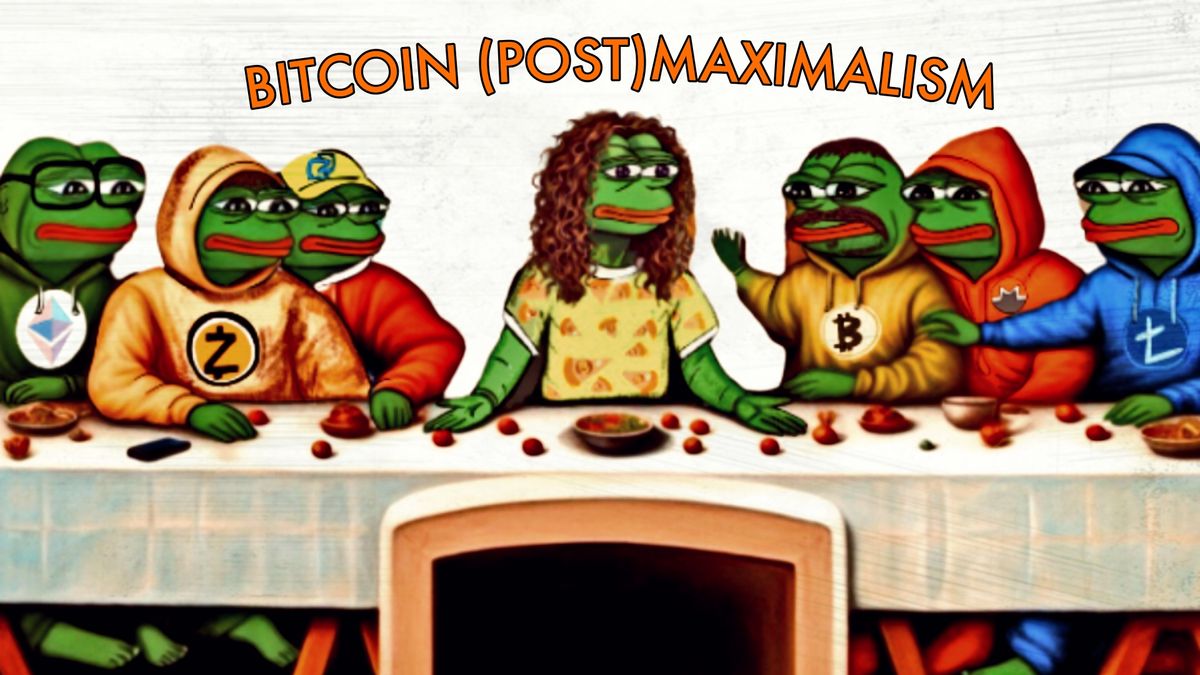
By all significant metrics, Bitcoin maximalism is a failed ideology. What started out as an initiative to bring all post-experimental technology from altcoins to a more secure network with a sounder monetary base, ultimately degenerated into a nihilistic game of losing battles and worshipping the US dollar.
But in more than a decade of militant maximalism, Bitcoin still didn’t scale to a significant level which empowers billions of users to transact without banks, custodians, or other trusted third parties. Bitcoin didn’t add any kind of base layer privacy in order to make the money fungible. Bitcoin didn’t become expressive enough to enable smart contracts… or even fulfill some of the basic features of programmable money.
Bitcoin is still vulnerable to quantum computers that, within a decade or two, might be able to break ECDSA (elliptic curve digital signature algorithm). The adoption is not much better either: none of the big companies that supported direct bitcoin payments in 2016 (Dell, Expedia, Steam, Microsoft, Overstock, Newegg) reverted their decision upon observing the progress brought to the protocol by SegWit, Taproot, and the Lightning Network.
Objectively speaking, Bitcoin maximalism’s only merit is that of making the price of BTC increase. A decade before the date of this article, on January 17th 2016, the price of one bitcoin was $382. Today, the same bitcoin is worth $95333. A 249x increase which most likely enriched everyone bold enough to hold for 10 years. Some call this the best performing asset of the decade… though in the same time interval Ethereum went from $1.32 to $3343 (a 2532x increase, more than 10 times higher than Bitcoin’s) and even Dogecoin pumped from $0.00001522 to $0.1371 (900x up).
Bitcoin maximalists like to talk about ”Bitcoin only”. But what if Ethereum was built on Bitcoin and Elon Musk had no objection against Bitcoin’s scaling to such an extent that he promoted BTC instead of Doge? Both of these scenarios were seriously taken into consideration — but every time, it was the arrogance of the maximalist ideology that pushed builders to other blockchains.
Not so long ago, the so-called ”Bitcoin dominance” (the amount of US dollars invested in BTC as opposed to altcoins) was higher than 90%. But in the aftermath of the block size wars and due to the patronizing ”everything is a scam that’s bound to fail” attitude of maximalism, this dominance metric has now dropped to 54.7%.
I can argue that in a world where bitcoiners were more open to innovation and didn’t disregard markets so much, the price would have been at least 30% higher than it is now — assuming that all the energy, innovation and capital that went into altcoins remained on the mother ship. Maybe that having everything under a powerful, recognizable and trusted umbrella would have taken us to a much more significant adoption too.
It’s not like there weren’t any attempts: Tether, the US dollar token which is often described as a ”stablecoin”, was first issued on Bitcoin’s Omni layer. The Omni layer itself was launched as the world’s first ICO (Initial Coin Offering) under the name Mastercoin — it was built on top of Bitcoin and the developers raised BTC.
In January 2014, we also witnessed the launch of Counterparty: another significant protocol, which enabled users to create tokens using OP_RETURN and even pay dividends to shareholders of decentralized companies. To bring this proto-Ethereum to life and create the native XCP token, more than 2130 BTC was burned to an unspendable address. It never really took off because of the subsequent OP_RETURN wars — but it did inspire Vitalik Buterin’s famous 2014 article ”On Bitcoin Maximalism, and Currency and Platform Network Effects”.
Speaking of Vitalik, when I had him on my podcast he acknowledged that he wanted to launch Ethereum on Bitcoin, but initially chose Primecoin instead due to the lack of OP_RETURN data size limitations. When asked how he would launch Ethereum today, Vitalik mentioned that the use of a sovereign rollup (much like Citrea and Alpen). However, given the Bitcoin culture of today in which everything is a scam except for BTC on the base layer, the Liquid federation, and the Lightning Network (well, MSTR stocks and USDT on Tron are cronyist exceptions) it’s hard to imagine how any attempt to bring extra features would succeed in getting significant traction. In other words, the Bitcoin maximalist ideology has been extremely efficient at repelling innovation and kicking it out into the altcoin land.
On the short term, this dismissive attitude dilutes Bitcoin’s dominance on the market. Tether is already the more popular medium of exchange worldwide, being transacted on networks such as Ethereum, Tron, Solana, and Polygon. The stablecoin started out on Bitcoin and paid transactions to the BTC miners. But due to the maximalist culture which didn’t nurture innovation and didn’t care much for the fee revenue of miners, nowadays it’s not a rare occurrence to see that Tether records much higher trading volumes than Bitcoin.
On the long term, discouraging unorthodox and “unapproved” Bitcoin users from transacting becomes a threat to the security budget. As described in chapter 6, paragraph 2 of the Bitcoin whitepaper: ”Once a predetermined number of coins have entered circulation, the incentive can transition entirely to transaction fees and be completely inflation free”. This is Satoshi Nakamoto’s biggest bet — that the limited supply model can become sustainable thanks to the existence of transaction fees. However, for most of 2025 (and early 2026) the transaction fees have been concerningly low.
Especially if one considers the fourth halving block (number 840000, mined on April 20th 2024) when the miners collected 37 BTC in fees. Compare this to the status quo of January 2026, when it’s possible to get a next block confirmation with a transaction fee lower than 1 satoshi per vbyte (and miners receive much less than 1 BTC in fees in most blocks). We are clearly experiencing a dangerous regression, and one which no current layer two or sidechain (with the exception of the proposed drivechains) can address directly.
Not even the legal tender stories turned out to be so successful. In El Salvador, the heavy reliance on custodians has made Bitcoin pretty pointless: when you have no censorship resistance against the entity holding the keys and the government knows information about every transaction, it’s just a CBDC training session with extra steps.
Sure, some bitcoiners moved there during the pandemic and enjoyed better tax rates and a more relaxed lifestyle than they did back in their home countries. But when locals must choose between US dollars and bitcoin, they are far more likely to prefer the dollar… for both saving and spending. In spite of all the educational efforts, all the positive government propaganda, and all the buzz that the new premium immigrant class has created.
There used to be another country which adopted bitcoin as legal tender, but these days we don’t talk about it anymore. In April 2022, the Central African Republic became the second sovereign nation to embrace bitcoin as an official currency. Less than a year later, this historic decision was reversed due to limited internet access and a troubled economic climate. It’s hard to blame anyone except for the overzealous bitcoiners who started a movement they could not sustain, in a place they did not properly understand. Arguably, this kind of situation does more harm than good: both to the Central African Republic (whose leadership loses credibility) and for Bitcoin (which looks bad and useless).
Arguably, the whole legal tender idea is bad for the simple reason that bitcoin is meant to be adopted voluntarily, in a grassroots manner. Not because a government enforces the acceptance of payments and is in a position to punish merchants who do not set up the right kind of point of sale devices. When the epitome of non-governmental money gets promoted by the president of a country and becomes something that all businesses should accept, it clearly defeats the purpose. BTC works best when it makes sense and provides clear advantages to the user. When it’s shoved down people’s throats and kids must learn about it in school too, it’s no longer revolutionary — especially in El Salvador, where the largest majority of locals use the Chivo wallet.
But then again, some Bitcoin maximalists really want nation states to impose this type of top-down adoption and one of the high priests of this movement (Samson Mow) even created a company which specializes in talking with political leaders to push bitcoin on the national agenda. A meritorious and admirable attempt, until you realize what it’s really about (free market internet money) and the only way in which governments will accept to adopt it (absolute control and surveillance). If half of this effort and capital was spent on adding fungibility to Bitcoin, maybe that these nation state adoption plans wouldn’t look so evil.
But then again, the nation state adoption is something that Bitcoin maximalism uses to signal legitimacy over altcoins. Nobody from Ethereum or Litecoin is able to pull this off (not that they actively pursue it in the first place). So even though Bitcoin maximalism lost most battles and took lots of beatings, at least the government supremacy maintains the illusion of success and provides an extra reason to celebrate stagnation.
Another reason to celebrate stagnation and feel superior is the ETF (Exchange Traded Fund) approval process. For a while, the institutions filing for ETFs were only focusing on Bitcoin. Advocates were arguing that only BTC is a digital commodity that will be able to navigate the government’s bureaucratic process with absolute legitimacy.
Even maximalist high priests such as Michael Saylor and Max Keiser were metaphorically screaming from rooftops that other coins such as Ethereum are nothing but unregistered securities that the SEC will regulate in the USA, and therefore there won’t be any altcoin ETFs. Only Bitcoin is pure and was immaculately conceived, therefore only Bitcoin could get the ETF. This ETF was promised as the ultimate reward for being a true maximalist. The holy grail at the end of the purity quest.
The one true treasure chest that you find in the dungeon, after slaying every shitcoiner on Twitter. The coronation that the high priests grant you for being such an abstinent warrior, who never even installed MetaMask to collect airdrops and never experimented with privacy preserving coins. Naturally, this will make all the bankers chase you with their suitcases of freshly-printed cash begging you to sell them some of your scarce bitcoins at a rate of 1 gazillion dollars per satoshi.
And then the SEC approved Ethereum ETFs in July 2024. The hardcore maximalists believed that BlackRock CEO Larry Fink is one of them… and then BlackRock launched the iShares Ethereum Trust (ETHA) to be traded on NASDAQ. After Ethereum got a bunch of spot ETFs approved, Ripple (XRP), Solana and Litecoin also joined the party in late 2025. In the future, we might even see Dogecoin ETFs becoming super successful because that’s exactly what we deserve.
This kind of institutional adoption was always a bad idea, compromising development at the expense of seeing an influx of capital on derivative paper assets that create inflation outside of the blockchain. But for a while, it worked as a purity metric for Bitcoin maximalism. ”There is no second best”… until the market strikes back. Are you tired of winning yet?
Bitcoin didn’t become a fungible currency. The grassroots adoption has been stalling for years. The Lightning network had to become mostly custodial in order to make transactions reliable and not bloat the blockchain with lots of channel openings. There are hardly any conversations about adding smart contracts.
And Bitcoin scaling? I’m sorry, I thought the ETF was the final point on the scaling roadmap?! All irony aside, this is a nasty stain on an otherwise inconsistent and highly subjective ideology in which the goalposts are moving constantly to make the losses look less painful.
Bitcoin maximalism only made sense while the purpose was to maximize what Bitcoin does. Not play political games to make it look like the lack of technical improvements is somehow beneficial.
I can also make a list of broken promises which created hype for a while, kept the bitcoiners happy, ignorant and maximally toxic… but turned out to be bitter disappointments. I will start with Blockstream’s Liquid federation that was supposed to be a proper two-way pegged sidechain, and the Taproot upgrade that their engineers built and advertised as the best thing since bread came sliced.
Taproot was supposed to be the transition from ECDSA to Schnorr, complete with cross input signature aggregation… but it was shipped in an incomplete state and nobody seems to care about this anymore. Oh and then you have the El Salvador volcano bonds fiasco, an idea which was sketchy from the very beginning but seemed to add some legitimacy to the Liquid federation: the network on which these bonds were supposed to be tokenized. It created a lot of buzz, got people excited, but the idea died out before any launch could take place.
Then you get gargantuan exaggerations and lies such as ”we’re gonna walk in a grocery store and buy Coke over Tor”… as told by former Strike CEO Jack Mallers in 2022 at the Bitcoin Miami conference. Yes, this was obviously a marketing plug for the American payments processor, which emphasized on the utility of bitcoin on the Lightning network with all the privacy features enabled. But the problem is that none of this ever happened.
It’s also unclear whether or not Mallers was really making the in-person payments via Lightning or he set everything up to make his video presentation look good. What was supposed to be Bitcoin’s biggest triumph for payments adoption (with promises about major brands such as Whole Foods, Chipotle, and Walmart joining the movement) turned into a major letdown that still lives rent-free in the minds of many hopeful maximalists.
Meanwhile, if you ask the average Bitcoin maximalist commentator about the state of the project, they will arrogantly say that they’re winning, everything is fine, and anyone claiming otherwise is a bitter shitcoiner. Arrogance is fine when it’s backed by provable data. But over the course of 2025 and early 2026, Bitcoin has only lost. The Winklevoss twins, early bitcoin adopters and the largest individual holders after Satoshi Nakamoto, pivoted to Zcash (a Bitcoin fork which added the Zerocash privacy upgrade that was proposed for BTC in 2014).
Due to similar privacy concerns in the era of automated blockchain analysis, many bitcoiners also found refuge in Monero — a decentralized money network that’s reactionary to Bitcoin, was built on a different codebase named CryptoNote, and makes use of many privacy improvements that were researched and developed for BTC over the years (ring signatures, bulletproofs, Dandelion++, stealth addresses). Furthermore, it’s important to point out that the true winner of Bitcoin’s block size war was Ethereum: Vitalik’s network received a lot of attention from users, developers, and researchers. In August 2017 when the Bitcoin Cash fork happened, the price of ETH was hovering above the $200 mark… then by the end of the year it surpassed $880. All of this could have come to Bitcoin, but instead we witnessed the rise of a new de facto number two cryptocurrency.
Then there’s also the Bitcoin community’s inability to reach consensus to activate soft forks as basic as OP_CTV or OP_CAT. The former is probably the most scrutinized and best understood upgrade proposal, which has been around for years and was nearly added to the code multiple times… until Jeremy and the rest of the CTV advocates hit the consensus brick wall every year between 2022 and 2025. OP_CAT is even more interesting, because it’s something that Satoshi Nakamoto himself coded but disabled in 2010, alongside other OP codes.
Blockstream chief scientist Andrew Poelstra is in favor of reactivating OP_CAT — especially now, after it’s been rewritten in Tapscript in 2023 by Ethan Heilman and Armin Sabouri so that all the previous concerns are eliminated. The Liquid federation has OP_CAT. Bitcoin Cash also has OP_CAT, alongside the rest of the Satoshi-era OP codes that were disabled.
OP_CAT does concatenation: puts together different pieces of data. You can do that in an Excel spreadsheet where you put ”ABC” in one row and ”123” in the next one. The result of your concatenation will be ”ABC123”. In the Bitcoin case, there are community concerns about ”unknown unknowns” — attacks that nobody can currently think about, but will figure out in the future. But you can say the same for the entire Bitcoin software stack! And if you think you’re smart and able to break a chain using OP_CAT, you can actually try it on BCH and make a lot of money if you short the token on exchanges.
CTV (Check Template Verify), on the other hand, enables users to set restrictions to the way in which the bitcoins can be spent. It’s non-interactive, meaning that you don’t need to be connected to the internet and operate a synced wallet in order for the conditions to be enforced. CTV can help set up more complex setups with multiple participants who set their spending conditions individually. It can help scale the Lightning network, by allowing millions of users to open their channels in one transaction.
OP_CTV is useful for basically every layer two, as it can eliminate the need for trusted setup ceremonies. Also, as Jay Berg explained on S16 E49 of the Bitcoin Takeover podcast, CTV scales Bitcoin in time: meaning that users can set their transactions to not be broadcast unless the fee reaches a certain low point. This would decongest the blockchain in moments of high demand and create a more predictable fee revenue for miners.
Why are CTV and OP_CAT relevant examples? Because they amplify the derangement. If we can’t even have these trivial upgrades, how and when are we going to get something more significant? Maybe that the upcoming quantum soft fork will increase the transaction sizes to the point where a block size increase is necessary. Maybe that monetary fungibility will become more popular in the future. Maybe that a large chunk of the community finally realizes that BIP 300 is a good idea. How are we going to get any of the big upgrades if tiny and well-understood soft forks that builders demand are met with borderline hostility?
Some of them this hostile attitude stems from quasi-humoristic conference presentations from the late 2010s, which people took too seriously. ”Everything which is not Bitcoin is a scam. Every attempt at changing Bitcoin is a scam. Every attempt at pushing people to spend Bitcoin is a scam. We shouldn’t be nice to scammers!” is a popular mantra that too many bitcoiners turned into their religion. The only reason it took off is the fact that the price of BTC went up. Even silly memes such as ”stock to flow” (S2F) and the ”rainbow chart” were supported by otherwise serious and respected bitcoiners (as in book authors, company CEOs, paid course sellers, and regular conference speakers).
I can argue that the stagnation started when the first ETFs were approved and even cypherpunk pseudo-leaders like Adam Back indulged in the trading game beyond any expectation from someone who created Hashcash and co-authored Confidential Transactions. But some would argue that the stagnation era began with Taproot — probably the least significant and most overhyped Bitcoin upgrade ever, which didn’t even deliver the promised Schnorr signature aggregation which was a major selling point.
It’s also easy to point out to the emergence of Michael Saylor, who essentially marked the transition into Bitcoin’s institutional adoption phase. But one can also go to the block size war days and the way Theymos was describing consensus in a 2015 Reddit Q&A: near-unanimity. This concept applied to hard forks, as they have the potential to split the network and create altcoins. But in recent years, the same standard is used to measure consensus for soft forks (optional upgrades) too!
Given these circumstances, it’s easy to see why researchers and builders choose to not spend years of their life bringing new ideas to Bitcoin. Best case scenario, they ship the product or service and they will not make any money due to the hostility of the HODLers. Worst case scenario, they build something that requires a change to the Bitcoin protocol that will never happen. Why would anyone rational and non-masochistic choose to engage with such a project, when everyone is welcoming and friendly in Ethereum, Solana, Litecoin and Zcash?
Faux Austrian economists will describe a scenario where everything goes to 0 against BTC because money has strong network effects and Bitcoin has the most decentralized and secure network. But there’s no sign of this happening. In a world where Bitcoin is winning, no other SHA256 chain would take any hash rate away from the dominant network.
Yet that isn’t the case at all: in 2025, Bitcoin Cash (BCH, the 2017 bigger block fork) has doubled its hash rate and also outperformed BTC in terms of price. That’s right, BCH went from 3.8 exahashes per second on January 1st 2025 to 6.5 exahashes per second exactly one year later. The highest point was 8.5 exahashes on November 22nd 2025, in a time when BCH was climbing on the CoinMarketCap rankings to become the 11st most liquid cryptocurrency.
I will say it once again, in a world in which Bitcoin is winning, this phenomenon would never happen. No altcoin would outperform BTC for an entire year. No altcoin could take away miners from Bitcoin. No smart developer would leave Bitcoin to work on an altcoin. No other chain would offer better incentives than Bitcoin.
Bitcoin needs a new culture and a complete reset when it comes to approaching innovation in computer science and math. After all, anyone claiming that the current iteration is a complete project that can safely ossify is either a deceitful clown who’s afraid of taking responsibility for changes or a smart altcoiner who wants you to bridge your BTC to their chain (WBTC on Ethereum, BTCx on Zano, BTC on Solana, BTC on Base, BTC on DarkFi). In principle, nobody wants to kill the goose that lays golden eggs. But when the music stops and the golden eggs stop coming, someone has to take responsibility for making a change.
We either improve Bitcoin to do everything, or else we embrace altcoins as legitimate networks that provide extra scaling and privacy/contracts. There is also a likely third way in which Bitcoin gets replaced by a new internet currency that simply works better and gets more users. Maybe something that doesn’t use a blockchain and solves the double spending problem in a way that’s more technical than game theoretical. There’s a non-zero chance that this may happen, and the odds further increase as the Bitcoin community becomes more complacent.
This new movement or ideology that I’ve been thinking about is simply called ”post-maximalism”. Something that understands the failures of maximalism and returns to the initial goals of the movement in order to fix existing problems. Something that is deeply optimistic and encourages experimentation instead of trying to incentivize inaction. A more rational approach to Bitcoin, which openly acknowledges the limitations and tries to find solutions… as opposed to stubbornly arguing that Bitcoin is already perfect and anyone arguing otherwise is a scammer.
I spent a lot of time thinking about this. But as always, Paul Sztorc has already written a long blog post about it… and it dates back to 2018! Unsurprisingly, Paul is once again ahead of the curve by almost a decade. But I disagree with his conclusions: altcoins have become better and more independent from the Bitcoin codebase.
Swapping services like SideShift have also taken off, allowing anyone to exchange currencies without having to register an account. Altcoins are no longer mere clones that compete for market share, but potential allies that provide research, as well as extra block space for BTC transactions. Even Paul Sztorc would agree that altcoins have merits: after all, he designed drivechains to include the features of Ethereum, Zcash, and Namecoin.
I must also give credit to Sergej Kotliar, CEO of Bitrefill. He introduced to me the concept of ”post-maximalism”, but under a different definition which referred to Solana: that it’s a project that was built irrespective of Bitcoin, without trying to be an answer to its limitations or trying to directly compete with it. Solana is ”post-maximalist” because it operates in a way that doesn’t care about Bitcoin. He mentioned it during S16 E38 of the Bitcoin Takeover podcast around the 10-minute mark and I’ve been thinking about it ever since.
In an upcoming writeup, I will provide more details about the concept of post-maximalism and how I think it would work. However, I think it was necessary for me to explain the motivation behind trying to think of a new philosophy for the Bitcoin world. Something more optimistic, which learns from the past and applies these teachings to a future that’s more free, sovereign, and empowering for individuals everywhere.
Because Bitcoin is a tool — and if the purpose shifts from enabling safe internet payments without trusted third parties and with a degree of privacy to making institutional investors more US dollars, then someone has to step up and try to fix the culture. It’s a difficult pursuit, but I believe it is worth it and very much in line with the reasons why I became interested in Bitcoin in the first place.
Related

S1 E4 Remastered: Omar Faridi on Bitcoin in Pakistan, Brain Drain & the Case for Moderate Thinking
In January 2019, I was still an editor at Crypto Insider. Working a fixed salary and editing other people’s articles while…

S1 E3 Remastered: Zack Voell on Bitcoin & Politics
(This remaster is sponsored by Helen’s Pizza, 183 Newark Avenue, Jersey City, where you can buy pizza, pasta, and coffee with…

S17 E38: Keagan McClelland on Lightning Metrics, Covenants, Consensus Politics & Verifying Bitcoin
There is a certain genre of Bitcoin Twitter argument that never quite resolves into a conversation. People trade metrics, memes…

Comments
Comments run on my own server. No ads, no trackers.