




S1 E3 Remastered: Zack Voell on Bitcoin & Politics
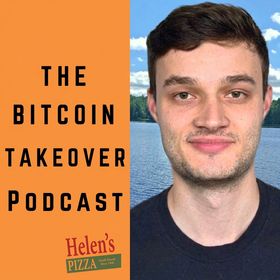
The audio keeps playing while you browse the site.
Ask the Archive
(This remaster is sponsored by Helen’s Pizza, 183 Newark Avenue, Jersey City, where you can buy pizza, pasta, and coffee with Bitcoin or shielded Zcash, with swaps accepted from just about any coin you happen to hold.)
January 2019 was a strange time to launch a Bitcoin podcast. The price was digging a grave somewhere around $3,500, the obituaries were being printed in bulk, and yet two twenty-somethings with political science degrees decided the moment was perfect for a crossover episode. I had just started this show, which almost launched under the name BIP, for Bitcoin and Politics, before I concluded the angle was too silly to sustain. Zack Voell was hosting The Coin Pod. The plan was simple: each of us would publish the conversation on our respective feeds.
I held up my end. Zack, it must be noted with affection, did not. The Coin Pod went silent that very month, which makes me the prime suspect in its unsolved disappearance. In the years since, Zack has passed through Messari, Compass Mining, and Blockstream, and has managed to become roughly as unpopular with the church of Bitcoin maximalism as I am, though for opposite reasons. I later interviewed Roger Ver. He did memecoins on Solana. Balance in all things.
What follows is why this conversation, recorded at 4 a.m. Romanian time at the bottom of a brutal bear market, still deserves your attention.
Two Political Science Refugees Walk Into Bitcoin
Most Bitcoin origin stories begin with code or with greed. Ours began with coursework. Zack attended a small liberal arts college in Pennsylvania with a strong Austrian economics department, and a roommate who orange-pilled him between classes. My own university was firmly left-wing, offering exactly one Austrian economics lecture buried inside a macroeconomics syllabus. I found Bitcoin through its funeral announcements: the 2014 headlines declaring it a Ponzi scheme and a drug dealer’s toy, which sent me wandering through the Silk Road and the coin mixers of the era out of pure curiosity. I bought in late, got rekt, and stayed for the ideas, which is the most common honest biography in this industry.
The Opt-In Economy
The conversation opens on the question that brought us together: can Bitcoin function as an instrument of international affairs, an oil currency, an embargo bypass? Zack’s answer frames Bitcoin as something genuinely new under the sun, an opt-in economy that no one is forced to use and no one is barred from leaving. Where Locke rejected “voting with your feet” as insufficient, Bitcoin offers a stranger upgrade: voting with your money, exiting one monetary regime for a parallel one without asking permission.
Buried in this section is one of the episode’s most quotable lines, delivered with the calm of someone who had just survived 2018: you only ever really experience one bear market, and that is your first one. Higher highs and higher lows do the emotional anesthesia for every cycle after.
Gridlock Is a Feature
The strongest stretch of the interview is Zack’s parallel between American monetary history and Bitcoin governance, and it holds up remarkably well. Colonial America was a monetary disaster zone: hyperinflated paper scrip in Rhode Island and New Hampshire, tobacco certificates circulating as money substitutes, and a currency situation so chaotic that the British Crown intervened to protect its own trade routes. Digital cash went through the same Darwinian gauntlet, with failed iterations stretching back to the 1980s before Bitcoin finally stuck the landing.
Then comes the insight worth the price of admission. Everyone complains that Congress is gridlocked and that Bitcoin never changes. Both observations are correct, and both are compliments. The Federalist system was designed so that bills move slowly and the status quo dies hard. Nakamoto consensus does the same for the protocol. A lack of novelty is not stagnation. It is the institution working as intended.
A Very American Invention With an Un-American Agenda
I put forward a thesis in this episode that I still find provocative: Bitcoin is a deeply American invention that works against America’s foreign policy interests. The whitepaper’s intellectual pedigree runs through Ralph Merkle, Wei Dai, and David Chaum. Hal Finney received the first transaction. Nick Szabo’s Bit Gold came closest to the design. Even the obligatory counterexample, Adam Back, is the token Brit who allegedly shrugged at Bitcoin until it crossed $1,000.
And yet here was Venezuela trading around an embargo, North Korea rumored to be stockpiling mined coins, and Palestinians receiving aid in a currency no blockade could stop. Zack’s counterpoint is the sharper one: adoption in 2019 was concentrated precisely where Bitcoin was needed least, among the technically literate and socioeconomically comfortable. His resolution is a phrase I have stolen ever since: liberty arbitrage. Bitcoin flows toward oppression the way water flows downhill, because freedom of speech and freedom of money are the two foundational rights from which all others spring.
From FDR’s Gold Grab to Voltaire’s Zero
History buffs get their money’s worth here. We cover FDR’s 1933 gold confiscation, Executive Order 6102 for those keeping score, and Zack’s prediction that a future Digital Asset Confiscation Act is not outside the realm of possibility, merely far harder to enforce against a bearer asset you can memorize.
We wander through Jefferson’s preference for metallic money, his dismissal of paper as roughly as valuable as maple leaves, and Voltaire’s verdict that all paper currency eventually returns to its intrinsic value of zero. Zack coins the condition we all live under: fiat inertia, the inability to imagine money that no one issues, because no living person remembers anything else. Bitcoin’s radicalism is not that it is new. It is that it reminds us of what we forgot.
Money as Trust, Bitcoin as Community
My favorite detour runs through Rousseau’s Discourse on Inequality, specifically his fable of the first man to fence a plot of land and declare it his, and the second fool who believed him. Nick Szabo’s monetary history supplies the rebuttal: money is a token of trust that lets strangers cooperate, and in that sense it built civilization. Zack extends this into territory that annoyed the maximalists of 2019: money necessarily creates communities, because a currency is only good within the circle of people who accept it. Bitcoin’s community is not an embarrassing accident. It is what money looks like when it is working.
Russia, Bernie Madoff & the $10 Billion Rumor
Every 2019 artifact needs its absurd news cycle, and ours was the rumor that Vladimir Putin was preparing to buy $10 billion of Bitcoin as a reserve asset. The source was an economist named Vladislav Ginko, whom Zack had actually messaged about a podcast appearance before the man went AWOL. The credibility of the rumor can be assessed by Ginko’s other public position: that Bernie Madoff, the septuagenarian Wall Street fraudster, is the true Satoshi Nakamoto and must be freed. Case closed, gently.
What makes this section worth revisiting is how it aged. In 2019, a nation-state buying Bitcoin was a joke about a scammer’s tweet. In the years since, El Salvador made it legal tender and strategic Bitcoin reserves became a topic of serious policy in Washington. The joke became the thesis. Meanwhile, Maduro confiscating mining hardware and Kim Jong-un quietly stockpiling coins were early signs of exactly the dynamic Zack identified: oppressive regimes grasp the incentive structure of Bitcoin faster than free ones do, which remains an uncomfortable thought worth sitting with.
Deplatforming and Money as Speech
Recorded weeks after the Patreon purge that sent Jordan Peterson looking for the exit and left Gab scrambling for banking rails, the episode captures the exact moment the Bitcoin narrative pivoted from sound money for libertarians to free speech for everyone. Zack cites a sociology paper listing the four freedoms money should confer: buy what you want, from whom you want, when you want, on terms you accept. Fiat checks none of them reliably. Bitcoin checks all four out of the gate. Once that penetrates the collective consciousness, adoption follows. Seven years later, the deplatforming debate has only grown louder.
The Inconvenience of Freedom
The closing argument is the honest one. Credit cards forgive forgotten PINs. Banks reverse mistakes. Bitcoin forgives nothing, asks you to run your own node, and makes you the sole custodian of your wealth. Zack’s formulation deserves quoting: trust is never destroyed, only moved, and Bitcoin moves it from fallible third parties onto your own shoulders. You become your own single point of failure, which is sobering and liberating in the same breath. Watching society slowly prepare itself for that responsibility has been the story of the years since.
Orange Pilling Your Date
And then there is the romance segment, the reason this episode gets quoted at conferences. Zack was chronicling his New York dating life on Twitter, where “so what do you do?” admits no good answer when the answer is Bitcoin. I countered with my 2017 strategy: let the date pay the bill, reimburse my half in BTC or Litecoin, and say “you’re going to thank me later.”
Results varied. Pro tip from the transcript: never attempt this in the middle of a bull run, because the subsequent crash becomes your fault forever. Both of us, for the record, ended the episode cautiously optimistic about the women we were seeing. I knocked on wood on air. Listen to find out whether it worked.
If you’re glad, then I’m Vlad.
Listen to this Remaster with Zack Voell on YouTube, Spotify, Apple Podcasts & More!
Time stamps:
0:00 – Intro
0:46 – Remaster Notes: This Show Was Almost Called “Bitcoin & Politics”
2:12 – Sponsor Shoutout: Helen’s Pizza in Jersey City
3:30 – The Crossover Episode Zack Never Published
4:41 – The Original Recording: January 2019
5:42 – Bitcoin as a Tool of International Affairs
7:49 – Bitcoin Obituaries, Silk Road Curiosity & Getting Rekt
11:39 – The Opt-In Economy: Voting With Your Money
13:26 – “You Only Ever Experience One Bear Market: Your First”
16:54 – The US Dollar’s Outlaw Origins
17:55 – Colonial Currency Disasters & Tobacco Money
20:27 – Thirty Years of Failed Internet Money
21:51 – Gridlock Is a Feature: Congress & Nakamoto Consensus
22:37 – Bitcoin: A Very American Invention
24:47 – Why Americans Seem to Own the Narrative
27:18 – The White Paper’s American Pedigree
30:44 – Could Bitcoin Have Come Out of China or Russia?
31:35 – Liberty Arbitrage & the Two Foundational Freedoms
35:15 – FDR’s Gold Confiscation
37:43 – Jefferson, Madison & the Hard Money Founders
39:10 – Voltaire’s Zero & the Fiat Inertia
43:08 – Rousseau, Property & Money as a Token of Trust
48:02 – Rational Ignorance: The Questions We Never Ask
50:55 – The Bitcoin Crash Course & Why Money Creates Community
55:36 – The Bitcoin Noob Moniker
58:52 – Dating as a Bitcoiner in New York City
1:02:58 – “But That’s Not Real Money”
1:04:15 – Paying Your Half of the Date in Bitcoin (2017 Edition)
1:09:48 – The Russia Bitcoin Reserve Rumor
1:13:48 – Bernie Madoff Is Not Satoshi Nakamoto
1:17:19 – Who Adopts First: The Unbanked or the Privileged?
1:20:18 – Deplatforming, Gab, Patreon & Money as Speech
1:23:07 – The Four Freedoms of Money
1:26:05 – The Inconvenience of Freedom
1:29:20 – Your Own Single Point of Failure
1:31:09 – If You’re Glad, Then I’m Vlad
Verify this episode
This is the SHA-256 fingerprint of the MP3 as published here, timestamped in the Bitcoin blockchain with OpenTimestamps. If one byte of the file changes, the fingerprint changes.
- SHA-256
4335be3d4e3dd3bea7d6008ef4d29624ff4366599225b86a2fe84fc4917bfd43- Proof
- 2026-09-08_remastered-2026-09-07_zack_voell_bitcoin_takeover_podcast_.mp3.ots · all episode hashes (proof)
- Status
- Anchored in Bitcoin block 974,312
How to check it yourself
- Download the MP3 and the proof into the same folder.
- Run
sha256sum 2026-09-08_remastered-2026-09-07_zack_voell_bitcoin_takeover_podcast_.mp3(on a Mac:shasum -a 256 2026-09-08_remastered-2026-09-07_zack_voell_bitcoin_takeover_podcast_.mp3). The result must match the SHA-256 above. - Install the OpenTimestamps client (
pip install opentimestamps-client) and runots verify 2026-09-08_remastered-2026-09-07_zack_voell_bitcoin_takeover_podcast_.mp3.ots. It hashes the MP3 again and checks the proof against your own Bitcoin node, then prints the block and the date the file existed by. Without a node,ots info 2026-09-08_remastered-2026-09-07_zack_voell_bitcoin_takeover_podcast_.mp3.otsshows the block height to look up in any block explorer.
Related
S1 E4 Remastered: Omar Faridi on Bitcoin in Pakistan, Brain Drain & the Case for Moderate Thinking
In January 2019, I was still an editor at Crypto Insider. Working a fixed salary and editing other people’s articles while…

Remembering Donald McIntyre: S1 E1 Remaster, on Bitcoin, Tim May, Nick Szabo and the History of Money
Donald McIntyre passed away in 2025, and the space lost one of its most unlikely polymaths. Born in Costa Rica, raised in…

S15 E15: Aaron van Wirdum on The Genesis Book, Cypherpunks & Bitcoin’s Pre-History
Aaron van Wirdum walks through The Genesis Book: e-gold, Hayek, the Extropians, the cypherpunks, Hashcash, Bit Gold, b-money…

Comments
Comments run on my own server. No ads, no trackers.