




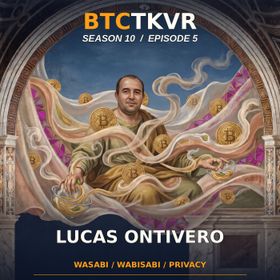
S10 E5: Lucas Ontivero on Wasabi Wallet, WabiSabi, Bitcoin Privacy
The audio keeps playing while you browse the site.
Read the transcript15,322 words, every line links to the minute it was said
Ask this episode
A week before we recorded, I watched Lucas Ontivero give a presentation at Wasabi about the new CoinJoin implementation, and he lost me somewhere in the middle. So I invited him on the show and asked him to explain it again, slowly, as if to someone who doesn't write cryptography for a living.
Lucas is from Argentina and was nopara73's first employee at Wasabi Wallet. When he joined, the project wasn't even called Wasabi. It was HiddenWallet. He's also one of the happiest and most optimistic people I've met in this space, which helps when the topic is as dense as WabiSabi. Wasabi Wallet was a sponsor of Season 10, as was Bitcoin Reserve.
WabiSabi Explained with Dollar Bills
In Wasabi 1, all the mixed outputs are 0.1 bitcoin or so. WabiSabi allows unequal outputs, and the question is how you keep privacy when the amounts differ. "It's a very, very delicate topic." The answer is standard denominations, the same idea as fiat bills. "Basically, you can pay whatever amount just by combining those standard denominations."
His example: if he joins with one bitcoin and I join with 0.8, there are many ways to split them. If he splits his into five 0.2 outputs and I split mine into four 0.2 outputs, "All the outputs look the same, so an external observer cannot say, 'Okay, this output belongs to Lucas and this output belongs to Vlad.'" With a hundred participants all choosing the denominations most likely to be chosen by others, an observer can't tell whose 0.5 is whose. "In the end, that is all the complexity. Technically, it's much harder, but from the point of view of the high level understanding, that is basically what we are working on."
It also means there's no minimum like the current 0.1 for joining a round. "It's for any amount."
Credentials Instead of Signatures
The reason Wasabi 1 had a single denomination is the cryptography behind ZeroLink. A blind signature tells you one thing: valid or not. "It's basically true/false or zero/one. It's one bit of information." With only that, the coordinator can't know what output value you're entitled to, so everyone gets the same 0.1.
"Now, in WabiSabi, we don't use signatures." It uses credentials, which can also carry an amount, so "You can create an output of whatever you want." Lucas gave credit where it belongs: it was nopara who started the research, using a credential system developed by the Signal app team.
The Coordinator Is the Enemy
The part I appreciated most is that Lucas is open about the fact that WabiSabi won't solve Bitcoin privacy entirely. We usually worry about chain analysis and outside observers, and rarely about what the CoinJoin coordinator itself learns. In WabiSabi, "The coordinator doesn't know which coins belong to you." Because inputs can be split into many sizes, change becomes the exception.
Anyone can run a coordinator, since everything is on GitHub, and anyone can point their Wasabi client to one. So the client has to assume the worst. "So obviously, in our model, the coordinator is an enemy." The client doesn't register all inputs in the same message, randomizes the timing, and goes through Tor. "I know nothing about you, right? So I cannot discriminate you."
That turned out to matter more than either of us knew. In 2024, zkSNACKs shut down its coordinator, and Wasabi users moved on to coordinators run by others, which is exactly the situation Lucas designed for.
From One CoinJoin a Week to Paying with Credentials
Lucas remembered how modest the early goals were, back when bitcoin was around $3,000: one CoinJoin a week, then one a day, then 20 participants, then the first 100-participant CoinJoin and one every hour. "It was getting better and better and better and better."
His personal dream goes further than mixing. If his wallet can send a credential to my wallet, my wallet registers the outputs and he signs the CoinJoin. "It means that I pay you, right? But I don't know what your outputs are." Compare that with a PayJoin, where the two of us fool an outside observer but still know the payment. "But if we implement something like this, for example, payment with credentials, well, I don't know where your money went and you don't know where my money came from, right? So it's unlinkable."
Fungibility, Satoshi and Taproot Marketing
Today you can discriminate between a bitcoin used on the Silk Road in 2012 and one recently moved through Coinbase, and I don't think that's good for the mission of the Bitcoin project. Lucas's goal is "to have this new money that is Bitcoin as fungible as possible," with JoinMarket, Samourai, Wasabi and more providers competing. "In the end, I think we will have the privacy that we deserve," especially if people need exchanges and KYC less.
I said Satoshi was too optimistic about the pseudonymity of using different addresses. Lucas defended him. "By the way, I think Satoshi was not so wrong." The problem is that we now interact with entities that collect information, and people don't take enough care. Cross-input signature aggregation could make big CoinJoins cheaper than normal transactions.
He was refreshingly honest about Taproot hype: "Because you need Taproot in order to develop these new solutions, but it's not the solution." What was released is the toolset. People still have to build with it.
Would He Add Confidential Transactions?
I asked a question I like asking privacy people. If tomorrow Bitcoin needed an emergency hard fork, would he also add confidential transactions, ring signatures or zero-knowledge proofs? Lucas was cautious. Range proofs are big, and the trend goes toward smaller transactions. "So if I am not 100% sure, I have to say no." More importantly: "There will be never another Bitcoin. Bitcoin is the thing, right? We have to take care of it." Adding something like that could split the network, "And that's not good at all." When I brought up the idea that the privacy wars would follow the scaling wars, he answered with "Honestly, I know you expect something more than 'I don't know' from me, but I don't know. That is the truth."
El Salvador and the Chivo Wallet
This is where we disagreed. My biggest concern about adoption is that it's going to be custodial, and I'm not a fan of El Salvador pushing people toward the Chivo wallet. Lucas, the optimist, saw the other side. People got involved because the government offered them $30, and some of them live on $10 a day. Now young people with phones know about Bitcoin and Lightning, and they can receive and spend it legally in a way he couldn't with his own salary. "So it is not black and white. There are grays too." His conclusion: "I think it was a very good move."
On education, he made a point that's easy to forget. "Money is something that it was already there when you were born, right? So you never had to think about these things." People learn by seeing a neighbor who saved bitcoin and is now doing better. "You don't need to explain anything. They can see it."
Wasabi 2.0, Private by Default
Lucas described the plan for Wasabi Wallet 2: better usability, WabiSabi, and privacy by default. "Just letting the wallet decide for you and take care of your privacy automatically, basically by CoinJoining in background." There's no coin control console for mixing in the new design. He also wanted a daemon that other wallets could integrate. "For me, I think it's the wallet that I use because for me it's the best wallet." Lightning privacy research had only just started, and he expected it to take a few years.
What Makes This Episode Worth Listening To
If you've ever wanted WabiSabi explained without a whiteboard, this is the episode. When I asked where to start reading, Lucas suggested beginning with the current state of the art, ZeroLink and WabiSabi, then JoinMarket, then going back in history. And when I asked how to follow his work, he gave the most cypherpunk answer possible: no Facebook, mostly GitHub, and "I try to be as low profile as possible."
Lucas came back in Season 15 to talk about Turbolay and Wasabi's future. For the beginnings of the project, listen to nopara73 in Season 5 and Season 13. You can also read the full transcript, visit Lucas Ontivero's guest page, or browse the WabiSabi and CoinJoin topics.
Listen to Lucas Ontivero on Spotify, Apple Podcasts, and More
Time stamps:
- 00:01:56– A simple explanation of WabiSabi
- 00:11:17– ZeroLink's blind signatures versus WabiSabi's credentials
- 00:22:18– Privacy against the CoinJoin coordinator
- 00:27:39– From HiddenWallet to the first 100-participant CoinJoin
- 00:31:06– Paying someone with a WabiSabi credential
- 00:41:06– Fungibility and coins from the Silk Road
- 00:50:08– Was Satoshi wrong about privacy?
- 00:53:58– Taproot is a toolset, not a solution
- 01:02:35– An emergency hard fork with confidential transactions?
- 01:17:21– El Salvador, the Chivo wallet and custodial adoption
- 01:22:59– Why people don't understand money
- 01:32:47– Wasabi Wallet 2 and privacy by default
- 02:04:35– Payments with credentials versus PayJoin
- 02:06:54– Where to start learning about CoinJoins
Verify this episode
This is the SHA-256 fingerprint of the MP3 as published here, timestamped in the Bitcoin blockchain with OpenTimestamps. If one byte of the file changes, the fingerprint changes.
- SHA-256
e3a8840ed1ef4796b8e55e9f6945ce11160dc7436d5570efda51214b781bb046- Proof
- 2022-01-22_s10_e5_lucas_ontivero_on_wasabi_wallet__wabisabi__bitcoin_privacy.mp3.ots · all episode hashes (proof)
- Status
- Anchored in Bitcoin block 974,312
- Timestamped
- After release. The episode came out on 22 Jan 2022, but this proof was made on 3 Nov 2026 and anchored in block 974,312, so it proves this exact file existed by 3 Nov 2026, not on the release date.
How to check it yourself
- Download the MP3 and the proof into the same folder.
- Run
sha256sum 2022-01-22_s10_e5_lucas_ontivero_on_wasabi_wallet__wabisabi__bitcoin_privacy.mp3(on a Mac:shasum -a 256 2022-01-22_s10_e5_lucas_ontivero_on_wasabi_wallet__wabisabi__bitcoin_privacy.mp3). The result must match the SHA-256 above. - Install the OpenTimestamps client (
pip install opentimestamps-client) and runots verify 2022-01-22_s10_e5_lucas_ontivero_on_wasabi_wallet__wabisabi__bitcoin_privacy.mp3.ots. It hashes the MP3 again and checks the proof against your own Bitcoin node, then prints the block and the date the file existed by. Without a node,ots info 2022-01-22_s10_e5_lucas_ontivero_on_wasabi_wallet__wabisabi__bitcoin_privacy.mp3.otsshows the block height to look up in any block explorer.
Related

S15 E45: Lucas Ontivero & Turbolay on Wasabi Wallet's Future
Lucas Ontivero & Turbolay on Wasabi after zkSNACKs: community coordinators, WabiSabi, unfuckable CoinJoin, daemon integrations &…

Preview: BTCTKVR Podcast Season 10
The Bitcoin Takeover Podcast keeps on keeping it real with season 10. This time around, we have 16 guests whose topics of…

S15 E54: Kruw on Running a Wasabi Coordinator, Blockchain Analysis & the Myths of Bitcoin Privacy
Kruw runs Wasabi's biggest coinjoin coordinator for zero fees. He explains how blockchain analysis works, Samourai's double…

Comments
Comments run on my own server. No trackers, no tracking cookies.