




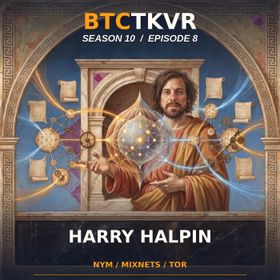
S10 E8: Harry Halpin on Nym, Mixnets, Tor, and Rediscovering Forgotten Cypherpunk Inventions
The audio keeps playing while you browse the site.
Read the transcript15,564 words, every line links to the minute it was said
Ask this episode
In the previous episode, Yuval Kogman mentioned Nym as one of the projects he was looking forward to. So the timing was perfect for my next guest, Harry Halpin, the CEO of Nym, whom I had met in Mallorca earlier that year. He greeted me by saying my magazine was spreading through Bitcoin conferences like a virus, which I told him wasn't a politically correct comparison anymore. I was partially kidding.
Nym aims to be a better version of Tor: decentralized, incentivized and built on mixnets instead of plain onion routing. Harry's first point was that it's not a race. "I think it's really profoundly unethical to launch prematurely." A wallet bug loses you money. A privacy bug can expose a human rights activist, so Nym was still on testnet while others pushed them to launch.
Mixnets vs. Tor
Harry started by saying he likes Tor. "I use Tor and Tor Browser every day." Then he explained the difference step by step. A VPN sends your traffic through one provider. Tor sends it through three hops, so only the entry node knows where you're coming from and only the exit node knows where you're going. "So Tor provides provably better anonymity than a VPN."
The weakness is metadata. If someone watches the first and last hops, they can compare timing and volume. "And that's honestly kind of dangerous." He cited the recent KAX17 attack on Tor relays as proof that it's possible.
Nym goes back to an older technology invented by David Chaum. Instead of passing packets along immediately, each node waits for packets from other people. "And then I mix those packets up like a deck of cards. I shuffle them. That's where the word mix network comes from." Nym also adds fake traffic and releases packets according to a Poisson process, so you don't have to wait forever for other users to show up.
A Market for Privacy
The economic difference is just as interesting. Harry runs a Tor relay, but "to be honest, I don't check to see if it's working very often because why would I?" Nobody pays him for it. Nym copies the model of Bitcoin mining: nodes get measured for quality of service and earn money for providing privacy, "a bit like you run Lightning nodes, like a kind of slow, more anonymous version of Lightning." He called it "an incentivized market-based economy for privacy."
Why Take Money from the European Commission?
On the Nym website, I saw that the project took funding from the European Commission, so I asked the obvious question about backdoors. Harry answered with history. The internet itself came from government funding. Adam Back tried to build a mixnet called Freedom with equity funding at Zero-Knowledge Systems, it didn't get enough users, and they eventually turned the privacy off. Tor's initial funding came through Paul Syverson and the Naval Research Lab.
The European Commission gave about three to four million in research grants to a project called Panoramix, where most of the Nym team met. "Now, you can say that's terrible, but that's, to be honest, how academics often work and how we meet." The code is open source, so "If there's a backdoor, you could download it, you could recompile it, you can literally fork it." Politically, they play smaller states like Switzerland off against the larger ones. "All of our funding is public."
He doesn't consider any government a friend. "All these alliances are temporary." He expects a conflict with the European Union at some point, and pointed to WikiLeaks as an example of how quickly governments change their minds. His advice: "never consider any kind of government to be a permanent ally of either Bitcoin or privacy." What excites him is that Bitcoin changes the funding model itself. "You can actually become completely autonomous in terms of funding."
Cypherpunks, Chaum and Western Civilization
Harry announced Nym's first white paper on the Cypherpunks mailing list, and said old cypherpunks understand mixnets immediately, which saves a lot of explaining. He walked me through the lineage: anonymous remailers, Mixmaster by Lance Cottrell and Len Sassaman, then Mixminion by Roger and Nick, the founders of Tor, with George Danezis, who also advised Nym.
I was expecting to name drop David Chaum at some point. "And we at Nym, we owe David Chaum a lot." But Chaum told them, "Oh, well, you're just a weird statistical thing. You're not really a mixnet." Harry also believes Chaum always thought the cypherpunks were a bit extreme: "you didn't want to replace Western civilization with cryptography. And personally, I do believe we should replace Western civilization with cryptography." I told him that if he ever has that conversation with Chaum, I want to host it.
Lightning Is Not as Private as You Think
I asked whether my Bitcoin node would be slower on Nym than on Tor. "Yeah, probably, but only a tiny bit slower." Nym isn't for speedy microtransactions. "If you're okay with losing some speed to gain some privacy, then we recommend using a mixnet."
That led to a strong statement about Lightning. "Lightning has very poor privacy properties despite being off-chain because the same sort of attacks you can do on Tor, you can essentially do on Lightning." Your internet provider can record every transaction, on-chain or not. "So I would argue that it's a confusion to think that just because something's off-chain, it's private." He gave Lightning Labs and Blockstream credit for understanding this, and said Chainalysis was already running full nodes in 2015 to collect peer-to-peer broadcasts. Surveillance only gets cheaper. "As time progresses, the ability to do these attacks gets cheaper and cheaper."
He was also realistic. "If I'm buying, I don't know, like a piña colada on Bitcoin Beach, do I, honestly, really want to hide that from the government?" Probably not. "People need to kind of be able to assess their own threats and use appropriate technology to defeat those threats." He even made a case for transparency: you can verify that there's no secret inflation.
Rediscovering Forgotten Inventions
This was the idea behind the episode title. "Anonymous credentials by Chaum and Stefan Brands is great technology. Everyone just forgot it existed. Now that we have Bitcoin, we should revisit it." The same goes for mixnets, "a forgotten technology," and for Counterparty, sidechains and Liquid. Reputation systems for mix nodes were researched by Roger and Nick around 1998 or 1999, and Adam Back worked on that problem too.
He doesn't want Bitcoin to lose focus. "I don't want Bitcoin to become so unfocused that it somehow loses its value proposition as hard money." He had just come back from Lebanon, where inflation wiped out people's savings. When I told him about my Counterparty experiments, he answered, "Let's start a Counterparty revival," and suggested using Bitcoin's wealth to support people like Ross Ulbricht, Julian Assange and Snowden. "This is a really revolutionary moment in human history."
The Token Question
I saved one question for the end: ICO. "Oh, Jesus." Harry said Nym wouldn't do a traditional token launch. The token would work as an internal reputation system for mix nodes, "we definitely don't want to compete or even claim to be competing with Bitcoin." Any public offering would come with "a fully registered prospectus-driven offering." He was harsh on the ICO era: "I'm sad most of it has been wasted on total scams."
What Makes This Episode Worth Listening To
It's the clearest explanation of mixnets versus Tor that I've recorded, from someone who also has the history of the cypherpunk ideas behind them. Before we finished, Harry asked me about Romanian surveillance history, and we talked about informer culture and why "authoritarianism combined with digital surveillance is an incredibly dangerous force." He also owns one of the original copies of my magazine from Mallorca, and promised not to sell it on eBay or some weird NFT site.
Harry returned in Season 17 alongside Amir Taaki and Christopher Cialone to talk about Palantir's technofascism, the Roman Storm trial and the privacy arms race. For more on Nym, listen to Max Hampshire and Alexis Roussel. You can also read the full transcript, visit Harry Halpin's guest page, or browse the Nym and mixnet topics.
Listen to Harry Halpin on Spotify, Apple Podcasts, and More
Time stamps:
- 00:02:24– Why Nym won't launch before it really works
- 00:04:17– What is Nym and how is it different from Tor?
- 00:07:55– How mixnets shuffle traffic
- 00:10:04– Incentives for running mix nodes
- 00:11:36– Why Nym accepted European Commission funding
- 00:21:08– Governments are never permanent allies
- 00:34:43– The cypherpunks and the history of mixnets
- 00:37:56– David Chaum
- 00:41:22– Nym vs. Tor for a Bitcoin node
- 00:45:59– Why Lightning isn't private
- 00:51:06– Chainalysis and cheaper surveillance
- 01:00:11– Rediscovering forgotten cypherpunk inventions
- 01:12:48– Nym and the token question
- 01:22:37– Romanian surveillance history
Verify this episode
This is the SHA-256 fingerprint of the MP3 as published here, timestamped in the Bitcoin blockchain with OpenTimestamps. If one byte of the file changes, the fingerprint changes.
- SHA-256
3c785a847ae2075b1dab6b2f98562ef1f49f7d8657e3d7abea2af2830dafdd9d- Proof
- 2022-02-20_s10_e8_harry_halpin_on_nym__mixnets__and_reviving_forgotten_cypherpunk_projects.mp3.ots · all episode hashes (proof)
- Status
- Anchored in Bitcoin block 974,312
- Timestamped
- After release. The episode came out on 20 Feb 2022, but this proof was made on 3 Nov 2026 and anchored in block 974,312, so it proves this exact file existed by 3 Nov 2026, not on the release date.
How to check it yourself
- Download the MP3 and the proof into the same folder.
- Run
sha256sum 2022-02-20_s10_e8_harry_halpin_on_nym__mixnets__and_reviving_forgotten_cypherpunk_projects.mp3(on a Mac:shasum -a 256 2022-02-20_s10_e8_harry_halpin_on_nym__mixnets__and_reviving_forgotten_cypherpunk_projects.mp3). The result must match the SHA-256 above. - Install the OpenTimestamps client (
pip install opentimestamps-client) and runots verify 2022-02-20_s10_e8_harry_halpin_on_nym__mixnets__and_reviving_forgotten_cypherpunk_projects.mp3.ots. It hashes the MP3 again and checks the proof against your own Bitcoin node, then prints the block and the date the file existed by. Without a node,ots info 2022-02-20_s10_e8_harry_halpin_on_nym__mixnets__and_reviving_forgotten_cypherpunk_projects.mp3.otsshows the block height to look up in any block explorer.
Related

S17 E20: Amir Taaki, Harry Halpin & Christopher Cialone on Palantir’s Technofascism, the Roman Storm Trial & the Privacy Arms Race
Some episodes are planned for months. This one happened because Zach Herbert postponed, I panicked, and the universe compensated…
S12 E12: Max Hampshire on Nym, Tor & Internet Privacy
Nym is one of the most interesting and promising projects in the field of internet privacy. And in the context of Bitcoin…

Preview: BTCTKVR Podcast Season 10
The Bitcoin Takeover Podcast keeps on keeping it real with season 10. This time around, we have 16 guests whose topics of…

Comments
Comments run on my own server. No trackers, no tracking cookies.