




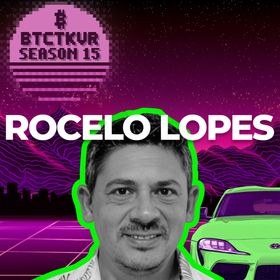
S15 E67: Rocelo Lopes on Self Custody, Tether Truth & Generational Bitcoin
The audio keeps playing while you browse the site.
Read the transcript11,359 words, every line links to the minute it was said
Ask this episode
I recorded this one in a gym at NiceHash X in Maribor, with Bitcoin sitting just under what Rocelo Lopes kept citing as the all-time high: $80,486. The conference had just marked ten years of NiceHash, and I wanted a conversation that was not another polished stage interview. Rocelo is a Brazilian bitcoiner who has been around since 2013. He mines, he talks about privacy without turning it into a brand, and he has a habit of saying the quiet part out loud. We talked about the invoice he almost refused, the 10 bitcoins he left on Mt. Gox, a kidnapping, Liquid, Tether, and why he keeps sending coins to a wallet he will not be able to open for years.
This was late in Season 15. A few days earlier I had sat down with David Bailey. At the same conference I also recorded with Jameson Lopp. Rocelo's episode is the one that stayed with me for different reasons. It is less about a protocol war and more about what happens when the coins, the publicity, and your real life start to occupy the same place.
The Invoice He Almost Refused
Rocelo came into Bitcoin the way a lot of early merchants did, except the numbers were absurd. He was in Tokyo, working in technology, and a client wanted to pay a bill he remembers as about $180,000 in bitcoin. He remembered the figure as about 1,015 bitcoins. At first he said no.
"This guy pay me with Bitcoin. I said no, I don't want this. I don't believe."
Then he changed his mind. "Okay, give me this funny coin, this Bitcoin."
That is not a hero origin story. It is a guy who thought the payment was a joke, took it anyway, and then had to figure out what he was holding. He started buying more in Tokyo. He met people around Mt. Gox. Mark Karpeles, he said, did not show up to the meeting he was hoping for, and he later left about 10 bitcoins on the exchange, which is a sentence a lot of 2013 people can still feel in their stomach. He did not tell it as a tragic set piece. He told it the way you tell a story you have already paid for.
He has been a programmer since he was 14. He was 51 when we recorded. That gap matters, because he does not talk about Bitcoin like a 24-year-old who just discovered hardness. He talks about it like someone who has already lived through a few cycles of being sure, being wrong, and still showing up.
Looking for Satoshi in Buenos Aires
After Tokyo he went to Argentina, to Labitconf, looking for Satoshi Nakamoto. Not in a mystical way. He wanted to complain. The 10-minute blocks bothered him. The one-megabyte cap bothered him. He wanted to tell the person who designed the thing that it was too slow and too small.
Satoshi was not there, obviously. Rocelo kept going back anyway. "It's just me and Alejandro from Kraken [who] is the only two person that is not involved on the organization that has been in every single Labitconf." Rodolfo, who organizes it, can probably confirm the attendance record better than I can. The point is not the badge count. The point is that Rocelo treated Bitcoin as a physical scene from the beginning: rooms, conferences, arguments, and the slightly crazy idea that you might bump into the author and tell him the blocks are too small.
I like that instinct even when I do not share the complaint. If you only meet Bitcoin on Twitter, you start thinking the protocol is a mood. If you keep showing up in the same rooms for a decade, you start noticing who is still there after the price does something dramatic.
Mining Until the Subsidy Changes
He started mining in 2014, not long after he got paid. That part of the story is almost conventional: buy coins, get curious about the machines, start producing blocks instead of only holding them. What is less conventional is how openly skeptical he is about the business after 2032, when the subsidy will have been cut again and fees are supposed to carry more of the security budget.
"I think mining after 2032, I don't know what those guys are going to do, because there is not much to mine anymore."
He is not preaching that mining dies. He is saying he does not want his own future tied to a business that, in his view, gets harder to justify once the easy issuance is gone. Coming from someone who has actually mined, that lands differently than it does from a commentator who has only ever bought the ETF.
He also talked about fitness, which is why we were in a gym in the first place. The line was simple enough: if you plan to hold for a long time, you should probably still be alive and reasonably sharp when the lock expires. I did not need a TED Talk version of that. I already believe it. Bitcoin does not care if you are in shape. Your future self might.
The Kidnapping, and the Wallets He Would Split Now
This is the part of the interview I want to handle carefully, because it is not entertainment.
Rocelo said his wife was kidnapped after he became more public. He described a cluster of mistakes that will be familiar to anyone who has watched bitcoiners get careless with visibility.
"The mistake was pretty much simple. Number one, ego."
He was selling mined bitcoin out of the same wallet, and the rest of the picture was easy to assemble. "I was getting from the mining that we're doing and putting everything on the same wallet. I not even took the time to say, let me set up a wallet only for this, a wallet only for that." People looked him up. "Let me check his Instagram, let me check his wife's Instagram. This guy's driving a McLaren, this guy's driving a Ferrari... guess what, became a target."
When they took his wife, he said, the number they wanted was not a number he could pay. "I said, listen, I do not have this amount of money." They did not pay a ransom. The trauma is still there. He did not present it as a closed chapter with a neat lesson at the end. He presented it as something he still lives with, and as a warning.
His advice was not exotic. Separate wallets. Take operational security seriously. Do not advertise the stack. "Stay humble." If you mine, do not let the entire business and the entire savings account share one obvious on-chain identity. If you are going to be public, assume that publicity and UTXOs can be connected by people who do not wish you well.
I have had this conversation in other forms, including with people who help whales design custody setups, like the team at Hodling.ch. The details change. The pattern does not. Bitcoin gives you self-custody, and then it gives you the consequences of being visible while you use it. Rocelo is not a theoretical example. He is someone who already paid that tuition.
Liquid Instead of Drivechains
When I steer these interviews toward scaling, I usually end up talking about Drivechains, because I have had Paul Sztorc on the show often enough that it has become a running theme. Rocelo was not interested in that fight. He was focused on Liquid.
He likes confidential transactions. He spoke about Adam Back with genuine respect. When I asked whether he had looked at Drivechains, he was almost dismissive, not because he had a counter-paper, but because his attention was already elsewhere. "I'm focused on Liquid. Liquid is a second layer of Bitcoin, and it's nice the way they do the privacy there. They have confidential transactions." And later: "Right now I'm bullish on Liquid. I think Adam Back did a fantastic job on it." For him, Liquid is not a culture-war position. It is a network he can actually use, with assets, with privacy properties that mainchain Bitcoin still does not have by default, and with a path into institutions that already understand issued assets better than they understand coinjoins.
I have written before about how limited Bitcoin's privacy still is. Rocelo did not need the essay. He has been using a sidechain because the base layer still shows too much. In this episode I also pointed people at Cake Wallet and silent payments: you should be able to receive without lighting up a reused address like a neon sign. Liquid is a different tradeoff. It is federated. It is not perfect. He still prefers a tool that exists to a purity test that leaves him exposed.
A Stablecoin Trojan Horse for the Banks
Then he made the claim that is in the title of the episode, the "Tether truth" part, and he did not whisper it.
"Liquid today for me, it is the Trojan horse to get inside the banks."
His argument is practical. In Brazil, he said, about 90% of crypto transactions are USDT. People do not start with a self-custody sermon. They start with a dollar token they can actually move. If you meet them there, you can later move them to bitcoin. If you refuse to meet them there, they still use the dollar token, just somewhere else.
He also said he had approval from the Brazilian Central Bank to test this with two digital banks in January, first with USDT, then with bitcoin. I am reporting that as his claim from the recording. I did not sit in the room with the regulator, and I am not going to dress a podcast statement up as a press release.
He was more comfortable talking about the people than about the paperwork. He described Paolo Ardoino, the CTO of Bitfinex and Tether, as a bitcoiner. That matters to him because he does not see USDT only as a rival religion. He sees it as rails. If those rails can sit on Liquid, then the banking system is being asked to touch a Bitcoin sidechain whether it uses the word Bitcoin on day one or not.
I have mixed feelings about this, and I said some of them on the tape. I would rather people get paid in bitcoin than in a dollar IOU. I also live in the world as it is. If the on-ramp in a country is a stablecoin, pretending otherwise is just a way to lose the users and then lecture them later. Rocelo is betting that the Trojan horse works in the direction he wants: banks first accept the token, then they accept the chain underneath it, then some of that activity becomes actual bitcoin.
He also talked about Keet, the peer-to-peer communication app from the Holepunch crowd, as a way to talk without handing the conversation to a company. That fits the same personality. He wants tools that do not require a permission slip, even when the business conversation is about banks.
Coins Sent to the Future
One of my favorite details in the interview is almost a throwaway if you are only listening for market calls. Rocelo has been sending bitcoin to himself in the future. He uses timelocks. He described it as a transaction that sends the coins forward, to a wallet he cannot just open because he is bored, scared, or tempted.
He described it in the simplest possible language. "I did a transaction, send the bitcoins to the future." A couple of years earlier he had sat down, counted the blocks he needed, and locked the coins forward. "For me was a relief. Now I do not have those bitcoins anymore. It's somewhere in the future, and then I'm going to get it in the future."
The custody picture that emerges is not a single hardware wallet in a desk drawer. It is a man who has been robbed of a sense of safety and is now trying to make his stack harder to steal, harder to coerce, and harder to spend in a panic. He also talked about a safe in Hong Kong, and about telling only a few trusted people that it exists. "I put in a safe in Hong Kong."
I respect that more than I respect another speech about diamond hands. A timelock is a commitment device. It is also a reminder that self-custody is not only about keeping other people out. Sometimes it is about keeping your present self from making a short-term decision with long-term money.
One Hundred Thousand, Then a Million After 2032
Because we recorded this in a gym, while the price was hanging around $80,000, I asked him where he thought it was going. "I think we do reach 100,000 by March, April next year." As for the bigger number: "My guess for a million is going to be after 2032."
Looking back from 2026, Bitcoin did cross $100,000 in early December 2024, only a few days after this episode was published on 28 November 2024. His March or April target was more conservative than the market turned out to be. I am leaving the million-dollar part alone. That was a long-range statement, and I am not going to pretend a podcast prediction is a calendar.
What I liked more than the number was the advice around it. He did not tell people to sit and wait for a price target like it was a bus. He talked about earning, about building, about not reducing a life to a chart. He also talked about politicians and keys, and he was not romantic about it. If the people who want to control the money also want to control the wallets, you should not be surprised when "adoption" starts to look like custody by someone else.
At the end I told him what I tell a lot of guests who came in from a slightly weird angle and stayed: ask the stupid questions. The invoice he almost refused was a stupid-question moment. The Labitconf trips were a stupid-question moment. The timelocks are a grown-up version of the same instinct. Bitcoin is easier to lose through embarrassment, or through showing off, than through not knowing the latest opcode debate.
Rocelo is not trying to win a developer argument. He is trying to stay self-custodied, stay alive, and still use the thing. After an hour in that gym, I found that more useful than another round of slogans.
Listen to Rocelo Lopes on Spotify, Apple Podcasts, YouTube, and More
Time stamps:
- 00:00:51– Welcome to the Gymcast!
- 00:01:47– Rocelo's Introduction
- 00:02:51– First Bitcoin Transaction
- 00:03:17– Buying Bitcoin in Tokyo
- 00:05:13– Meeting Satoshi Nakamoto?
- 00:06:51– Importance of Physical Fitness for HODLing
- 00:08:22– Transition from Bitcoin Skeptic to Miner
- 00:09:35– Future of Bitcoin Mining
- 00:10:53– From Bitcoin Enthusiast to Kidnapping Victim
- 00:11:34– Lessons on Operational Security
- 00:14:13– The Need for Bitcoin Privacy
- 00:15:23– Discussion on Privacy Solutions
- 00:16:14– Focus on Liquid and Future Innovations
- 00:17:16– Bitcoin Privacy and Opsec
- 00:17:33– Litecoin's Extension Block
- 00:18:16– Comparing Bitcoin and Monero
- 00:19:19– Liquid's Adoption Challenges
- 00:20:24– Liquid as a Trojan Horse
- 00:23:19– USDT's Role in Crypto
- 00:25:50– Emerging Market Adoption
- 00:28:24– Decentralization Beyond Money
- 00:30:49– Self-Custody Advice
- 00:32:42– Creative Solutions for Bitcoin Security
- 00:34:31– Importance of Privacy in Bitcoin
- 00:35:17– Creative Responses to Bitcoin Ownership Questions
- 00:36:22– Staying Humble and Low Profile
- 00:38:03– Reflections on Roger Ver's Predictions
- 00:38:28– Future Bitcoin Price Predictions
- 00:39:10– User Empowerment in Bitcoin Holding
- 00:40:30– BlackRock's Role in Bitcoin Market
- 00:41:13– Earning Bitcoin Instead of Buying
- 00:42:25– Challenges for Bitcoin Businesses
- 00:43:22– Creating Demand for Bitcoin
- 00:44:16– Complications of Using Bitcoin
- 00:46:08– Incentivizing Bitcoin Adoption
- 00:47:35– Bitcoin as Software and Scalability
- 00:49:08– Exploring Other Cryptocurrencies
- 00:51:26– Future of Bitcoin
- 00:52:24– Bitcoin vs. Gold
- 00:53:28– Bitcoin in Global Economy
- 00:55:13– Top-Down Adoption of Bitcoin
- 00:56:39– Trust in Politicians
- 00:58:08– Bitcoin's Freedom
- 01:00:11– Bitcoin Price Speculation
- 01:00:52– Self-Custody and Privacy
- 01:01:04– Always Ask Questions
Verify this episode
This is the SHA-256 fingerprint of the MP3 as published here, timestamped in the Bitcoin blockchain with OpenTimestamps. If one byte of the file changes, the fingerprint changes.
- SHA-256
9c189988f3df0e6676d2f69995ff0524e7c86846da835bd6987e055c45a75e4a- Proof
- 2024-11-28_s15_e67_rocelo_lopes_on_self_custody_tether_truth_generational_bitcoin_.mp3.ots · all episode hashes (proof)
- Status
- Anchored in Bitcoin block 974,312
- Timestamped
- After release. The episode came out on 28 Nov 2024, but this proof was made on 3 Nov 2026 and anchored in block 974,312, so it proves this exact file existed by 3 Nov 2026, not on the release date.
How to check it yourself
- Download the MP3 and the proof into the same folder.
- Run
sha256sum 2024-11-28_s15_e67_rocelo_lopes_on_self_custody_tether_truth_generational_bitcoin_.mp3(on a Mac:shasum -a 256 2024-11-28_s15_e67_rocelo_lopes_on_self_custody_tether_truth_generational_bitcoin_.mp3). The result must match the SHA-256 above. - Install the OpenTimestamps client (
pip install opentimestamps-client) and runots verify 2024-11-28_s15_e67_rocelo_lopes_on_self_custody_tether_truth_generational_bitcoin_.mp3.ots. It hashes the MP3 again and checks the proof against your own Bitcoin node, then prints the block and the date the file existed by. Without a node,ots info 2024-11-28_s15_e67_rocelo_lopes_on_self_custody_tether_truth_generational_bitcoin_.mp3.otsshows the block height to look up in any block explorer.
Related

S17 E15: Danny Plainview & Chad Master on OP_NET, Smart Contracts on Bitcoin L1 & the Great Stablecoin Unlock
Editor’s note: this conversation was recorded in late March 2026, in the days surrounding OP_NET’s mainnet activation. The…
S17 E12: Ray Youssef on the Mexico Arrest & Life After NoOnes
Ray Youssef does not do quiet exits. In his telling, he walked out of Monerotopia in Mexico after giving a Malcolm X…

S15 E19: Alexei Zamyatin on Build on Bitcoin & Layer 2s
Alexei Zamyatin is a (recovering) academic cryptographer who co-founded the Build on Bitcoin project – an initiative which…

Comments
Comments run on my own server. No trackers, no tracking cookies.