




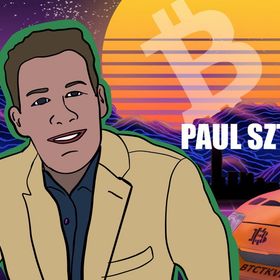
S15 E68: Paul Sztorc on Activating Drivechains via CUSF
The audio keeps playing while you browse the site.
Read the transcript20,360 words, every line links to the minute it was said
Ask this episode
Paul Sztorc came back on the show with a new acronym and an old obsession. He still wants Drivechains. He still thinks BIP 300 is how Bitcoin gets features without turning the base layer into a mall. What changed in December 2024 was the delivery mechanism. He was no longer waiting for Bitcoin Core to become enthusiastic. He was talking about CUSF, a "Core-untouched soft fork," and telling people they could already download the software.
This was not his first visit. In Season 15 Episode 16 he had to dance around the word Drivechains. By the time he showed up in Season 15 Episode 44, the argument was already a live-show sport. This episode is the one where he tries to cut the Gordian knot: leave Core alone, let miners run an extra program, and turn a soft fork on or off without asking a repository for permission.
A Soft Fork That Leaves Core Untouched
The pitch is almost aggressively boring once you get past the branding. Miners run an enforcer beside an unmodified Bitcoin Core node. That extra software is what notices the new rules and acts on them. In the simplest version, it uses the existing invalidateblock path to reject a block that breaks those rules. Paul was careful to say that this is only the simplest path, not the only one, which matters because critics immediately go for the kill switch. "The idea has ways of working that don't involve invalidateblock. That's just the simplest way."
The point, as he framed it, is political as much as it is technical. "A soft fork doesn't change Bitcoin. It leaves the old Bitcoin network exactly the way it is. So the soft fork is the thing that doesn't change Bitcoin." If that soft fork can be activated without changing the Core repo, then the people who treat that repo as a sacred object no longer get a veto by sitting still. You can also deactivate the thing later. That is the part a lot of "soft forks are forever" rhetoric does not like to sit with.
I have always liked this instinct, even when I argue with Paul about taste. Bitcoin's most important quality is not that one team of maintainers stays in a good mood. It is that users and miners can enforce rules. If the only realistic way to add a feature is to win a culture war inside one GitHub organization, then we do not have a protocol. We have a court.
Peter Todd, Luke, and Who Actually Has to Upgrade
A lot of the first half of the interview is Paul answering other people. Peter Todd had criticized the invalidateblock path, including the idea that maybe it should just be removed so nobody can do this. Paul's reply was that removing the obvious tool would not kill the idea, only the easy explanation of the idea, and that treating a debugging command as the entire design is a way to miss the point.
Then came Luke Dashjr, or at least Luke's theory of soft forks. I put it this way on the tape: Luke "believes that a soft fork is something that everyone must upgrade to, so it's sort of like a slow hard fork." Paul's counter is the old one, and I still think it is correct. "From my point of view, a soft fork is: miners could build on one of two blocks... they always choose to mine on the block that enforces a new tightened rules." People who do not care can keep running old software. The people who want the new rule can enforce it. That is the whole difference between a soft fork and a hard fork.
This is also why he keeps coming back to light clients, SPV, Neutrino, and data availability. If "everyone must run a full node and upgrade on command" is your model of Bitcoin, then of course CUSF looks rude. If Bitcoin is a system where most people verify as much as they need and miners are the ones who actually decide which chain is heaviest, then an enforcer sitting next to Core is not a betrayal. It is an admission of how the network already works.
He was skeptical of the idea that zero-knowledge proofs will just let everyone sync and relax. I did not need him to become a ZK researcher on the spot. I needed him to say the quiet part: a lot of the current scaling conversation is about making people feel that they are still verifying when they are actually trusting a more fashionable intermediate.
When Core's Policy Is to Do Nothing Controversial
We also talked about Bitcoin Core as an institution, which is where Paul gets sharp.
"Ava Chow has explicitly explained on Twitter that the policy is not to do anything controversial, and the policy is that if anyone threatens any kind of lawsuit or whatever, that they will yield completely to that threat. So it is like a threatocracy."
That is his word, threatocracy, and I am leaving it as his characterization of a public policy conversation, not as a court finding. The surrounding point is harder to dismiss. If the default posture is "do nothing controversial," then controversial software does not get merged, and the definition of controversial expands until it includes anything interesting. Paul thinks libbitcoin and Eric Voskuil are a reminder that a full node does not have to be slow, and that Core's aura of sacredness is not the same thing as quality.
I have some sympathy for maintainers who got sued, harassed, or conscripted into other people's wars. I have much less sympathy for the conclusion that the remedy is paralysis. If the only safe merge is the one nobody cares about, then Drivechains will never go in through the front door. That is why CUSF exists. It is a side door that still uses Core, which is a very Paul kind of compromise: he will not worship the repo, but he also will not pretend users want to compile a brand new Bitcoin implementation just to try a sidechain.
If Even BIP 300 Is Too Much, Maximalism Is Dead
This is the emotional center of the episode, at least for me. Paul has been talking about BIP 300 for years because it is supposed to be the opposite of a base-layer grab bag. The sidechain has the features. The L1 stays boring. If even that is treated as an attack, then the slogan "just do it on a layer" is empty.
He said that in a world where Bitcoin will not take new features, there is no Bitcoin maximalism left, because anyone who wants the feature has to get it from a different project. You can pick ossification, or you can pick a bigger Bitcoin economy. You do not get to pick both and then insult the people who leave.
I had just spent a lot of Season 15 in that exact argument, with Jameson Lopp, with fiatjaf, and with the "we can already do everything on Lightning" choir. Paul is blunter than most of them. He thinks the custodial piles accumulating around ETFs and corporate treasuries will eventually fail in the same family of ways Mt. Gox and FTX failed, and that more people getting exposure through Saylor-style vehicles is still, on net, better than the alternative. Adoption can be sloppy and still be real. What he will not accept is the idea that Bitcoin should stay small and morally pure while all of the actual activity happens on wrapped coins somewhere else.
He also pointed at a market fact I keep raising because it refuses to go away: wrapped bitcoin has had more liquidity than Lightning, Liquid, and Rootstock combined. If your theory is that "the people will just use Bitcoin," the people are already telling you what they want to do with it. They want contracts, leverage, other assets, and a faster environment. You can despise that demand. You cannot veto it out of existence.
Covenants as a Mental Illness, Soft Forks as Harmless
Then he said the thing that will get clipped out of context.
"My position on covenants is that the entire covenants project is a mental illness. Every single one of them is a mistake. But nonetheless we should still activate all these soft forks because they are completely harmless."
I laughed, because of course he did both in the same breath. Paul does not like covenants. He thinks the project is a wrong turn. He also thinks the idea that a soft fork must be endlessly debated until every faction feels spiritually ready is Luke Dashjr's category error. Miners, in his model, should be able to turn these things on and off. If a covenant experiment is useless, it will die of uselessness. If it is harmful in practice, it can be deactivated. What should not happen is a years-long theology seminar that prevents any experiment from existing.
This is consistent with how he talks about almost everything. He wants the market to try the software. I had just done an episode with Avihu M. Levy on ColliderScript, so I was not going to pretend the covenant conversation was imaginary. I also was not going to pretend Paul's disdain was subtle. He can think a design is silly and still want it activated. That combination makes him irritating to people who want a prophet. It makes him useful to people who want a process.
Lightning, wBTC, and the Developer Grift
Lightning did not get a gentle review.
"Lightning is too interactive. The fees are high when you... actually make it work, the fees are high because it's difficult to manage the liquidity. People cheat on managing the liquidity with the submarine swaps, where for every Lightning transaction there's an L1 transaction."
Then the knife: "None of this stuff will be competitive in the long run. It is all just a developer grift."
Ark, in the same conversation, got thrown into the same bucket of cleverness that may not survive contact with users. I am not going to re-litigate every second-layer brand here. The pattern is the same: if the only way the system works is by reintroducing the base chain, or a custodian, at the exact moment a user tries to do something normal, then you have not escaped the base chain. You have built a more complicated on-ramp to it.
Download It Yourself
The practical part of CUSF, at least as he described it in December 2024, is that you can try it. The software downloads real Bitcoin Core, plus an activator, plus the Thunder L2, and there is a Signet. The binaries were at releases.drivechain.info. The company is still LayerTwo Labs, and the code is on GitHub. Names around the mempool enforcer were already in flux on the tape, so I am not going to freeze a domain from a half-remembered URL and pretend it is a standard.
This was also, according to Paul, the first episode Noones sponsored, which he mentioned with a kind of amused gratitude. LayerTwo Labs, SideShift, and Hodling.ch were in the read as well. I am noting the sponsors because they were part of the show, not because the software argument depends on them.
He walked through the pace of Bitcoin's actual soft-fork history, and this was one of the cleaner statements in the whole recording:
"In the first like seven to eight year period we did 16. In the second seven to eight year period we did two. And one was SegWit, took 26 months from when it was coded to when it was activated, and then Taproot took 40 months. So it's just been getting slower and slower."
That is why he rebuilt the work as CUSF. If the merge process is the bottleneck, you stop treating the merge process as the only door.
Looking back from 2026, I should be honest about what happened after this conversation. Miners did not in fact flock to run the enforcer, and in April 2026 Paul announced a hard fork instead. I wrote about that later, in eCash ECX: Paul Sztorc forks Bitcoin to prove a point. I am not rewriting the December 2024 interview as if he already knew that would be the next move. On this tape, CUSF was still the path he wanted: Core stays untouched, the soft fork is optional, and anyone can get on board without waiting for a priest class to feel ready.
You Don't Have to Wait Eleven Years
He closed the way Paul usually closes, which is to say that he thinks he is right and that the rest of us are slow.
"I'm also right about Drivechain and BIP 300, and I'm right about CUSF also. I'm right about all these things. So it's like, what do you want me to do? It's not my fault that everyone else is so slow."
He also said prediction markets are still only the tip of the iceberg compared with what he has been describing, even after Polymarket made the idea legible to a mass audience. The last line I kept was the most useful one, because it was aimed at listeners who have been watching him repeat himself since 2013:
"You don't have to wait 11 years to get on board with CUSF."
I have now had Paul on the show enough times that I can recite the Drivechain speech from memory. This episode is still worth hearing, because CUSF was his attempt to stop asking Bitcoin Core for a hall pass. Whether you think that is elegant engineering or an attack on process, it is a clearer statement of the problem than another year of saying "consensus is not there yet" and then going home.
Listen to Paul Sztorc on Spotify, Apple Podcasts, YouTube, and More
Time stamps:
- 00:00:46– Introducing Paul… again!
- 00:01:56– Core Untouched Soft Fork
- 00:02:19– Peter Todd's Criticism
- 00:04:44– Debate on Soft Forks
- 00:05:00– Luke Dash Jr.'s Perspective
- 00:08:51– SPV Wallets and Full Nodes
- 00:12:10– Data Availability Issues
- 00:14:16– Neutrino and Privacy
- 00:17:05– Dandelion++ Proposal
- 00:18:45– Quality of Bitcoin Core Development
- 00:19:36– Libbitcoin’s Fast Sync
- 00:20:01– Bitcoin Core Limitations
- 00:20:55– Governance Challenges
- 00:24:39– Responsibility in Development
- 00:25:31– Mainstream Adoption Concerns
- 00:26:54– Risk of Centralization
- 00:27:55– Michael Saylor's Influence
- 00:33:19– Wrapped Bitcoin and Smart Contracts
- 00:34:31– Bitcoin Core's Innovation Stagnation
- 00:37:11– BIP 300 and Soft Forks
- 00:38:27– Redefining Bitcoin Maximalism
- 00:40:46– The Miners' Interests
- 00:41:56– Layer Two Labs
- 00:43:53– Explaining the Core Untouched Soft Fork Proposal
- 00:46:04– Challenges with Soft Fork Activation
- 00:48:12– Slow Progress of Soft Forks
- 00:49:21– Competition Among Layer 1 Solutions
- 00:51:31– Critique of the Lightning Network
- 00:53:06– Concerns Over Custodial Solutions
- 00:54:17– Historical Perspective on Lightning Network
- 00:55:22– Cultural Issues in Criticizing the Lightning Network
- 00:56:40– Incompetence in Development
- 00:58:57– Potential for Improvement
- 01:00:22– BIP Activation Dynamics
- 01:01:22– Prediction Markets for Bitcoin Soft Forks?
- 01:02:49– Political Control in Bitcoin
- 01:04:18– Concerns About Full Nodes
- 01:05:38– Covenants and Activation Delays
- 01:06:56– Blockstream's Influence
- 01:08:01– Why Covenants Are a Mistake
- 01:09:13– The Role of Miners in Soft Forks
- 01:10:21– Misguided Investments in Technology
- 01:11:23– Competition in Bitcoin Development
- 01:14:46– Privacy Improvements in Bitcoin
- 01:17:13– The Search for Innovative Solutions
- 01:21:41– User Experience and Adoption
- 01:22:45– No Interest in User Experience
- 01:23:19– Changing the Culture
- 01:24:04– Technological Gaps
- 01:25:15– Network Effects and Competition
- 01:26:34– Bitcoin's Complacency
- 01:28:13– Decentralization Spectrum
- 01:29:05– Historical Context of Competition
- 01:31:29– Privacy Innovations
- 01:34:10– Politicians Praising Bitcoin
- 01:35:31– Mainstream Adoption
- 01:37:33– Innovation and Disruption
- 01:38:16– Sponsor Plug and Market Insights
- 01:42:52– Community Questions
- 01:43:20– Blocking on Twitter
- 01:45:40– Perceptions of Bitcoiners
- 01:46:37– Miners' Misunderstanding of Bitcoin
- 01:49:07– Future of Bitcoin Projects
- 01:50:15– Privacy Improvements in Bitcoin
- 01:51:57– Monero's Position in Privacy
- 01:54:36– Mempool Policy and CUSF
- 01:58:20– Conway's Law in Bitcoin
- 02:00:09– Criticism of Bitcoin's Direction
- 02:01:59– Responsibility in Bitcoin Core Development
- 02:04:15– Ad Hominem Attacks in Bitcoin Proposals
- 02:05:06– Closing Statement on CUSF
- 02:05:16– The Future of Consensus
- 02:06:08– Soft Forks and Innovation
- 02:07:12– Understanding Soft Forks
- 02:08:18– Prediction Markets in Bitcoin?
Verify this episode
This is the SHA-256 fingerprint of the MP3 as published here, timestamped in the Bitcoin blockchain with OpenTimestamps. If one byte of the file changes, the fingerprint changes.
- SHA-256
178d6abb7da4854a3d0d9c74384ae330400b81e6412b9ea7ab4ec36da2af53c9- Proof
- 2024-12-10_s15_e68_paul_sztorc_on_activating_drivechains_without_a_soft_fork_cusf_-_09.12.2024_21.07.mp3.ots · all episode hashes (proof)
- Status
- Anchored in Bitcoin block 974,312
- Timestamped
- After release. The episode came out on 10 Dec 2024, but this proof was made on 3 Nov 2026 and anchored in block 974,312, so it proves this exact file existed by 3 Nov 2026, not on the release date.
How to check it yourself
- Download the MP3 and the proof into the same folder.
- Run
sha256sum 2024-12-10_s15_e68_paul_sztorc_on_activating_drivechains_without_a_soft_fork_cusf_-_09.12.2024_21.07.mp3(on a Mac:shasum -a 256 2024-12-10_s15_e68_paul_sztorc_on_activating_drivechains_without_a_soft_fork_cusf_-_09.12.2024_21.07.mp3). The result must match the SHA-256 above. - Install the OpenTimestamps client (
pip install opentimestamps-client) and runots verify 2024-12-10_s15_e68_paul_sztorc_on_activating_drivechains_without_a_soft_fork_cusf_-_09.12.2024_21.07.mp3.ots. It hashes the MP3 again and checks the proof against your own Bitcoin node, then prints the block and the date the file existed by. Without a node,ots info 2024-12-10_s15_e68_paul_sztorc_on_activating_drivechains_without_a_soft_fork_cusf_-_09.12.2024_21.07.mp3.otsshows the block height to look up in any block explorer.
Related
S15 E19: Alexei Zamyatin on Build on Bitcoin & Layer 2s
Alexei Zamyatin is a (recovering) academic cryptographer who co-founded the Build on Bitcoin project – an initiative which…
S17 E46: Livestream from TABConf 8, Part 1 (feat. Paul Sztorc, Andre Beganski, Alex Lewin, Janusz, Christopher Allen, Will & Michael Tidwell)
Live from the last TABConf: Paul Sztorc on quantum soft forks and eCash, Christopher Allen on multisig, Janusz on Zark and…
S17 E38: Keagan McClelland on Lightning Metrics, Covenants, Consensus Politics & Verifying Bitcoin
There is a certain genre of Bitcoin Twitter argument that never quite resolves into a conversation. People trade metrics, memes…

Comments
Comments run on my own server. No trackers, no tracking cookies.