




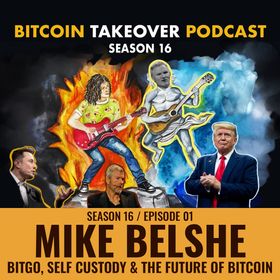
S16 E1: Mike Belshe on BitGo, Self Custody & The Future of Bitcoin
The audio keeps playing while you browse the site.
Read the transcript21,481 words, every line links to the minute it was said
Ask this episode
Before this interview I went digging through YouTube comments under a panel Mike Belshe had done in Nashville, and one of them said, more or less, that this new BitGo guy was interesting. New. Mike co-founded BitGo in 2013, helped make two-of-three multisig a custody standard before anyone called it a standard, and before that created SPDY at Google, the protocol that became HTTP/2. He just does not do many interviews.
So I opened Season 16 with him. We streamed it live on January 2, 2025, the day before Bitcoin's 16th birthday, across YouTube, Twitter and Twitch. I came in with a long list: multisig and MPC, wrapped bitcoin, the block size war, the Strategic Bitcoin Reserve, privacy, the $5 wrench attack and why Lightning still feels unfinished. Mike answered all of it like an engineer who has spent too long in standards meetings to believe in silver bullets. "Everything's got trade-offs" might as well be the episode title.
He came back to the show in Season 17 for a conversation about BitGo, quantum computing and the Clarity Act. This is the first one.
Two-of-Three, Theft and Loss
People mostly know BitGo now as a regulated institutional custodian. Mike wanted to correct that first. "People actually forget that we pioneered self-custody," he told me. In 2013 the idea was simple: use multisig "in this two out of three way where it protects against both theft and loss."
That distinction matters more than it sounds. Two-of-two or three-of-three setups protect against theft, he explained, but lose one key and the money is gone. Two-of-three protects against both. Today BitGo runs self-custody and qualified custody on the same platform, and on chains that do not support native multisig it uses multi-party computation, or MPC, while insisting on a real two-of-three threshold.
MPC came with a warning. It has been around since the 1980s, it is computationally heavy, and "it's super easy to mess up." In an MPC signing round the parties go back and forth about eight or nine times, which makes true cold storage close to impractical. He was skeptical of newer vendors claiming cold-storage MPC with algorithms that have only had a few years of review. "Typically the way you make crypto great is you put it up for peer [review] and you let it be reviewed for like 10 plus years." He also mentioned Stanford's Dan Boneh, one of the authors of BLS signatures, as an example of how fast this field has moved from obscure to popular.
Wrapped Bitcoin and the Third Use Case
I asked about WBTC, which I described on air as bigger than Lightning, Liquid and pretty much every other Bitcoin Layer 2. Mike framed it inside his broader view of what digital assets are for: Bitcoin as store of value, payments still being worked out, and DeFi as the third strong use case.
The story he told was modest. Around 2017 and 2018, DeFi on Ethereum struggled because ether was too volatile to be good collateral. Engineers at BitGo, and he was careful to give them the credit, "came up with the concept of like, look, let's create basically the world's first, you know, digital asset stablecoin" for bitcoin. For about a year and a half it sat there with little use, and then DeFi took off.
Later in the interview he made the regulatory case for DeFi, which I had not heard put quite this way. Broker-dealers have to be monitored for their whole careers because people can be tempted to cheat. Put the broker-dealer into a smart contract, he argued, and regulators only need to audit the code once. "The code won't steal, but the people will."
On protecting WBTC from any single government, he said BitGo had "just moved to a multi-custodial model where the other holders of keys are actually in different nations," and that BitGo was working toward seven regulated custodians in seven countries so that no one regulator could order a confiscation alone.
From Netscape to RFC 7540
Mike's background explains a lot of how he thinks. He was at Netscape in the early days, alongside Brendan Eich, and later joined Google as Chrome was being built. HTTP/1.1 had barely changed in about 15 years, so he built a protocol first called Flip, then SPDY, which eventually became HTTP/2. The final standard was finished after he left Google, while he was running BitGo. "I think BitGo is the only crypto company that has its name on an RFC." You can check: RFC 7540, May 2015, lists M. Belshe with BitGo as his affiliation.
I had read that he was inspired by Tim Berners-Lee. He corrected the detail. It was not a quote but a status code built into the web's protocols, HTTP 402 Payment Required, which has barely ever been used. In the Netscape era, he said, people assumed secure protocols were for ecommerce, but without Bitcoin "it's difficult to put cash in your computer and have it go through a wire." So the web got credit cards instead, "a whole morass of payment technology that all of us pay for through the nose."
His vision for the alternative was an AI agent negotiating a news article down from ten cents to five, and payments with zero clicks. "What's better than one click? Zero clicks."
Bitcoin Payments and a Pragmatic Heresy
I pointed out the irony that most bitcoin "payments" today are internal ledger moves at PayPal or Cash App. Mike agreed that fees have been the obstacle and said Lightning, about seven years in, "certainly isn't here yet."
Then he said something many people in my audience would not enjoy hearing. Small amounts of money do not need Bitcoin-grade security, the same way you do not keep your savings in your physical wallet. If other chains build better retail payments, they may win that part. "It doesn't have to be a single blockchain world. I know this is the Bitcoin Takeover podcast, so I hope I'm not speaking [sacrilege] here. I'm just trying to be pragmatic."
He came back to this near the end, after I told him about the most expensive Lightning payment I have ever made. I had sent about $10,000 from Phoenix to Kraken because I did not want to wait on a compliance team, paid a 1% fee and lost $100 when an on-chain transaction would have cost a few cents. Mike's response was gracious and a little professorial: "consider it tuition." Then he compared it to credit cards, which take three to five percent once you add up both sides, but sell you consumer protection in return. His conclusion was that we may need different money for different jobs: Bitcoin as an inflation hedge and protection from seizure, and something else for everyday purchases where you want insurance against fat fingers.
Sidechains, Drivechains and Hand-Waving
LayerTwo Labs was one of my sponsors, and I asked him about Drivechains, which Paul Sztorc had been pushing on my show for years. He took the long view. The arguments are old, he said, going back to 2013 and 2014, and they all come down to the same tension: how do you keep Bitcoin static enough to hold a billion dollars safely while still allowing innovation? Liquid, Rootstock and Drivechains were all attempts at that, and in his telling none of them took off the way their designers hoped.
He was much sharper on colored coins and metaprotocols. Omni, formerly Mastercoin, and some of today's inscription-based assets keep state that Bitcoin miners do not see. "If the miners are not aware of whatever state it is you're trying to maintain, it does not leverage Bitcoin's decentralization." People "like to hand-wave over that," he said, and the lesson keeps coming back "every five to 10 years."
Privacy and Vint Cerf's Dilemma
I brought up Zerocoin and Zcash, and how Bitcoin seemed to be drifting away from privacy and fungibility. Mike asked if I knew who Vint Cerf was. I did not, and I said so on the stream. He explained that Vint Cerf co-created TCP/IP, and that Cerf once told him that building security into it from the start would have been "basically a non-starter."
For Mike, blockchains are stuck in the same dilemma. Bitcoin used to be called pseudonymous, and I have written before about how limited its privacy still is. "Come on, it's completely non-private." He said he loves Zcash, but human nature and regulators work against shielded transactions. On the human side, we only care about privacy when it is too late, the way people only got upset with Facebook years after handing it everything. On the regulatory side, exchanges and custodians are treated with suspicion for wanting to support shielded transfers, even though KYC and on-chain privacy are not mutually exclusive. He told me BitGo's regulated entities are restricted on the shielded side of Zcash because regulators prevent it, and that he had discussed whether optional shielding was Zcash's big flaw with Zooko, who disagreed with him. (Zooko's own Season 16 interview is worth reading alongside this.)
His forecast was bleak. "I'm afraid we're gonna miss on privacy for decades." Getting HTTP/2 done took "a lot of will" and about ten years, and he sees privacy on blockchains as still at the starting gate.
The Civil War He Watched Up Close
I called the block size war a civil war about which developers and companies would control Bitcoin. Mike was gentler. He said everyone pushing a block size proposal was a Bitcoin fan, and that "the humans voted and the humans spoke."
BitGo attended some of the meetings that led to the New York Agreement but did not sign it. Coming from the IETF, he preferred standards driven "by developers and code" rather than back-room agreements. He admitted he thought SegWit2x would have been a little better, and that more block space might have changed the last few years, but he was not unhappy with the result. He also understood the fear: if you can push one change, can someone push a worse one later? On the supply, he was absolute. "I would go to the mat fighting for not changing the supply ever."
On Gavin Andresen's role in legitimizing Craig Wright, Mike called Wright a liar and a fraud, a view the UK High Court effectively confirmed in 2024, but refused to blame Gavin. "He got tricked, and I'm sure that he's kicking himself more than anybody else about that." What Bitcoin should take from that episode, he said, is pride that it withstood an adversary, and a reminder that security has to scale with value. "If Bitcoin were ever compromisable at a nation level, that's what we should really be worried about."
A Strategic Reserve That Makes Little Sense
This was recorded weeks before Donald Trump returned to office, while a US Strategic Bitcoin Reserve was the topic of every Bitcoin podcast. Mike's answer was refreshingly unenthusiastic. "To be honest I don't think it really makes a lot of sense." The country that can print the reserve currency, he argued, is the one country that does not need bitcoin in its reserves.
He contrasted that with El Salvador and Panama, which use the US dollar and absorb inflation without being first in line for newly printed money. For them, holding something other than dollars makes sense. He also raised a point politicians tend to skip: much of the bitcoin the US government holds was seized and technically belongs to someone else, such as coins recovered from the Bitfinex hack.
The Wrench, the Wife and the Recovery Wizard
When I mentioned the risk of a new Executive Order 6102, the conversation turned into the old self-custody versus custody debate, and Mike gave the most practical advice of the episode. The question every holder should ask is "what percentage of your net worth are you comfortable protecting by yourself?" There is no wrong answer, but once you decide, you have to build security to match: fire, theft, inheritance and every edge case.
He told me he regularly has conversations with long-term holders whose spouses ask how they would recover the coins if something happened. That is where he thinks the industry, BitGo included, has failed. As for himself, he was very direct about the $5 wrench attack. "You can kidnap me, you can, you know, hold the wrench to me, you can rip my fingernails out, you're gonna get nothing," because he does not hold the keys himself.
On hardware wallets he was supportive and critical in the same breath. Use them, he said, and "please don't use browser wallets." But a single seed in a bank safety deposit box protects against a house fire and not against a government that freezes the boxes. He was proud of BitGo's open-source wallet recovery wizard, which lets customers recover funds "without touching a single BitGo server," and pointed out that MPC wallets are harder to recover because "everybody's protocol is proprietary."
I asked how BitGo differs from Casa, which Jameson Lopp co-founded after working at BitGo. Mike said he and Jameson are still friends and called Casa's three-of-five design a different trade-off, not a mistake. More keys can mean more security in theory, but "complexity also impacts the security." Almost every exchange hack, he said, has been about operational security, not broken cryptography. BitGo, he added, has never lost funds.
Bitcoin Is Mostly Locked
For the long-term view he leaned on his internet experience. "I think Bitcoin is mostly locked." Most innovation will happen at the wallet and application layers, he said, and Lightning now competes against every other chain and Layer 2 on whether it is a good payment system. "It's not been moving fast enough, frankly."
I raised the security budget and the question of who will pay miners once the subsidy fades, including Peter Todd's tail emission idea, which I said I would only support in a life-and-death situation. Mike thought fees would balance out over time like a pendulum. On quantum computing, he said it was good that people were thinking about it early but that "we got at least 10 years." That answer is worth reading against his later Season 17 interview, where quantum became a main topic.
He also gave me the best framing I have heard for Satoshi. Borrowing from Peter Thiel's Zero to One, he said Satoshi "looks like he was very much a zero to one type of guy": someone who combined primitives into something new, not the polished engineer who scales it. I had brought up the hacky early code, the poker game and the marketplace that were in the original client, and the time Satoshi asked Laszlo Hanyecz to ease off GPU mining. Mike's point was that Satoshi was surprised by how fast mining centralized, and that people who treat his words as prophecy forget he was improvising.
His New Year's wish was the same idea that ran through the whole conversation. He wanted "a better balance in the ecosystem between self-custody and custody," and systems that bring self-custody principles to people who will never manage seed phrases themselves. For a guy who says he is mostly behind the scenes, it was a surprisingly complete worldview, and a good way to start a season.
Listen to Mike Belshe on Spotify, Apple Podcasts, YouTube, and More
Time stamps:
- 00:00:42– Introducing Mike Belshe
- 00:01:58– Mike Belshe's Background
- 00:02:05– Self-Custody vs. Institutional Custody
- 00:03:56– Multi-Signature Technology
- 00:04:51– Understanding Multi-Party Computation
- 00:05:53– Advancements in Cryptography
- 00:08:26– BitGo's Role in Tokenizing Bitcoin
- 00:09:09– Defining DeFi's Importance
- 00:12:12– Mike's Technology Background
- 00:14:57– Inspiration from Tim Berners-Lee
- 00:17:11– Bitcoin's Zero Click Payments
- 00:17:36– Bitcoin Custodianship Issues
- 00:18:25– Challenges of Bitcoin Payments
- 00:19:20– Scaling Bitcoin and Lightning Network
- 00:20:13– Bitcoin's Role in Digital Money
- 00:21:15– Layer Two Solutions and Drivechains
- 00:22:31– Scaling Discussions in Bitcoin's History
- 00:23:16– Sidechains and Their Limitations
- 00:24:29– Innovation vs. Immutability
- 00:25:32– Importance of Real Applications
- 00:28:42– Privacy and Fungibility in Bitcoin
- 00:30:51– Lessons from TCP/IP and Blockchain Privacy
- 00:32:53– Regulatory Concerns and Privacy Solutions
- 00:34:01– Understanding the Static of Security
- 00:34:59– SideShift
- 00:35:54– Bitcoin's Civil War: Block Size Wars
- 00:36:16– Human Decisions in Bitcoin
- 00:37:10– Historical Proposals and Interpretations
- 00:37:58– Challenges of Block Space and Fees
- 00:38:48– Bitcoin Consensus
- 00:39:41– SegWit and Its Implications
- 00:42:00– Gavin Andresen's Role in Bitcoin
- 00:42:13– Bitcoin's Resilience Against Adversaries
- 00:43:05– Need for Enhanced Security
- 00:44:30– Strategic Bitcoin Reserve in the USA
- 00:45:19– El Salvador's Currency Strategy
- 00:49:13– Self-Custody Concerns
- 00:50:17– Security Measures for Self-Custody
- 00:50:43– Privacy as a Solution
- 00:51:14– Self-Custody Options
- 00:52:24– Family Legacy and Custody Challenges
- 00:52:28– Public Key Cryptography Innovation
- 00:53:29– HODLING.ch
- 00:54:15– Protecting Against Government Confiscation
- 00:54:21– Multi-Custodial Model Explanation
- 00:56:03– Hardware Wallets Discussion
- 00:58:03– Safety Deposit Box Concerns
- 00:58:56– Trade-offs in Security Solutions
- 01:00:09– Onboarding New Users
- 01:01:01– Edge Wallet Features
- 01:03:02– BitGo's Wallet Recovery Wizard
- 01:05:08– BitGo vs. Casa
- 01:05:46– Multi-Signature Security
- 01:09:10– Early Adoption of Multi-Sig
- 01:11:54– Building a New Monetary System
- 01:13:49– Regulatory Changes in the US
- 01:15:32– Impact of MiCA in Europe
- 01:16:17– War on Cash
- 01:18:03– Global Financial Systems
- 01:19:48– Zero Knowledge Proofs
- 01:20:04– Zcash Discussion
- 01:21:18– Privacy Technologies in Bitcoin
- 01:22:26– Challenges of On-chain Traceability
- 01:23:19– Philosophy on Transaction Privacy
- 01:24:51– Concerns About Privacy Adoption
- 01:25:34– Historical Context of TCP/IP Security
- 01:27:24– Bitcoin as Digital Gold
- 01:29:01– Ethereum's Role in DeFi
- 01:32:01– Benefits of Smart Contracts
- 01:33:25– Reflections on Bitcoin's Journey
- 01:34:30– Future of Bitcoin
- 01:36:12– Lightning Network Fees
- 01:38:01– Trade-offs in Payment Systems
- 01:42:01– Adoption of Bitcoin and Early Adoption Costs
- 01:44:38– Long-term Viability of Bitcoin Mining
- 01:47:17– The Future of Bitcoin and Layer Solutions
- 01:49:01– Community Response to Bitcoin Vulnerabilities
- 01:51:11– Satoshi's Vision for Mining
- 01:52:35– Satoshi's Intentions
- 01:54:16– Empathy for Satoshi
- 01:54:24– 0 to 1 Concept
- 01:55:53– Bitcoin's Anniversary
- 01:56:33– Centralization in Crisis
- 01:57:45– Zero Knowledge Proof Bug
- 01:58:45– Following Mike Belshe's Work
Verify this episode
This is the SHA-256 fingerprint of the MP3 as published here, timestamped in the Bitcoin blockchain with OpenTimestamps. If one byte of the file changes, the fingerprint changes.
- SHA-256
6cccd9e1b2adf6ec0f502435c1b866895329459b60f8caf1f8398b1549250e58- Proof
- 2025-01-03_s16_e1_mike_belshe_on_bitgo_the_future_of_bitcoin.mp3.ots · all episode hashes (proof)
- Status
- Anchored in Bitcoin block 974,312
- Timestamped
- After release. The episode came out on 3 Jan 2025, but this proof was made on 3 Nov 2026 and anchored in block 974,312, so it proves this exact file existed by 3 Nov 2026, not on the release date.
How to check it yourself
- Download the MP3 and the proof into the same folder.
- Run
sha256sum 2025-01-03_s16_e1_mike_belshe_on_bitgo_the_future_of_bitcoin.mp3(on a Mac:shasum -a 256 2025-01-03_s16_e1_mike_belshe_on_bitgo_the_future_of_bitcoin.mp3). The result must match the SHA-256 above. - Install the OpenTimestamps client (
pip install opentimestamps-client) and runots verify 2025-01-03_s16_e1_mike_belshe_on_bitgo_the_future_of_bitcoin.mp3.ots. It hashes the MP3 again and checks the proof against your own Bitcoin node, then prints the block and the date the file existed by. Without a node,ots info 2025-01-03_s16_e1_mike_belshe_on_bitgo_the_future_of_bitcoin.mp3.otsshows the block height to look up in any block explorer.
Related
S17 E43: Mike Belshe on BitGo, Quantum & Clarity
Mike Belshe does not do many interviews. Which makes it much more of an honor to have him on my show for…
S17 E19: Amaury Séchet on Forking Bitcoin Twice, Quantum FUD & Scars from the Block Size Wars
Two years after our first interview, I decided to invite Amaury Séchet(@deadalnix) to find out what the Greg Maxwell of big…
The Best Quotes from Every Episode of Bitcoin Takeover Podcast! (2019-2026)
The best Bitcoin Takeover quotes from every episode, seasons 1 to 17: Vitalik Buterin, Roger Ver, Phil Zimmermann, Slush and 300+…

Comments
Comments run on my own server. No trackers, no tracking cookies.