




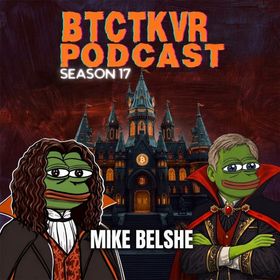
S17 E43: Mike Belshe on BitGo, Quantum & Clarity
The audio keeps playing while you browse the site.
Read the transcript27,138 words, every line links to the minute it was said
Ask this episode
Mike Belshe does not do many interviews. Which makes it much more of an honor to have him on my show for the second time. We’re talking about the man who pioneered multi-sig custody in 2013, wrote HTTP/2.0 as its lead author, and built the company that holds more Bitcoin in institutional custody than anyone else on the planet.
Eighteen months later, Mike Belshe was photographed at the White House alongside Brian Armstrong and the Winklevoss twins. BitGo has completed its IPO. The company that began as a self-custody experiment (and still offers a free service for it) has become the largest Bitcoin bank. And the conversation we had in January 2025, which centered on self-custody philosophy and the lingering scars of the block size wars, has evolved into something more urgent: market structure legislation, quantum computing timelines, AI-generated code audits, and the question of whether Bitcoin’s fee market can sustain its own security.
This interview tells the story of what changed, and what did not.
(Sponsored by Cake Wallet, SideShift, Braiins Hash Power, Orange Rock, and Layer 2 Labs. Cake Wallet sponsored the $100 giveaway. The winning number was 91.)
The Clarity Act: Does this Wild West Need a Sheriff?
When Belshe last appeared, the regulatory conversation was about survival. The Biden administration’s agencies (Gensler at the SEC, Gruenberg at the FDIC, Hsu at the OCC) had spent years making it clear that touching crypto was a career risk for any bank. Operation Chokepoint was not a conspiracy theory. It was a documented pattern of regulatory pressure that made banks retreat from digital assets entirely.
Now the conversation has inverted. The Clarity Act, a market structure bill for digital assets, was up for a cloture vote on the day we recorded. Belshe’s framing of why it matters is instructive, and it comes from an unexpected source: the BitGo IPO road show. During that process, he found himself explaining to Wall Street investors what a private key is. These are not people who have been following Bitcoin since 2013. They are traditional finance professionals who have been waiting on the sidelines, and what they told him, repeatedly, was that without a legislated path forward, crypto remains the Wild West. Uninvestable. Untouchable.
His insight is that the undecideds inside large financial institutions, the compliance officers and risk managers who are neither Bitcoin enthusiasts nor Bitcoin haters, will continue to be swayed by the naysayers as long as there is no statutory clarity. A new administration could reverse everything with executive orders, just as Trump reversed Biden’s approach with his own. Legislation is the only thing that survives a change of government.
But Belshe’s confidence extends beyond the bill itself. Morgan Stanley, Charles Schwab, Citibank, JPMorgan, BNY Mellon, Fidelity, BlackRock: they are all in now. Larry Fink says everything will be tokenized, and Belshe takes that statement at face value. Even without the Clarity Act, he argues, it would be politically catastrophic for any future administration to yank the banking and trading infrastructure out from under millions of Americans who already hold digital assets. The horse has left the barn. The bill would simply make it official.
There is a darker thread underneath. Belshe returns repeatedly to the war on cash, and he is careful to separate the Bitcoin ATM bans popping up in American cities from anti-Bitcoin sentiment. They are anti-cash. The regulators want visibility into every transaction, and cash is the last anonymous rail. Bitcoin ATMs are collateral damage in a much older fight.
BitGo’s Evolution: From Self-Custody Pioneer to Bitcoin Bank
Surprisingly, BitGo still offers a free service to individual users. The same platform that institutions have used for over a decade is available to anyone, at no cost, with self-custody and custody wallets side by side. Both use two-of-three multi-sig or MPC, with three independently generated keys on three separate implementations. Belshe’s framing is that BitGo is the only company in the world offering both models on the same platform, and he seems genuinely puzzled that more people do not see the value in having the option.
The Coldcard exploit looms large in this conversation, as it does in every security conversation this year. Belshe’s analysis is clinical: the problem was not cold storage itself, but the single point of failure inherent in any single-key system. One random number generator, one implementation, one seed phrase. If any link in that chain fails, everything fails. His alternative, three keys generated by three different systems, eliminates that failure mode by design. He is careful not to dance on anyone’s grave, but the lesson is clear: the industry’s definition of “cold storage is safe” was always incomplete.
He also walks through the Bybit hack, where attackers exploited blind signing on Ledger devices to drain funds. The lesson is not that hardware wallets are broken, but that security is a systems problem, not a device problem. The best hardware in the world cannot protect you if your user interface is tricking you into signing the wrong transaction.
Forks, Replay Protection & the Custodian’s Dilemma
With two Bitcoin forks in the air (Luke Dashjr’s BIP 110 chain, already live, and Paul Sztorc’s ecash hard fork, scheduled for Halloween), I asked Belshe how BitGo handles airdrops. His answer reveals the custodian’s dilemma in full. BitGo has a formal fork policy with three criteria: technical proficiency (including replay protection), market cap, and liquidity. Most forks fail on the first criterion alone. Without replay protection, spending coins on the fork can accidentally spend coins on the original chain. BitGo would have to manually engineer protection, a process he describes as super expensive and risky, requiring them to suspend movements on both chains and insert special markers into transactions.
His broader view on forks is pragmatic and consistent with what he said in S16 E1. The technical merit of a fork matters more than its politics. BIP 110’s attempt to control what goes into transactions struck him as futile, and the market agreed. Sztorc’s approach, he noted, at least comes from someone with credible technical reasoning and a long history in the space. Whether the market values it is a separate question, and one he is content to let the market answer.
The New York Agreement, Corrected
One of the most valuable moments in the interview comes when I mistakenly say Belshe was part of the New York Agreement. He corrects me immediately, and then goes further than he ever has on the record. BitGo never signed it. His name was added without his permission, after he had explicitly declined. The reason goes back to his roots at the IETF, the Internet Engineering Task Force, where protocol debates happen between individuals who shed their corporate affiliations. Signing a document that says “I think the protocol should be this way” on behalf of a company was, in his view, the wrong way to build consensus.
This matters because the mythology of the block size wars has calcified into a simple narrative: the New York Agreement was a corporate takeover attempt, and everyone associated with it was on the wrong side. Belshe’s account complicates that. He was in the room, he declined to sign, and his reasoning was principled rather than political. He also addresses the Jameson Lopp departure directly, noting that he considers Lopp a friend to this day and speculating that Lopp left to work on Bitcoin only, not because of any disagreement over the block size wars. Whether that is the full story is for Lopp to say, but the offer to do a joint podcast is on the record now.
The Block Size Counterfactual
On the substance of the debate, Belshe’s position has not changed, but his framing has matured. He still believes a block size increase would have been trivial and might have allowed Bitcoin to capture the payments use case that stablecoins now own. But he is equally clear that the community made its choice, and he respects it.
The decentralization concerns were legitimate, even if he thinks they were overweighted. The result is that Bitcoin is a store of value, full stop, and stablecoins on other chains have inherited the payments layer. He does not think this is reversible at this point, and he does not concern himself with the issue. Markets evolve over time and send clear signals to all participants.
Quantum: The Perception Problem
The quantum computing discussion is where Belshe becomes most animated. His argument is nuanced: the threat today is more about perception than reality. Estimates suggest a quantum computer would need roughly 73 days to crack a single key, which is not an imminent danger. But perception drives capital allocation, and if institutional investors believe quantum is a threat, they will not allocate to Bitcoin regardless of what the math says.
BitGo’s response is already deployed. Their quantum-resistant wallet architecture changes the unspent selection mechanism to ensure that when coins are spent from an address, all coins at that address are spent together, leaving no exposed public keys behind. It is a clever, practical mitigation that works today, without waiting for a protocol-level quantum-resistant signature scheme. Belshe walks through the example patiently: receive one bitcoin at address A, receive another at the same address, spend half a bitcoin, and the legacy approach leaves one bitcoin with an exposed public key. BitGo’s approach spends both, eliminating the exposure.
The harder problem is Satoshi’s coins. Belshe is visibly uncomfortable with the freeze debate. He is, in his own words, antithetically opposed to freezing anyone’s coins, and he points out that WBTC, which BitGo issues, has no freeze function, unlike every stablecoin on the market. But he also thinks the game theory leads inevitably to a freeze scenario: someone will fork Bitcoin with frozen Satoshi coins, someone will fork it without, and the market will choose the frozen version because the monetary incentive to eliminate a potential quantum vulnerability outweighs the philosophical objection. He does not like it. He thinks it will happen anyway.
Belshe is not the only guest this year to wrestle with that scenario. Hunter Beast and Mark Karpelès argued over quantum-proofing Bitcoin and the fate of Satoshi's coins in S17 E23, and Amaury Séchet, who has forked Bitcoin twice, gave his own take on quantum FUD in S17 E19. Put the three side by side and you get a fairly complete map of where this fight is heading.
The AI Laboratory
The AI segment of the interview is unexpectedly rich. Belshe reveals that BitGo has been investing heavily in AI for two and a half to three years, with five different agents reviewing every code change for security, style, database load, and more. The bottleneck, he notes wryly, is now the humans, who are too slow to review what the AI produces. His most interesting observation is that AI’s real breakthrough is not speed but breadth: it can scan across an entire codebase and catch the subtle interaction bugs that arise when separate teams own separate modules and fail to communicate about how a change in one affects the other.
He is also blunt about the economics. BitGo spends millions on frontier AI models, and he has met with both Anthropic and OpenAI. His verdict: their business model is in trouble. The price difference between frontier models and cheaper alternatives (open source local models) is not 10% but 90-95%, and enterprise customers will not sustain those costs indefinitely. He predicts a massive capital inflow into AI infrastructure, followed by a collapse, a reset, and then the real value accruing to applications built on top, not to the models themselves.
The random number experiment that runs through the episode as a recurring joke turns out to be genuinely revealing. Ask any major AI model for a random number between 1 and 30, and they all say 17. It is a perfect illustration of what these models actually do: they predict what a human would consider a good answer, not what a truly random process would produce.
Belshe, a computer scientist who has spent his career thinking about randomness, finds this both amusing and instructive. When we escalate to asking for BIP 39 seed phrases, the safety guardrails kick in, then partially relent, then kick in again. My local Qwen model eventually produces one after 20 minutes of grinding, which is a twofold blade: either a triumph of open-source AI, or a warning about how easy it is to generate keys you should never trust.
What Changed in 20 Months
Comparing S16 E1 to S17 E43 reveals a company and a CEO that have both grown more confident and more public. In January 2025, Belshe was philosophical, reflective, almost academic. He talked about HTTP/2.0, Netscape, Vint Cerf, and the philosophy of self-custody. The block size wars occupied a large share of the conversation, as did the Taproot upgrade, the Strategic Bitcoin Reserve debate, and the question of whether privacy would ever come to Bitcoin (his answer then: probably not for decades).
In October 2026, the conversation is operational. The Clarity Act, the IPO, the White House, the quantum migration, the AI auditing pipeline, the retail launch. The philosophical questions have not disappeared, but they have been subordinated to execution. Belshe is no longer asking whether Bitcoin will survive. He is asking whether the infrastructure around it can be built fast enough to meet the demand he saw on the IPO road show.
Several specific shifts stand out:
On privacy: In S16 E1, Belshe predicted privacy would take decades to arrive on Bitcoin and noted that regulators made it nearly impossible for regulated entities to support shielded transactions. In S17 E43, BitGo has implemented shielded Zcash, he is tracking the growth of the shielded pool (from 55,000 ZEC in 2017 to 4.5 million today), and he connects the demand for privacy directly to the political environment… specifically California’s proposed wealth tax and the historical precedent of Executive Order 6102. The tone has shifted from “this is hard” to “this is happening and we are building for it.”
On custody: In S16 E1, the custody versus self-custody debate was framed as a philosophical trade-off with no wrong answers. In S17 E43, BitGo has resolved the tension by offering both on the same platform, free for individuals, with the explicit goal of letting users move between models as their needs and comfort levels change. The “marble pillars” analogy he uses to explain how banks historically earned trust (by investing visibly in permanence) maps directly onto what BitGo is trying to do with its regulatory footprint across seven jurisdictions.
On the block size wars: In S16 E1, Belshe discussed the New York Agreement with some diplomatic distance, noting BitGo was “sort of a participant” but did not sign. In S17 E43, he is more direct: his name was added without permission, he never signed, and the IETF ethos of individual rather than corporate protocol debate is the reason why. He also goes further in acknowledging the legitimacy of the small-block position, saying the community chose conservatism and that choice is “done.”
On fees and miner incentives: In S16 E1, this was a theoretical concern. In S17 E43, Belshe acknowledges it as a live question, noting that Bitcoin miners are already shutting down to pivot to AI, and discusses Marathon’s Slipstream service (paying miners directly for inclusion) as a potential future model, though one he is not sure he likes. He remains optimistic that the difficulty adjustment will handle the transition, but the optimism is tempered with more specifics than before.
On his public profile: In S16 E1, Belshe described himself as “a little bit more behind the scenes.” In S17 E43, he opens by expressing gratitude for the recent White House visit and pokes a little fun at the fact that I worried he had outgrown Bitcoin Takeover. The IPO, the road show, the regulatory engagement: BitGo’s CEO is now a public figure in a way he was not 20 months ago, and he seems to have made peace with that.
On forks: In S16 E1, forks were discussed primarily in the context of the block size wars and as cautionary tales. In S17 E43, with two live forks in progress, Belshe engages with the mechanics (replay protection, airdrop logistics, market cap thresholds) and even offers a measured take on Sztorc’s ecash, calling it “a reasonable theory” that sidechain fees could sustain miners.
On AI: Barely mentioned in S16 E1. In S17 E43, it is a major theme: BitGo’s internal AI pipeline, the frontier model cost problem, the Anthropic bounty, the quantum-AI intersection, and the random number experiments. The shift reflects the broader industry transformation, but Belshe’s engagement is deeper than most CEOs who bolt “AI strategy” onto their talking points.
The constants are equally significant. His commitment to two-of-three multi-sig as the security model has not wavered since 2013. His belief that Bitcoin’s fixed supply is inviolable remains absolute: “I would go to the mat fighting for not changing the supply ever.” His IETF-rooted view that protocol debates should be technical, not political, runs through both episodes. And his fundamental optimism, the conviction that these problems are solvable and that the trajectory is upward even when the details are messy, is the thread that connects the Mike Belshe of January 2025 to the one of October 2026.
The K-Shaped Economy & the Case for Tokenization
The most politically charged segment of the interview comes when Belshe diagnoses America’s K-shaped economy with unusual directness. The rich are getting richer because they hold assets and can borrow against them at rates below inflation, effectively shorting the dollar. The poor are getting poorer because they hold cash, which is designed to lose value, and every time they accumulate a small asset (a few thousand dollars of stock), an emergency forces them to sell it back into cash. The investment banks that could offer asset-backed lending do not service small accounts because the cost is too high.
His solution is tokenization: put the assets on-chain, automate the lending infrastructure, and drive the cost of financial services low enough that a person with $10,000 in AT&T stock can borrow against it instead of selling it when the car breaks down. It is a compelling argument, and it connects directly to the Clarity Act thesis: the infrastructure for this future cannot be built without legal clarity, and the people who need it most are the ones least served by the current system.
He acknowledges the depressing framing and then insists it is actually optimistic, because crypto is the bridge that makes this possible. Without it, the K-shape would be permanent. With it, there is at least a path.
The Satoshi vs. Hamilton Postscript
The interview closes on a lighter note. I direct listeners to the “Satoshi vs. Alexander Hamilton” rap battle video, filmed at LinkedIn’s offices, featuring Belshe in the room and a pre-fame Sam Altman standing unrecognized in the crowd. It is a good reminder of how long some people have been building in this space, and how quickly the cast of characters changes. Belshe was there then. He is here now. And judging by the trajectory of BitGo’s rise to dominance, he is not planning to go anywhere.
Listen to Mike Belshe on Spotify, Apple Podcasts, YouTube & More!
Time stamps:
0:00 – Intro
1:54 – Welcome to S17 E43: Mike Belshe Returns
2:26 – The White House Visit & the Clarity Act Vote
3:35 – Why Wall Street Needs the Clarity Act
5:43 – Martin Gruenberg, Operation Chokepoint & the Vulnerability Window
7:00 – Does Clarity Affect Bitcoin Payments?
8:18 – The Three Camps Inside Every Bank
10:12 – Will the Next Administration Rug Pull Crypto?
11:15 – Executive Orders vs. Legislation
12:08 – Larry Fink: “Everything Is Going to Be Tokenized”
14:30 – Market Structure as Infrastructure Robustness
16:42 – MiCA, the War on Cash & the Bitcoin ATM Ban
19:48 – The Cake Wallet Contest
21:17 – BitGo Today: Custody AND Self-Custody
23:00 – The Marble Pillars Lesson: How Banks Earned Trust
24:58 – Why BitGo Is Free for Individuals
26:13 – Coldcard & the Single Point of Failure Problem
27:19 – Two-of-Three Multi-Sig vs. Single-Key Cold Storage
28:38 – Bybit’s Blind Signing Hack
30:47 – Random Number Generators & Why Every AI Says 17
33:42 – AI Code Auditing at BitGo
35:11 – The Frontier Model Business Model Is Broken
37:16 – AI Vlad & Seasons 18-21 in Parallel
40:18 – Regulators vs. Borderless Money
43:38 – The $3 Random Number Experiment
48:21 – Sponsors: Layer 2 Labs & Braiins Hash Power
55:27 – BitGo’s Fork Policy: Replay Protection & the Three Criteria
59:41 – Why Two Bitcoin Forks in 2025?
1:01:53 – Belshe on Forks: Technical Merit vs. Politics
1:05:47 – Satoshi’s Blueprint or Final Solution?
1:09:00 – Forks as Scaling the Idea of Bitcoin
1:11:03 – Satoshi’s Unanticipated Centralization Vectors
1:14:16 – Clearing the Record: BitGo & the New York Agreement
1:18:46 – The Block Size Counterfactual
1:20:34 – Tether on Omni: A Technical Correction
1:24:56 – Liquid’s Hack as Sidechain Vindication
1:28:11 – The Fee Subsidy Problem & Tail Emission
1:33:01 – Fixed Supply as Bitcoin’s Fundamental Promise
1:38:03 – Miner Subscriptions & Marathon’s Slipstream
1:39:48 – Fungibility, Privacy & the Regulatory Threat
1:42:34 – Zcash Shielded Adoption: 4.5 Million ZEC
1:44:12 – BitGo’s Shielded Zcash Implementation
1:46:00 – Executive Order 6102 & California’s Wealth Tax
1:49:16 – The K-Shaped Economy & Borrowing Against Assets
1:54:41 – Do Forks Inflate the Coin Supply?
1:59:28 – The Payments Expectation vs. Protocol Reality
2:05:24 – Stablecoins, Iran & Tether’s Freeze Function
2:09:00 – Jameson Lopp, Casa & the New York Agreement Myth
2:13:15 – Ethereum, Solana & the Trade-off Landscape
2:15:30 – The BIP 39 Seed Phrase Experiment: Quen’s Answer
2:16:19 – The Winning Number: 91
2:17:31 – The Religion Question
2:18:13 – SideShift Ad Read
2:19:10 – Quantum: The Perception Threat
2:22:38 – BitGo’s Quantum-Resistant Wallet Architecture
2:25:07 – The Unspent Selection Mechanism Explained
2:28:03 – Satoshi’s Coins & the Freeze Debate
2:29:11 – WBTC as Bitcoin’s Largest Scaling Layer
2:29:25 – The Anthropic 100 BTC Bounty
2:33:06 – Open Source AI & the Arms Race
2:35:05 – Will Clarity Pass Today?
2:37:51 – BitGo Wants Competition
2:38:18 – Satoshi vs. Hamilton & Goodbye
Verify this episode
This is the SHA-256 fingerprint of the MP3 as published here, timestamped in the Bitcoin blockchain with OpenTimestamps. If one byte of the file changes, the fingerprint changes.
- SHA-256
4bef4005f6313b74256699d175b2f5b9b889ea5f09901f4f52499d6f7944b187- Proof
- 2026-09-16_s17_e43_mike_belshe_on_bitgo_quantum_clarity.mp3.ots · all episode hashes (proof)
- Status
- Anchored in Bitcoin block 974,312
How to check it yourself
- Download the MP3 and the proof into the same folder.
- Run
sha256sum 2026-09-16_s17_e43_mike_belshe_on_bitgo_quantum_clarity.mp3(on a Mac:shasum -a 256 2026-09-16_s17_e43_mike_belshe_on_bitgo_quantum_clarity.mp3). The result must match the SHA-256 above. - Install the OpenTimestamps client (
pip install opentimestamps-client) and runots verify 2026-09-16_s17_e43_mike_belshe_on_bitgo_quantum_clarity.mp3.ots. It hashes the MP3 again and checks the proof against your own Bitcoin node, then prints the block and the date the file existed by. Without a node,ots info 2026-09-16_s17_e43_mike_belshe_on_bitgo_quantum_clarity.mp3.otsshows the block height to look up in any block explorer.
Related
S17 E18: Dr. K on Scaling Proof of Work, Soaping the Competition with Quai & Unifying Physics
Dr. K (Karl Kreder), architect of the Quai Network, came back for his second appearance on Bitcoin Takeover to defend his…
The Best Quotes from Every Episode of Bitcoin Takeover Podcast! (2019-2026)
The best Bitcoin Takeover quotes from every episode, seasons 1 to 17: Vitalik Buterin, Roger Ver, Phil Zimmermann, Slush and 300+…
S17 E13: Charlie Spears on Blockspace Media, the Purity Spiral & the Case for Classical Maximalism
Editor’s note: this conversation was streamed live in mid-March 2026, a week after the US switched to daylight saving time (which…

Comments
Comments run on my own server. No ads, no trackers.