




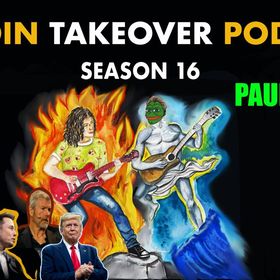
S16 E52: Paul Sztorc on Bitcoin's Culture Wars
The audio keeps playing while you browse the site.
Read the transcript17,198 words, every line links to the minute it was said
Ask this episode
Paul Sztorc is a Bitcoin maximalist who builds the tools that let people leave Bitcoin, and he sees no contradiction in that. "Weirdly, I'm the biggest maximalist of them all," he said, a few hours into a livestream that ran 1 hour 48 minutes. He is also the person who spent the evening arguing that Lightning should stop being the center of Bitcoin's scaling conversation, that mining pools are in a perfect equilibrium, and that the Core versus Knots fight is a bore. He is the creator of Truthcoin, the author of "Derangements of Bitcoin," and a developer at LayerTwo Labs, where he is shipping a launcher called Bit Window.
I have had Paul on the show many times, and the previous episodes ran from the philosophy of drivechains to the three-stage eCash launch. This one started with a demo he had intended to give and ended with a fact I got to reveal about who lurks in his company's Telegram chat. In between my cat was struck off camera, which I will get to, and I got a correction on Monero wrong, which I will also get to.
"He has joined the idiot team"
We opened where everyone opens right now, with Bitcoin Core v30 and Knots. I said it was so annoying that I no longer want to participate in the argument. Paul went further. "It's boring. It's so stupid. I can't believe how it's dragged on for this long," he said, and on the question of whether the whole thing matters, "Like, who cares? It's a silly issue. The whole thing is a silly issue."
He had a verdict on one particular person's role in it, which was about Nick Szabo and his position at JAN3: "He has joined the idiot team." I will leave Nick's side of that for another day.
What interested Paul more was how far the culture has drifted. He told me about a 2015 episode of Bitcoin Uncensored where a speaker said, "Bitcoin doesn't do AML. It does ML." People laughed, and nobody expected to be cancelled for it. "So we used to have more of a sense of humor is my point," he said. Bitcoin Twitter in 2025 does not have that quality, and Paul wants it back, which is part of why the later part of the night turned into a discussion about a satirical video.
A Demo, a Launcher, and Local Block Explorers
Paul did not want to do a live demo. "I think every live software demo is a big mistake because people have different setups. And it's boring, I think, to wait for certain things," he said. We did it anyway, in the sense that he talked me through it.
Bit Window is a software launcher. It bundles Bitcoin Core, the BIP 300 Activator, a Zcash-based privacy chain, and Thunder, and it ships with a faucet, a block explorer and an ecash calculator. You download it, you run it, and you are looking at a full environment for testing layer twos instead of reading about them. He told me about the networks it can run on: a Signet with 60-second blocks, and a Forknet that replays real Bitcoin transactions, so you can watch a drivechain behave under something resembling real conditions.
The BIP 300 Activator is the piece he spent the most time explaining, and he said there are two things he always has to explain first. One of them: "And the second thing I have to explain is the activator is much better than waiting around for Bitcoin Core to do a soft fork, which they will never do." The mechanism lets a soft fork be implemented "without changing any lines of code in Bitcoin," as he put it. People who want it run the activator alongside their node, and when enough hash rate signals, it turns on.
When he described the testing path, it went from a local machine to Signet, then Forknet, then Testnet 4, and eventually Litecoin. At one point he brought up Eric Voskuil's libbitcoin as the superior implementation he was not using for any of this, and I made a mental note to ask Eric about that.
My Cat Takes Sides
Around the 18-minute mark we were on CTV activation and the argument that arrived after it: that no upgrade should happen until the mempool filters are fixed. I said as much. "Suddenly the conversation changed to, well, we should never get any upgrades to Bitcoin until we fix the filters." That is when my cat decided to join the conversation, took a swing, and I physically hit her and switched off the camera for a minute. She is fine.
Paul's response to the filter conversation was the same as his response to most things that day: it is a sideshow. In his version the real obstacle is that Bitcoin Core will not do the soft fork, so the activator exists to route around that.
Lightning, the Sacred Cow
This was the section where Paul said what a lot of people tell me privately. "And it's still the biggest sacred cow of them all," he said about Lightning, claiming it should no longer be the focus of development. His argument is about L1 congestion. "Once the ordinal users showed up of L1, it crowded out Lightning, caused Lightning to suck." If channel opens and closes cost real fees on a congested chain, then the thing that was supposed to relieve L1 is itself bottlenecked by L1.
He spoke at TABConf on exactly this, and he told me there is a Telegram channel called "Lightning's Best Moments" that archives tweets, complaints and user fund losses. It is the kind of resource nobody at a Lightning company wants to link to. He also described the typical Lightning booster as someone out of the loop: "They heard from someone who heard from Peter McCormack, who heard from Tadge Dryja, you know what I mean, like they're like way outside the loop."
I pushed on whether that is fair to the people actually building it. There are Lightning developers who read the code, and I have had some of them on, including Ben Arc on LNBits V1 and the state of Lightning and Super Testnet on Monero vs Lightning privacy. Paul's reply was about intent: "a good intention is worth not very much." What counts, for him, is whether the thing works for a normal user under load.
Drivechains vs. Altcoins, and a Perfect Equilibrium
The pitch Paul keeps coming back to is that drivechains answer the altcoin problem. "The drivechain is a solution to the problem of altcoins," he said, and the reasoning rests on switching costs: moving into a separate altcoin means leaving Bitcoin's network effects behind, while a layer two keeps them. He called altcoins a regression for that reason, and said of their future, "I think they have no future," which he said flatly and without apparent enjoyment.
We drifted into mining pools, where he is relaxed in a way I did not expect. He defends the current pool structure as "a perfect equilibrium," and he rejected both Stratum V2 and DATUM as unnecessary. His reason is that the recourse already exists: "If 100% of the hash rate, if all of the pools are doing something wrong, you just disconnect and start your own pool and you use the peer-to-peer network to advertise it." A miner who does not like what the pools are doing can disconnect and start a pool of his own at any time, and nothing stops him.
On price, he said the thing a lot of Bitcoiners think and few say: "We should be crashing like 99% towards zero dollars per coin, but of course we're not." On Blockstream, he told me, "the one failure of Blockstream, I think, created all the altcoins." I asked whether he is really a maximalist after all this. His answer: "Weirdly, I'm the biggest maximalist of them all."
Brazilian Models and the Brand as Hostage
The satirical video came up around the 43-minute mark. It features Brazilian models reading, with a straight face, a script based on a conversation between Luke Dashjr and Pierre Rochard. I told Paul "That was a masterpiece," and I meant it. His account of why he made it: "everyone's taking themselves too seriously, so how can we just like shine a light on how silly this is?"
That led into branding, and Paul's view that the brand is a liability as much as an asset: "the brand is like a hostage that you can execute." He gave me the example of Sky Doge, which he described as "an altcoin that launched with my idea and they had fun with it. That's what's important." Fun is the goal, and the ownership of the idea is not.
We also talked about the difference between experts and elites, a distinction he has made before. "So the experts are the people who actually know but the elites are who everyone listens to." He added, on a related point, that "no amount of money can defeat superior knowledge, actually. You need to have an idea of what to do first." It is why he does not worry about a better-funded rival.
On scientific versus religious worldviews he said: "You know, a scientific worldview is like playing with doubt all the time. And the religious worldview, everything's just black and white. And it's an easier way to live." I did not ask which camp he thinks Bitcoin Twitter lives in.
Monero Rings, Zcash Code, and a Correction
For the privacy sidechain in Bit Window, Paul uses Zcash's code. We got into ring signatures and decoy sets, and I corrected him on Monero's structure: the decoy set was raised from 11 to 16 outputs. He took the correction in stride. His broader position is that "privacy is inherently social and you need to mix," meaning it depends on other people being in the same pool with you.
On whether one design beats another, he would not claim to know: "I don't think it's actually that much better. But maybe I'm wrong about that." A related thing he said about R&D generally: "R&D is mostly a creative endeavor," which is why he is wary of anyone who claims to know the result in advance.
We then had a tangent on prediction markets, which is his old field. He joked about the FBI raid on Shayne Coplan of Polymarket, calling it a "welcome to prediction markets" moment. And he repeated a claim that Matt Odell alleged Michael Saylor lobbied spot Bitcoin ETF issuers against donating profits to Core development. That is Paul reporting what he says Matt said, and I have not checked it.
SPV, Op-Nops, and Who Reads the Comments
Late in the stream we went back to first principles. On SPV, Paul said "SPV strikes the perfect balance," and I added a detail I wanted on the record: "Satoshi did not give us SPV. He just conceptualized it." On the old fight about full nodes versus light clients, he thinks the framing has expired: "I think it's like over for that dichotomy now." And on labels more generally, "It doesn't mean anything anymore, I think."
He had a line on why drivechains are possible at all. "Satoshi put in, he put in the op-nops specifically for this purpose so that people could use them later. And it's kind of like a demonstration that Bitcoin isn't dead." On how hard it is to get anywhere near using it today, he said you "have to like run across a minefield in a war zone to get there."
Between the technical bits we slid into nostalgia: the Macintosh Quadra 605, Windows 95, Windows 7. I described Windows 7 in terms of what I liked about it, "everything that XP was with some of the graphics of Vista," and Paul agreed it was the best of the lot. He also explained why older software was harder to use: "People in the past, they sort of did like a bite the bullet situation where they're like, we need the user to understand how a file system works."
Near the end, I told him something he did not know. Vitalik Buterin lurks in the LayerTwo Labs "DC Insiders" Telegram chat and comments there. I have seen it. Paul had not.
His last remark of the night was about how he gets anything done, and it is the line I would put on the wall of any startup: "you prepare, you prepare, you prepare, and then bang, it's just on."
Listen to Paul Sztorc on Spotify, Apple Podcasts, YouTube, and More
Time stamps:
- 00:01:30– Welcome to the Bitcoin Takeover Podcast and Paul's Second Appearance This Season
- 00:02:28– Bitcoin Civil War: Core v30 vs Knots Debate
- 00:03:02– Nick Szabo Joining the Debate and Ties to Samson Mow's Company
- 00:04:11– Op Return Limit Silliness and Historical Bitcoin Uncensored Humor
- 00:05:21– Shift in Bitcoin Community: From Subversive to Suit Coiner Route
- 00:06:02– Resistance Money, Privacy, and Black/Gray Markets
- 00:09:18– Rambling Due to Sickness/Jetlag and Software Demo Tease
- 00:09:29– LayerTwo Labs Software Overview and Download Instructions
- 00:11:55– Tweet on Turning Transactions into JPEGs
- 00:13:00– Bit Window Software Explanation vs Bitcoin Knots
- 00:15:31– Bit 300 Activator vs Bitcoin Core Pull Requests
- 00:17:25– No More Soft Forks in Bitcoin and Activation Challenges
- 00:18:23– CTV Almost Activated, Shift to Filter Debates
- 00:19:10– Bitcoin's Potential Death from Complacency
- 00:19:36– Derangements of Bitcoin Post and Lightning as Sacred Cow
- 00:20:02– TABConf Presentation on Lightning Network Issues
- 00:22:52– Lightning Network Blackpill Article and Updates
- 00:24:40– Lightning Cult and Misunderstandings
- 00:26:24– Promoting Chaumian Ecash and Human Rights Foundation
- 00:27:03– Funding R&D: Ecological Impacts and Bad Ideas
- 00:29:02– Maginot Line Example: Funding Bad Defenses
- 00:30:16– Drivechains Activation on Litecoin Progress
- 00:31:58– Next Tests: Testnet 4 and Forknet Realism
- 00:32:58– Litecoin Activation Process and Differences
- 00:34:49– Dogecoin Merged Mining and Potential Activation
- 00:35:26– Sky Doge as First Drivechain Chain
- 00:36:50– Bit Window Advantages Over Knots
- 00:37:25– Views on Mining Pools and Game Theory
- 00:40:05– Critique of Luke Dash Jr.'s Ideas on Pools
- 00:41:05– Transaction Relay Policies and Miner Incentives
- 00:41:47– Emotional Manipulation in Debates
- 00:43:13– Raising Funding and Different Approaches vs Luke
- 00:44:02– Marketing: Funny Videos and Memes
- 00:45:05– Luke Dash Jr.'s Character and Expertise
- 00:46:05– Experts vs Elites in Bitcoin
- 00:48:08– Testing LayerTwo Labs Software on OSes
- 00:48:38– Windows/Linux Discussion and Preferences
- 00:59:30– ZK Rollups and Data Availability on Bitcoin (Post-Truncation)
- 01:00:06– Non-Miner L2s Have No Future
- 01:01:47– Drivechain as Minimal, Optional Soft Fork
- 01:02:55– Tom Cruise Party Analogy for Bitcoin Upgrades
- 01:03:08– Derangements of Bitcoin Post Recommendation
- 01:03:50– Viewer Comment: Layer 2s Bad, More Altcoins Needed
- 01:04:03– Importance of Competition in Crypto
- 01:07:02– Altcoins as Regression Due to Switching Costs
- 01:08:33– Sponsor Plugs: LayerTwo Labs, SideShift, Bitcoin.com, NoOnes
- 01:09:07– Questions: Why Zcash for Fungibility Sidechain? DAGs?
- 01:13:35– Prediction Market L2 and Ambitious Design
- 01:14:24– Truthcoin History and Inspiration for Others
- 01:16:34– Robin Hanson as Prediction Market OG
- 01:17:23– Zcash vs Monero: Code Forks and Privacy Comparison
- 01:21:30– Privacy via Decoys vs Pools in Zcash/Monero
- 01:24:10– Zcash Advantages for Sidechains
- 01:26:30– Zcash Drawbacks Ideal for Sidechain Rollovers
- 01:27:42– Zcash as Research Lab for Bitcoin/Ethereum
- 01:28:07– R&D as Creative Endeavor Over Funding
- 01:30:19– Zcash Launch Story and Roger Ver's Influence
- 01:31:08– Truthcoin Parallels and Sidechain Intent
- 01:32:03– Maximalist Sacrifices for Bitcoin
- 01:32:31– Blockstream's Failure and Altcoin Rise
- 01:34:29– Thoughts on DAGs (e.g., Kaspa, Quai)
- 01:36:20– SPV Importance and Satoshi's Vision
- 01:39:05– SPV Balances Security and Convenience
- 01:39:59– DAGs Not Solving Key Scaling Problems
- 01:42:42– Shitcoin Definition: Outdated Dichotomy
- 01:43:53– Optimism for Bitcoin's Future Choice
- 01:45:32– One Coin to Rule Them All Analogy
- 01:45:38– Thanks, Wrap-Up, and Jay Berg Recommendation
- 01:46:54– Future Live Demo Tease
- 01:47:16– Join Drivechain Insiders Telegram Group
Verify this episode
This is the SHA-256 fingerprint of the MP3 as published here, timestamped in the Bitcoin blockchain with OpenTimestamps. If one byte of the file changes, the fingerprint changes.
- SHA-256
87d81237d15a2eee8220dee466d56e7c98f248289488c04481cf85dba810fb7e- Proof
- 2025-10-24_s16_e52_paul_sztorc_on_bitcoin_s_culture_wars.mp3.ots · all episode hashes (proof)
- Status
- Anchored in Bitcoin block 974,312
- Timestamped
- After release. The episode came out on 24 Oct 2025, but this proof was made on 3 Nov 2026 and anchored in block 974,312, so it proves this exact file existed by 3 Nov 2026, not on the release date.
How to check it yourself
- Download the MP3 and the proof into the same folder.
- Run
sha256sum 2025-10-24_s16_e52_paul_sztorc_on_bitcoin_s_culture_wars.mp3(on a Mac:shasum -a 256 2025-10-24_s16_e52_paul_sztorc_on_bitcoin_s_culture_wars.mp3). The result must match the SHA-256 above. - Install the OpenTimestamps client (
pip install opentimestamps-client) and runots verify 2025-10-24_s16_e52_paul_sztorc_on_bitcoin_s_culture_wars.mp3.ots. It hashes the MP3 again and checks the proof against your own Bitcoin node, then prints the block and the date the file existed by. Without a node,ots info 2025-10-24_s16_e52_paul_sztorc_on_bitcoin_s_culture_wars.mp3.otsshows the block height to look up in any block explorer.
Related
S17 E11: John Carvalho on Bitcoin Depression, Lightning Derangement & the Atomic Economy
John Carvalho was the second guest in the history of this podcast, way back in season one, episode two, when he was…
S17 E26: Calin Culianu, Steve Thurmond & The Phenomenal Big Blockers on Nine Years of Bitcoin Cash
Almost nine years after the big split of the Bitcoin community, it was time. Time to sit down with the people who…
S17 E37: Paul Sztorc on the eCash Three Stage Launch, Free Coins & 12 Drivechains
Paul Sztorc now holds the record for the most appearances on this show: eleven. Nobody else has come close, and nobody else…

Comments
Comments run on my own server. No trackers, no tracking cookies.