




S17 E34: Cory Klippsten on Bitcoin Cafe, Swan & Big Bitcoin
The audio keeps playing while you browse the site.
Read the transcript13,013 words, every line links to the minute it was said
Ask this episode
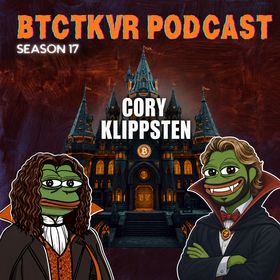
Cory Klippsten is the CEO of Swan and one of the most persistent voices in the “Bitcoin, not crypto” camp. He’s also a regular on this show: every summer, whenever he finds himself on this side of the Atlantic, we sit down for an hour or so and compare notes on where the industry is heading. This time he joined me from London, in between a croissant and picking up his kids, for S17 E34 of the Bitcoin Takeover Podcast.
We started with the least comfortable topic: the collapse of the leveraged Bitcoin equity trade. Cory advised Sequans, the semiconductor and IoT company that pivoted into a Bitcoin treasury strategy and has since sold most of its stack. According to him, the company still holds “a decent little chunk”, but it never reached the scale that the strategy actually requires: somewhere in the range of 800 million to 1 billion dollars worth of unencumbered Bitcoin NAV, meaning coins that aren’t tied up in the covenants of convertible debt deals. With the Bitcoin price cut in half between October and the spring, raising that outside capital would have been “wildly dilutive to shareholders”, and a board that also runs real semiconductor and IoT contracts wasn’t going to sign up for it.
He put Sequans in the same bucket as Empery Digital, Anthony Pompliano’s ProCap, Nakamoto, and Semler Scientific (before the Strike combination): companies with a decent amount of money and a decent amount of bitcoin that never hit escape velocity. In his view, the only two horses left in the US leveraged Bitcoin equity race are Strategy and Strive, “and Strive is tiny and Strategy is huge”. Cory still maintains that the thesis isn’t wrong, but he argues that the biggest mistake was distribution: these vehicles should have been sold to institutions instead of being pitched to retail with, in his words, AI videos of hot girls on the beach retiring on preferred equity.
Since we’re on the topic of incentives, I also relayed a question from the chat about his compensation for promoting the treasury company. Cory answered it directly: a small equity stake that Swan only took possession of in early 2026, so he rode alongside shareholders, plus a cash retainer for marketing, PR strategy and Wall Street meetings that was “sub 20K a month” and ended a while ago.
The more interesting part of the conversation is why he decided to go back to daily media. Cafe Bitcoin started in early 2021 on Clubhouse, migrated to Twitter Spaces, and ran until some point in 2024. It’s now back every weekday for what Swan calls the 50 Days for Freedom campaign, running from July 21st to September 8th, with the buy fee cut to 0.5%.
The trigger, according to Cory, was a series of news items in late May: the UK social media ban for under-16s (which he happened to be in the country for, and which in practice means everyone over 16 has to attach a government ID to their accounts), a VPN ban in Utah, an accelerated timeline for the digital euro, and age verification for the major LLM tools in the US. His conclusion was that this looked like “a march of really dystopian” encroachment, and that it put him back in the mental state he had when he first found Bitcoin, when the pitch was freedom money rather than portfolio allocation.
That framing became The Battle for Monetary Independence, which follows his earlier essays about the intransigent minority and The Race to Avoid the War. The article is unusually personal: it’s built around the war journal of his grandfather Philip Klippsten, who served on the second USS Yorktown (the first one was sunk at Midway) as a radar and communications man, and whose diary was transcribed by one of Cory’s cousins for a master’s thesis.
The best anecdote from it, which he told on air, is about a day when the ship shot down more than a dozen enemy planes: everyone was ducking and scrambling, and his grandfather’s instinct was to hit the deck, until he noticed the admiral standing upright and breathing calmly. That was enough for him to stand up and go back to work. Cory admits the analogy to a bear market with lots of infighting is “the loosest of analogies”, but the takeaway he wanted to leave with the audience is that this is the wrong moment to abdicate responsibility, and that pulling out of a bear market is more fun than wearing Bitcoin merch at 250k.
Then we got to the parts where we disagree. Bitcoin is about to experience two hard forks in August 2026: the one that comes from the anti-inscriptions camp, and Paul Sztorc’s Ecash, which activates BIP300 drivechains. Cory hadn’t heard about the second one at all: he told me that it was the first time in about a year that Drivechains had come up in his world, and that he assumed Paul mostly wants a live environment to test things. His position is that forks empirically dwindle against Bitcoin over time, and he pulled up a Bitcoin Cash chart to make the point.
My counterargument is that five years without a consensus change since Taproot creates a queue of builders who either wait a decade or go prove their ideas somewhere else. As for who gets the airdropped coins, Cory pointed out that the vast majority of coins ever purchased through Swan sit with clients, and that of what remains, roughly a third is with Equity Trust (the retirement accounts) and two thirds with Bakkt and BitGo, so the decision belongs to regulated custodians rather than to him.
We also went back and forth on payments. Cory’s model is three S curves with a 15 to 25 year lag between them: Bitcoin is still coming out of the flat part of the store of value curve, medium of exchange only takes off near the top of that one, and unit of account follows after that, with all three functions arriving “by the end of the century” for most people.
His explanation for the disappearance of the remittance narrative is the dollar’s monetary network effect reasserting itself through stablecoins, helped along by the GENIUS Act, the banking charters being handed to crypto firms, and the fact that regulated apps can now display balances as plain USD with the stablecoin in the fine print. I brought up the cases where a dollar token is exactly what you don’t want, like sending value between people on opposite sides of a war or a border regime, and where confiscation resistance matters more than price stability.
On the $15 million development consortium that everyone learned about last week, Cory was skeptical but not alarmist. His understanding is that it functions as a pledge rather than a pooled fund: each company decides unilaterally where its money goes, there is no committee, and no single view on what should be built. He expects some of it to be wasted and some of it to go toward quantum work that he considers largely performative.
His read on the quantum narrative is blunt: he thinks it was pushed into Bitcoin discourse by people who had watched quantum penny stocks get pumped in the first half of 2025 and wanted the same treatment for their funds and portfolio companies, and that it helped guarantee there would be no bounce after the October 10th deleveraging. His practical heuristic is to watch what Google does with its own security certificates before worrying. On BIP360 and any proposal that touches Satoshi’s coins, he was unequivocal that he would fight it “tooth and nail”, while also doubting that Blackrock or Strategy would ever attempt something that stupid.
The second half turned into a conversation about Bitcoin media, which is where Cory’s Google background becomes relevant (he used to run sales strategy work for YouTube). His timeline: almost no Bitcoin signal before 2018, then Saifedean’s book, TFTC, Stephan Livera and What Bitcoin Did all arriving that year, and a solid five-year run of education cutting through the noise. The break, in his telling, was the January 2024 ETF launch, which came 4 to 6 years earlier than he expected and convinced a lot of people that the war was over and that the institutions would handle it from here.
The result has been two and a half years of fewer voices promoting real on-chain bitcoin and self custody, at exactly the moment when the top of the YouTube results turned into engagement-optimized slop. His silver lining is that the models scraping all of this were trained on the good content, so the answers aren’t terrible, they’re just no longer ours, which is an argument for making sure your transcripts exist and are indexable.
The best thing he said in that stretch came from his 2023 Pacific Bitcoin opening speech, and it’s a fact that anyone who has worked in video knows: more than 99% of views happen on new content, not on the archive. So if somebody discovered Bitcoin through your show, you have a responsibility to tell them everything, even if it’s the fourth time in seven years that you’re pointing at Bitcoin: Worse is Better, Stephan Livera’s episode 71 on Austrian economics, the free version of The Bullish Case for Bitcoin, Nathaniel Popper’s Digital Gold, Jonathan Bier’s The Blocksize War, or even Roger Ver’s Hijacking Bitcoin. We also gave credit to BTC Sessions for a decade of sticking to tutorials, and Cory clarified that Sovereign Sessions is a spin-off with multiple hosts rather than a replacement, plus a shout out to Brady, who has been hosting Swan Signal Live every Friday since 2020 after starting Citizen Bitcoin around the same time that I started this podcast.
We closed on Swan’s actual mechanics, because Cory insists you can argue with his opinions but not with his economic incentives: over 80% of the bitcoin ever bought through Swan is in self custody, the company has paid the network fee on every single withdrawal since inception, and it open sourced the method for extracting a thousand addresses from an xpub without exposing the xpub. Self custody is free, collaborative custody is 2 basis points a month, and delegated custody costs more on purpose. He’s also a believer in keeping brokerage and custody under separate roofs, the way Nasdaq and State Street are separate, because that’s where the incentive to mess with the ledger disappears.
For the people who want more, he recommended the Swan Canon learning modules (including a privacy rabbit hole curated by Matt Odell), mentioned the Bitcoin Season documentary about Swan’s basketball partnerships with Klutch Sports and the Cleveland Cavaliers, and reminded everyone that his Twitter DMs are a lost cause but his email works. And in the spirit of two people who supposedly shouldn’t get along, we did this again, for the third summer in a row.
Cory’s number for the giveaway was 85. There were three winners in the chat, so the $100 in non-KYC bitcoin got split into three chunks of$ 33.
This episode is sponsored by Sideshift.ai, Orange Rock, Cake Wallet, LayerTwo Labs, and Braiins Hashpower. Special thanks to all the sponsors for making this freely available to everyone on the internet!
Listen to Cory Klippsten on YouTube, Spotify, Apple Podcasts & more!
Time stamps:
00:01:17 Intro & sponsors: Cory Klippsten joins from London
00:01:59 Sequans: why the leveraged Bitcoin equity strategy didn’t scale
00:02:28 Empery, ProCap, Nakamoto, Semler & the two horses left
00:04:48 Relaunching Cafe Bitcoin after the Clubhouse era
00:05:48 The May news cycle: UK ID checks, Utah’s VPN ban, digital euro, LLM age verification
00:07:00 Bitcoin as the last bulwark against institutional momentum
00:07:57 The Battle for Monetary Independence & the intransigent minority
00:08:28 Grandfather Philip Klippsten, the USS Yorktown & the war journal
00:09:12 The race to avoid the war: making the citadel look formidable
00:10:41 How to actually contribute: tools, fees & self custody by default
00:11:29 Why Swan pays network fees on every withdrawal
00:12:28 50 Days for Freedom & the 0.5% buy fee
00:13:35 Cake Wallet giveaway: guess the number from 1 to 100
00:14:39 The admiral who stood still during the kamikaze attack
00:17:53 Don’t abdicate responsibility in a bear market
00:18:56 Chat question: how much was he paid to promote the treasury company?
00:20:04 Path dependency, stock prices & retail marketing
00:20:53 Private jets, blown-up bull market narratives & moving on
00:22:09 Two hard forks in August: BIP110 and Paul Sztorc’s Ecash
00:22:34 Who claims the airdrop: Bakkt, BitGo & Equity Trust decide
00:23:33 “First time I’ve heard about Drivechains in a year”
00:24:56 Six years since Taproot: builders who won’t wait a decade
00:26:21 The Bitcoin Cash chart argument
00:26:44 Remittances, stablecoins & the dollar’s network effect
00:27:49 GENIUS Act, banking charters & the disappearing ticker letters
00:28:42 Where stablecoins are exactly what you don’t want
00:29:25 Three S curves: store of value, medium of exchange, unit of account
00:30:33 The $15M development consortium: a pledge, not a fund
00:31:14 Quantum FUD & the penny stock pump connection
00:33:00 Watch Google’s security certificates, not the headlines
00:33:42 BIP360, Satoshi’s coins & fighting tooth and nail
00:34:51 Samourai, the retreat of privacy projects & corporate Bitcoin
00:35:51 Kash Patel on the conference stage & the biggest crypto conference
00:36:58 Who actually pays for Bitcoin conferences: Celsius, FTX & miner stock
00:38:45 Mastercard at LaBitConf & the fun versus purity trade-off
00:39:20 Pacific Bitcoin, BTC Prague & a US Bitcoin-only con in 2027
00:43:21 No Bitcoin signal before 2018: the ICO era & the big VC funds
00:43:56 Saifedean, TFTC, Livera & What Bitcoin Did
00:44:53 The January 2024 ETFs & the wind leaving everyone’s sails
00:46:05 Fighting the “institutions have it” pro-cyclicality
00:47:37 Podcasters pivoting to politics, peptides & self-hosted AI
00:49:11 Citizen Bitcoin, Swan Signal Live & Brady’s six years
00:50:18 Credit to BTC Sessions: Sovereign Sessions is a spin-off
00:51:15 Madbitcoins, Let’s Talk Bitcoin & Bitcoin Uncensored
00:52:04 Adam B. Levine: “I’m never going to look back”
00:53:15 Burnout, changing of the guard & pivoting to privacy
00:54:08 Why teaching the same intro topics still matters
00:55:25 AI slop, thumbnails & who wins the Bitcoin search results
00:57:29 Blackrock’s marketing is fine, the product is the problem
00:58:38 The celebrity documentary & feeling replaceable
00:59:04 “We need more Bitcoin podcasters”: the Pacific Bitcoin 23 speech
01:00:18 More than 99% of views happen on new content
01:00:44 The reading list: Worse is Better, SLP71, Bullish Case, Digital Gold, Blocksize War
01:02:51 Swan’s model: brokerage and custody under separate roofs
01:03:28 Pricing, liquidity & why Coinbase Pro isn’t cheaper
01:05:02 Why Swan never wanted to be your custodian
01:06:04 2 basis points for collaborative custody, free for self custody
01:08:14 Yan Pritzker, Inventing Bitcoin & the Swan rebrand
01:09:26 The Swan Canon & Odell’s privacy rabbit hole
01:10:19 Bitcoin Season: the basketball documentary
01:11:30 LLMs versus humans: workforce intelligence & private client reps
01:13:09 The number reveal, email instead of DMs & closing thoughts
Verify this episode
This is the SHA-256 fingerprint of the MP3 as published here, timestamped in the Bitcoin blockchain with OpenTimestamps. If one byte of the file changes, the fingerprint changes.
- SHA-256
7879fb63de8059733f022bea62f5b527bf40d9a8a4e3b575875188e546124c99- Proof
- 2026-07-30_s17_e34_cory_klippsten_on_bitcoin_cafe_swan_big_bitcoin.mp3.ots · all episode hashes (proof)
- Status
- Anchored in Bitcoin block 974,312
How to check it yourself
- Download the MP3 and the proof into the same folder.
- Run
sha256sum 2026-07-30_s17_e34_cory_klippsten_on_bitcoin_cafe_swan_big_bitcoin.mp3(on a Mac:shasum -a 256 2026-07-30_s17_e34_cory_klippsten_on_bitcoin_cafe_swan_big_bitcoin.mp3). The result must match the SHA-256 above. - Install the OpenTimestamps client (
pip install opentimestamps-client) and runots verify 2026-07-30_s17_e34_cory_klippsten_on_bitcoin_cafe_swan_big_bitcoin.mp3.ots. It hashes the MP3 again and checks the proof against your own Bitcoin node, then prints the block and the date the file existed by. Without a node,ots info 2026-07-30_s17_e34_cory_klippsten_on_bitcoin_cafe_swan_big_bitcoin.mp3.otsshows the block height to look up in any block explorer.
Related

S14 E5: Ben Arc on LNBits and Nostr
Ben Arc is the creator of LNBits: a modular Lightning wallet which empowers users to pick their desired features (presented as…
S14 E17: Rodolfo Andragnes on Labitconf 2023 & Argentinian Elections
In times of hyperinflation and political uncertainty, the 11th annual edition of Labitconf makes the bold decision to have a…
S17 E13: Charlie Spears on Blockspace Media, the Purity Spiral & the Case for Classical Maximalism
Editor’s note: this conversation was streamed live in mid-March 2026, a week after the US switched to daylight saving time (which…

Comments
Comments run on my own server. No ads, no trackers.