




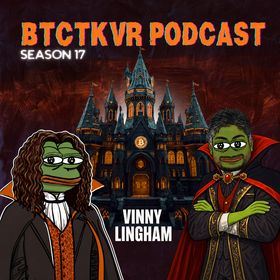
S17 E35: Vinny Lingham on Bitcoin Post-Maximalism, Scaling Regrets & Saylor’s Endgame
The audio keeps playing while you browse the site.
Read the transcript14,246 words, every line links to the minute it was said
Ask this episode
Vinny Lingham found Bitcoin in 2012 for the most unglamorous reason imaginable: chargebacks. His gift card company Gyft was getting hammered by fraudsters from every corner of the internet, and since a gift card is a digital code and not a physical package with a tracking number, there was no way to prove delivery and no way to fight the disputes. So when he read about a payment system where the money simply cannot be clawed back, he did what very few merchants were willing to do in 2013: he plugged it in and let customers pay with BTC.
What he describes about that era is the part of Bitcoin history that has been quietly memory-holed. Gyft accepted zero confirmation payments. Not one confirmation, not six: zero. Thanks to the first seen rule, the moment a transaction hit the mempool it was effectively final for commercial purposes, because the cost of attempting a double spend on a $50 gift card was absurdly high compared to the payoff.
Vinny compares it to the moment Starbucks and McDonald’s stopped asking for signatures on card payments, having done the math and concluded that the lost sales from slow queues cost them more than the occasional one in a hundred chargeback. Gyft processed around 100,000 Bitcoin transactions over two and a half years with zero double spends. Then RBF arrived, and that business model quietly died.
From there the conversation becomes a tour of every fork in the road that Bitcoin took and Vinny disagreed with. He was building Civic on Bitcoin, patents filed and all, when the 2017 fee spike made the whole thing unviable. He was on the Bitcoin Foundation while it was being dismantled.
He watched Blockstream go from a struggling startup to the most politically powerful entity in the ecosystem, and he is not shy about naming Reid Hoffman’s money as the reason it survived at all. His view of Bitcoin Core governance is blunt: the project keeps pruning dissenting voices, so Mike Hearn is gone, Gavin Andresen is gone, and now even Luke Dashjr has effectively been pushed out, which leaves a room where everyone agrees with each other because everyone who disagreed has been shown the door.
Speaking of Luke, Vinny tells one of the strangest stories I’ve heard about the block size wars. Back in 2017 he presented research suggesting that 8 to 16 megabyte blocks were perfectly stable, and Luke’s counterargument was that Bitcoin needs to scale to 50 billion people. When Vinny pointed out that demographers like Hans Rosling put the human population peak at around 10 billion, Luke allegedly replied with Catholic religious texts arguing that contraception-using heathens will be out-reproduced by Catholics. Whether or not you find that funny, it’s a reminder that protocol decisions affecting trillions of dollars were made by people with very specific worldviews.
Where does this leave him now? Vinny is what you might call a Bitcoin post-maximalist. He was a maxi, he wrote the articles, he tried to build everything on the most secure chain in existence, and then he concluded that the constraint was political rather than technical. So he led the Solana seed round at Multicoin, and today he co-chairs Praxos Capital, a delta neutral crypto hedge fund where the direction of the market genuinely does not matter. He is, in his own words, delta neutral on crypto personally as well.
He also has an interesting reframe on the store of value debate: Bitcoin is not a store of value, it’s a store of liquidity. People park liquidity in it, which is exactly why it dumps when equities dump and pumps when the Fed prints. For contrast, he offers the hundred year suit test: a finely tailored suit in New York cost roughly one ounce of gold a century ago, and it costs roughly one ounce of gold today. That’s what preserved purchasing power actually looks like.
The most uncomfortable part of the interview is the counterfactual. If the blocks had grown, if the op codes had stayed, if Vitalik’s pitch to the Core developers hadn’t been rejected, Vinny believes there would be no altcoin industry at all. There would be one chain doing identity, tokens, payments and settlement, with transaction fees exceeding block rewards and miners funded sustainably forever, exactly as Satoshi described the subsidy as a temporary bootstrapping mechanism. The price might be lower, or it might not, but the ascent would be slow and boring and stable. His punchline is the one that should make bitcoiners uneasy: if we had actually used Bitcoin as cash, it would be a store of value today.
Instead we get Tether on Tron running the global south, a Bitcoin price that is roughly where it was five years ago, and two hard forks landing in August. Vinny is skeptical of BIP 110’s chances given the hash rate signaling, though he sympathizes with the philosophical consistency of the argument, and he thinks August could be a bloodbath month for Strategy. His concern is not just the preferred shares trading below par and the dilution treadmill, but the total absence of proof of reserves from a company whose CEO once blew up a different company through accounting problems. If a fork happens and Strategy goes to sell the forkcoins, we may find out whether the 850,000 number is really 850,000.
We also spent a good stretch on the Satoshi question, where Vinny holds the unfashionable position that it was a small group rather than one person, that Craig Wright was probably around early even if he certainly isn’t Satoshi, and that the writing style points to Australia or New Zealand. I pushed back with Hal Finney’s debug logs and the residential California IP address, we asked Claude for its probability distribution (Szabo 30%, Hal 20%, someone we’ve never heard of 30%, Craig Wright 0%), and neither of us walked away convinced.
This episode is sponsored by SideShift.ai, Braiins Hashpower, Orange Rock, LayerTwo Labs, and Cake Wallet.
Listen to Vinny Lingham on YouTube, Spotify, Apple Podcasts & more!
00:01:06 Intro & sponsors: Vinny Lingham, 15 years in Bitcoin
00:02:04 Gyft: a dozen companies and one gift card problem
00:02:26 Chargebacks, stolen cards & getting attacked by scammers
00:04:13 Why Bitcoin looked like the perfect payment rail
00:04:51 Zero-conf payments and the first-seen rule
00:05:48 The Starbucks and McDonald’s signature math
00:06:51 100,000 Bitcoin payments, zero double spends
00:07:13 Civic’s Bitcoin patents & the 2017 fee explosion
00:07:37 Blockstream, Adam Back, MIT and the Epstein files
00:08:10 Core keeps pruning dissenting voices
00:08:55 Why Bitcoin still can’t be the whitepaper’s payment system
00:09:08 Counterparty, Mastercoin & the birth of Ethereum
00:09:34 “Nothing has happened in Bitcoin in five years”
00:10:16 Why he went and backed Solana instead
00:10:23 Sympathy for BIP 110 over Core
00:11:08 Inscriptions can be done many ways
00:12:27 “Lightning will be ready in 18 months” forever
00:13:26 Drivechains, BIP 300 & the Ecash fork paying miners
00:14:44 UX, mainstream users and idiot-proof money
00:15:17 People who don’t know you can hold BTC outside an ETF
00:15:27 Is the ETF the real scaling layer?
00:15:37 What Vinny signed up for when he read the whitepaper
00:16:30 Wayne Vaughn in the chat
00:16:48 Saylor’s Bitcoin Security Consortium and the $15M
00:17:24 Saylor argues against bigger blocks and covenants
00:17:49 How is this different from the Bitcoin Foundation?
00:18:36 Saylor as systemic risk: crashing the minority fork
00:19:43 Losing SPV and the simplicity of early Bitcoin
00:20:48 When did you last actually use Bitcoin?
00:21:22 Six confirmations vs Apple Pay
00:21:41 Gyft’s customers who had no credit cards
00:22:07 Not a store of value: a store of liquidity
00:23:24 So what is a store of value, exactly?
00:26:00 The 100 year test: one ounce of gold buys one suit
00:27:09 Does the whitepaper ever say “digital gold”?
00:27:53 Saylor’s redefinition: expensive to move, held by institutions
00:28:08 Privacy, tiny payments and why volume creates stability
00:28:42 Exchanges are layer two, Lightning is layer three
00:29:06 Solana at the World Series of Poker
00:30:07 BSV, Teranode, BCH and who actually handles volume
00:30:58 Does everyone really need to run a node?
00:31:30 Luke Dashjr, 16MB blocks and 50 billion Catholics
00:33:34 Arguing with someone who redefines words
00:34:33 How did Blockstream become so politically powerful?
00:35:40 Reid Hoffman’s $20 million
00:36:26 Reading the Epstein files with Bitcoin eyes
00:36:45 Tether won the global south instead
00:37:42 “The community is people who never built anything”
00:38:00 Why Elon Musk walked away from Bitcoin
00:39:07 The ESG excuse & the Bitcoin Mining Council
00:40:05 Elon on bandwidth, latency and second layers
00:41:03 Why Civic started on Bitcoin and left
00:42:05 Multicoin, the Solana seed round & founding Praxos
00:42:29 Why “Civic” and not “Supra”
00:42:46 Nobody wants identity: crypto’s actual number one use case
00:44:03 Zcash’s comeback, Ironwood & the auditable supply
00:45:34 Delistings and the headwinds facing privacy coins
00:46:06 Why Zcash chose DeFi rails over merchant adoption
00:47:07 How to know you’re in a bear market
00:47:25 Elgamarov & how small this world really is
00:48:10 What does Vinny actually hold today?
00:49:27 Praxos: delta neutral, funding rates and volatility
00:51:44 Sponsors: Braiins, Cake Wallet, SideShift, LayerTwo Labs, Orange Rock
00:54:40 Wayne Vaughn’s question: will the CLARITY Act pass?
00:56:47 Michael Saylor and the Strategy problem
00:57:14 The GBTC discount scenario
00:58:16 Why August could be a bloodbath
01:01:56 Node counts, sybil attacks and hash rate
01:03:16 The rewritten history of SegWit and SegWit2x
01:04:19 How Bitcoin Cash became the fallback plan
01:04:59 Gavin Andresen and the word “bamboozled”
01:06:00 Was Craig Wright involved at all?
01:08:04 Hal Finney’s logs and the Van Nuy, California IP address
01:08:55 GMX, German privacy law and the missing paper trail
01:11:17 Roger Ver, the checksum test and Craig
01:13:00 Asking Claude Fable 5 who Satoshi is
01:14:17 The case for Nick Szabo and the trusted third parties
01:15:31 The counterfactual: what if Bitcoin had scaled?
01:19:35 Tron, USDT and five years of outperforming BTC
01:20:09 Bitcoiners understand supply, not demand
01:20:36 What happens when the block rewards run out
01:21:15 Rentable SHA256 and the state actor attack scenario
01:22:54 Will Vinny claim the August fork airdrops?
Verify this episode
This is the SHA-256 fingerprint of the MP3 as published here, timestamped in the Bitcoin blockchain with OpenTimestamps. If one byte of the file changes, the fingerprint changes.
- SHA-256
24a8d69b49d229cd5f41cf2a138d8f46797f04208597bd16718e18a2c2d9e683- Proof
- 2026-08-01_s17_e35_vinny_lingham_on_bitcoin_risk_management.mp3.ots · all episode hashes (proof)
- Status
- Anchored in Bitcoin block 974,312
How to check it yourself
- Download the MP3 and the proof into the same folder.
- Run
sha256sum 2026-08-01_s17_e35_vinny_lingham_on_bitcoin_risk_management.mp3(on a Mac:shasum -a 256 2026-08-01_s17_e35_vinny_lingham_on_bitcoin_risk_management.mp3). The result must match the SHA-256 above. - Install the OpenTimestamps client (
pip install opentimestamps-client) and runots verify 2026-08-01_s17_e35_vinny_lingham_on_bitcoin_risk_management.mp3.ots. It hashes the MP3 again and checks the proof against your own Bitcoin node, then prints the block and the date the file existed by. Without a node,ots info 2026-08-01_s17_e35_vinny_lingham_on_bitcoin_risk_management.mp3.otsshows the block height to look up in any block explorer.
Related
S17 E26: Calin Culianu, Steve Thurmond & The Phenomenal Big Blockers on Nine Years of Bitcoin Cash
Almost nine years after the big split of the Bitcoin community, it was time. Time to sit down with the people who…
S17 E38: Keagan McClelland on Lightning Metrics, Covenants, Consensus Politics & Verifying Bitcoin
There is a certain genre of Bitcoin Twitter argument that never quite resolves into a conversation. People trade metrics, memes…
S17 E39: Kurt Wuckert Jr on the Big Block Wars, BSV, Craig Wright & the Road Not Taken
Every community has its designated villains, and in Bitcoin’s longest running morality play, Kurt Wuckert Jr has worn the black…

Comments
Comments run on my own server. No ads, no trackers.