




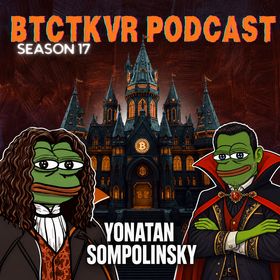
S17 E36: Yonatan Sompolinsky on Kaspa Covenants, DAGKnight & Coordination Markets
The audio keeps playing while you browse the site.
Read the transcript18,900 words, every line links to the minute it was said
Ask this episode
Yonatan Sompolinsky came to Europe for a reason he would only describe on record as a secretive meeting of DAGKnight magicians. Before flying back home, he spent a day in Romania with me: we hiked, had lunch in Brașov, and made a point of not discussing Bitcoin or Kaspa until the microphones were on. Then we got in the car and drove to Bucharest, where I was supposed to drop him off at the airport.
The conversation lasted the entire road trip, killed two camera batteries, survived a bumpy mountain road, an Aston Martin sighting, a police car, Labubu mascots in Bușteni, and a borrowed flashlight that gave the final hour the atmosphere of a summer camp horror story. When the camera gave up for good, we switched to Yonatan’s laptop and kept going, because a one-hour interview was never in the cards for us. Our previous encounter, S16 E41 from last summer, ran for about seven hours.
This is also the second road episode of the season, after S17 E2 with Tyler Spalding, in which we recorded on the way to the Bear Sanctuary in Zărnești. There is something about driving through Romania that makes guests honest. In Yonatan’s case, it produced what might be the densest episode of the season: Kaspa’s new covenants, a progress report on DAGKnight, an impromptu lecture on Hayek, a eulogy for rollups, a love letter to Zcash, and the first proper explanation of his new project, Stag Hunt, and the coordination markets thesis behind it. Somewhere near the end, the roles reversed and he started interviewing me.
(I guessed the episode number on air and overshot it. This is S17 E36 because I thought I would publish other interviews first.)
Covenants, done in the right way
While Bitcoin has spent years going in circles around OP_CAT and OP_CTV (a stagnation I wrote about at length in my post-maximalism essay), Kaspa simply shipped a hard fork that does covenants. Not covenants as an afterthought, hacked together through string concatenation, but purpose-built opcodes designed from the outset to inspect all transaction fields. Plus something subtler that rarely makes it into the conversation: a richer sequencing commitment, placed in the block headers and in consensus itself.
The distinction matters more than it seems. With OP_CAT-style covenants, you can have a prover that views the entire sequence of transactions and proves it ran a subset of them correctly. What you cannot do is commit the sequencer to run all transactions, in order, skipping none. Without that extra commitment, you can build almost-based apps, but not censorship-resistant ones (based meaning the app controls nothing about sequencing: the L1 does it all). Bitcoiners would call the equivalent sovereign rollups, and today those are mostly BitVM-flavored optimistic constructions, with the obligatory jargon split between optimistic and optimistically verified rollups, which neither of us could define cleanly while driving.
Then came the punchline: for the record, Yonatan is very bearish on rollups. He only utters the word because Bitcoiners who still think about apps think in those terms. In his reading, ZK was adopted by Ethereum mainly as a scaling technology, not a privacy one. The heavy lifting in zero knowledge proofs is in the validity rules, and privacy in a world of shared public state is conceptually limited anyway.
What zero knowledge is actually good for is the separation of layers: keep the L1 thin, UTXO-oriented, and paranoid, then bridge an expressive world of computation to it through a ZK opcode. An L1 that wants to secure money should not deal with computation; that is too large of a failure surface. On this point, Kaspa deliberately follows Bitcoin’s design principles. Meanwhile, Ethereum itself has quietly concluded that the layer 2 roadmap was an inferior way to run an ecosystem and is drifting back toward an L1-centric construction, a realization the rest of the space is processing with a great lag.
What do covenants unlock in practice? Ephemeral logic. On Ethereum or Solana you deploy a contract, a heavy operation optimized for lasting usage, and then interact with it in a separate action. With Kaspa’s covenants you define one-time logic and lock the coins atomically, inside the same transaction: a generalized atomic swap.
We swap only if the coins pass through this whitelist, within the next hour, with a three-out-of-five condition, plus whatever other constraints your business orchestration requires. No contract deployment, and the transaction looks like a regular transfer, except the script pubkey locks a logic.
It sounds incremental, since it only saves one round of interaction, but Yonatan argues it is the natural shape of the agentic economy: agents doing hit-and-run interactions rather than committing to lasting contracts. Yes, he said AI agents out loud. Partly because it is true, partly so the algorithm finds this podcast.
When I pressed him for the use case list, he pushed back in a way I found more honest than any list: crypto is going through a crisis about what it is useful for at all. This bear market is not only bearish in market cap; it is bearish in actual usage. Users disappear once the price stops going up, and he does not remember that being the case in previous cycles. So the right order of operations is to first agree on which use cases crypto is good for, draw that circle, and only then say what Kaspa is optimized for within it.
DAGKnight: fast because it is paranoid
The progress report is good, accelerated by the aforementioned magician summit, which is the real reason he was in the area. One clarification he insisted on: DAGKnight is not faster per se. You could run 100 blocks per second on Phantom GHOSTDAG today, and you could run DAGKnight at 10 BPS. The point is that DAGKnight is the only protocol resilient to 49% Byzantine attacks that has no latency parameter.
Every other protocol must hardcode an upper bound on network latency and defend against the worst case. A parameterless, responsive protocol simply confirms transactions at the actual network latency, whatever it happens to be. If Kaspa raised the block rate to 100 BPS today, the hard fork would have to bump the parameter K, and confirmations would take about eight times longer: tens of seconds, at least. With DAGKnight, you keep confirming at network speed.
And here is the part that sounds like a magic trick, and which connects to the nuclear winter line from our previous interview: responsiveness and catastrophe resistance are dual. Any consensus system that confirms as fast as the underlying network permits is necessarily resilient to that network breaking apart, because the protocol cannot tell the difference between a global catastrophe and a slow afternoon. It just aggregates obliviously and confirms more slowly.
You cannot implement one property without the other. The catch is that distributed systems folklore holds a famous impossibility theorem: no protocol can be responsive and tolerate more than a third of Byzantine actors. The DAGKnight paper describes how they bypass it, and Yonatan calls the result theoretically optimal, the pinnacle of what you can achieve if you want to remove trust assumptions from the network layer.
Credit where it is due: DAGKnight is joint work with Michael Sutton, Kaspa’s informal CTO and lead developer, whom I have not interviewed yet and apparently must. Among other things, Michael built (together with AI, as one does in 2026) a new programming language for covenants called Argent. Yonatan refused to belabor it because it is not his to celebrate, which is exactly why I am celebrating it here.
Real-time decentralization
The mental map Yonatan offers is simple: crypto is split between systems that are real time and systems that are decentralized, and nobody married the two. Whatever is instant has quick finality and a single leader inside the window of your interaction (Solana, Hyperliquid). Whatever samples an honest majority takes its time. His softer characterization: these systems are short-term centralized.
And only proof of work bundles the two roles that proof of stake almost always separates: being selected to produce a block, and choosing what goes inside it. Not the PBS separation; a deeper one. So if your use case needs a good sample of the honest majority within a single network round, 100 proof of work blocks per second is the only place to get it.
Bridges, oracles, attestations from the outside world: anywhere you would otherwise choose between trusting one leader or waiting minutes for votes to accumulate. This, in his words, is the holy grail of Kaspa: escaping the tradeoff, having your cake and eating it too. Though he is careful to note the system has other tradeoffs, pruning included.
The Zcash chapter
“Bitcoin is dead boring to me at this stage.” He follows Zcash and Solana instead, and the Ecash hard fork, in his view, would have been a good idea a few years ago but now smells like too little, too late. On Zcash he said something I have not heard anywhere else: the rise of Ironwood, with its verifiable supply, is a tectonic movement that went under the radar.
The most cryptography-heavy project in the space has shrunk the role of cryptography from verifying every state transition to verifying the supply, because the historical state transitions of Zcash can no longer be verified. There was a bug, and in that department history is unfixable. He expected a debate and got silence. When he asked Zooko about it, the answer was pragmatic: use proofs for whatever we can have them for, and for now that is the supply.
This hits home for Kaspa, which prunes everything and does not even attempt to prove historical correctness. A Zcash core developer once criticized him for exactly that, until Yonatan asked him about Zcash’s own unfixable history and watched him reconsider on the spot. And it matters for the market: Zcash’s comeback proves that a proof of work project with concrete, formal improvements over Bitcoin can break the glass ceiling.
Bitcoin’s launch was pristine and auditable, with no historical bugs and, as he noted dryly, no usage either. If Zcash can rise, the door is open for Kaspa. The Zcash crowd has even started discussing shorter block times, and they are definitely aware of DAGs, even if they have not yet reached the time scales that require one.
There is also Zooko lore. Years ago, Zooko slept in Yonatan’s car in Israel (whether he was broke at the time remains unverified). And one day before the Sapling bug was announced, while quietly sitting on the worst secret in Zcash’s history, he found the calm to listen to Yonatan’s pre-launch anxieties about Kaspa and tell him to just launch and see what reality gives you. Would any other coin survive two inflation bugs? His hunch is no. Zcash did, partly because the bugs were found by its own people, whose codebase is so far ahead of the curve that maybe five people in the world fully understand it.
I used the moment to deliver my own Zcash evangelism (Sean Bowe, Halo 2, Tachyon, the Ironwood migration I did on day one, and the finance guys like Cory Klippsten who reduce the whole comeback to VC games), and I got teased for driving like Bitcoin confirms: conservatively, six confirmations at a time, watching out for the police. Fair. For more of my thoughts on why this matters, see S17 E35 with Vinny Lingham, where the Ironwood upgrade and the auditable supply also came up.
Hayek, and the positive vision
The Oxford Union speech and the manifesto in progress are not, he insists, the start of a political movement. His immediate political ambition is to conquer his own house, and even that is going poorly. The idea underneath: revolutions wind down, and crypto is at that stage. Cypherpunks hail the individual, but mostly in the French tradition that Hayek called false individualism: the atomic, isolated individual who trusts no one, connects to no one, and lives in the woods of an undisclosed location.
Think Jameson Lopp; think the early Blockstream aesthetic. The English tradition, true individualism, still centers the individual as the atomic particle of society, but as an enthusiastic individualist who creates ties, communities, and trust. And trust between people does not imply trust in the settlement layer: the base layer stays trustless and paranoid, while the applications built on top of it are optimized for people who actually connect.
His claim is that the protective, negative program of cypherpunk, building tools that negate Big Brother, has been covered in principle, even if tasks remain. Protective values have an a priori limit on how deep they can integrate into the lives of ordinary people. What the movement lacks is a positive vision for how people coordinate. Which brings us to the stag.
Project Stag Hunt and coordination markets
Forget the prisoner’s dilemma, which he hates seeing treated as the problem of humanity (the Moloch school of thought, after Scott Alexander’s demon of defection). The stag hunt, Rousseau’s old game, is the better model of a free society: two hunters can each catch a hare alone, or coordinate to catch a stag and feast. Unlike the prisoner’s dilemma, coordination is an equilibrium: no altruism required, no regulator, no superintelligence to govern us. Societies fail at stag hunts not because people defect, but because they lack coordination devices. They get stuck in the inferior equilibrium.
Project Stag Hunt builds those devices. The primitive is playfully called a Nintendo: an enhanced intent (think NEAR Intents, where you sign constraints on what may happen with your funds rather than function calls) that is persistent and conditional on the crowd. If many people sign this same intent, consider mine signed as well. You set your own threshold: three friends and $100, or $30 million, whatever coordination makes the move worth it.
Operators (Kaspa miners are the natural candidates) continuously evaluate the largest subset of Nintendos whose conditions are met, and when a threshold is crossed, the move snaps atomically. In many cases the pack formation should stay opaque to the operators, via threshold homomorphic encryption, so they cannot front-run or back-run the coordination. Crucially, signing a Nintendo never locks your capital. It is actionable but not committed: you can move your money, raise your thresholds, or retract whenever you want.
The use cases write themselves once you see the primitive: migrating liquidity out of a stale pool only if enough capital moves with you; the Netflix scenario, where a scattered majority dislikes the policy but cannot find the exit because there is no discovery layer for shared preferences; composing conditions so that users, seed investors, and builders each move only if the others do. The broad category is exiting network effects: hopping from an agreed-inferior focal point to a superior one. Moving the Ethereum L2 mess to a cohesive ecosystem would, in this terminology, be a stag. And like prediction markets, coordination markets do not need to wear the crypto costume. Normies can understand them as tech.
The role reversal
Then he turned the microphone on me: what would it take for you to become an XYZ maxi? My answer, condensed: things that stop Big Brother. Political science, the ACTA protests when I was twenty, a 100,000-signature petition, internet freedom advocacy, a bachelor thesis on online elections. Then Bitcoin.
Then Zcash, the Bitcoin fork with the best privacy its design can possibly have, and the reason I keep returning to it on episodes like S17 E8 with Riccardo Spagni. The tipping point for any technology is when adoption starts feeling obvious, and I borrowed Paul Sztorc’s party metaphor: the first guests are your close friends, not the cool kids.
I am obviously not one of the cool kids, just a few years early (Zcash at $30, the Coldcard hack, the privacy narrative shift). When Yonatan asked whether he counts as one of the cool kids or one of the weird early guests, I told him the truth: he is the party person. I just bring people.
My actual answer to “what does Kaspa need” was wallet support, more than exchange listings. Exchanges are nice for liquidity and legitimacy until they delist you for low volume or, as the Monero-on-Binance saga suggests, sit on your price. Wallets have quietly become exchanges themselves (Cake Wallet, Edge, in-wallet swaps, NEAR Intents as Uniswap on steroids), and that is the front line that matters now.
We arrived at the Palace of Parliament close to midnight: the second largest administrative building in the world after the Pentagon, built by a dictator who starved the nation for it, 80% unused, occasionally rented out for weddings. “So this is your big brother?”, Yonatan asked. No. My distant uncle that I do not like. The one who smells.
This episode is sponsored by Cake Wallet, LayerTwo Labs, Braiins Hashpower, Orange Rock, and SideShift.ai!
Listen to Yonatan Sompolinsky on YouTube, Spotify, Apple Podcasts & More!
Time stamps for YouTube:
- 00:01:54– Intro: a road trip with Yonatan Sompolinsky
- 00:02:50– Life since S16 E41: Oxford Union & the state of Kaspa
- 00:03:53– Kaspa shipped covenants while Bitcoin debates OP_CAT
- 00:05:24– Sequencing commitments & based apps explained
- 00:07:48– Why OP_CAT alone can’t do censorship-resistant based rollups
- 00:08:21– BitVM & optimistic vs optimistically verified rollups
- 00:09:05– ZK was born for privacy but lives for scaling
- 00:10:18– “For the record, I’m very bearish on rollups”
- 00:13:27– Ethereum quietly abandons the L2 roadmap
- 00:14:33– What ZK is actually for: a thin L1 & separation of layers
- 00:16:05– Kaspa follows Bitcoin’s UTXO design principles
- 00:17:04– Ephemeral logic: generalized atomic swaps
- 00:18:25– Camera gymnastics & an Aston Martin
- 00:20:28– What covenants won’t give you: the DeFi Lego box
- 00:21:05– One-time logic vs contract deployment
- 00:24:18– The use case question & crypto’s crisis of utility
- 00:27:17– Bitcoin the turtle & the DAGKnight progress report
- 00:29:17– DAGKnight: 49% Byzantine resilience, no latency parameter
- 00:30:50– Why 100 BPS on GHOSTDAG would 8x confirmation times
- 00:31:21– Sponsors: Cake Wallet, LayerTwo Labs, Braiins, Orange Rock & SideShift
- 00:35:33– Zcash made a comeback
- 00:36:19– The mental map: where Kaspa is unique
- 00:39:49– Real-time decentralization: sampling the honest majority
- 00:40:47– Solana & Hyperliquid: fast, but led by one
- 00:43:46– Only proof of work bundles proposing & content
- 00:45:35– A bear market in usage, not just price
- 00:46:53– Old-world use case: bridges & oracles
- 00:48:22– Tourism break: Bușteni, mascots & ski resorts
- 00:50:38– Hit-and-run agents & the agentic economy
- 00:52:06– Having your cake and eating it too
- 00:55:32– Vlad on Ecash, miner fees & Satoshi’s biggest bet
- 00:57:37– Sinaia & the royal train station
- 00:58:38– “Bitcoin is dead boring to me at this stage”
- 01:00:50– Ironwood, verifiable supply & Tachyon
- 01:01:39– Driving like six confirmations
- 01:02:59– The tectonic shift nobody noticed: verifying the supply
- 01:04:43– The bug & Zcash’s unfixable history
- 01:07:04– Kaspa’s pruning vs historical correctness
- 01:09:12– How Zcash’s rise paves the way for Kaspa
- 01:10:17– The Zooko sleeping-in-the-car story
- 01:11:32– “Just launch”: Zooko one day before the Sapling bug
- 01:13:05– Downplaying the bug & the counterfeit scenario
- 01:15:34– Peter Todd’s demurrage & the Ironwood migration
- 01:18:25– Would any other coin survive this?
- 01:19:55– Ethereum’s identity crisis
- 01:22:28– Back to L1: too little, too late; Solana’s cohesion
- 01:23:46– Oxford Union & political ambitions
- 01:25:44– Hayek: true vs false individualism
- 01:27:04– The isolated individual: Lopp, Poelstra & early Bitcoiners
- 01:33:52– The enthusiastic individualist
- 01:35:52– Coordination markets & Project Stag Hunt
- 01:36:19– Prisoner’s dilemma vs stag hunt
- 01:37:24– Moloch, the demon of defection
- 01:38:30– Part 2: stag hunt as the optimistic game
- 01:43:55– Intents & NEAR Intents
- 01:45:15– Intents vs smart contracts
- 01:46:41– Part 3: Rousseau’s ape men
- 01:51:05– Intendos: “if many sign this, consider mine signed”
- 01:53:04– Example: migrating a liquidity pool together
- 01:54:54– Pack formation & threshold homomorphic encryption
- 01:57:02– Actionable but not committed
- 01:58:38– The Netflix example: voice for the scattered majority
- 02:02:56– Who are the stags we need to hunt?
- 02:03:31– Minarchist, anarchist or libertarian?
- 02:04:52– Stag = shared utility; escaping Ethereum’s L2 mess
- 02:07:48– Composable Intendos
- 02:09:18– Exiting network effects
- 02:10:31– The Kaspa-Ethereum overlap: GHOST & Casper
- 02:13:15– “I don’t like DAGs”: it’s just a data structure
- 02:14:11– Why DAGKnight survives a world war
- 02:16:42– Michael Sutton & the Argent language
- 02:18:18– Bypassing the impossibility theorem
- 02:19:26– Ahead of his time or poor communicator?
- 02:20:51– BPS vs TPS: the shift already happened
- 02:22:25– Falling between the cracks
- 02:24:37– The next narrative: coordination markets
- 02:25:46– Brașov to Bucharest: documenting the trip
- 02:26:51– Roles reversed: Yonatan interviews Vlad
- 02:28:26– ACTA protests, internet freedom & political science
- 02:30:13– Sztorc’s party metaphor
- 02:31:17– Zcash at $30 & the Coldcard hack
- 02:33:00– What Kaspa actually needs: wallets, not exchanges
- 02:35:16– Broadening cypherpunk: from protective to positive
- 02:38:36– What have we really accomplished?
- 02:40:53– Arriving at the Palace of Parliament
- 02:45:17– The secret handshake & farewell
Verify this episode
This is the SHA-256 fingerprint of the MP3 as published here, timestamped in the Bitcoin blockchain with OpenTimestamps. If one byte of the file changes, the fingerprint changes.
- SHA-256
49e23ace68ebafc161fb7da401d713e7bfb7bda4157ff98c4601958242205873- Proof
- 2026-08-10_s17_e36_yonatan_sompolinsky_on_dags_stags_the_future_of_kaspa_10_08_2026_16.23.mp3.ots · all episode hashes (proof)
- Status
- Anchored in Bitcoin block 974,312
How to check it yourself
- Download the MP3 and the proof into the same folder.
- Run
sha256sum 2026-08-10_s17_e36_yonatan_sompolinsky_on_dags_stags_the_future_of_kaspa_10_08_2026_16.23.mp3(on a Mac:shasum -a 256 2026-08-10_s17_e36_yonatan_sompolinsky_on_dags_stags_the_future_of_kaspa_10_08_2026_16.23.mp3). The result must match the SHA-256 above. - Install the OpenTimestamps client (
pip install opentimestamps-client) and runots verify 2026-08-10_s17_e36_yonatan_sompolinsky_on_dags_stags_the_future_of_kaspa_10_08_2026_16.23.mp3.ots. It hashes the MP3 again and checks the proof against your own Bitcoin node, then prints the block and the date the file existed by. Without a node,ots info 2026-08-10_s17_e36_yonatan_sompolinsky_on_dags_stags_the_future_of_kaspa_10_08_2026_16.23.mp3.otsshows the block height to look up in any block explorer.
Related

S17 E28: Josh Swihart on Zcash’s Comeback, the Orchard Bug & Forking the Company
Twenty months ago, Josh Swihart came on this show to talk about Zcash at its darkest hour: Binance was threatening delisting over…
S17 E49: Kris Nuttycombe (Zcash at Ten, Hard Forks, Dev Fund, Ossification)
Kris Nuttycombe of ZODL on Zcash at ten: hard forks as a superpower, freezing Sprout, NU7, Tachyon, the Dev Fund, testnet forks…

S17 E19: Amaury Séchet on Forking Bitcoin Twice, Quantum FUD & Scars from the Block Size Wars
Two years after our first interview, I decided to invite Amaury Séchet(@deadalnix) to find out what the Greg Maxwell of big…

Comments
Comments run on my own server. No trackers, no tracking cookies.