




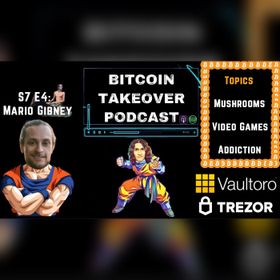
S7 E4: Mario Gibney on Psychedelics, Video Games & Addiction
The audio keeps playing while you browse the site.
Read the transcript15,981 words, every line links to the minute it was said
Ask this episode
His name is Mario, he really likes mushrooms, and he stays away from video games so he doesn't get addicted. Rest assured, Mario Gibney is no mustachioed Italian plumber. He is a co-host of the Unhashed Podcast and works at Blockstream in Victoria, British Columbia, and when he agreed to record with me, he sent me a GIF of a dancing mushroom. I thought he was just being enthusiastic. "Yes, yeah, that was a carefully chosen GIF, yeah."
Season 7 was about the lives bitcoiners have outside Bitcoin, and Mario came with a clear pitch. We did talk about psychedelics, but we also ended up talking about addiction, virtual reality, the Blockstream lizard people, Twitter echo chambers and, despite our promise, stock-to-flow. Before any of that, he had to follow his colleague Colin Aulds from S7 E2 and sing the Unhashed theme song. He did. "You can fork yourself if you don't abide."
Psychedelics as Therapy
The thing that captured Mario's attention outside Bitcoin is the use of psychedelics in therapy. He struggled with depression in his mid-20s, and talk therapy and meditation were helping gradually. Then he started reading about substances that had been banned for decades and "actually could be used safely and to help people out a lot with a variety of mental health challenges."
The curiosity started in South Korea, where marijuana is treated like meth or cocaine. That made him read about the history of the war on drugs, and back in Canada, with more relaxed rules, he got more involved: a conference in Victoria, meetup groups advocating for legal change, and a week in the Peruvian Amazon for a series of ayahuasca ceremonies "which were really transformative for me."
I have never even smoked a cigarette, so Mario had to explain the basics. DMT on its own is broken down by the body if you eat it. Amazon cultures discovered that combining two plants, one with DMT and one with an MAOI, gives "an extremely powerful psychedelic effect for about five, six hours, sometimes even longer," usually in a ceremony led by a shaman who sings for you.
Video Games as the Real Drug
Then I asked the obvious question: why can't he just play video games? That turned out to be the more dangerous topic. "I used to be quite the gamer and gaming correlates very, very badly with my mental health."
With Civilization, he would start a game at 8pm and not stop until 5am. "I almost failed my first year of university because of this stuff." Every time he stopped playing, the real problems came back, so he went back into the game. "So I actually had to quit gaming a few years ago, and I'm very glad I did."
When I concluded that he thinks drugs are fine and video games are bad, he corrected me. "See, I don't think video games are bad. I don't think drugs are fine." He would never recommend cocaine, meth or heroin, a friend of his had a hard time with an addiction to speed, and the point is that different substances and activities affect people differently. "I would never judge someone else for playing video games, and I don't think we should ban them or anything."
I don't really understand the pull, since I play for 30 minutes before bed and switch off, and I told him about a single World of Warcraft quest that once took me an entire day. Mario stayed away from World of Warcraft. The last game he played regularly was Overwatch, in the PC bangs of Seoul after Bitcoin meetups, with Ruben Somsen and their friends. His plan is to give himself a month or two off in a decade or so and catch up on what games have become.
VR, Florence and an Italian Who Orders Meal Kits
We spent a while on virtual reality. Mario helped out with the Magical Crypto Conference as an avatar and liked Beat Saber because "you can get proper exercise," but he expected to buy a headset within five years and immediately regretted saying it out loud. When I described VR meetups where people just sit in a virtual cinema, he wasn't impressed: "It almost seems like a waste if that's all you're doing with VR."
He also has family in northern Italy (of course, with a name like Mario), but admitted to being pretty Canadian, down to ordering meal kits during the pandemic. I told him he should visit Florence. I stand by that.
From a Bar in 2015 to Blockstream
Mario first heard about Bitcoin in 2015, from a guy at a bar who was into Bitcoin and Soylent and sent him about a dollar on a Mycelium wallet, on a phone that is now lost. A year later, with spare time after quitting a university program, he found the Seoul meetup run by Ruben Somsen. "I remember showing up for the first meetup and I understood maybe, I don't know, 20% of what they were talking about."
He binged Andreas Antonopoulos videos, took free C++ courses and Dan Boneh's cryptography courses, and became one of the meetup organizers during the 2017 mania. After the fight against SegWit2x, Warren Togami recommended him for the job, and he moved back to Canada in January 2018 to work at the Blockstream office in Victoria.
Naturally, I had to ask about the reptiles. "Of course, of course. We are the lizard people." He claims credit for resurrecting the meme with lizard masks and an Illuminati eye on the office wall for Halloween 2018. His one regret is that Greg Maxwell quit three days before he was hired, and he doesn't blame Greg for avoiding the spotlight after "a lot of harassment and threats from people back in 2016, 2017."
Following People You Disagree With
The best part of the episode, in my opinion, was about curating social media. Mario uses Twitter's "Show fewer tweets" option aggressively, but he deliberately follows people he disagrees with. On climate, he follows Steve Barbour of Upstream Data, who burns stranded natural gas to mine and is "really into fossil fuels." On the 2020 US election, he jumped into the replies of Peter McCormack's bet with American HODL to find people with opposite views, and ended up following Hass McCook.
He also tweeted that "I don't think supporting Bitcoin and UBI is a problem," expecting 20 likes and a few people calling him an idiot. He got a few hundred likes and "quite a few dozen people calling me an idiot."
I asked whether Bitcoin will really change the world for the better, since I had heard stories about early adopters who got rich and had no idea what to do with their lives. Mario's answer was more nuanced than what you usually hear on Bitcoin Twitter. "You know, I do think it's going to be massively positive, otherwise I wouldn't be working here." But he called the idea that money printing is the main cause of wealth inequality a persistent myth, and he admitted that early adopters tend to be people like him and me, not the poorest people in the world. What he'd like to do with his own gains is help fund clinics that offer psychedelic therapy once it becomes legal.
Team Rainbow
The rainbow next to his Twitter name is not what most people think, or at least not only that. "No, I think stock-to-flow is kind of a dumb meme. And all of the best things you can say about stock-to-flow, you can also say about the rainbow chart." The mushroom is a double meaning as well: psychedelics, and Super Mario.
I agreed on stock-to-flow and called it ponzinomics on air. What if we all stopped working on adoption, development and education, and the price was still supposed to go up 10x every four years because it's programmed in the code? Mario invited me to join Team Rainbow. I said I'd think about it.
We ended with Mario's preferred custody solution ("all my bitcoins are safely stored on QuadrigaCX") and with me confusing statechains with drivechains while trying to lure Ruben onto the show. I said I wasn't going to cut it out, and I didn't.
What makes this episode worth listening to is how openly Mario talks about addiction and self-discipline, without preaching to anyone who doesn't share his struggles. You can read the full transcript of this episode, visit his guest page, or go back to Colin Aulds' episode to compare their versions of the Unhashed theme song.
Listen to Mario Gibney on Spotify, Apple Podcasts, and More
Time stamps:
- 00:02:27– Intro: typically Canadian
- 00:03:19– Mario sings the Unhashed theme song
- 00:06:03– Psychedelics and mental health
- 00:09:58– South Korea and the war on drugs
- 00:11:25– DMT and ayahuasca ceremonies
- 00:13:31– Civilization and gaming addiction
- 00:17:02– Drugs aren't fine, video games aren't bad
- 00:25:28– Overwatch in the PC bangs of Seoul
- 00:28:52– Virtual reality and Beat Saber
- 00:41:40– Florence, Italian roots and meal kits
- 00:45:37– How Mario got into Bitcoin
- 00:49:13– Blockstream and the lizard people
- 00:52:10– Greg Maxwell and Pieter Wuille facts
- 01:06:02– Curating Twitter and following people you disagree with
- 01:15:56– Bitcoin and UBI
- 01:17:43– Will Bitcoin make the world better?
- 01:23:15– Stock-to-flow and Team Rainbow
- 01:28:09– Where to follow Mario
Verify this episode
This is the SHA-256 fingerprint of the MP3 as published here, timestamped in the Bitcoin blockchain with OpenTimestamps. If one byte of the file changes, the fingerprint changes.
- SHA-256
004c52bec3793a0e05d547b650cf5e8792eee4128bfb6ac4708d6fda6f466cf9- Proof
- 2020-12-25_s7_e4_mario_gibney_mushrooms_vr_video_games_psychedelics_ads.mp3.ots · all episode hashes (proof)
- Status
- Anchored in Bitcoin block 974,312
- Timestamped
- After release. The episode came out on 25 Dec 2020, but this proof was made on 3 Nov 2026 and anchored in block 974,312, so it proves this exact file existed by 3 Nov 2026, not on the release date.
How to check it yourself
- Download the MP3 and the proof into the same folder.
- Run
sha256sum 2020-12-25_s7_e4_mario_gibney_mushrooms_vr_video_games_psychedelics_ads.mp3(on a Mac:shasum -a 256 2020-12-25_s7_e4_mario_gibney_mushrooms_vr_video_games_psychedelics_ads.mp3). The result must match the SHA-256 above. - Install the OpenTimestamps client (
pip install opentimestamps-client) and runots verify 2020-12-25_s7_e4_mario_gibney_mushrooms_vr_video_games_psychedelics_ads.mp3.ots. It hashes the MP3 again and checks the proof against your own Bitcoin node, then prints the block and the date the file existed by. Without a node,ots info 2020-12-25_s7_e4_mario_gibney_mushrooms_vr_video_games_psychedelics_ads.mp3.otsshows the block height to look up in any block explorer.

Comments
Comments run on my own server. No trackers, no tracking cookies.