




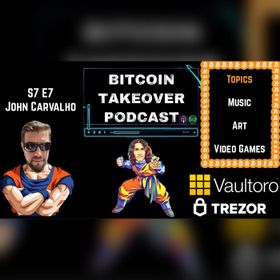
S7 E7: John Carvalho on Music, Art & Video Games
The audio keeps playing while you browse the site.
Read the transcript19,880 words, every line links to the minute it was said
Ask this episode
John Carvalho doesn't like the Beatles. I tried to make the case for their songwriting, their studio experiments and the way they changed from one album to the next. None of it worked. For someone who spends a good part of his public life disagreeing with bitcoiners, John is just as difficult to convince when the subject is music.
This is his third appearance on Bitcoin Takeover, making him the first guest to reach that number. After our conversations about Bitcoin politics and shilling Lightning to the moon, I wanted to talk about the things he does when he isn't working. Season 7 gave us an excuse to leave Bitcoin aside and find out more about the people behind the arguments.
So we talked about punk rock, home recording and video games. I also reminded him that I once told him I hated the drums on a song he sent me. Apparently, my diplomacy needs some work.
The Record Label Before Bitcoin
John played electric guitar in a punk band in high school. The band booked its own shows, toured the East Coast of the United States and eventually played in Canada. Making the music was only part of the job. They printed cassettes, made shirts and stickers, and learned how to put the whole thing in front of an audience.
That became his first business: an independent record label doing for other bands what he had already learned to do for his own. Later, he withdrew from college to go on tour. The story sounds more glamorous when I tell it than when he does. John remembers feeling that he was paying to attend high school again, not having much money, and wanting to give the band a proper try. Touring did not make him rich.
His influences moved from rap to grunge and then melodic punk. Nirvana and Pearl Jam mattered, followed by bands such as Propagandhi and Hot Water Music. I suggested that grunge made playing guitar less intimidating than the virtuoso performances of the previous generation. John pointed out that the punk he played could still involve harmonized guitar parts that were anything but easy.
He still has recordings, but he wasn't keen to make the band's name the subject of the interview. Fair enough. We're here to talk about the music, not excavate somebody's teenage drama.
Designing Something People Will Enjoy
When I asked about art, John didn't separate drawing from the thing the drawing was supposed to become. As a child, he made a comic book rather than a collection of unrelated pictures. He designed maps for games, took an interest in branding, and thought about how the pieces fit together.
The same applied to playing live. A part that worked on a recording could fall flat in a room, while a small detail could unexpectedly get a reaction from the audience. His description was simple: "an empathy for the consumer of the art."
I asked whether he had always wanted to be some sort of Roger Waters, building a concept around everything. Not quite. Sometimes the band chose a name because it sounded weird, or wrote a difficult guitar part to impress another guitarist. There was a design behind it, but they were also young musicians having fun.
A Garage Studio and Too Many Mixes
Years after the band, John turned his garage in Florida into a recording studio. He put foam on the walls, bought microphones and preamps, made beats and recorded local rappers in Jacksonville. Some of that work found another use: the music in a Bitrefill advertisement came from an old beat, and he planned to use his own composition for the intro and outro of The Biz podcast.
I remembered a collaboration he sent me and my complaint about its drum sound. John remembered spending far too much time remixing songs. After listening to the same recording all day, you can lose perspective and start making changes that nobody asked for.
"And then optimizing and iterating on a song, you run just as much risk of killing the song as you do improving it."
I agreed. Adding effects can become a way of avoiding the question of whether the song needed them in the first place. It's a useful warning for anyone who records things at home, including the host of this podcast.
The Beatles Argument
John listens for an emotional response, not a place in a history book. I can explain why the Beatles mattered, but that doesn't make their records work for him. "It just feels like it wasn't really made for me when I listen to the Beatles."
We had more agreement about some of the grunge bands, though not enough to turn this into a comfortable list of shared favorites. His favorite Led Zeppelin song is D'yer Mak'er, which wasn't the answer I expected. I found its reggae influence less original than the band's other work. John liked the mood and the fact that it didn't sound like their usual material.
He recommended David Bazan, Bright Eyes, The Weakerthans and Greg MacPherson. I offered my own opinions on Dylan and the Beatles, and we managed to spend a surprising amount of time trying to remember song titles. If you're looking for an authoritative history of rock music, this isn't it. It's two people who play instruments comparing the records that meant something to them.
Games That Feel Like a Sparring Session
John grew up with games and remembers Final Fantasy II fondly. He also played Magic: The Gathering, sometimes returning to its online versions before leaving them alone again. What interests him is the whole product: the card artwork, the rules and the possibilities for building a deck.
These days, he prefers competition to spending hours following a story. "I haven't really encountered a captivating story in a video game in forever, so I don't even look for it." A game should feel "like a sparring session of some kind," a way to test his thinking against somebody else. I find myself going in the opposite direction. I like a single-player game that I can finish in shorter sessions, which is why Sonic Mania came up during the conversation.
We also talked about the creative path he almost took: making music for video games. He considered studying it, but worried about whether the work would pay. Knowing his tendency to get absorbed in a project, he suspected he might end up wanting to create an entire game instead of just its soundtrack.
The Hobby That Wouldn't Go Away
We did eventually fail to keep Bitcoin out of the conversation. Collectible cards led us to Mt. Gox, and from there to the similarities between the cultures around scarce objects and money. John described going deeply into hobbies, reaching a level he was happy with, then moving on. Bitcoin interrupted that pattern.
"I mean, I should mention that Bitcoin is the only hobby that I've never given up."
That probably explains why even an interview about his other interests ends with a discussion about Bitcoin businesses and paying for creative work. He was preparing The Biz because he wanted a place to discuss building companies, and because he didn't want his appearances to promote sponsors he disliked. I talked about my own difficulty funding the show through donations. John wasn't surprised: "Nobody's tipping on the internet." He thought the model was flawed and wanted to try others. We didn't solve that problem either.
You can find more of our conversations on John's guest page. For this one, read the full transcript or listen on the episode page. And if you follow his music recommendations, try not to spend the entire song judging the drums.
Listen to John Carvalho on Spotify, Apple Podcasts, and More
Time stamps:
- 00:01:52– Welcome and John's third appearance
- 00:03:13– Punk bands and an independent record label
- 00:11:51– Drawing, design and the audience
- 00:29:24– Home recording and mixing
- 00:37:08– The Beatles disagreement
- 01:08:25– Video games and Magic
- 01:26:59– Collecting playing cards
- 01:33:13– Bitcoin as a hobby
- 01:38:58– The Biz and choosing sponsors
Verify this episode
This is the SHA-256 fingerprint of the MP3 as published here, timestamped in the Bitcoin blockchain with OpenTimestamps. If one byte of the file changes, the fingerprint changes.
- SHA-256
600c440a705ba49feceb8c7e0c871f726a60c84fcde0f099aaa7b8333d6903df- Proof
- 2020-12-25_s7_e7_john_carvalho_on_music__creativity__video_games.mp3.ots · all episode hashes (proof)
- Status
- Anchored in Bitcoin block 974,312
- Timestamped
- After release. The episode came out on 25 Dec 2020, but this proof was made on 3 Nov 2026 and anchored in block 974,312, so it proves this exact file existed by 3 Nov 2026, not on the release date.
How to check it yourself
- Download the MP3 and the proof into the same folder.
- Run
sha256sum 2020-12-25_s7_e7_john_carvalho_on_music__creativity__video_games.mp3(on a Mac:shasum -a 256 2020-12-25_s7_e7_john_carvalho_on_music__creativity__video_games.mp3). The result must match the SHA-256 above. - Install the OpenTimestamps client (
pip install opentimestamps-client) and runots verify 2020-12-25_s7_e7_john_carvalho_on_music__creativity__video_games.mp3.ots. It hashes the MP3 again and checks the proof against your own Bitcoin node, then prints the block and the date the file existed by. Without a node,ots info 2020-12-25_s7_e7_john_carvalho_on_music__creativity__video_games.mp3.otsshows the block height to look up in any block explorer.
Related
S14 E5: Ben Arc on LNBits and Nostr
Ben Arc is the creator of LNBits: a modular Lightning wallet which empowers users to pick their desired features (presented as…
S1 E2 Remastered: John Carvalho on Bitcoin Politics, the Foundation’s Failures & That Roger Ver Interview
(Recorded January 2019, remastered 2025. Sponsored by Helen’s Pizza in Jersey City, 183 Newark Avenue, where you can pay with…
S17 E11: John Carvalho on Bitcoin Depression, Lightning Derangement & the Atomic Economy
John Carvalho was the second guest in the history of this podcast, way back in season one, episode two, when he was…

Comments
Comments run on my own server. No trackers, no tracking cookies.