




Bitcoin BLAKE2b: The Fork That Fired the Miners
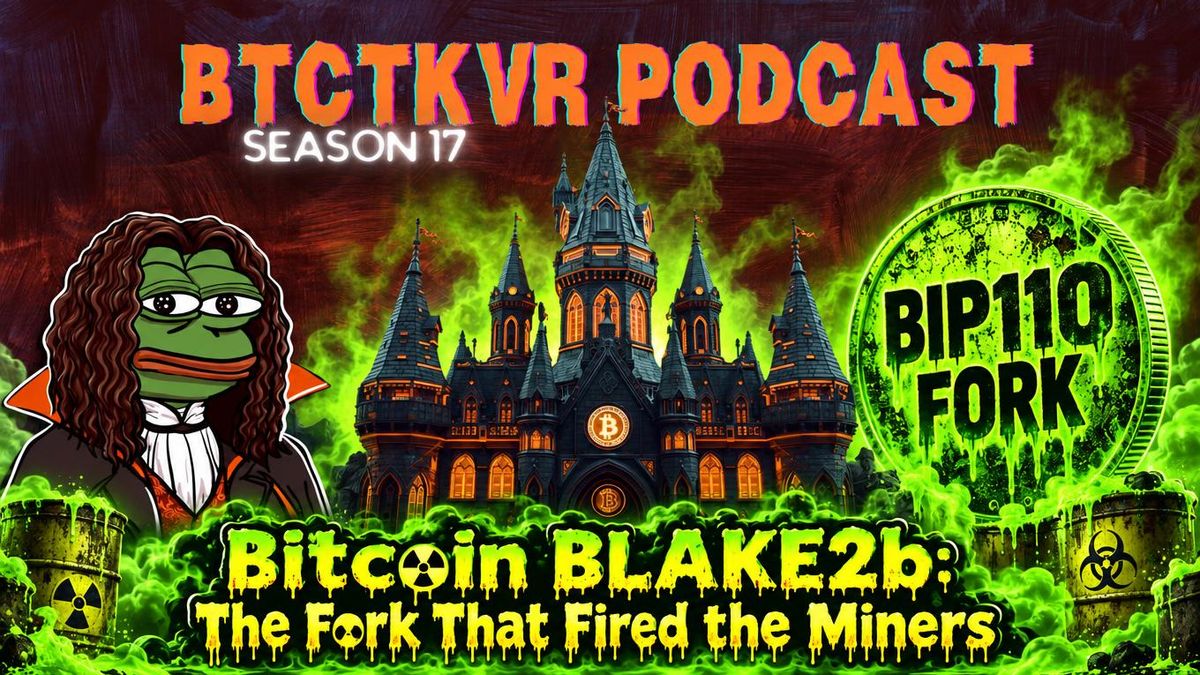
How Luke Dashjr’s anti-spam soft fork won 2.53 percent of the hashrate, died in eight blocks, came back with a new proof of work chosen by lottery, and now wants to lock its own miners’ rewards for 45 days
In May, eight hours into my Bitcoin Cash marathon with Calin Culianu and Steve Thurmond (S17 E26), the conversation drifted toward Luke Dashjr. Someone asked whether I agreed with the fork he was threatening to unleash. I said I didn’t: “If you want to fork off, at least add something that’s technologically interesting. He’s going backwards.” I even added the detail that made the room laugh: “He wants 333 kilobytes.” Calin, who maintains Bitcoin Cash Node, was less polite. “I can fork Bitcoin Core tomorrow. It’s not that hard. It’s like 95 percent the same code anyway.”
Three months later Luke forked Bitcoin, and the blocks on his chain are capped at about 300 kilobytes. I had been wrong about one thing: the fork does contain something technologically interesting. It just arrived wrapped in the strangest governance I have covered in this magazine. The new proof-of-work algorithm was picked by lottery, where the last hex digits of Testnet4 blocks sealed the project’s fate. Activation required a New York Post headline in the coinbase: ”blake2b_headline=8-30 NYPost Deride and Conquer”. Its developers call the chain they left “Spamcoin” and the exchanges that list it “incompetent.” Now the fork is going after its own miners.
Of every chain in this issue, this is the youngest and the most volatile, and it may prove the most short-lived. It is also the only one that began as an attempt to make Bitcoin smaller and less scalable. Which is ironic, as so-called Bitcoin maximalists are trying to minimize the design.
Vital statistics
Snapshot data from 17 to 21 September 2026. This chain changes weekly, so read every figure with its date.
| Field | Value |
|---|---|
| Names | Bitcoin BLAKE2b, Bitcoin BIP110, BTCB2, XBT; the project itself also says BIP110, and Luke Dashjr calls it BTC |
| Category | UTXO hard fork of Bitcoin with a new proof of work; every BTC holder at block 961,631 holds the same balance on this chain |
| Last common block | 961,631, mined 8 August 2026 at 19:33:48 UTC |
| Split | 961,632 at about 20:12 UTC on 8 August, the first block of BIP-110’s mandatory signaling period |
| SHA-256d stall | Eight blocks (961,632 to 961,639) in 22 days, the last one tagged OCEAN on 28 August |
| First BLAKE2b block | 961,640, 30 August 2026 at 06:14 UTC, mined by SilentWave |
| Proof of work | BLAKE2b with a 164-byte version-2 header; Bitcoin’s 2,016-block retarget kept |
| Temporary rules | Reduced-data rules and an 800,000 weight unit cap (about 300 kB) until 1 September 2027 |
| Client | Bitcoin Knots 29.4.1.knots20260508 |
| Supply | Same 21 million cap and halvings; 20,067,600 coins at the split; next halving at block 1,050,000 |
| Coinbase maturity | 100 blocks, rising to 6,480 blocks (about 45 days) for rewards mined from 973,440 to 979,920 |
| Hashrate | About 17 PH/s of BLAKE2b across 27 pools (8 September); not comparable with Bitcoin’s SHA-256d exahashes |
| Height | 972,506 on 17 September, about 5,170 blocks ahead of Bitcoin |
| Price | Peak $1,799 (5 September); $270 to $315 (21 September) |
| Market cap | Not listed on CoinGecko or CoinMarketCap; no meaningful figure exists |
BIP-110: the soft fork that wanted a smaller Bitcoin
The story begins with a grievance that has nothing to do with block size, at least on its surface. Since the Ordinals wave of 2023, a vocal part of Bitcoin’s community has regarded inscriptions, large OP_RETURN outputs, and other non-monetary data as spam that burdens node operators and crowds out payments. Bitcoin Core disagreed, and in 2025 it went the other way, loosening its OP_RETURN policy. Bitcoin Knots, the alternative client Luke Dashjr has maintained for over a decade, became the home of the opposition.
Kurt Wuckert Jr told me on S17 E39 that his own political awakening came from the same wound, from the other direction. Around 2014 his OP_RETURN tokenization prototype stopped working when Core cut the data carrier size, and his first reaction was to go looking for who this Luke Dashjr person was. A decade later, the anti-data camp and the pro-data camp were both still fighting over the same 80 bytes.
BIP-110, the “Reduced Data Temporary Softfork,” was written by Dathon Ohm and credits Luke for the original draft. For about a year, it would have limited new output scripts to 34 bytes (OP_RETURN to 83), capped data pushes at 256 bytes, banned the Taproot annex, deep control blocks, OP_SUCCESS opcodes and OP_IF inside Tapscript, and grandfathered all existing coins. Activation needed 55 percent of miners signaling on bit 4. If they refused, Knots nodes would begin rejecting every block that did not signal at height 961,632.
They refused. Signaling peaked at 2.53 percent. On 8 August the mandatory period began, Knots nodes rejected the next block the majority mined, and the chain split. More than 99 percent of hashrate stayed on Bitcoin.
The minority chain inherited Bitcoin’s full difficulty, which meant it needed roughly Bitcoin’s hashrate to produce a block every ten minutes. It produced two blocks in eight hours and then almost nothing: the Roughnecks pool mined four in the first week, then single blocks arrived on 17, 21, 23 and 28 August.
The last, tagged OCEAN, came from the pool Luke co-founded, which had pointed its customers’ hashrate at the minority chain for about 18 hours without clear consent. OCEAN’s hashrate fell 96 percent in August. Its customers demanded new leadership, and on 29 August Luke resigned as chairman, CTO and director, with OCEAN buying back his equity.
The stalled chain also had no replay protection. By mid-August more than 400,000 transactions were sitting in its mempool, most of them ordinary Bitcoin transactions that users had broadcast without realizing they were valid on both chains.
Bitcoin’s developers moved faster than its miners. On 9 August Mark “Murch” Erhardt filed a motion to remove Luke as a BIP editor, citing his central role in “a new forkcoin spun out of Bitcoin under his leadership.” The other editors approved it within days. Luke’s reply: “They have no authority to do so.” The official BIP-110 document was marked Closed “following a chain split with stalled mining.” The advocacy site bip110.org, meanwhile, still says BIP-110 “has been activated at the block height 961632 on 8 August 2026 successfully.” Both statements are technically true, which tells you everything about how this fork uses language.
The lottery, the headline and the rehearsal
A chain that cannot attract SHA-256 miners has one way out: stop needing them. On 10 August, at a Bitcoin Knots development meeting on the project’s official Discord, supporters divided up the work. Luke took the new block header and proof of work. A developer known as Kyle took replay protection. Chris Guida, who had already updated a proof-of-work change plan Luke wrote in 2017, took the job of carrying BIP-110’s rules into the new chain.
The algorithm itself was chosen by lottery. On 11 August Knots ran a commit-reveal process on Testnet4 to pick among six candidates: BLAKE2b-256, SHA3x, BLAKE2s, Scrypt, BLAKE3x2 and Eaglesong. BLAKE2b won the next day. The choice mattered, because BLAKE2b is the algorithm of Siacoin, which means a secondhand market of ASICs (Bitmain’s Antminer A3, Goldshell’s SC5 and SC Lite) already existed.
Peter Todd accused Luke of choosing Testnet4 for the draw because its blocks are easy to manipulate, and pointed out that people close to the fork, such as the account @BitcoinSith, showed off freshly acquired BLAKE2b machines barely a week later, when delivery normally takes two to three weeks. That is Todd’s allegation, not a finding, but it is the kind of question a proof of work chosen by dice invites.
Then came the rehearsal. On 29 August Luke asked the remaining SHA-256 miners to stop, and release candidate rc4 was set to mark the last SHA-256 block. On 30 August he published the parameter that would seal activation: blake2b_headline=8-30 NYPost Deride And Conquer. The first BLAKE2b block had to carry that day’s New York Post headline in its coinbase, echoing the Times headline Satoshi placed in Bitcoin’s genesis block. SilentWave mined it at 06:14 UTC. Within two hours SilentWave, PyBLOCK, Helios, PythonPool, TrueNorth, Connor’s Lab and a solo miner had produced fourteen more, each just under the new 800,000 weight unit cap. The rehearsal became the launch, and the final Knots release followed on 2 September.
What changed at the fork
The BLAKE2b hard fork is not BIP-110. The project’s own FAQ says so, and the distinction matters: BIP-110 was a temporary soft fork; this is a permanent new chain.
- A new proof of work. BLAKE2b replaces SHA-256d from block 961,640. Every Bitcoin ASIC in the world became useless on this chain overnight.
- A 164-byte header. Bitcoin’s header is 80 bytes. The new one adds the block height, a transaction count, larger nonce fields, ASIC profiles, time-offset data, an XOR key and a field reserved for merge mining.
- A transaction-count commitment. Committing to the number of transactions in the header closes the Merkle tree ambiguity behind CVE-2017-12842, a fix Bitcoin Cash already has and Bitcoin still lacks.
- Block-withholding protection. A pool can hash with a secret XOR key so its workers cannot tell when they have found a valid block and quietly withhold it.
- Opt-in replay protection.
SIGHASH_UNIFIED(bit 0x20) commits to every input amount and works across legacy, SegWit and Taproot inputs. It only protects users who choose it; ordinary signatures remain valid on both chains. - The reduced-data rules. BIP-110’s restrictions apply until the parent block’s median time passes 1 September 2027, alongside a block weight cap of 800,000 units, about 300 kB. Luke has wanted smaller blocks since at least 2017, when he proposed cutting Bitcoin’s base block to 300 kB. He now has them.
- A low starting difficulty. The initial target was set for roughly 218 TH/s. Because far more BLAKE2b hashrate arrived than that, blocks came in seconds until the 2,016-block retarget caught up, four times harder at each step. That is why this chain is now thousands of blocks ahead of Bitcoin.
Addresses, keys, ports and the network magic were not changed. A BTCB2 address looks exactly like a Bitcoin address, so exchanges have to identify the chain by its fork-anchor hashes, not by appearance.
Timeline
| Date | Event |
|---|---|
| Jul 2026 | Adam Back calls BIP-110 “idiocracy”; signaling hovers around 1 to 2 percent |
| 8 Aug | Mandatory signaling begins at 961,632; chain splits at 2.53 percent peak support |
| 9 to 10 Aug | Motion to remove Luke as BIP editor; Knots Discord meeting assigns hard fork work |
| 11 to 12 Aug | Commit-reveal lottery on Testnet4 selects BLAKE2b from six candidates |
| 15 Aug | Minority chain stalled at 961,635; more than 400,000 replayed transactions waiting |
| 28 Aug | Last SHA-256d block, 961,639, tagged OCEAN |
| 29 Aug | Luke resigns from OCEAN; SHA-256 miners asked to stop |
| 30 Aug | BLAKE2b activates at 961,640 with the New York Post headline in the coinbase |
| 2 Sep | Final Knots 29.4.1 release |
| ~2 Sep | First trades on Neoxa as BTCB2 around $80, on a 131.7 percent bid-ask spread |
| 5 Sep | Peak at $1,799 |
| 8 Sep | Neoxa renames it XBT; Alphapool passes 50 percent of hashrate; blacklist patch appears |
| 15 Sep | Luke opens Knots PR #419, “Long coinbase maturity” |
| 21 Sep | PR #419 merged; price $270 to $315 |
| 22 Sep | 45-day maturity window begins at block 973,440 |
| 1 Sep 2027 | Reduced-data rules and 300 kB cap scheduled to expire |
Where it trades
No major exchange lists the coin, and neither CoinGecko nor CoinMarketCap tracks it. Everything that exists trades on three small venues, each under a different name.
| Venue | Ticker | Pairs | Notes |
|---|---|---|---|
| Neoxa / NeoxEX | XBT (since 8 Sep; the market URL still reads BTCB2_USDC) | USDC, USDT, BTC | First venue; about USD 916,000 in 24h volume on its USDC book on 8 September; publicly endorsed the 45-day maturity soft fork |
| NonKYC | BTCB2 | USDT, BTC | Internal record names the asset “Bitcoin BIP110 (BLAKE2b)”; about $280,000 in 24h volume on 17 September |
| SafeTrade | BIP110 and XBT | USDT | Very thin; the BIP110/USDT market has at times shown as disabled |
A naive calculation (20 million coins times $300) produces a market cap of about USD 6 billion. It is meaningless. A handful of order books with six-figure daily volume cannot price 20 million coins, most of which have never moved since the split and belong to people who do not know or care that they own them.
Neoxa’s own debut was chaotic. A pro-BIP-110 website published a warning that it was “a high-risk, unverified custodial exchange,” and Neoxa’s staff answered by threatening to delist the coin over the controversy. Within a week it was the fork’s main market.
The war with the exchanges
Every fork in this magazine eventually fights about its name. This one fought about its name before it had a price.
Luke’s position is that nothing was forked away from Bitcoin at all. “There’s no reason for Bitcoin to change its name,” he wrote in August, and he has since published a timeline of Bitcoin’s history in which the majority chain becomes “Spamcoin” from 8 August 2026. On X he argues that the BTC ticker has belonged to Bitcoin for over a decade, and Bitcoin has now moved to BLAKE2b.
When Swan co-founder Yan Pritzker asked whether he really believed exchanges don’t run their own nodes, Luke answered that competent operators would never have listed the SHA-256 chain: “If they did, they wouldn’t be selling fake bitcoins now. Unless you’re saying it’s intentional fraud.” Chris Guida has told supporters to avoid KYC exchanges entirely and acquire the coin through goods and services.
The exchanges were unmoved. Not one venue agreed to list the fork as BTC. Neoxa’s explanation was simple: “We didn’t use BTC because we already have a BTC ticker on the exchange.”
Instead it used XBT, the ISO 4217-style code Kraken and much of the institutional world have used for bitcoin for years. That produced its own backlash. “XBT is the ISO-compliant currency code for Bitcoin,” wrote Coinjoined Chris of Seedor and Bitsurance fame.
“Blake Bitcoin is not Bitcoin is not XBT.” Neoxa replied that “projects choose tickers,” that the team had asked for XBT, and that it had done its due diligence and “there was nothing illegal about calling it XBT.” The project also uses an old version of the Bitcoin logo.
So the same asset now answers to BTCB2, XBT, BIP110, “Bitcoin BLAKE2b,” “Bitcoin BIP110” and, according to its founder, BTC. That is not a branding problem, but an outright operational hazard: the addresses are identical to Bitcoin’s, and the ticker on at least one exchange is a synonym for Bitcoin’s own.
The war with its own miners
The fork’s founding complaint was that Bitcoin’s miners refused to enforce rules its users wanted. Its first month showed that the complaint travels.
In the vocabulary of this camp, a miner is whoever builds the block template, meaning chooses the transactions. Someone who points an ASIC at a pool and hashes whatever the pool hands them is not really mining. They are “blind hashing.” This is why the fork’s mining stack is built around DATUM, the OCEAN-developed protocol that lets individual miners build their own templates, and why several pools now subsidize it. Lazarus Pool raised its public stratum fee from 15 to 25 percent from block 973,750, giving half of the increase to miners who run their own DATUM gateway.
On 8 September one pool, Alphapool, briefly controlled more than half of the fork’s hashrate. On the Knots Discord, supporters argued over whether that was an attack or just miners chasing cheap blocks. Some told Alphapool on X to “stop mining.” A proposal appeared on GitHub to blacklist Alphapool’s payout address at the consensus level, which would have made its blocks invalid.
Luke labeled that patch “DO NOT RUN THIS CODE.” Alphapool, bewildered, wrote: “Never in all my years have I seen submitting hashrate and securing a blockchain protocol in and of itself perceived as a ‘hostile attack.’” In the same Discord it promised to cap itself at 30 percent of network hashrate and refuse new connections above that. By the afternoon it had fallen below 18 percent.
Luke’s own answer was more structural. On 15 September he opened Knots PR #419, “Long coinbase maturity,” a temporary soft fork merged on 21 September. On Bitcoin a miner can spend a block reward after 100 confirmations. On this chain, rewards mined between blocks 973,440 and 979,920 cannot be spent for 6,480 blocks, about 45 days.
Node policy keeps the long-maturity check for relay even after the window ends. The release notes accuse some operators of blind hashing, and describe the change as the first of three phases against pool concentration. Later phases, according to the project’s own material, could stretch maturity to a full year, and blocks produced by “non-miners” would forfeit their rewards if the network reaches consensus.
The logic is coherent on its own terms. A hashrate renter who has to wait 45 days, or a year, to sell is exposed to the coin’s price for that entire time, which makes a hit-and-run attack less attractive. It also makes mining this chain a long position that nobody can hedge, on a coin that fell 84 percent in two weeks.
One irony was pointed out during code review. On 18 September a reviewer warned that nodes running the new maturity rule without the backing of most hashrate could end up isolated on an accidental fork. That is a fair description of what happened to BIP-110 on 8 August.
Governance by Discord
For a movement that exists because it believes Bitcoin Core makes decisions without real consensus, the fork’s own decision-making has been unusually informal. The work plan was divided in a Discord meeting. The proof of work was drawn by lottery. The activation block was defined by a newspaper headline posted on X. The response to a dominant pool was debated in Discord, and the pool’s promise to limit itself was made in Discord too. The planned rule under which “non-miners” lose their rewards applies only “if the network reaches consensus,” and I could find no public document explaining how that consensus will be measured, who counts as a non-miner, or who decides.
This is not unusual for a chain six weeks old. It is unusual for a chain whose founders call the other side “centrally managed.”
How it differs from Bitcoin today
On scaling philosophy. Every other fork in this issue wanted more room: Bitcoin Cash, Bitcoin SV and eCash with bigger blocks, Bitcoin Gold with fairer mining. This is the first to want less. Blocks are a third the size of Bitcoin’s base block, and the explicit goal is block space for money only. Tip blocks I have observed so far carry anywhere from a dozen to a little over a thousand transactions.
On security. Changing the proof of work did what it was supposed to do: Bitcoin’s ASIC fleet can no longer attack this chain, or support it. The fork is now defended by roughly 17 PH/s of BLAKE2b, a figure that means little to anyone outside the Siacoin market, and by a pool ecosystem in which one operator could, and briefly did, command a majority. The 45-day maturity is the fork’s answer to rented hashrate. Bitcoin Gold’s experience in this magazine suggests that exchanges will also demand very deep confirmations.
On decentralization. One client, Knots, maintained by the person who designed the fork, chose its algorithm, announced its activation string and wrote its maturity rule. The miner base is new, enthusiastic and concentrated. The project’s answer is DATUM: many small miners building their own templates. Whether that holds when the coin is worth less than the electricity is the next test.
On adoption. Three small exchanges, three tickers, no aggregator listing, and no wallet support beyond Knots itself and a few community projects. The fork’s leaders are openly hostile to the exchanges that would normally bring liquidity, and those exchanges have shown no interest in coming.
Who is who
The fork
- Luke Dashjr, maintainer of Bitcoin Knots and one of Bitcoin’s earliest contributors. Credited on BIP-110, author of the BLAKE2b header, the activation headline and the coinbase maturity rule. Removed as a BIP editor and resigned from OCEAN in August; now leads CONVOY Mining. Calls the original majority chain Spamcoin.
- Dathon Ohm, author of the BIP-110 specification.
- Chris Guida, developer who updated the 2017 PoW change plan and ported BIP-110’s rules to the new chain; the most outspoken voice against KYC exchanges.
- Kyle, developer assigned replay protection at the 10 August meeting.
- Loogart, supporter whose X exchange with David Schwartz became the fork’s most quoted defense: “We accepted that we lost the attempt to fix the legacy chain, so we continued Bitcoin elsewhere.”
- SilentWave, miner of the first BLAKE2b block.
- Alphapool, the largest pool by hashrate, briefly above 50 percent; now self-capped at 30 percent.
- Lazarus, PyBLOCK, Mycology, Pow.re, XorPool, Blockvase and others, the 27-odd pools and solo miners of the first month.
- Neoxa, the exchange that listed the coin first and renamed it XBT.
The other side
- Bitcoin Core and the BIP editors, led in this episode by Mark “Murch” Erhardt, who filed the motion to remove Luke.
- OCEAN, the pool Luke co-founded, which lost 96 percent of its hashrate after sending customers’ work to the minority chain.
- Adam Back, Blockstream CEO: BIP-110 was “idiocracy” in July, and after the split, “Live by the fork, die by the fork.”
- David Schwartz, Ripple’s former CTO, to Loogart: “You switched from participating in governance to attacking when you refused to accept that you lost.”
- Peter Todd, who accused the PoW lottery of being rigged by incompetence and malice.
- Coinjoined Chris, who led the protest against the XBT ticker.
What Bitcoin BLAKE2b proved
- A user-activated soft fork without miners is a hard fork with extra steps. At 2.53 percent support, mandatory signaling did not enforce anything on Bitcoin. It created a second chain and stranded its users’ transactions.
- You can change Bitcoin’s proof of work in three weeks. From the lottery on 11 August to the first BLAKE2b block on 30 August took nineteen days. Whatever else you think of this fork, that was a fast piece of engineering.
- The header can be fixed. The transaction-count commitment and the XOR key address real, known problems in Bitcoin’s design that Core has not addressed.
- Firing the miners doesn’t end the argument with miners. Within six weeks the chain that left Bitcoin over miner power was fighting a dominant pool and drawing up rules to take rewards from “non-miners.”
- The market decides the ticker. No exchange agreed to call this chain BTC, just as no exchange agreed to call Bitcoin Cash or Bitcoin SV by that name.
- Hold your forks. If you held Bitcoin in self-custody on 8 August, you own this coin under your existing keys. Anyone asking for your seed phrase to “claim” it is a thief.
Will it flip Bitcoin?
No. The fork has no aggregator listing, three thin order books under three different names, a hashrate measured in a different unit from Bitcoin’s, a single-client governance model, and a price that fell 84 percent in its first three weeks. It also has something every other fork in this issue lacked at birth: a founder with fifteen years of Bitcoin development behind him and a following that genuinely believes the majority chain has been captured.
The honest verdict comes in two parts. As a claim to be Bitcoin, it is already over; the exchanges have spoken, and so has more than 99 percent of the hashrate. As an experiment, it is barely six weeks old, and the questions it asks are real: whether a small, data-restricted chain can keep miners honest by locking their rewards, and whether template-building miners can replace pool operators. Treat flip talk as advocacy. Watch block 979,920.
Scorecard inputs
| Criterion | Evidence |
|---|---|
| Technical ambition | New PoW chosen and deployed in 19 days; 164-byte header with tx-count commitment and XOR key; SIGHASH_UNIFIED; long coinbase maturity. Real engineering on a rushed schedule |
| Political radicalism | Mandatory signaling at 2.53 percent support; “Spamcoin”; exchanges accused of selling “fake bitcoins”; consensus blacklist proposed against a pool; planned reward forfeiture for “non-miners.” The most radical governance posture in this issue after BSV |
| Adoption | Neoxa (XBT), NonKYC (BTCB2), SafeTrade (BIP110/XBT); no CoinGecko or CoinMarketCap listing; no major exchange |
| Scalability claims vs measurement | Explicitly anti-throughput: 300 kB blocks until 1 September 2027 |
| Decentralization | Single client and single lead developer; one pool briefly above 50 percent; DATUM template-building as the proposed remedy |
| Security model | About 17 PH/s of BLAKE2b, drawn from the Siacoin ASIC market; immune to SHA-256 ASICs; 45-day maturity against rented hash; replay protection opt-in only |
| Long-run viability | Continuous blocks since 30 August; active development; three-phase miner plan. Counter-signals: 84 percent drawdown, ticker chaos, hostility to exchanges, rules expiring in 2027 |
| Speculative context | Upside: a pure-money brand for the anti-inscription camp. Downside: illiquidity, replay losses, mistaken deposits to BTC addresses, and a miner base that may not wait 45 days to be paid |
Sources
BIP-110 specification and bip110.org; Bitcoin BIP110 technical reference; Bitcoin BLAKE2b FAQ; Bitcoin Knots 29.4.1 release; mempool.guide explorer and mempool.space for fork-anchor hashes; blake2bminer.com block-by-block chronology; awesome-bitcoin-blake; Bitcoin.com News on the revival, the USD 1,799 peak, the XBT ticker and Alphapool fight and the 45-day maturity; Crypto Economy on PR #419; BeInCrypto on OCEAN, Adam Back and the “fake bitcoins” exchange; crypto.news on the 2.53 percent signaling peak and the Schwartz exchange; Observatorio Blockchain on the Discord meeting and PoW lottery; CriptoNoticias on the “Spamcoin” timeline; Odaily on the stalled chain; LeedMiner name map; Lazarus Pool; Jimmy Song on replay and maturity economics; Bitcoin Takeover Podcast S17 E26 (Calin Culianu, Steve Thurmond and guests, May 2026) and S17 E39 (Kurt Wuckert Jr, August 2026).
This essay is part of BTCTKVR: Forks!, my free 2026 magazine about Bitcoin forks. Start with What the Fork?! for the overview, or hear the guests argue it in their own words in Bitcoin Forks, Described by Dorks.
Further context, November 2026
On the Fork Wars timeline
This essay already distinguishes BIP 110, the 2025 data-limit soft-fork proposal, from the 30 August 2026 BLAKE2b hard fork at block 961,640. A shorter entry that keeps the same distinction, and now draws some of its block-level facts from this essay, is in Fork Wars: BIP 110 and the BLAKE2b chain. Lukas Hozda’s review of BIP 110 is S17 E17. The magazine home is BTCTKVR: Forks!.
The vital-statistics table in this essay is a mid-September 2026 snapshot. This update does not refresh later hashrate or price figures, because this page does not have a later primary of the same quality as the table’s own sources.
Related
S17 E17: Lukas Hozda on Building Bitcoin in Rust & Why Mempool Filters Can’t Work
Recorded in a soundproofed room at Braiins headquarters in Prague that once doubled as an ASIC oven (more on that later), this…
S17 E42: Bob Summerwill on Ethereum Classic & Bitcoin’s Fork Season
I first met Bob Summerwill in person at the Proof of Work Summit in September 2023: the event where Bitcoiners, Litecoiners…
S17 E23: Hunter Beast & Mark Karpeles on Quantum-Proofing Bitcoin, Satoshi’s Coins & the Ghost of Mt. Gox
This interview took place on April 29th 2026, at the LayerTwo Labs booth at the Bitcoin Conference in Las Vegas with Hunter…

Comments
Comments run on my own server. No trackers, no tracking cookies.