




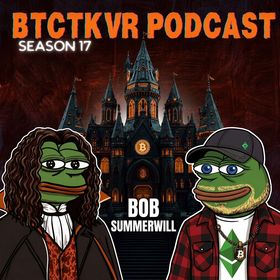
S17 E42: Bob Summerwill on Ethereum Classic & Bitcoin’s Fork Season
The audio keeps playing while you browse the site.
Read the transcript33,993 words, every line links to the minute it was said
Ask this episode
I first met Bob Summerwill in person at the Proof of Work Summit in September 2023: the event where Bitcoiners, Litecoiners, Monero and Dogecoin people, and even members of the Rootstock team all shared a stage without anyone being excommunicated. Thanks to Bob, I spent an entire day with Phil Zimmermann. Thanks to Bob, I finally met Donald McIntyre in person in 2024. So when fork season arrived in Bitcoin, with Luke Dashjr’s BIP 110 fork already limping along and Paul Sztorc’s ecash hard fork scheduled for Halloween, there was exactly one veteran of fork warfare I wanted at the table.
Bob was inside the Ethereum Foundation during the DAO hack of 2016, later spent six years as executive director of the ETC Cooperative, and before all of that helped turn FIFA from a laughingstock into the best-reviewed sports game on the planet. This is his account. Some of his conclusions are his own, and I present them as such.
Sponsored by Layer 2 Labs, launching the ecash hard fork on October 31st, SideShift, where you can swap stablecoins for sound money, Orange Rock for trading without KYC, Braiins Hash Power for renting hash rate, and Cake Wallet, who sponsored the $100 giveaway. The winning number was 96, and congratulations to Allison for guessing it.
The DAO, Told by Someone Who Was There
The received version of the DAO hack is cartoonish: a hacker stole the money, Ethereum rolled back the chain, the end. Bob’s retelling is considerably richer. The DAO began as Slock.it, a startup building smart locks for Airbnb-style rentals and bike sharing, announced at DevCon 1 in November 2015. It mutated into a general DAO framework, then into an unofficial ecosystem fund for all of Ethereum, partly because there was simply nothing else to do with your ether at the time.
Two design choices poured fuel on the fire: a child DAO mechanism that let anyone exit with their funds after a month, which was marketed as making the whole thing “risk-free,” and an uncapped raise. The result was that roughly 14% of the entire ether supply piled into one smart contract.
Bob had three reservations at the time, all of them vindicated. Was it legal? The SEC later retroactively declared it a security. Were the high-profile curators personally liable? They were plastered across the website with no legal entity protecting them. And was it wise to let anonymous strangers vote on a mountain of money? As he put it, how on earth is that a good idea?
Then came the reentrancy bug, which Bob explains with an ATM metaphor anyone can grasp: the contract let you withdraw again and again before it ever updated your balance. But here is the detail the folklore gets wrong. There was no rollback. The hard fork was an “irregular state transition,” a wonderfully bureaucratic euphemism, which converted the DAO contracts into simple refund contracts. Users had to actively claim their money back, and some refunds sit unclaimed to this day. Meanwhile, the hacker published a letter threatening legal action, arguing he had merely used the code as written, which was awkward, because “code is law” had been the project’s own marketing.
Two Ethereums From the Start
The most illuminating frame in the whole episode comes from Charles Hoskinson’s 2017 ETC Summit talk: there were always two Ethereums. One crowd wanted Bitcoin with smart contracts, where immutability is sacred. The other wanted a decentralized application platform, where ether is oil rather than money, and a bug that hurts end users gets fixed the way Microsoft fixes Windows, with an ugly patch in the wrong place if necessary.
When the vote came, 80 to 85% of the network chose the bailout, not because Vitalik dictated it, but because most people simply would not let a thief walk away with the community’s treasury. The minority chain kept mining, Poloniex listed it, and Ethereum Classic became the first minority fork in history to survive, defying Satoshi’s famous warning that it would go badly for the losing side.
Bob’s takeaway is cheerful: forks are divorces, and divorce beats staying together in misery. He illustrates this with the story of a shared house in his twenties and a roommate so antisocial she marked her milk bottle so nobody could steal from it. The other four tenants did not argue with her. They simply rented a different house and left. I confessed a matching story about a freeloader who ate our food, played our PS4 for three months, and could only be dislodged by the entire apartment relocating without him. It is the intolerant one who stays. The sane ones leave.
Why, then, did ETC not flourish? Bob is candid. The foundation cut funding, kept the trademark, and the applications never ported, because smart contracts are useless without the social layer of websites, keys, and integrations around them. Barry Silbert’s Grayscale money kept the lights on for years. Later came genuine sabotage: ETC Labs, funded by Digital Finance Group, promised to fund Igor Artamonov’s ETC Dev team, told him to stop looking elsewhere, then stiffed him and hired everyone except Igor and Donald McIntyre.
And when Ethereum finally moved to proof of stake, Chandler Guo’s Ethereum PoW fork intercepted the moment with a naked cash grab: no software released until after the split so they could solo mine, and the fee burn redirected to an opaque multisig. It launched at $60 and trades at 25 cents. ETC, for the record, is still a top 100 coin.
Fork Season in Bitcoin
All of this history lands directly on the present. My reading of the two current Bitcoin forks is that they are polar opposites. The BIP 110 fork, which I call “Balake” in honor of the Key & Peele substitute teacher sketch, is reductionist: smaller blocks, diminished miners, and a theory that nodes form a democracy that can fire the miners, decided by Discord polls of dubious provenance.
Paul’s ecash fork is maximalist in the literal maximizing sense: merged mined SHA-256, drivechains, new branding, and a deliberate refusal to fight over the Bitcoin name. Bob’s verdict on the anti-fork mindset is blunt. Consensus in these systems is voluntary, nobody can compel anyone to run anything, and the little dictators who say “you can have freedom, but not like that” have misunderstood the technology they claim to defend.
His advice for Paul, earned the hard way, is twofold. Get mining working from day one, because a chain that produces a block a week is a dead chain, and attention in this industry has the lifespan of a mayfly. And get exchange listings, because the Poloniex listing is what turned ETC from a protest into a market. Let the dumpers dump early, let the coins move into hands that value them, and find a real price.
Paul has since laid out the launch plan in detail. In S17 E37, his record eleventh appearance on the show, he walks through the three-stage launch and how to claim the free coins, and my explainer eCash (ECX): Paul Sztorc Forks Bitcoin to Prove a Point covers what the drivechains actually do. Read them next to Bob's advice and judge for yourself whether Paul took it.
The deeper philosophy came from Exiled Surfer at Hackers Congress in 2023, where Bob gave a talk cheerfully titled “Jaded as Fuck”: everything is an experiment. Imagine, Bob says, if the block size wars had been handled that way. Fork off two-megabyte blocks, measure what happens, learn, and merge the lesson back. Instead we got religion. He notes that Ethereum’s layer twos are worth about 30% of the base chain’s market cap, while Bitcoin’s entire layer two ecosystem is a rounding error, and that WBTC on Ethereum, with around 120,000 BTC, quietly became the largest Bitcoin sidechain in existence. Nobody praises it. Everybody uses it.
From Prepper to Builder
The emotional core of the episode is Bob’s origin story, which he had never told me in full. He began as a gold and silver bug who dismissed Bitcoin as a scam because, as a software engineer, he knew how bad most software is. Then came what he calls his Alex Jones phase: The Creature from Jekyll Island, peak oil, sailing lessons for the coming collapse, a basement full of military rations, and a Geiger counter after Fukushima. The spiral bottomed out when Michael Ruppert, whose documentary Collapse Bob had followed, committed suicide. That was the wakeup call: keep feeding yourself despair and you end up dead.
The alternate path arrived in a pub in February 2014, in the form of a conversation about Bitcoin 2.0 and everything money could become. A year later Bob was in Toronto on a TD Securities contract, attending Ethereum meetups with Vitalik, Joe Lubin, and Anthony Di Iorio, and watching the mainnet launch felt like being present when Tim Berners-Lee switched on the web. He volunteered, then got hired by the Ethereum Foundation. The lesson he draws is not about Ethereum. It is that building a life raft is healthier than stockpiling for the flood.
Making FIFA Great Again
For the millions of us who grew up on these games, the final hour is pure gold. Bob started at Psygnosis of Lemmings and Wipeout fame, worked on Harry Potter and the Chamber of Secrets (the PS1 version, with the Burrow tutorial and the gnome tossing), and then, at a 2002 town hall with EA chairman Larry Probst, stood up and told one of the most powerful men in gaming that nobody in the UK studio actually played FIFA, because they all preferred Konami’s Winning Eleven.
He felt the blood drain from his face. Instead of being fired, he was offered a seat in Vancouver. The turnaround took seven years, a full engine rewrite, and producer Dave Rutter’s rule that 80% of resources go to passing, shooting, and tackling, the core gameplay, with everything else treated as noise. By FIFA 10 the series was pulling 90-plus Metacritic scores. Bob also owns a notorious tweet declaring the Wii U crap, which he stands by, and I stand by my Switch 2. Friendship does not require agreement.
The Threads That Bind Us
The closing stretch is where this episode stops being an interview and becomes a letter between friends. We talked about the Proof of Work Summit and how Paul Sztorc was meant to speak at both editions, how Charlie Shrem’s appearance died to a time zone error, and how Nick Spanos simply ghosted.
We talked about Donald McIntyre, whom Bob announced the ETC Cooperative’s funding wind-down to at that 2024 summit, whom I tried to get hired by Sergio Lerner, and whose Etherplan writings survive on the Internet Archive. Bob attended his memorial and will share the remastered S1 E1 with Donald’s family. We talked about the Nick Szabo interview Donald nearly arranged for me, sunk by my own twenty-question enthusiasm, and about Elaine Ou, who keeps the co-op alive for its last core developer.
We also talked about Vitalik, whose three-hour appearance on this show earned my genuine respect, and whose combination of brilliance and social oddity inspired my tweet about the difficulty of telling autism from genius, and which one is dominant when you have both. Bob, who has known him since before the whitepaper, describes a man with a cat backpack and no house who never cared about money at all.
Bob’s own parting gift to the space is earlydaysofeth.org, a wiki-style history of Ethereum’s first years, complete with Ralph Merkle and Neal Koblitz as one-time advisors, Eric Lombrozo and Peter Todd in the orbit, four Romanians in the whitepaper phase, and an Amir Taaki quote for the ages: “We can build this on Bitcoin. Why do you need a new thing?”
There is also the Ethereum time machine, Bob’s project of renting GPUs to mine the 2016 Homestead fork back to life, because sometimes the best way to honor history is to run it. And there is his one piece of advice to his 2015 self, delivered with a wince: look after your private keys. He wiped a machine holding a $10,000 ETH grant. At today’s prices, that is a paid-off mortgage.
Ten years from now, I hope someone builds “Early Days of Ecash” to document the fork launching this Halloween. Bob’s closing words are the right ones for that project, and for everything else in this space. We got to try.
Listen to Bob Summerwill on Spotify, Apple Podcasts, YouTube & More!
Time stamps (everything is about 1 minute earlier on Spotify):
0:00 – Intro
1:22 – Welcome to S17 E42: Fork Season Begins
2:26 – Bob Summerwill & the DAO Hack Origin Story
4:11 – Slock.it, Smart Locks & the First DAO
8:03 – Child DAOs and the “Risk-Free” Pitch
11:04 – Bob’s Reservations: Legal Liability & Randos Voting With Money
14:27 – The Reentrancy Bug: 14% of the Supply Drained
17:14 – Code Is Law vs. Bailout: The Great Schism
20:42 – Hoskinson’s “Two Ethereums From the Start”
26:25 – “Can You Guys Please Stop Trading?”
27:44 – The Irregular State Transition (It Was Not a Rollback)
31:10 – The Hacker Threatens Legal Action
35:08 – The Vote & Activation Day
38:22 – Ethereum Classic: The First Minority Chain to Survive
42:34 – Forking Is Part of Nakamoto Consensus
43:19 – Sal, Donald McIntyre & the Cypherpunks of ETC
44:22 – Barry Silbert, Grayscale & the ETC Cooperative
47:26 – The Weird Roommate Theory of Forks
51:00 – Why Ethereum Classic Didn’t Win
56:27 – Bitcoin Cash, Dormant Coins & Grassroots Adoption
57:45 – Vlad’s “Many Bitcoins” Theory & the Accidental 21 Million
1:01:13 – Voluntary Consensus & the Little Dictators
1:05:37 – The Blake Fork (BIP 110) & the Node Democracy LARP
1:08:01 – Paul Sztorc’s Ecash: The Maximalist Hard Fork
1:10:47 – BitVM, Rollups & Bitcoin’s Missing Layer Twos
1:14:17 – Connection Trouble & the Speed of Light
1:15:03 – Sponsors: SideShift, Ecash, Orange Rock, Braiins, Cake Wallet
1:19:18 – Giveaway Reveal: The Number Is 96
1:20:28 – Why the Best Technology Doesn’t Win
1:23:50 – Tether on Tron: The Joke That Worked
1:27:07 – Tron’s Plagiarized Whitepaper & the Web 4 Roadmap
1:30:04 – NEO, EOS, NEM & the $4 Billion ICO
1:34:41 – Ultrasound Money & the EIP-1559 Burn
1:38:18 – The Prague Photographer’s Lament
1:41:08 – Bob’s Origin Story: Gold Bugs & the Alex Jones Phase
1:45:53 – El Salvador’s Quiet Bitcoin Regression
1:49:07 – Meeting Bitcoin in a Pub (February 2014)
1:55:44 – Bitcoin 2.0: BitShares, Counterparty, Mastercoin, NXT
1:58:48 – Toronto, TD Securities & Joining the Ethereum Foundation
2:03:06 – Michael Ruppert’s Collapse & Choosing to Build
2:07:24 – Self-Driving Cars & Assassination Markets
2:11:02 – Does Ecash Feel Like Early Ethereum?
2:14:53 – Will Bitcoin Ever Fork Again?
2:20:24 – WBTC: Ethereum Is Bitcoin’s Biggest Sidechain
2:22:48 – The Self-Custody Industrial Complex
2:24:52 – Zcash, Monero & Tachyon
2:28:38 – “Everything Is an Experiment”
2:31:46 – The Block Size Wars Counterfactual
2:36:52 – Ethereum PoW: Anatomy of a Cash Grab
2:42:26 – ETC Labs, DFG & the Sabotage of ETC Dev
2:46:27 – Could ETC Have Flipped ETH?
2:50:07 – Bob’s Advice for Paul Sztorc
2:56:50 – The EA Years: Psygnosis, Wipeout & Harry Potter
3:02:56 – “None of Us Play FIFA”: Confronting the Chairman
3:13:22 – Fixing FIFA: The Seven-Year Turnaround
3:22:02 – FIFA Nostalgia & Vlad’s Prodigy Brother
3:25:12 – The Notorious Wii U Tweet
3:27:37 – Professional Chaos Agent? Proof of Work Summit Stories
3:33:24 – Charlie Shrem’s Time Zone & Nick Spanos Ghosting
3:36:51 – Advice to 2015 Bob: The Lost ETH Fortune
3:39:00 – Remembering Donald McIntyre
3:42:06 – The Nick Szabo Interview That Almost Happened
3:44:38 – Vitalik, Autism & Genius
3:48:08 – Early Days of Ethereum & the Ethereum Time Machine
3:59:36 – “You Got to Try” & Where to Follow Bob
4:00:22 – Outro & Sponsors
Verify this episode
This is the SHA-256 fingerprint of the MP3 as published here, timestamped in the Bitcoin blockchain with OpenTimestamps. If one byte of the file changes, the fingerprint changes.
- SHA-256
5896dcec7847e148edd0958e4a63b00f45066c3bdb14073dc3357447791390ac- Proof
- 2026-09-12_s17_e42_bob_summerwill_on_ethereum_classic_bitcoin_forks_-_12_09_2026_05.24.mp3.ots · all episode hashes (proof)
- Status
- Anchored in Bitcoin block 974,312
How to check it yourself
- Download the MP3 and the proof into the same folder.
- Run
sha256sum 2026-09-12_s17_e42_bob_summerwill_on_ethereum_classic_bitcoin_forks_-_12_09_2026_05.24.mp3(on a Mac:shasum -a 256 2026-09-12_s17_e42_bob_summerwill_on_ethereum_classic_bitcoin_forks_-_12_09_2026_05.24.mp3). The result must match the SHA-256 above. - Install the OpenTimestamps client (
pip install opentimestamps-client) and runots verify 2026-09-12_s17_e42_bob_summerwill_on_ethereum_classic_bitcoin_forks_-_12_09_2026_05.24.mp3.ots. It hashes the MP3 again and checks the proof against your own Bitcoin node, then prints the block and the date the file existed by. Without a node,ots info 2026-09-12_s17_e42_bob_summerwill_on_ethereum_classic_bitcoin_forks_-_12_09_2026_05.24.mp3.otsshows the block height to look up in any block explorer.
Related
S17 E19: Amaury Séchet on Forking Bitcoin Twice, Quantum FUD & Scars from the Block Size Wars
Two years after our first interview, I decided to invite Amaury Séchet(@deadalnix) to find out what the Greg Maxwell of big…
S17 E38: Keagan McClelland on Lightning Metrics, Covenants, Consensus Politics & Verifying Bitcoin
There is a certain genre of Bitcoin Twitter argument that never quite resolves into a conversation. People trade metrics, memes…
S17 E23: Hunter Beast & Mark Karpeles on Quantum-Proofing Bitcoin, Satoshi’s Coins & the Ghost of Mt. Gox
This interview took place on April 29th 2026, at the LayerTwo Labs booth at the Bitcoin Conference in Las Vegas with Hunter…

Comments
Comments run on my own server. No ads, no trackers.