




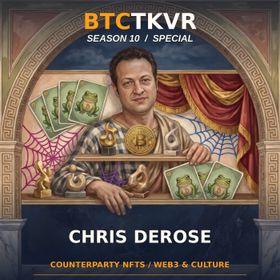
S10 Special: Chris DeRose on Counterparty, NFTs, Web 3, Ladyboys
The audio keeps playing while you browse the site.
Read the transcript27,853 words, every line links to the minute it was said
Ask this episode
"What's up, party people? This is Chris DeRose." That's how the episode starts, with my guest trying to take over the intro before I could say anything. It was his third time on the Bitcoin Takeover Podcast, after the Season 2 bonus on unpopular opinions and Season 9 on the philosophy of demoralization, and once again we couldn't have a short conversation. We went on for almost three hours.
Chris had just come back from Central America and Mexico, where he mostly read, worked out and checked things out. "I'm so like tame these days." I don't fully believe that, but I had a surprise ready for him anyway.
Seven Years Early on Counterparty
I had done my research and found an article from October 30th, 2014, titled Counterparty and the Asset Revolution. It's the transcript of a conference presentation in which Chris compared Counterparty to the Tontine Coffee House. He was seven or eight years ahead of the NFT craze, and I told him so.
He was modest about it. "It's kind of not that hard to be ahead sometimes in this space, but it's all about timing." What frustrates him is watching the latecomers get the attention. People like Jim Cramer show up and "you're just like, why is this guy getting all the attention for being five years late to this idea?"
His favorite moment of vindication came in a not-so-nice hotel in Honduras. He was flipping through the channels and saw a football player on ESPN shilling NFTs of his trophy. "He had no idea where that thing started. He had no idea what the joke was or what the irony was or what the meaning was." For Chris, it "was just like the punchline to a very long joke."
Pepe, Mickey Mouse and Uncopyrighted Myths
My prediction was that Pepe is going to end up just like Mickey Mouse, used in every context and without any identity of its own. Chris took it somewhere more interesting. "We used to have more collective myths in societies, and we kind of lost that with copyright law." In his view, "4chan is basically like the Disney of unlicensed myths or uncopyrighted myths," and if you want to talk decentralization, it's hard to beat 4chan as a source of culture.
Copyright came up more than once. He believes it's at odds with NFT goals, since any game engine that accepts copyrighted materials invites international law into the studio. Later he called removing copyright law one of the bigger ways to liberate yourself, and admitted that "it's a completely lost cause."
NFTs, Bananas and Collective Delusions
I find the NFT craze irrational. NFTs are like the new ICOs, except you don't get a roadmap. You buy a token tied to a mutable JPEG, and people act as if they bought the legal rights to the image. Chris traced it back to the modern art world and the banana duct taped to a wall in South Beach, which first sold for $40,000. His summary is one of my favorite lines from the whole conversation: "the elites have effectively lost their minds and authorized all of us to lose our minds and we just happen to be way better at losing our minds than people who are worth $10 million plus."
He also offered an explanation for why art gets mythologized. A piece of art is a bearer instrument, and when wealthy people need to route value between each other, they're "all incentivized now to believe each other's stories." It becomes "a sort of collective delusion."
The DEROSEHEAD
Which is exactly why I decided to create the DEROSEHEAD, a Counterparty card in my Bitcoin Heads collection, next to the JOSHUAHEAD, the NOPARAHEAD and the VLADHEAD. I asked Chris to pick the supply. "Well, there's only 21 million Bitcoin. So like, why not? Why not make it 21 cards?"
His advice for the launch was to keep the price low and make no money. "You have to be like the Satoshi figure. You have to be benevolent in handing over this Ponzi to the first round of bag holders." We settled on one card for me (the pre-mine, because I'm a scammer), one for Chris, three for listeners who draw his face in more than two and a half minutes, and 16 sold for 100 bits each, which roughly covers the on-chain fees.
I'll never sell my card, and Chris will never sell his Rare Pepes. His sister, who wants nothing to do with Bitcoin, badgered him for a whole month about cashing out. "I'm not selling them. This is like a family heirloom. I'm going to die with this. I'm going to leave this to my kids."
I told him about the WHEREBCYCARD someone sent me, a Spells of Genesis depiction of the angry Mt. Gox customer asking Mark Karpelès where his money was. "That was a significant day in Bitcoin history." That's what I like about the Counterparty assets issued on Bitcoin in 2015, 2016 and 2017: they tell stories from Bitcoin history. Chris's take on the competition was harsher. To him, "the Ethereum hype might as well just be like a dot com hype," and if NFTs are worth anything long term, "I find it very hard to believe that providence won't win out."
Performative Adoption in El Salvador
I asked Chris what he made of El Salvador. He had been there, and he wasn't impressed. "When I went there, I didn't see any prices listed in Bitcoin. I didn't see many people, any people using Bitcoin. The ATMs were largely decorative." He called it "performative adoption," and said so much of the space is "performative adoption and performative metrics."
I presented my own suspicion that the implementation looks like a perfect experiment in compliance. Chris didn't dismiss it, but he went back and forth between conspiracy and incompetence: "the conspiracies are unfalsifiable."
His broader view of money is something he calls chartalism. "I think about currency as an extension of the military." He knows "that's an insufficient view for many reasons," and was the first to say he didn't want to end up there.
Leadership, Block Size and the Gold Simulacrum
We revisited the block size war, since I remembered his 2016 interview with Roger Ver in which he was on the small block side. Chris surprised me. "I don't know that I am in favor of increasing the block size, but I can say that I like the bigger block community a lot more." To him, the poison of that debate was about leadership. "What we were really referring to was the authoritarianism of leadership or the, you know, the obstinance of the leadership." On Bitcoin Core he was careful: "They're not like bad people, they're not misleading the community exactly. But the problem is that there's no accountability, there's no transparency."
I told him part of the reason I do this podcast is to keep the old spirit alive. "The spirit you have is mostly dying. I hate to tell you." Much of the newer crowd sees Bitcoin through what he calls the gold simulacrum. "They read Saifedean's liturgy on that matter." The early momentum "was more of like a Blade Runner kind of aesthetic, maybe, than, you know, King Midas or something."
My answer to that is Counterparty. Sending someone a token called the DEROSEHEAD costs a fee, and it's also a form of free speech. I very much like the idea of Bitcoin being free speech money. Chris agreed: "I commend you for keeping the spirit alive."
Web 3 and Performative Decentralization
Web 3 was supposed to be a decentralized internet. To Chris, it "seems fairly vacuous." "Everyone's performing the act of decentralization, because that's what people want to see, that's what they want to buy, or that's what they think will sell." He was there when Ethereum launched and rejected it early: "Ethereum was just overtly a company."
The part that stayed with me is his explanation of why real innovation slowed down. "There used to be a lot more innovation being done in decentralization before all the token nonsense." When VCs overfunded the space, "no respectable developer is even going to want to get involved."
I was hoping for something more optimistic as a closing note, and in the end I got it. "Bitcoin succeeded by like every fucking measure. It's just that like, it wasn't what we wanted, maybe in some senses." He thinks we have more than one chance, and pointed out that "the best internet work was done after the dotcom boom ended."
What Makes This Episode Worth Listening To
Chris is one of the few people who can make me laugh and question my assumptions in the same sentence. The last stretch of the episode is fan questions, including flat earth, shorts, and the one that gave this episode the last word in its title. It's not for everyone, and that's how Chris likes it. He came back again in Season 15 to talk about Bitcoin Uncensored, simulacra and life after Bitcoin.
You can read the full transcript, visit Chris DeRose's guest page, or explore the Counterparty and Rare Pepes topics. If you've never made one, here's how to get your first Bitcoin NFT on Counterparty.
Listen to Chris DeRose on Spotify, Apple Podcasts, and More
Time stamps:
- 00:00:51– Chris DeRose takes over the intro
- 00:08:46– Counterparty and the Asset Revolution, a 2014 presentation
- 00:11:44– Pepe, Mickey Mouse and 4chan as the Disney of uncopyrighted myths
- 00:18:42– NFTs, modern art and the banana taped to a wall
- 00:25:26– Creating the DEROSEHEAD card with a supply of 21
- 00:33:16– Why Chris will never sell his Rare Pepes
- 00:47:29– El Salvador and performative adoption
- 01:00:02– Currency as an extension of the military
- 01:30:23– Bitcoin leadership and the block size war
- 01:54:35– The cypherpunk spirit and the gold simulacrum
- 02:18:21– Web 3 and performative decentralization
- 02:44:00– Bitcoin succeeded, just not how we wanted
Verify this episode
This is the SHA-256 fingerprint of the MP3 as published here, timestamped in the Bitcoin blockchain with OpenTimestamps. If one byte of the file changes, the fingerprint changes.
- SHA-256
5bfed9e8345099ad55042f98d27010a44ad7f30e337c061edc1853a53095c34a- Proof
- 2022-01-11_s10_special_chris_derose_on_nfts__web_3_and_ladyboys.mp3.ots · all episode hashes (proof)
- Status
- Anchored in Bitcoin block 974,312
- Timestamped
- After release. The episode came out on 11 Jan 2022, but this proof was made on 3 Nov 2026 and anchored in block 974,312, so it proves this exact file existed by 3 Nov 2026, not on the release date.
How to check it yourself
- Download the MP3 and the proof into the same folder.
- Run
sha256sum 2022-01-11_s10_special_chris_derose_on_nfts__web_3_and_ladyboys.mp3(on a Mac:shasum -a 256 2022-01-11_s10_special_chris_derose_on_nfts__web_3_and_ladyboys.mp3). The result must match the SHA-256 above. - Install the OpenTimestamps client (
pip install opentimestamps-client) and runots verify 2022-01-11_s10_special_chris_derose_on_nfts__web_3_and_ladyboys.mp3.ots. It hashes the MP3 again and checks the proof against your own Bitcoin node, then prints the block and the date the file existed by. Without a node,ots info 2022-01-11_s10_special_chris_derose_on_nfts__web_3_and_ladyboys.mp3.otsshows the block height to look up in any block explorer.
Related
S16 E22: J-Dog on Counterparty & Bitcoin Tokens
J-Dog, creator of FreeWallet and TokenScan, on the Counterparty fork, dispensers, Dogeparty days, 40,000 asset names and…
Les NFTs Bitcoin sur Counterparty (et Comment Obtenir Ou Créer votre Premier NFT)
Omniprésents sur l’ensemble des médias et pourtant largement incompris, les NFT sont les sujets de fascination et (surtout) de…
Bitcoin NFTs on Counterparty (and How to Get or Create Your First One)
Omnipresent all across media channels and yet largely misunderstood, NFTs are this cycle’s subject of fascination and (mostly)…

Comments
Comments run on my own server. No trackers, no tracking cookies.