




Karliatto and Chill on the Bleskomat Open Source Bitcoin ATM (S11 E2 Full Article)
The audio keeps playing while you browse the site.
Read the transcript5,001 words, every line links to the minute it was said
Ask this episode
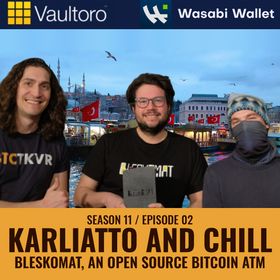
Season 11 is about lesser-known European, Asian and African projects that fly under the radar. The Bleskomat fits perfectly. I caught its co-founders, Karliatto and Chill, at a conference in Istanbul, minutes before their demo. On the table was a small 3D printed box: you put coins in one side and get Lightning bitcoin on your phone.
It's open source, it works offline, and it's a great way to show people what Bitcoin does. The original show notes have the short version.
Why Bring It to Istanbul
Karliatto was clear that the box in front of me was "just the do-it-yourself project." They built the kit because they kept running workshops at conferences "and people were asking us." Alongside it, "we have like a complete full ATM that takes banknotes and coins, and we are selling that as a product."
Turkey was an obvious fit. "Because of the inflation problem that they are having, it could be a place where our product can help." But the main reason to travel was simpler: "to meet other people, related projects, learn from them, share stuff with them, and have fun."
Chill explained who the kit is for. Hobbyists and hackerspaces "want to be able to onboard and educate their local communities about Bitcoin." Nothing does that like a real object. "You can put in one coin, and you can literally buy Bitcoin with this."
How It Works
The flow is easy. "You start inserting coins, but you might not insert only one. You might want to insert five, 10, I don't know, 100." Then you press the button, and "it displays you a QR code that you scan with your Lightning wallet that supports LNURL, which most of the Lightning wallets nowadays do."
"Then you just receive the money instantaneously in your wallet." For a newcomer, that's the moment. They install an app and use Lightning right away, and since everything uses LNURL, "they're all compatible."
Offline by Design
The key point, Karliatto said, is that "it works totally offline. So the ATM is never connected to the internet, which is one problem less that you have to solve." That helps "in places where the internet connection might not be reliable."
How can a machine sell bitcoin without the internet? The phone does the talking. The QR code "contains the amount that you have inserted and the currency that you have it set up, and all this information is signed by a key." That secret "is shared by the machine and the server."
Then the user's wallet contacts the server, which "verifies that this signature is valid and belongs to a legit ATM," and "then the server releases the payment."
Chill explained why the signature matters. They "extended the LNURL withdraw specification in order to include a little technical HMAC signature," so you can tell "whether or not the amount that was entered into the device is tampered with or not." Because the QR code holds the amount, "you don't want the person, the customer, to change that."
The same trick works for other devices. "All of these devices can theoretically be offline and they can communicate indirectly using the customer's device, which is the phone, which is connected to the internet."
Train It With Any Coins
The DIY version only has a coin acceptor, and "you can retrain it with any coins that you want." At a conference, "you just go to some vendors, you get some coins and now you can train it with the local currency and it just takes you a few minutes."
The machine doesn't care about prices. "The machine itself doesn't know anything about exchange rates. It just knows which coins you tell it, which currency." Set the symbol, like "TRY for Turkish lira," feed it a few of each coin, "and you're good to go."
The exchange rate lives on the server, checked "in real time." When someone scans the QR code, "the server does the calculation in that moment," so it always matches "the market rate, and then your fee."
Open Source, Except the Name
I asked if I could take the code, build my own and sell it. "It's totally open source," Karliatto said. You can "take it, modify, build on top of it, do whatever you want, sell it if you want." The server software is open too.
Chill added one condition. "The name is obviously trademarked, so you can't call yours, if you build the thing, don't call it Bleskomat, call it something else." Open source also lets people "verify that what we're doing is legit."
The name itself is Czech. "We started this project in Czech Republic. And blesk is the meaning, it means lightning in Czech." The "mat" comes from "automat." I told them it sounded a bit blasphemous to the fiat standard, and Chill took it well: "If you prefer that definition, sure, why not?"
Where the Bitcoin Lives
The device holds only fiat. "If somebody steals that, obviously they can steal the money that's inside the machine, but they cannot steal any of your Bitcoin." The bitcoin sits in a Lightning hot wallet, so "what is recommended is to not have so much in terms of Bitcoin in that hot wallet at a time."
You have options. The open source server works with several Lightning service providers, "but we also have integration with LND directly." You can even run "your own Lightning node behind a Tor hidden service."
Even if someone hacks the box, "it can't steal your Bitcoin, basically." You can "delete the key from the server or disable it."
Kit, Iron Box and Business Model
The DIY kit sells for "around 175 euros with the case and all the components," including a one-year subscription to the hosted Bleskomat platform, for people who "don't have the time, don't have the skills" to run a server. Even then, "that server never has the custody of any funds."
The full version is "made in iron," "handmade," and takes bills, holding "up to 300 banknotes at a time." It's meant "for like a restaurant or a food truck or festival." It's offline too, and since "it's 12 volt, you could run it off of a car."
Why the ESP32
They started with a Raspberry Pi, but "the whole thing was very complex." The ESP32 is "way simpler because you don't need to have an operating system running. You just flash the firmware." Karliatto summed up the philosophy: "We believe that simplicity is more reliable."
Chill liked that it's "basically a commodity chip. It's everywhere," with huge open source support. It also uses less power and costs less.
Physical Security and the Law
Physical theft is still a risk, so these machines "are designed for supervision." The big one is "about eight kilograms. It's not hard to just walk away with." Karliatto compared its security model to "a cash register in a restaurant or a coffee shop."
On regulation, they keep it practical. Laws change "across countries," but "in our experience, there are not many issues, at least in the European countries." Mostly, "you just have to report the benefits." Anyone going bigger "could have better legal advice from their tax advisor."
Build One or Buy One
Both versions have a job. The DIY kit is for the enthusiast who keeps talking to family about Bitcoin "but you are talking about something abstract." The big one is for a business that wants to "sell bitcoins and make a profit out of it," while giving people "the opportunity to buy bitcoin in your place." You can follow the project at bleskomat.com.
What Makes This Episode Worth Listening To
It's short, it was recorded on the spot, and it explains a clever trick: a Bitcoin ATM that never touches the internet. If you want to show your family how Bitcoin works, a box that turns coins into sats beats any explanation. As Karliatto put it, "then they see it in action, they see how fast it is."
You can read the full transcript, the original show notes, or visit the guest pages for Karliatto and Chill.
Listen to Karliatto and Chill on Spotify, Apple Podcasts, and More
Time stamps:
- 00:01:39– The DIY kit and the full ATM
- 00:02:19– Why Istanbul
- 00:02:44– Onboarding with a real object
- 00:04:21– How it works
- 00:04:55– Totally offline
- 00:05:41– Train it with any coins
- 00:07:18– Fully open source
- 00:07:48– The name is trademarked
- 00:08:25– LNURL withdraw with HMAC
- 00:09:18– The signed QR code
- 00:14:10– Where the bitcoin lives
- 00:14:43– LSPs, LND and Tor
- 00:16:26– What Bleskomat means
- 00:17:32– Price and the hosted platform
- 00:18:56– The iron full version
- 00:20:45– From Raspberry Pi to ESP32
- 00:23:27– A commodity chip
- 00:24:10– A hacked device can't steal bitcoin
- 00:25:23– Physical security
- 00:27:05– Laws and taxes
- 00:29:08– Real-time exchange rates
- 00:30:14– Build one or buy one
Verify this episode
This is the SHA-256 fingerprint of the MP3 as published here, timestamped in the Bitcoin blockchain with OpenTimestamps. If one byte of the file changes, the fingerprint changes.
- SHA-256
347bdce34bfc8f287a5fd05bda4d4d0c9ae46eb1eda23f109b3eadba03f1b2c8- Proof
- 2022-05-12_s11_e2_bleskomat_free_open_source_bitcoin_lightning_atm_.mp3.ots · all episode hashes (proof)
- Status
- Anchored in Bitcoin block 974,312
- Timestamped
- After release. The episode came out on 12 May 2022, but this proof was made on 3 Nov 2026 and anchored in block 974,312, so it proves this exact file existed by 3 Nov 2026, not on the release date.
How to check it yourself
- Download the MP3 and the proof into the same folder.
- Run
sha256sum 2022-05-12_s11_e2_bleskomat_free_open_source_bitcoin_lightning_atm_.mp3(on a Mac:shasum -a 256 2022-05-12_s11_e2_bleskomat_free_open_source_bitcoin_lightning_atm_.mp3). The result must match the SHA-256 above. - Install the OpenTimestamps client (
pip install opentimestamps-client) and runots verify 2022-05-12_s11_e2_bleskomat_free_open_source_bitcoin_lightning_atm_.mp3.ots. It hashes the MP3 again and checks the proof against your own Bitcoin node, then prints the block and the date the file existed by. Without a node,ots info 2022-05-12_s11_e2_bleskomat_free_open_source_bitcoin_lightning_atm_.mp3.otsshows the block height to look up in any block explorer.
Related
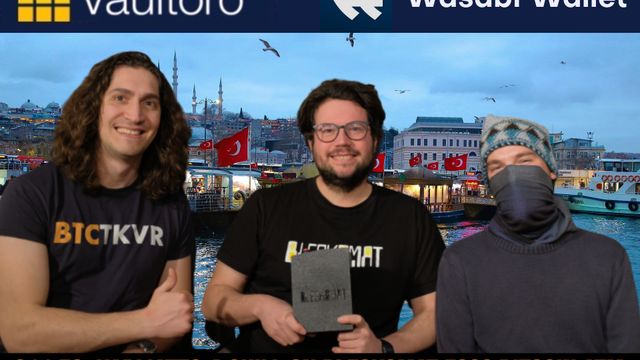
S11 E2: Karliatto and Chill on Bleskomat, An Open Source Bitcoin ATM
Bleskomat is the kind of project that gives me confidence in the future of Bitcoin and also reminds me why I enjoy…
S17 E18: Dr. K on Scaling Proof of Work, Soaping the Competition with Quai & Unifying Physics
Dr. K (Karl Kreder), architect of the Quai Network, came back for his second appearance on Bitcoin Takeover to defend his…

S15 E5: Edan Yago on Sovryn, Bitcoin DeFi & Challenging the Orthodoxy
Edan Yago is a core contributor to the Sovryn project: a decentralized finance (DeFi) layer that’s built on top of Bitcoin’s…

Comments
Comments run on my own server. No trackers, no tracking cookies.