




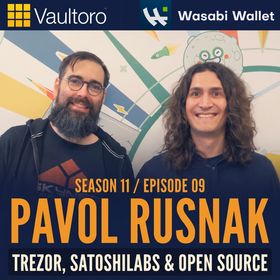
S11 E9: Why Is Trezor Open Source? Pavol Rusnak (Stick) on SatoshiLabs
The audio keeps playing while you browse the site.
Read the transcript9,728 words, every line links to the minute it was said
Ask this episode
Why is Trezor open source? According to Pavol Rusnak (aka Stick: co-founder and CTO of SatoshiLabs, co-creator of the Trezor and co-author of BIP39 and BIP44), it comes down to two principles the company has kept since the beginning: being open source, so the device can be audited and improved by anyone, and being independent, so no investor can push compromises into a security product. That's also why SatoshiLabs is now building Tropic Square, an open-source secure element chip, instead of trusting vendors that keep their flaws secret.
I've recorded this interview in person in Prague, in front of a painting of an octopus with bitcoins, and after talking online for a while, it was finally a chance to meet Stick face to face. And right away, Pavol corrected a mistake from my intro: despite the common misconception, Pavol never really worked on Slush Pool.
Key takeaways:
- Pavol discovered Bitcoin at a Prague conference in November 2011 and met Slush at the Brmlab hackerspace meetups.
- The first Trezor batch grew from a planned 1,000 units to an order of 30,000, which let SatoshiLabs bootstrap without VC money.
- SLIPs exist because some SatoshiLabs ideas, like SLIP-39 Shamir backups, were too general for the BIP repository.
- Tropic Square aims to remove the information edge chip vendors keep over hardware wallet makers and their users.
How Did the Trezor Start?
With a conversation between friends. Pavol got into Bitcoin at what may have been the first Bitcoin conference ever, in Prague in November 2011, and kept running into Slush at the weekly meetups at Brmlab, while Slush was running the one-man operation that later became Slush Pool. Mining was one problem, but storing coins safely was another, especially for regular people on Windows computers. Neither of them was a hardware designer, so they learned electronics through trial and error at the hackerspace (Pavol gives a shout-out to a friend named Sargon, and to a fellow Brmlab member who now runs GeneralBytes).
They thought there were maybe 100 people on Bitcoin Talk who'd want one, plus a few hundred more, so they planned 1,000 devices. The manufacturer said that was small and talked them into 30,000, of which they produced a third at first, and the demand turned out to be big enough to fund the company without outside investors. The crowdfunding sold the Trezor One for one bitcoin (back when a bitcoin was worth somewhere between 16 and 80 euros), and the metal version went for three. Today, Pavol can only say that SatoshiLabs has sold more than a million devices, and estimates that the whole hardware wallet market is somewhere between 5 and 10 million.
The open-source part comes from Pavol's years at SUSE Linux, where competitors like SUSE and Red Hat shared the same codebase and met at conferences to share knowledge. It seemed obvious that Trezor should follow the don't trust, verify mantra too. I also asked about the narrative that the Trezor One is old tech (I admit I fell for the Ledger pitch in 2018), and Pavol's answer was that this was the plan all along:
"we tried to make the original Trezor as simple, as dumb as possible" (00:26:32)
No batteries, no Bluetooth, no NFC, and enough computing power to keep getting software upgrades, including Taproot. The Model T in 2018 kept the same philosophy with a bigger touchscreen. As for clones, Pavol isn't worried about bootleg copies sold in markets SatoshiLabs can't reach anyway, and loves the paranoid people who build their own Trezors from guides on Instructables and Hackaday.
What Are SLIPs and Why Did SatoshiLabs Need Them?
SLIPs (SatoshiLabs Improvement Proposals) started when one of their ideas was rejected from the BIP process for being out of scope, which Pavol admits made sense. BIPs work like the RFC documents behind the internet: de facto standards rather than official ones. So SatoshiLabs opened its own repository, and outside contributors joined in. SLIP-39, the Shamir secret sharing scheme for recovery seeds, is the best-known one, and Keystone has adopted it too. I reminded listeners that if you've ever written down 12 or 24 words, you've used BIP39, the standard Pavol co-authored, and Pavol was surprised to see it used even by GrapheneOS for disk encryption recovery. Interoperability matters, because Bitcoin is about freedom, not walled gardens.
Then we got to privacy. SatoshiLabs wants to cover a triangle of usability, security and privacy, which is why Trezor Suite got a one-click Tor switch, and why the team was talking to Wasabi Wallet about bringing CoinJoin into Trezor Suite. Full disclosure: Wasabi Wallet sponsors this podcast, but I'd defend CoinJoins anyway, because privacy is how Bitcoin gets fungibility, and it's great to see a company remove the stigma instead of treating them as something undesirable.
Tropic Square is the most ambitious part. People always asked why Trezor didn't use a secure element, and the answer is that every chip SatoshiLabs examined had a critical flaw, while vendors either didn't bother fixing them or forbade talking about them. As Pavol puts it:
"I don't want to know more than my users." (00:58:39)
The project clicked about two years before our interview, when the person who'd talked them into the 30,000 batch and an ASIC designer, Honza Pleskač, both became available. The first chip is meant as secure storage, and thanks to a Google-funded program for open-source chips, the team had free test runs scheduled for May and November, with a Trezor using it expected later.
Pavol is one of those engineers who's humble about having written standards used by pretty much every wallet out there, including the shitcoin ones. Needless to say, it was an honor to interview Stick in person. And if you can figure out a good way to sell Bitcoin peer-to-peer in Europe without KYC, Pavol would like to hear from you, which might be the most useful job ad ever read on this podcast.
FAQ:
Did Pavol Rusnak work on Slush Pool? No. Pavol calls it a common misconception that likely comes from working so closely with Slush since they met in 2011.
Who wrote BIP39? BIP39 lists Marek Palatinus (Slush), Pavol Rusnak, Aaron Voisine and Sean Bowe as authors, while BIP44 is by Slush and Pavol.
What is Tropic Square? A SatoshiLabs company building an open-source secure element chip, so hardware wallet makers don't have to trust closed chips with undisclosed flaws.
Listen to Pavol Rusnak on Spotify, Apple Podcasts, YouTube & More
The full transcript is on the S11 E9 transcript page, and the episode record is here. For the other half of the founding duo, read S8 E8 with Slush on Trezor and Tropic Square and the 3094 bitcoin theft that led to the creation of the Trezor. My BIP39 page explains the seed standard, and S11 E8 with SatsJoseph is another Prague conversation from this season. Pavol's projects: SatoshiLabs, Trezor, Tropic Square, the SLIPs repository and the BIP39 specification.
Time stamps of S11 E9 of the Bitcoin Takeover Podcast, featuring Pavol Rusnak (transcript-derived):
- 00:00:00Intro
- 00:00:29Welcome: Pavol Rusnak (Stick) of SatoshiLabs
- 00:01:36November 2011: a Bitcoin conference in Prague
- 00:02:46Brmlab, Slush and the Slush Pool misconception
- 00:03:32Mining is one thing, storing is another
- 00:05:19Learning hardware at the Brmlab hackerspace
- 00:07:32From 1,000 devices to a batch of 30,000
- 00:09:07Open source and the SUSE Linux lesson
- 00:12:10Independence: no VC money
- 00:13:11Sponsors: Vaultoro, Wasabi Wallet
- 00:16:00Who introduced Stick to Bitcoin?
- 00:18:05Was the Trezor a luxury item?
- 00:19:43The crowdfunding: one bitcoin for a Trezor
- 00:22:39More than a million Trezors sold
- 00:24:36Is the Trezor One old tech?
- 00:26:32No batteries, Bluetooth or NFC
- 00:28:28The Model T in 2018
- 00:30:08Hardware wallet or signer with a display?
- 00:30:58Trezor clones and staying in business
- 00:35:48Building your own Trezor
- 00:37:05BIPs, RFCs and why SLIPs exist
- 00:40:03SLIP-39 Shamir backups and interoperability
- 00:42:38BIP39 seed words and BIP44
- 00:43:54Cryptographers from Charles University
- 00:44:59BIP39 in GrapheneOS, and NixOS
- 00:45:56CoinJoin and the usability, security, privacy triangle
- 00:48:03Talking to Wasabi Wallet
- 00:50:27WabiSabi and fungibility
- 00:51:47Tropic Square: an open-source secure element
- 00:53:12Sponsors: Vaultoro, Wasabi Wallet
- 00:56:03Why Trezor avoided secure elements
- 00:57:41Chip vendors and undisclosed flaws
- 00:59:13How Tropic Square came together
- 01:01:08First and second generation of the chip
- 01:03:40Google-funded test runs at the foundry
- 01:05:47When will a Trezor use the chip?
- 01:07:04Invity and buying Bitcoin without KYC
- 01:10:12Where to follow Stick
- 01:11:39Sponsors: Vaultoro, Wasabi Wallet
Verify this episode
This is the SHA-256 fingerprint of the MP3 as published here, timestamped in the Bitcoin blockchain with OpenTimestamps. If one byte of the file changes, the fingerprint changes.
- SHA-256
4bf06d39c01bf5856e02e1d36ed4dbe7d54d1e5d9fd1b56cb2d7ce13aed15bf4- Proof
- 2022-07-12_s11_e9_pavol_rusnak_on_trezor__satoshilabs__and_open_source_software.mp3.ots · all episode hashes (proof)
- Status
- Anchored in Bitcoin block 974,312
- Timestamped
- After release. The episode came out on 12 Jul 2022, but this proof was made on 3 Nov 2026 and anchored in block 974,312, so it proves this exact file existed by 3 Nov 2026, not on the release date.
How to check it yourself
- Download the MP3 and the proof into the same folder.
- Run
sha256sum 2022-07-12_s11_e9_pavol_rusnak_on_trezor__satoshilabs__and_open_source_software.mp3(on a Mac:shasum -a 256 2022-07-12_s11_e9_pavol_rusnak_on_trezor__satoshilabs__and_open_source_software.mp3). The result must match the SHA-256 above. - Install the OpenTimestamps client (
pip install opentimestamps-client) and runots verify 2022-07-12_s11_e9_pavol_rusnak_on_trezor__satoshilabs__and_open_source_software.mp3.ots. It hashes the MP3 again and checks the proof against your own Bitcoin node, then prints the block and the date the file existed by. Without a node,ots info 2022-07-12_s11_e9_pavol_rusnak_on_trezor__satoshilabs__and_open_source_software.mp3.otsshows the block height to look up in any block explorer.
Related
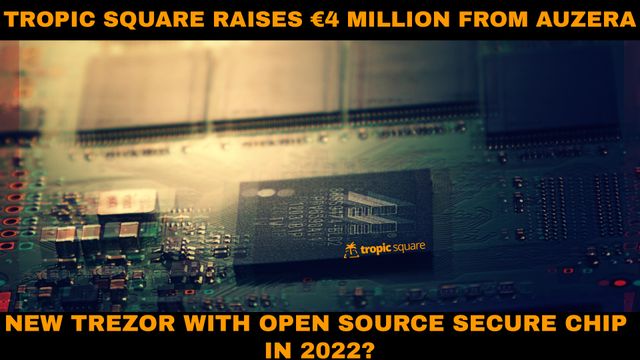
New Trezor hardware Wallet with Tropic Square Open Source Chip In 2022?
Tropic Square’s ambitious project to deliver fully transparent and auditable secure element chips is big news for the Bitcoin…
S17 E29: Is Vibe Coding Good for Bitcoin? Grafton Clark on Privacy & Culture
Some podcast episodes are about a product, a protocol, or a company. This one is about a feeling: the feeling that the…
S17 E24: Is Air-Gapping Over? Zach Herbert on Passport Prime & KeyOS
Some interviews you plan for weeks. This one I planned around a box. Two weeks after Zach Herbert handed me a Passport…

Comments
Questions or corrections? Email me, or say it on Nostr or X. I read all three.
Email meNostrX