




Slush on Trezor and Tropic Square (S8 E8 Full Article)
The audio keeps playing while you browse the site.
Read the transcript12,941 words, every line links to the minute it was said
Ask this episode
Slush has a habit of doing things nobody has done before. He started the first Bitcoin mining pool, then co-created Trezor, the first Bitcoin hardware wallet. In this Season 8 episode, he explained his next ambitious project: Tropic Square, an open source and auditable secure chip.
"We are used to doing things where nobody succeeded yet," he told me. "It was like in the pool, it was in the Trezor." We also compared Trezor with the new devices on the market and talked about passphrases, backups, air gaps, multisig and Shamir. The original show notes have the short version.
From Software Engineers to Hardware
The story goes back to Trezor itself. "We are simply software engineers, and we have been pushed into the hardware because we realized that if we want to secure Bitcoins, we need some hardware for running our code on top of it."
He was clear about open source. "It's not kind of fetish or something." It's "a movement which radically improved the software world in the last 20 or 30 years." And "open source itself is not a goal. It's a tool how to achieve the security." He disagrees with the idea that you must choose between being secure and being open source.
Why Build a Chip
Customers wanted better physical security, and Slush admitted the problem plainly. "All the hardware is insecure for different reasons." Physical security "is an unsolved challenge on the market still." So SatoshiLabs decided to apply its software approach to silicon, because "the current hardware industry" is "lagging many years behind the software development."
It took them three years to even start, because they lacked funding and specialists. What makes Tropic Square different, he said, is incentives. The secure element industry "build on the obscurity," while Tropic Square exists to "solve some problem which we have ourselves."
He was realistic about timing. The first chip "won't be fully open source itself," but the goal is "an open source digital circuit which touch the user data secrets." The plan was a testing chip by the end of 2021 and "first Trezor prototypes with Tropic Square next year."
The verification idea is clever. They want to publish the chip's source code and "even the scans from X-rays," so experts can check that "the open source design which will be on GitHub really compiles into the design" in your hands.
Clones and Licenses
I asked about the licensing debate after the Passport launched on Coldcard's code. Slush understood. "We have been there and done that." Trezor once changed its license because of KeepKey, then "when the emotions settled down," they "reverted the license back."
His view: "it's really necessary to give credits where the credits are." Even with "like 40 clones of Trezor in the wild," SatoshiLabs chose to keep "improving and making some standards and moving the industry forward."
Why He Still Pushes Passphrases
"I understand that passphrases goes against the usability itself," he said. "But I don't see any way how to avoid passphrases in really strong setups." Telling people to trust the hardware alone is "clearly irresponsible," because "really nobody knows what's inside the hardware."
"Having a secure element is not a holy grail." A passphrase also gives you plausible deniability and protects your recovery seed. And no hardware is perfectly safe. "The game is only about making it expensive enough or hard enough," because "there's no silver bullet."
For the next Trezor, he hinted at "our secure element and better connectivity," and maybe a slightly bigger touchscreen, since the "touchscreen on the Model T is a success."
He also explained the T9-style keyboard on the Model T. They tested it on young people who'd never used old Nokia keyboards, and surprisingly, it worked. On the Trezor One, he still thinks a weak passphrase isn't helpful, so a rich input matters.
Paper Beats MicroSD
Some wallets back up to microSD cards. Slush gave his reasons for avoiding that. "MicroSD cards are really poor long-term storage." A photographer friend has "a box full of some microSD cards" that "worked until they didn't," and "you have no way how to check if your backup is alive." Put a card into a computer and you might be "doomed just by doing this." Paper and metal you can check offline.
There's a human factor too. "The people will naturally go with the most easiest way which we offer them," so if the insecure path is too easy, people take it.
Air Gaps and QR Codes
Slush wasn't impressed by the air gap trend. "Except that it looks cool and super nerdy, I don't think it solves any practical issue." You still exchange data "which you as a human can't verify." QR codes also hit size limits when a wallet must stream previous transactions to verify fees.
"I don't think it's more or less secure. I think it's the same." USB allows richer interaction, so for him it's about usability. His only disagreement with the Passport was building it around QR codes. About the Jade, he liked "the concept" and called it "inspirational," though he wondered how its low price leaves money for development.
Trezor Suite and Privacy
Trezor Suite was close to release. "There's already implementation of Tor connectivity, so you can connect over Tor by a single click." They were also working on full node support and CoinJoin. "The grand vision is to have a one-click setup with the pruned node directly in the Trezor Suite."
Historically, Trezor sent advanced users to Electrum or Wasabi. Slush likes both projects, but with a bigger team, the plan was to bring those features into the Suite, because "we can deliver the total or the best user experience only if we control the whole stack."
The Suite also checks whether a "new" device was already initialized, because "shipping prefilled or initialized devices did happen." It's "not like a cryptographically secure verification, but it solves the practical issues which we see in the field."
On customer data, they actively delete it once it's no longer needed. "We don't need to know who's our customer."
Multisig for Companies, Shamir for People
"I think that multisig is a great tool and Trezor has perfect support for multisig." But it fits places "where multiple people need to interact," like a company "where the CEO and CFO have a control over the Bitcoins." For one person, "it makes the complexity much bigger. And it practically doesn't improve that much."
Shamir backup, which he helped design as SLIP-39, gives individuals "social backup and geographic backup really, really strong," while keeping the ease of a single hardware wallet. Shamir won't come to the Trezor One, because it needs "some richer interface on the device," and he sees it as a tool for "even lifetime savings." He expects multisig to "eventually improve with Taproot," but for now "single person proper multisig setup is really much more complex than Shamir." Using five vendors doesn't make you safe by itself. The real problem for most people is "where to store the recovery seeds."
And building your own air-gapped computer setup? "This was exactly what I was recommending to people to do before we had Trezor." Seeing how people struggled with it "was the motivation for doing Trezor." "Any Linux can be safe if you know what you are doing, and any system can be unsafe if you don't know what you are doing." He recalled an old Android bug where a weak random number generator gave different users the same private keys in a mobile wallet, through no fault of its developers. "You can have honest developers, good developers, but you have no control on what kind of system the users will install the software."
What Makes This Episode Worth Listening To
Slush has been "in Bitcoin since 2010," and he sees each bull market redefine the space. Here you hear his engineering philosophy and his long-term bet on open hardware, from the person who started the hardware wallet industry.
You can read the full transcript, the original show notes, or visit Slush's guest page.
Listen to Slush (Marek Palatinus) on Spotify, Apple Podcasts, and More
Time stamps:
- 00:03:27– Pushed into hardware
- 00:05:12– Open source is not a fetish
- 00:06:02– A tool to achieve security
- 00:07:31– All hardware is insecure
- 00:08:55– Building their own chip
- 00:10:23– Doing what nobody did
- 00:11:47– Aligned incentives
- 00:12:55– An open digital circuit
- 00:13:43– Timeline for prototypes
- 00:16:41– X-ray scans for verification
- 00:18:42– Reverting Trezor's license
- 00:20:20– 40 clones in the wild
- 00:22:52– Why passphrases matter
- 00:24:38– Not a holy grail
- 00:26:49– MicroSD is poor storage
- 00:32:13– People take the easiest path
- 00:32:59– No silver bullet
- 00:37:17– Air gaps look cool
- 00:41:27– Same security, richer interaction
- 00:43:31– The Passport and QR codes
- 00:45:13– The Jade
- 00:48:50– The next Trezor
- 00:50:30– The Model T keyboard
- 00:55:45– Tor in Trezor Suite
- 00:56:59– Controlling the whole stack
- 00:58:47– Prefilled devices
- 01:03:34– No Shamir on the Trezor One
- 01:07:46– A pruned node in the Suite
- 01:10:15– Multisig for companies
- 01:11:15– Not for single persons
- 01:14:20– Social and geographic backup
- 01:17:04– Multisig after Taproot
- 01:18:03– Where to store your seeds
- 01:19:39– Deleting customer data
- 01:23:52– Why Trezor exists
- 01:27:05– Any Linux can be safe
- 01:28:29– Honest developers, unknown systems
- 01:34:44– In Bitcoin since 2010
Verify this episode
This is the SHA-256 fingerprint of the MP3 as published here, timestamped in the Bitcoin blockchain with OpenTimestamps. If one byte of the file changes, the fingerprint changes.
- SHA-256
71e4f072addafdb99db48bef26b581a0440f51acf6c56dff74d191b627da20ef- Proof
- 2021-04-28_btctkvr_s8_e8_slush_on_trezor_and_tropic_square.mp3.ots · all episode hashes (proof)
- Status
- Anchored in Bitcoin block 974,312
- Timestamped
- After release. The episode came out on 28 Apr 2021, but this proof was made on 3 Nov 2026 and anchored in block 974,312, so it proves this exact file existed by 3 Nov 2026, not on the release date.
How to check it yourself
- Download the MP3 and the proof into the same folder.
- Run
sha256sum 2021-04-28_btctkvr_s8_e8_slush_on_trezor_and_tropic_square.mp3(on a Mac:shasum -a 256 2021-04-28_btctkvr_s8_e8_slush_on_trezor_and_tropic_square.mp3). The result must match the SHA-256 above. - Install the OpenTimestamps client (
pip install opentimestamps-client) and runots verify 2021-04-28_btctkvr_s8_e8_slush_on_trezor_and_tropic_square.mp3.ots. It hashes the MP3 again and checks the proof against your own Bitcoin node, then prints the block and the date the file existed by. Without a node,ots info 2021-04-28_btctkvr_s8_e8_slush_on_trezor_and_tropic_square.mp3.otsshows the block height to look up in any block explorer.
Related
S8 E8: Slush on Trezor and Tropic Square
When he doesn’t break Satoshi’s expectations about how mining will work and doesn’t work on perfecting the world’s first Bitcoin…
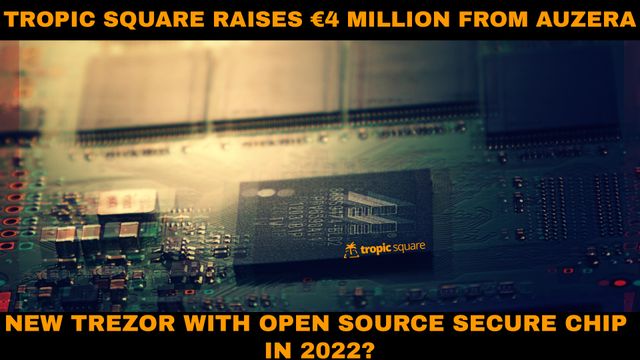
New Trezor hardware Wallet with Tropic Square Open Source Chip In 2022?
Tropic Square’s ambitious project to deliver fully transparent and auditable secure element chips is big news for the Bitcoin…
Tropic Square’s Open Source Secure Chip Begins Development
Back in May 2020, SatoshiLabs (the company behind Trezor, Invity, and Blockbook) has announced the launch of the Tropic Square…

Comments
Comments run on my own server. No trackers, no tracking cookies.