




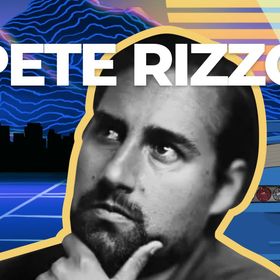
S15 E39: Pete Rizzo on Bitcoin History, Journalism & Culture
The audio keeps playing while you browse the site.
Read the transcript21,360 words, every line links to the minute it was said
Ask this episode
Pete Rizzo calls himself a Bitcoin historian, which is either the most natural job title in the world or the most suspicious one, depending on who you ask. Bitcoin is barely old enough to shave. Why would it need archives, Pantheons, and people digging through IRC logs at three in the morning?
Rizzo's answer flips the whole premise. "If you say hey Bitcoin history it kind of flips it on its head," he told me. Calling it history deems Bitcoin worthy of having one. People and events shaped it. That knowledge is not optional decoration for maximalist Twitter. It is how you stop confusing yesterday's outsider idea with today's sacred cow.
He is not a native of "Bitcoin land," as he put it. No libertarian pedigree, no cryptographer childhood. He came for the stories: early CoinDesk, later Bitcoin Magazine, content work for Kraken, and the public persona of The Bitcoin Historian. Somewhere after leaving CoinDesk he almost walked away from the industry entirely. Instead he spent years in the archives, contextualizing the fights he lived through and the ones he missed. This episode was my chance to put him next to the rest of the Magazine orbit I have been collecting this season, from Aaron van Wirdum on The Genesis Book to David Bailey on maximalism. History first. Culture second. Neither as tidy as the memes pretend.
Nobody Understands Bitcoin (And That Is the Point)
Jameson Lopp's line gets quoted until it means nothing. Rizzo treats it as a research brief. "Nobody understands Bitcoin I think that's true," he said, and his project is to make the path through the primary materials less miserable for everyone else.
When he joined in 2013, Bitcoin felt finished: a settled technology he would never touch. By the 2017 fork wars he had to build his own model of why he was still there. That took him backwards into mailing lists, IRC dumps, and the awkward realization that the people "driving Bitcoin forward" were often learning in public just like him.
The cultural fault line he keeps pointing at is change itself. Newer bitcoiners arrive locked into a certainty package. They were told what Bitcoin is, and they are having a hard time watching the understanding evolve. His lived experience is the opposite. "My experience of Bitcoin is in fact that it has actually always been changing," he said, "and that any change from that would be the change." Status quo is the learning curve. Ideology is the sales pitch that pretends the curve ended.
Outsider Ideas That Became Mainstream
Rizzo's favorite historiographic move is pinning one idea to one stubborn person. The block size limit is his best example. Today, questioning it can get you culturally fined. Historically, it was a minority view that had to be championed through consensus. "Bitcoin is a history of sort of outsider ideas becoming mainstream," he told me. The block size limit is simply the cleanest specimen.
That is also why he has been publicly defensive of Ordinals while half the timeline treats them like graffiti on a cathedral. He sees the same pattern: an outsider idea clawing into the mainstream through pain. The bull case is not that every JPEG is sacred. The bull case is that Bitcoin keeps absorbing heresies that later look obvious.
We walked through the Pantheon: Gavin Andresen, Mike Hearn, Jeff Garzik, Wladimir van der Laan, Pieter Wuille, Peter Todd, Luke Dashjr. Modern Twitter often collapses them into one vague "old guy" silhouette. Rizzo's complaint is specificity. People cheer Luke without knowing what Luke actually shipped, versus Wuille, versus van der Laan. Popularity without contribution maps is how myths replace history. For a different fork-era map of the same battlefield, my chat with Kurt Wuckert Jr. on the big block wars is a useful companion.
Primary Materials Beat Spook Stories
The fork wars left a residue of rumors. Gavin was a spook. Mike Hearn was a spook. Peter Todd worked for a Canadian military contractor, so maybe everyone is a spook if you squint hard enough. Rizzo's reaction was not to pick a team slogan. It was to download the IRC files.
"Preserving stuff in like an archive is much different than like writing a history," he said. Make the materials accessible so people can form their own opinion. He does not pretend every rumor is false. After sitting with the sources, he personally concluded that Mike and Gavin's preferred roadmap was less well reasoned than the other side. That conclusion came from homework, not from a HODL thread telling him what to think.
Eric Voorhees sits in his framework as a useful counterpoint who never left the conversation. Gavin and Mike exited; Eric stayed to defend himself. "I was a Bitcoin maximalist I am a Bitcoin maximalist," is roughly how Rizzo summarizes Eric's claim, with the twist that human freedom requires accepting other technologies Bitcoin does not provide. You can dislike the conclusion and still admire the consistency. Victors write stories. Archives are the check and balance.
Roger's Book, Libertarians & the Nine Sociologies
We both bought Roger Ver's book. We both hunted for spicy backroom details. We both came up mostly empty. Rizzo read most of it and filed it as "a Bitcoin Standard for the Bitcoin Cash perspective": public information reorganized into an explain-it-like-I'm-five of why the Bitcoin project "failed" and why BCH is the real thing. As anthropology, he wanted juicy stories. As market analysis, he shrugged. "If Bitcoin Cash was better than Bitcoin right then the market would at least say that."
The deeper cut is political taxonomy. Early libertarians, in his telling, forked away from modern maximalism. Roger, Charlie Shrem, Eric Voorhees: better a million cryptocurrencies for liberty than a monoculture that rejects them. "Modern Bitcoin maximalism like is not libertarian," he said, which is ironic given how hard the brand markets itself as liberty cosplay.
His three-axis sorter is blunt and useful: attitude toward Bitcoin, toward crypto, toward the state. Multiply positive, neutral, and negative on each axis and you get nine sociologies. The average 2021-2022 maxi, in his sketch, is pro-Bitcoin, anti-crypto, and neutral-to-positive on the state, including asking regulators to enshrine Bitcoin as specially valid. Eric's exit, as Rizzo reads it, was refusing to become so anti-crypto that he turned pro-state. That tension still runs the timeline.
Look at What They Do
If the ideology were consistent, actions would matter more than vibes. Rizzo's rant on Bitfinex, Tether, and Ordinals is the clearest section of the episode. Stablecoins on Lightning, Turing-complete experiments on Bitcoin, NFTs on Bitcoin: all three were "narrative infractions" under 2021 maxi rules. Reality imposed anyway. "Cry harder," as the meme goes.
Then the inconsistency. Tether can compete with Bitcoin's global settlement pitch, pay fees to other chains, fund their development, and buy Treasuries, yet stay socially safe if they say the right things at the right parties. Ordinals people say inflammatory stuff and get treated as attackers while, on-chain, they pay miner fees, onboard wallets, and stress-test edge cases. "It's almost like they're saying I'm gonna attack you but then you go to somebody's house and then you make them dinner," he joked. Demand, intellectual capital, and real capital are good for Bitcoin even when the marketing copy is rude.
The Berlin Wall Between Bitcoin and Crypto
His metaphor for the culture war is a Berlin Wall. He enjoyed the wall. He chose a side. He also remembers when there was no wall: Adam Back and Joseph Lubin on the same stage, civil, no two-minute hate. "The wall is coming down," he said. Intellectual capital and real capital are migrating to Bitcoin. Younger bitcoiners who never lived in undivided Germany have been taught to hate the East Berliners on principle.
He is old enough to remember Bitcoin Core developers contributing to Dogecoin, Viacoin, Litecoin, MimbleWimble. Allen Farrington's line stuck with him: Vitalik as Emmanuel Goldstein, Twitter as the two-minute hate. Rizzo interviewed Vitalik, Vlad Zamfir, Zooko. He cannot perform the required hatred at the volume the pulpits demand. Casey Rodarmor's crime, in that framing, was forcing maxis to admit crypto people are real humans who can use Bitcoin. For the cypherpunk mailing-list version of that older undivided culture, Perry E. Metzger on Bitcoin in 2008 still hits differently.
There is no cosmic bonus round for having "done the right thing" and avoided every altcoin. If Bitcoin wins, Chris Dixon still makes money. Vitalik still owns bitcoin. The Ethereum Foundation still owns bitcoin. "They won't be taken out into the streets," Rizzo said. Markets are not a morality machine that pays you extra for purity. Choose pragmatism or ideology. He chooses pragmatism, including a Trump-era world where Bitcoin and crypto arrive as one political blob whether your timeline likes it or not.
Luke, Radicalization & the Fork That Might Not Come
Luke Dashjr fills a void: champion against Ordinals, technical rhetoric, Ocean pool, Knots. Rizzo separates Luke-the-person from the social group that wanted a champion. His worry is radicalization. "They're the most likely to fork off," he said, because the dogma maps cleanly onto the old Bitcoin Cash checklist: Core is failing, Core is compromised, purity demands exit.
What stops them from rewriting consensus? "The economic majority does not support them." Mining on ideology instead of profit is a loss-making hobby with a timer. The sociological maxi thesis he steelmanned (Bitcoin is the culture of good people, not the tech) gets stress-tested either way. Culture matters. Culture is not a consensus rule.
Bitcoin Uncensored, Johnny Dilley & Chris DeRose
Before the monoculture hardened, Bitcoin Uncensored (Chris DeRose and Johnny Dilley) spent 2015-2017 interviewing the users companies pretended to represent: street workers, drug dealers, ATM operators. Their lasting contribution, in Rizzo's view, was busting the claim that BitPay, Coinbase, and the VC stack were consensus.
As CoinDesk editor he put them on the 2016 most influential list and lived to regret the meeting volume. "I was in more meetings about why I should have taken them off that list than pretty much anything I've ever had while I was at CoinDesk," he laughed. Unpopular then. Useful forever. Johnny Dilley receded into respect without being forced out. DeRose is harder to hear from, which makes him easier to forget. Rizzo still ranks DeRose among his favorite co-hosts of that era.
Maximalism's Two Success States & Ordinals as Art
His maximalism thesis is colder than the memes. Success state one: everything else goes to zero and only Bitcoin remains. Success state two: everything migrates onto Bitcoin. He is biased toward the second because "not everything in the crypto industry is the total scam," and because incentives already point that way. Even if you believe the scam thesis, you still have to manage a decade of scams trying to reposition on Bitcoin.
Casey Rodarmor gets the flowers the culture underpays. He did not ask Rizzo to shill Ordinals. He shipped software with intent to disrupt crypto culture, and it worked. "Even if you think NFTs are not art," Rizzo argued, "paradoxically Ordinals is the greatest piece of Bitcoin art," because art is human expression that forces critical questions: fee markets, block space, whether arbitrary data has value. Raising the questions is the art. Answering them is optional. Pair this with Casey himself on inscriptions and Bitcoin culture if you want the inventor's cut.
Bitcoin Is Tech, Ethereum Is Culture
One of Rizzo's preferred memes: "Bitcoin is a technology that is misunderstood as a cultural movement and Ethereum is a cultural movement that has been misunderstood as a technology." Ethereum-world wanted freedom from bitcoiners to tinker. Bitcoin's actual vehicle is the tech that plans to still be the tech in decades. The inversion explains a lot of mutual talking past each other.
We wandered into Amir Taaki and Mircea Popescu: early gravity wells, incomplete assimilation into polite historiography, anti-development vibes that aged into tragedy when the most formative years (2015-2017) happened without some of those voices. "If you have a formidable opinion on the crypto space," Rizzo said, "it's 90% likely that your opinion was formed during those years." For Amir in his own words, start with S12 E2 on the early days of Bitcoin and the later S17 E40 episode with Prof. Richard Werner.
Libbitcoin, Voskuil & "Bitcoin Is Crypto"
Near the end we tipped our hats to Eric Voskuil and libbitcoin: alternate implementations as another outsider idea the ideology has not fully digested. Bitcoin Core-as-Bitcoin is a live argument. Knots is another. Consensus-compatible multiplicity is decentralization with teeth, not a slogan.
Rizzo's cycle prediction has been stable for a year and a half. We are moving from "Bitcoin and crypto" to "Bitcoin is crypto": a reawakening that Bitcoin can compete in markets other cryptocurrencies claimed. He expects the cycle to end with Bitcoin, Solana, and Ethereum closer to parity, and with brain drain and capital drain still favoring Bitcoin even for non-ideological VCs. "We're moving towards the reunification of Germany," he said. Tear down the wall.
My hope matched his: less tribalism, more building. He added a corrective Westerners forget. Chinese CEOs already lived under carpet bans, house arrest, shuttered businesses. Draconian action is present tense elsewhere. Pretending NFTs "don't exist" on Bitcoin is the same category error as pretending that ban is future tense.
Pete Rizzo's beat is not nostalgia. It is refusing to let the victors' PowerPoint replace the IRC log. If Bitcoin keeps changing, the archive is how you notice. If the wall comes down, the archive is how you remember there was a time before it.
Listen to Pete Rizzo on Spotify, Apple Podcasts, YouTube, and More
Time stamps:
00:00:48 – Bitcoin's Historical Significance
00:02:09 – Bitcoin's Emergence and Pete Rizzo's Journey
00:03:40 – Challenges in Understanding Bitcoin's History
00:05:24 – Bitcoin's Ever-Changing Nature
00:08:12 – The Importance of Contextualizing Bitcoin's History
00:13:47 – The Battle Over Bitcoin's History
00:18:04 – Acknowledging Contributions and Controversies
00:21:16 – The fork wars
00:23:19 – Eric Voorhees' perspective
00:24:14 – Preserving and accessing primary materials
00:26:58 – Bitcoin maximalism and libertarianism
00:34:36 – Roger Ver's book on Bitcoin Cash
00:41:52 – The imposition of ideologies on Bitcoin
00:42:31 – Inconsistencies in Bitcoin ideology
00:42:57 – Actions and intentions of Bitfinex and Tether
00:45:38 – Perception of anti-crypto sentiment
00:46:28 – Berlin Wall analogy and Bitcoin culture
00:50:27 – Consensus and alignment within Bitcoin culture
00:59:45 – Emergence of new monoculture in Bitcoin
01:00:45 – Complexities of Bitcoin sociology
01:02:02 – Luke Dashjr and individualist perspectives in Bitcoin
01:02:49 – Luke's Defense
01:03:49 – Radicalization and Forking
01:04:37 – Bitcoin's Future
01:05:22 – Mining and Ideology
01:05:56 – Bitcoin Maximalism
01:06:44 – Scaling and Culture
01:07:47 – Bitcoin Users and Ideology
01:08:44 – Culture and Goodness
01:15:19 – Influence of Bitcoin Uncensored
01:19:05 – Bitcoin Maximalism Thesis
01:21:01 – Future of Bitcoin Maximalism
01:22:41 – The Bitcoin Takeover Podcast
01:23:29 – Casey Rodarmor and the Ordinals Protocol
01:24:26 – Bitcoin Art and Ordinals Protocol
01:27:16 – Layered Structure of Toxicity in Crypto
01:31:22 – Early Bitcoin Maximalists and Influential Figures
01:32:13 – Bitcoin as Technology vs. Ethereum as Culture
01:38:06 – Influence of Amir Taaki and Mircea Popescu
01:42:09 – Legacy of Mircea and Anti-Development Culture
01:43:31 – Acknowledging Mircea Popescu's Contributions
01:44:22 – Bitcoin and Economics
01:45:29 – Eric Voskuil and Crypto Economics
01:46:20 – Decentralization and Alternate Implementations
01:48:02 – Bitcoin's Role in the Crypto Market
01:50:30 – Tribalism and Political Impact
01:51:37 – Negative Political Action and Bitcoin
01:53:16 – Closing Remarks and Appreciation
Verify this episode
This is the SHA-256 fingerprint of the MP3 as published here, timestamped in the Bitcoin blockchain with OpenTimestamps. If one byte of the file changes, the fingerprint changes.
- SHA-256
ef3bf2839f17f84c9e3ea2ff1b6325cbea6ff7a2e3f431464b7876fee7550728- Proof
- 2024-05-30_s15_e39_pete_rizzo_on_bitcoin_history_culture.mp3.ots · all episode hashes (proof)
- Status
- Anchored in Bitcoin block 974,312
How to check it yourself
- Download the MP3 and the proof into the same folder.
- Run
sha256sum 2024-05-30_s15_e39_pete_rizzo_on_bitcoin_history_culture.mp3(on a Mac:shasum -a 256 2024-05-30_s15_e39_pete_rizzo_on_bitcoin_history_culture.mp3). The result must match the SHA-256 above. - Install the OpenTimestamps client (
pip install opentimestamps-client) and runots verify 2024-05-30_s15_e39_pete_rizzo_on_bitcoin_history_culture.mp3.ots. It hashes the MP3 again and checks the proof against your own Bitcoin node, then prints the block and the date the file existed by. Without a node,ots info 2024-05-30_s15_e39_pete_rizzo_on_bitcoin_history_culture.mp3.otsshows the block height to look up in any block explorer.
Related
S17 E13: Charlie Spears on Blockspace Media, the Purity Spiral & the Case for Classical Maximalism
Editor’s note: this conversation was streamed live in mid-March 2026, a week after the US switched to daylight saving time (which…
S17 E11: John Carvalho on Bitcoin Depression, Lightning Derangement & the Atomic Economy
John Carvalho was the second guest in the history of this podcast, way back in season one, episode two, when he was…
S15 E33: David Bailey on Bitcoin Maximalism, Ordinals & the Biggest Stage in Bitcoin
David Bailey on Bitcoin maximalism, Ordinals, OP_CAT vs CTV, high fees, BitVM, Tether and Bitcoin Conference boycotts, plus a…

Comments
Comments run on my own server. No ads, no trackers.