




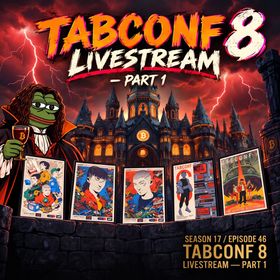
S17 E46: Livestream from Tabconf 8, Part 1 (feat. Paul Sztorc, Andre Beganski, Alex Lewin, Janusz, Christopher Allen, Will & Michael Tidwell)
The audio keeps playing while you browse the site.
Read the transcript25,868 words, every line links to the minute it was said
Ask this episode
There is a funeral happening in the room behind me, and I am not attending it. That was more or less the thesis of this livestream, recorded on October 14th 2026 in the hallway of the Georgia Tech Exhibition Hall in Atlanta, during TABConf 8. Michael Tidwell had already announced that this eighth edition would be the final one, and while he was holding the Town Hall (which everyone, including him, ended up calling the obituary), I parked a tripod under a giant ecash.com banner and grabbed anybody who walked by with something interesting to say.
What followed was 2 hours and 40 minutes of conference-floor chaos: Paul Sztorc demoing quantum-resistant signatures twenty days before his hard fork, a journalist who just swapped Decrypt for MARA, a private AI engineer and a private money builder finding common ground, a cypherpunk who wrote the reference implementation of SSL 3, a man with a list of six people he wants out of federal prison, and finally the organizer of the funeral himself, Michael Tidwell, who walked out of his own wake to sit next to me. My camera died eleven minutes in. The webcam saved the day. You cannot script this, and I would not want to.
Quick housekeeping: this was a live, unedited stream with mics changing hands, people wandering in and out of frame, and comments coming in from the chat. Sponsors for the trip were Cake Wallet, Braiins Hashpower (who paid for my hotel), SideShift.ai (who paid for my plane ticket), Orange Rock and LayerTwo Labs. Nobody paid to be interviewed, and nobody got editorial approval.
Paul Sztorc and the Quantum Soft Fork Nobody Will Run
The first guest was the obvious one, because the backdrop was literally his poster. I introduced Paul as a man “less than 20 days away from launching the masterpiece of his life,” and he immediately downgraded himself: “The worst. Well, okay. We’ll see. That’s for historians to judge, you know?”
He came with a tech demo on a laptop screen that nobody watching could see (we promised screenshots). It was CUSF 2, the second “Core Untouched Soft Fork,” his way of doing soft forks “without changing any lines of code in Bitcoin.” The first one was BIP 300/301 for drivechains. The sequel packs four features: “We have four different quantum resistant signature options.
Two hash, two lattice.” On top of that, OP_VAULT, OP_CTV (the opcode Jeremy Rubin spent years trying to get into Bitcoin, as he told me in S17 E22), and OP_CAT. Scroll to the bottom of the wallet and you get a button that says you can “sweep your coins into a quantum-resistant UTXO.” His words to Nic Carter and the quantum alarm crowd: “problem solved right here.”
It ships in the next version of BitWindow. The catch is that it does nothing on BTC unless a majority of hashrate runs the extra piece of software next to Bitcoin Core, which “should cost them basically nothing.” So when will miners do it? “Never. A million billion years.” Why? “Because they’re all spineless. Spineless cowards with no leadership skills. Or some other reason, I’m sure.” I asked whether the whole point of Bitcoin is not having leaders. “In this case, no.”
On whether quantum is real or a scam to sell vapor hardware, I framed it as Pascal’s Wager: if quantum is fake, we optimized for nothing; if it is real, we had better be ready. The idea that the fix can wait until 2029 or 2032 got called “super overconfident and cocky” on air, because “it just implies that Bitcoin has no competition and nothing else can happen,” while the Zcash side is picking up network effects and some of the VCs who used to back Bitcoin.
Paul ran down the list of use cases that drifted elsewhere: memecoins on Solana, darknet markets on Monero, stablecoin volume that “was originally a Bitcoin project” and now lives off Bitcoin. “So yeah, we could have had all that on Bitcoin this whole time, but instead we have this belief in Bitcoin’s infallibility.” He even recruited Greg Maxwell into the argument, paraphrasing the idea that believing Bitcoin cannot fail is the most likely way for it to fail. “Join our club of Vlad, myself, and Greg Maxwell.” I pointed out that I do not go to the same clubs as Greg Maxwell.
Then the camera died. I switched to the laptop webcam, the angle went crooked, and the room produced the line of the hour: “It’s crooked just like Bitcoin Core.”
Soft Forks Are Reversible, Free Coins Are Free
Back on topic, Paul’s eCash hard fork is the pressure valve for all of the above. As I pitched it on air: “not mandatory, just take free coins and do whatever you want.” Paul’s addition: “that’s the fun part that you don’t have to pay anything.” If you already hold bitcoin, you can claim your eCash and “see what Bitcoin could have looked like if we didn’t have so much of the bad culture, which is against changing anything.” (If you need the backstory, I wrote a whole piece on it: eCash (ECX): Paul Sztorc Forks Bitcoin to Prove a Point, and Paul explained the launch plan in S17 E37.)
His frustration with the soft fork stalemate is that nobody gives him a reason. Soft forks, in his view, are “opt-in, ignoreable and reversible. And yet we can’t do that.” He had just given a 15 minute talk followed by 45 minutes for the audience to disagree with him, and complained that people mostly agreed: “To me, that seems like more evidence that it must be right.” When I brought up the Luke Dashjr argument that every soft fork eventually becomes mandatory, Paul answered with a language analogy. Nobody is forced to use a new word like “Kafkaesque.” It only spreads if people like it. “That whole eventually part of it is doing a lot of work.”
We took questions from the chat. Someone asked how to claim the coins and joked about how much Michael Saylor would get. Paul’s guess, which he labeled as an assumption: “Well, Saylor doesn’t self custody, I bet.” That reminded me of my conversation with Mike Belshe of BitGo, a company that started with self-custody tools and became one of the largest custodians in the space. The claiming process itself is simple: download the software, it syncs the BTC history, and “an equal number of coins will be waiting for you there.” From there you can split and move them independently.
I also asked Paul about exchange listings, because he refuses to pay for them. His alternative is liquidity pools: “Why spend money to get listed on the exchange? You can add the liquidity.” Whoever fronts the capital earns the trading fees, and the market starts before the network even launches. “Let’s just see who just lists it anyway.”
Midway through, Shinobi walked through the frame. I noted on air that he “still thinks that using Coldcard is a good idea,” while I was wearing a Coldcard around my neck as a trophy for being right about that device. Then Paul left for the Town Hall, and I went fishing for the next guest.
André Beganski on Leaving Decrypt and Journalism as a Public Good
The next person to take the mic was André Beganski, who introduced himself as “a senior content manager at MARA,” at the newly launched MARA Foundation, after a long run as a reporter at Decrypt. I told him I always respected Decrypt’s reading progress bar that made finishing an article feel like a small victory, and I also told him that back in 2018, when I was at a competing outlet, I respected Decrypt for keeping its integrity, “the Block not so much. No offense. I mean, yes offense, get offended.” André, ever the professional: “You’re not going to get a hot take on that.”
He walked me through DL News, the media arm of DeFi Llama, which he praised for going “deeper than anybody else into the technicals” of rollups, like whether there is an escape hatch to pull funds back to L1. I countered with my own war story: Blockworks once wanted me to give up Bitcoin Takeover for a show of theirs called Supply Shock. “I don’t think there’s an amount of money that you can pay me that’s gonna make me quit my dream project,” I said, for a gig that might get shut down in six months. Which, I noted, is roughly what happened.
André told me about a new print crypto magazine called The Ledger, whose first issue has Jeff Benson interviewing sourdough bakers about crypto. He admitted it probably will not win a Pulitzer, but “it’s insightful and it’s entertaining.” In return I handed him a copy of my own BTCTKVR: Forks! magazine, which became his reading material for the flight home.
The serious part of our chat was about the economics of independent media. In the first three or four seasons of this show, I made nothing; Bitcoin Magazine paid the bills. Today I cannot imagine stepping away, and I joked that I am glad I did not become “a mediocre coder right now in C++,” because storytellers are harder to replace with AI.
André pushed it further: “What really separates good publications from bad publications is original news.” Everybody on Twitter repeats the same headlines. Real investigation takes weeks. “I think journalism is a public good if it’s done the right way,” he said, and he called the hype-driven corner of the industry “a product of financial nihilism.”
I told him I do have sponsors rolling at the bottom of the screen and I send them the stats, and if they do not like the numbers, they can drop out. That is the whole arrangement.
Alex Lewin on Private AI, Fedi & Why Privacy Is About Other People
While Orange Rock got its sponsor read (trade without KYC, and please do not gamble with leverage, I cannot endorse that), a new guest sat down. I opened with my line about not attending the funeral, and the nuance arrived right away: “It might not be dead,” since there is a real chance Tidwell gets bored and does it again at some point. “But hello, my name is Alex.”
Alex Lewin works at Finite, “a company called Finite that’s working with organizations like HRF to help them with their sovereign AI strategies,” building privacy-preserving agents and training activists. Before that he spent two and a half years at Fedi, before that Blockspaces, and before that NCR on their Lightning work. He is from Atlanta, moderated BitDevs Atlanta, gave a talk earlier that day, and was playing Capture the Bitcoin. “It’s an honor that everybody comes to our home to hang out and talk about Bitcoin.”
When Janusz (more on him below) joined the table, I asked them to find the overlap between private AI and private money. Alex gave the cleanest answer about why he cares: “Privacy is not that important to me personally as much as it’s an important ingredient for liberty. In order to be free, you have to have privacy.” If you live under a less free government, he added, “privacy is a heck of a lot more important.” My own angle was fungibility: an open internet currency cannot discriminate between coins from Russia and coins from South Africa without fragmenting the internet into camps.
Asked what still makes him bullish after a bruising year, Alex said Bitcoin is the only cryptocurrency “that really can’t be changed by a single-digit number of people,” and that its value proposition has not changed, even if “we’re living in spooky times. It’s hard to write open-source software when all the bugs that are in the software will be found and exploited.” He also had an honest moment about AI. Parroting Rob Hamilton, who had just been on stage, he said AI “is going to make Bitcoin better, not worse,” and admitted he went through “a bit of an existential crisis as a software engineer” when his hard-won skills seemed to become obsolete, until the framing flipped: a software engineer with AI tools is more productive, not less valuable.
When I asked about his favorite fork, he would not play along with anything but Bitcoin: “Cryptocurrency in my opinion is only valuable if it’s incredibly decentralized, incredibly incorruptible, and Bitcoin’s the only one in my opinion that has that property to a degree at which I believe in it.” On claiming forked coins, he was equally conservative: “I do not think it’s worth the quick buck to touch on your cold storage.” And if Bitcoin went to zero tomorrow? Three words: “Pivot to AI.”
Janusz on Zark, Zcash Primitives & the Free Market of Privacy
Janusz, who goes by @januszg_ and builds LX, arrived with a project name that was practically designed to troll Ark maximalists. I kept calling it “private Ark.” It is not an Ark. “It’s kind of a joke,” he admitted. He wanted to rename it out of fear that people would be upset, but his co-founder said to keep it. The original idea “was based on like Mercury,” and then the name wrote itself: “Zcash plus Spark equals Zark.” His write-up is Introducing Zark if you want the technical version.
I asked him the clip-worthy question: why bring Zcash privacy to Bitcoin and not Monero privacy? He said he is a fan of both, but that the framing is wrong. “We don’t really want to bring Zcash per se to Bitcoin. I think we want to take the primitives that were developed in that ecosystem that are very useful and can be applied to Bitcoin.”
The goal is a free market of privacy solutions with different trade-offs. He explained the mental model clearly: Monero hides amounts with Bulletproofs and hides senders with ring signatures, making you one of 16 decoys. Zcash’s Orchard pool publishes “a complete black box of unlinkable hashes,” so your anonymity set is everyone in the pool. Applied to Bitcoin, L1 becomes the savings account and this kind of protocol the spending account.
I argued that Zcash, with Tachyon on the horizon, is trying to scale privacy, while Monero’s FCMP++ will make transactions heavier, and that Zcash shares Bitcoin’s code ancestry while Monero comes from CryptoNote and Bytecoin. Janusz was more diplomatic: “We’re in the first inning of research,” and Monero will probably explore L2s too. Even Tachyon cannot escape the historical set of nullifiers that has to be kept forever.
Then he said something I did not expect from a former Zcash contributor. On the recent Orchard bug (covered in depth with Josh Swihart in S17 E28), the soft fork to pause Orchard transactions was coordinated so fast that some major wallet providers did not know it was happening. “What’s to say that coordinating and doing something to, for example, just shut off a pool for whatever reason because some person used it?”
That is exactly why he builds on Bitcoin, even when it is painful. If Bitcoin had a native SNARK verifier, he said, we would never even have these discussions about things like BitVM and witness encryption, and working within those limited constraints is “just a fun thing to do.” As someone at the table summed it up moments later: “Only Bitcoin is stubborn enough to, rather than upgrade itself with something simple, we force ourselves to invent witness encryption to get a feature we want.”
This was his first TABConf, which gave him the best answer to my funeral question: “For me it’s not a funeral because it’s my first one. It’s just a party.” On the fork airdrops, he echoed Alex on not touching his cold storage, but said he would “probably try to acquire some tokens with Paul’s work and play around with it,” especially the Zcash-style drivechain that Paul has always used as his canonical BIP 300 example. If Bitcoin went to zero, he would take a break and “figure out what to do next. I don’t know what I would do.”
Interlude: AI Psychosis and Why You Should Show Up
Somewhere between the privacy talk and the fork talk, the table drifted into the strange mood of 2026. Somebody confessed, “now we’re all in AI psychosis and we’re just clanking all day and prompting our clankers,” without a single meeting in three weeks. I compared it to Europeans discovering coffee and tobacco, and admitted that I have an AI agent that gives me 15 minutes of website fixes every day and keeps a backlog of what I ignored. “Am I working with AI or am I working for AI?”
The conclusion we all agreed on: you can build anything in 15 minutes now, but “just the fact that you made it, it doesn’t mean that anyone will care.” Showing up is what makes people care. The moral of the story, delivered straight to the camera: “Unless I see your face here, I’m going to assume that you’re AI on Twitter.” Followed by a correction from the peanut gallery: “Unless they’re my talks, okay? I want to see a full auditorium.” Paul, back at the table by then, believes he has spoken at all eight TABConfs (“I think I did the keynote maybe twice”). Which prompted the obvious accusation that Paul killed the conference by speaking too often.
Christopher Allen on Randomness, Multisig & the Coldcard Lesson
I had been trying to get Christopher Allen on the show for about three years, and only managed to meet him in Atlanta. He is a legendary cypherpunk, the founder of Blockchain Commons, and as of today “Bitcoin is still my financial reserve.” These days he works lower in the stack: “How do we secure our keys? How do we create systems that are more reliable?” A lot of what went wrong in the past year, he said, was stuff he had been warning about for a while.
His warnings go back to Netscape. When SSL was new and VeriSign was the only certificate authority, servers needed a security review of their randomness before getting a certificate, and his company was the only one willing to do those reviews. “Over half of the software servers that were submitted to us, we in an hour or two found fundamental problems with randomness.”
VeriSign eventually gave up and switched to self-certification. That is why Blockchain Commons built LetheKit, which lets you create seed words offline with dice. But you can only do so much security on chips, so his real advice is structural: “The real solution is not to rely on any single key.” Legacy multisig, MuSig, FROST, heterogeneous key generation.
Their SmartCustody work in 2022 laid out a checklist that takes about an hour. People did not take the hour, and Christopher puts the blame on “the wallet companies of being very narrow,” adding: “We could’ve solved these problems years ago,” and then it “wouldn’t have mattered that Coldcard had a bug.”
I said I felt bad for the victims, who did everything they were told and still lost their funds. Christopher’s criticism of Coinkite was about culture: “I felt like the Coldcard Coinkite team kind of pulled away from the open source community.” He described them building on open source code and later closing it once others started using theirs, which removed any incentive for other teams to review it.
I added my own grievances about how researchers were treated (mugs and t-shirts instead of bounties, downplayed severity). Christopher was more measured on bounties, noting that LLMs are flooding the world with obscure CVEs and many communities cannot afford programs, but drew the line at the withdrawal from shared work: “Bitcoin started as open source.
Satoshi believed in it.” His design mantra is worth framing: “We want no single points of failure, no single points of compromise. Also important is no single points of denial.” That last one is why Blockchain Commons does not recommend BIP 38, after too many people locked themselves out of their own funds.
From RSAREF to TLS 1.0, DigiCash and a UTXO That Revokes Certificates
Then I asked how a cypherpunk who worked on SSL ended up in Bitcoin, and got a history lesson I will happily replay. Christopher’s company was the only organization in the United States besides RSA Data Security that could license the RSA patent through RSAREF, which was free as long as you made less than half a million dollars. That put them on the ground floor with Netscape. “I led the community around creating that standard, writing the reference implementation, and then kind of leading it through the IETF process where it ultimately got renamed TLS.” TLS 1.0 is the culmination. TLS is now the world’s dominant security protocol.
He worked with David Chaum on DigiCash before Chaum moved to the Netherlands, later became CTO of Certicom, and tried to launch a micro-currency in 2000 or 2001. Patents killed it: the Merkle patent blocked Merkle trees and timestamping, and he wanted Schnorr signatures for their aggregation powers, which were also patented. That patent is why we got ECDSA, and why NIST’s secp256r1 curve carries suspicions about where its constants came from, which is also why Satoshi picked secp256k1, with its small, obvious “nothing up my sleeve” numbers. Taproot finally brought Schnorr to Bitcoin.
When the whitepaper circulated in 2008, it looked like “another one of these proposals of many.” He only dove in around 2013, and the appeal was “its ability to do censorship-resistance,” not investment. His first Bitcoin project was using UTXOs to revoke X.509 certificates: tie a certificate to a UTXO, spend it, and within minutes the whole world knows it is revoked. “That became kind of the first prototype of the decentralized identifier.” That led to the DPKI paper (Vitalik was among the authors, he noted), the Rebooting the Web of Trust gatherings twice a year until COVID, and eventually the DID standard.
Paul came back to the table and Christopher brought up his biggest beef: “We’ve been saying since 2005 or earlier, don’t reuse keys.” Satoshi built that principle in, and yet Ethereum derives from one private key and Nostr uses one private key, which is “really hard to pry out of the bottom of Nostr.” Paul’s defense of the habit was practical: one key pair per identity, multiple identities. “You have Dread Pirate Roberts and then you have Ross Ulbricht.” Christopher had to leave, and promised a part two. I am holding him to it.
Will on Six Privacy Prisoners and 21 Days Before the Midterms
Paul then handed his mic to someone with, in his words, “a very important message”: “Time is of the essence, we only have like 21 days before the midterm election.” The guest introduced himself only as Will, and he had a list. “I’ve been concerned about the grotesque injustice that has been forced on a number of privacy stalwarts, as I’ve given to calling them. There are six cases that I’m aware of.”
He went chronologically. First Larry (most likely Larry Harmon of the Helix mixer), still in federal prison for operating a custodial mixer years ago. Then Ian Freeman, who ran a few Bitcoin ATMs in New Hampshire. Then Roman Sterlingov, the Swedish-Russian dual national accused of operating Bitcoin Fog, whose case Will thinks few people know about because Roman Storm dominates the news.
Will’s claim is that Sterlingov was only a user, and that “the only evidence they were able to produce at trial was this crap from Chainalysis clustering.” He was arrested at LAX in April 2021 on his second visit to the US and denied bail partly because he held four valid passports (Russia issues internal and international passports, and Sweden, like some other countries, issues a second one for travel conflicts).
Next came Roman Storm of Tornado Cash, convicted on the unlicensed money transmitting charge while the jury hung on the two money laundering counts. “So how the hell is he guilty of operating an unlicensed money transmission business? He is not,” Will said, citing FinCEN’s own guidance on non-custodial software. (For more on that trial, see S17 E20 with Amir Taaki, Harry Halpin and Christopher Cialone.) Last, the two Samourai Wallet developers, Keonne Rodriguez and William Lonergan Hill, arrested in SWAT-style raids despite “no criminal record and no history of violence.”
In Will’s account, prosecutors asked FinCEN in the fall of 2023 whether Samourai was a money transmitter, were told it was not, and withheld that from the defense. He also described the judge being changed shortly before a key motions hearing, all motions denied without explanation, and the developers accepting a plea of five and four years plus heavy financial penalties. He recommended reading Keonne’s letters from prison.
The ask: pressure President Trump, “who has pardoned far less deserving people, to issue full pardons with restitution.” Paul jumped in with the political angle, pointing to Aaron Day’s StarkFreedom PAC, which funds third-party Senate candidates in tight races. His pitch was blunt: “If Trump wants this project killed, he should free” them, and people on the left could earn goodwill by promising the same. Then Paul admitted the 21 days figure was improvised: “I’m just making that number up, but we only have a few days.”
Michael Tidwell Walks Out of His Own Funeral
The closing act was the man himself. After someone in the crowd nominated “Roast beef? He’s a very fast talker,” I spotted Michael Tidwell, the organizer of TABConf and of Bitcoin Atlanta, and he came over straight from the Town Hall where he had just eulogized his conference.
First I asked about the Tabbies, the forgotten idea that showed up in his Town Hall slides. “Like the Tonys, the Oscars,” he explained, an award ceremony where “if you got a Tabbie, it’s like a big deal.” Robin Linus got one. They handed out three per year for three years, with guest presenters like Andrew Poelstra and Paul opening the envelopes.
Then the big question: why kill TABConf? “It’s just saturation. That’s like the number one reason. There’s just too many Bitcoin conferences.” Was it David Bailey? “No, not really.” It was “death by a thousand cuts”: Bitcoin++, OPNEXT, Prague, Lugano, and every hometown event people do not want to miss.
He announces dates a year in advance, and other organizers still book over him, which he does not hold against them since he is “also a hypocrite” who enjoys those conferences too. This was my first TABConf, after years of sending magazines and almost making it, and I told him I would have come even if it were not the last one.
On Paul’s eCash, Michael called it “the least dramatized hard fork, the most kosher calm hard fork in recent memory,” and wondered how a fork without emotional stigma will do when people vote with their feet. On drivechains, he described the game theory Paul’s critics keep raising (miners will just steal), and said that if the experiment proves miners constantly steal, it is “a finished experiment.” I had my own mixed feelings: drivechains were supposed to drain the altcoin market of use cases on Bitcoin, and now they launch on a different network.
Debates, No Shilling & How TABConf Got Scammed in 2019
Michael’s TABConf was always a tent for heretics. The BTC versus BCH versus BSV debate (we argued about whether that was 2018 or 2019, and he corrected me: 2019) came from a simple motive: “I don’t want to shrink the Bitcoin community. I want to grow the Bitcoin community.” He even wanted Dash and Monero people in the fold, and said “the Monero people are probably the most reasonable.”
We remembered Amanda B. Johnson and Evan Duffield presenting DarkCoin at a Bitcoin Atlanta monthly meetup. During the ICO craze, the rule was strict: “You can have stage time, you have to answer your questions, you’re not allowed to shill.” And of course, Paul was always “debating someone,” including the famous Peter Todd debate.
Then the trivia I asked for, which he warned was “kind of funny in hindsight, but it’s not funny.” In 2019, trying to save money on catering, he hired a community member who had been coming for a year, wired $10,000 for three days of lunches to a business name that was not the guy’s own, and got bread “with like a slice of cheese and one slice of turkey.”
A few days later the woman who actually made the food called asking to be paid her $1,000. “If you gave me ten thousand, I could have actually gave you real lunches.” The guy, Bobby, pocketed the rest. “And that’s how TABConf got scammed in 2019.” As I put it: it is not just the ICOs and the memecoins, it is also the food people.
He always wanted Greg Maxwell to come, and was surprised Matt Odell never did, “just because he’s really close, like geographically.” Nick Szabo, on the other hand, “never gave me the time of day,” so he could care less. He told me the obituary was held a day early as a deliberate experiment, because around 100 people would leave that night and he wanted as many in the room as possible.
His two favorite memories: the hardcore trivia for BitDevs where people argued about “what was the byte of this sighash flag,” and the standing ovation that ended the Town Hall minutes earlier. “I was like, what do I do? Do I just stand here and walk off? Like, do I wave?” I missed it because I was livestreaming, which feels like the most Bitcoin Takeover sentence possible.
Bitcoin Is Not My Religion, Taproot Is My Favorite Fork
We also covered Atlanta lore: Rassah of Mycelium landing his plane at an airport meetup barbecue and blowing the food off three or four picnic tables with the propellers, Stephen Pair of BitPay coming to TABConf, and Jeff Garzik living in Atlanta for years without showing up. Michael also floated a “Kill Tidwell” comedy format inspired by Kill Tony, one minute per comic, because “Bitcoin has so much drama and memes and people that are constantly online that the memes never stop.”
When I asked his favorite fork (no BTC allowed), he picked a soft fork: “I would say Taproot soft fork was my favorite.” Why? “I love using Taproot. I think it’s great. I think it’s super underutilized.” All the TABConf puzzles are Taproot-related now. Hard forks?
“I like all the hard forks.” To him, the ability to fork is Bitcoin’s nuclear option: “You need hard forks in order to keep everyone in line with the right incentives.” If you think a fork can kill your bitcoin, he asked, “then are you really a bitcoiner?”
His summary: “Bitcoin’s not my religion.” He explained it with a thought experiment about a yellow metal with all of gold’s properties plus one extra, and people who reject it only because it is not gold. Making technology your religion “makes you irrational to evaluate alternatives.”
We disagreed on one thing. I argued for putting a small slice into airdrops and forks you believe in. He thought that is just risk cutting the other way: chase the Luke Dashjr coin or eCash for a 100x and “you’re becoming the most irrational VC possible.” Will he dump his own eCash on October 31st? “No, I’m not gonna dump it. I didn’t dump my Bitcoin Cash.” Then his phone rang, and I let him go with the highest honor I can bestow: my third favorite Michael, after Michael Jordan and Michael Jackson.
Not a Funeral, an Evolution
Somebody at the table said it best near the end: “This is not the death of TABConf. It’s the evolution of TABConf.” The hallway proved it. I flew 17 hours for this, my camera quit, I improvised a setup from two trips to Best Buy and one to Target, and I still came out with one of the most fun episodes of the year. If you missed the talks inside, they will be on YouTube. The conversations outside will not be, unless someone like me is standing there with a tripod. And if you want to dig deeper into the forks we kept mentioning, start with What the Fork?! and the story of Luke’s Bitcoin BLAKE2b fork.
Listen to Paul Sztorc, André Beganski, Alex Lewin, Janusz, Christopher Allen, Will & Michael Tidwell on Spotify, Apple Podcasts, YouTube, and More
The hallway did not stop on day one. For day two, with Kevin Loaec, Ekrem Bal of Citrea, Spaces Protocol and The Bitcoin Pivot, continue with S17 E47.
Time stamps:
1:55 Welcome to Bitcoin Takeover at TABConf 8 with Paul Sztorc
2:30 CUSF 2 demo: quantum-resistant signatures, OP_VAULT, OP_CTV & OP_CAT
4:30 Sweeping coins into a quantum-resistant UTXO with BitWindow
5:05 Why miners will never run it
5:52 Is quantum FUD? Pascal’s Wager & Saylor
7:50 Bitcoin’s overconfidence & the competition
8:41 How altcoins took Bitcoin’s use cases
10:17 Greg Maxwell & the belief in Bitcoin’s infallibility
11:39 Camera dies, webcam to the rescue
12:30 eCash hard fork: free coins later this month
13:08 Soft forks are opt-in, ignorable & reversible
14:35 Kafkaesque: will soft forks become mandatory?
16:01 Live questions: claiming eCash & does Saylor self-custody?
16:46 Mike Belshe, BitGo & custodians
17:48 The war on crypto, PGP & Enigma
18:44 How to claim your eCash coins
19:13 Liquidity pools instead of paying for exchange listings
21:37 Shinobi walks by & the Coldcard trophy
21:50 Paul leaves for the Town Hall
22:34 Spotting Christopher Allen & sponsor thanks
24:14 André Beganski joins: from Decrypt to MARA Foundation
25:25 Decrypt, The Block & trade publications
25:57 DL News & DeFi Llama
26:49 Blockworks’ offer & Supply Shock
27:43 BTCTKVR: Forks! magazine
28:10 The Ledger magazine & sourdough bakers
29:43 Going independent: Bitcoin Magazine vs Bitcoin Takeover
30:30 Storytellers vs AI
32:13 Original reporting & journalism as a public good
33:54 Sponsors & transparency
34:36 Camera battery woes & how to follow André
35:50 Orange Rock sponsor break
37:55 Alex Lewin joins: Finite & private AI
38:47 Fedi, Blockspaces & NCR
39:28 Atlanta, BitDevs & Capture the Bitcoin
40:14 Janusz joins: Zark = Zcash + Spark
41:38 Private AI meets private money
43:35 Privacy as an ingredient for liberty
44:03 Fungibility & a universal currency
45:21 Why Zcash-style privacy and not Monero?
47:05 Shielded pools vs ring signatures
49:44 Scaling privacy: Tachyon vs FCMP++
51:18 The first inning of privacy research
53:56 A bearish year: what still makes you bullish?
56:23 AI will make Bitcoin better, not worse
57:46 Why aren’t you at the TABConf funeral?
58:50 The hallway track & why showing up matters
1:00:48 AI psychosis & conferences
1:01:36 Coffee, tobacco & AI as a productivity drug
1:03:08 Forks magazine handout
1:03:46 Atlanta’s BeltLine
1:04:52 Favorite conferences: Bitcoin++ & Nashville
1:06:12 The Town Hall & the Tabbies
1:06:47 Paul has spoken at all eight TABConfs
1:07:43 Favorite fork? Bitcoin vs Zcash
1:09:22 The Orchard bug & a coordinated soft fork
1:11:29 Only Bitcoin is stubborn enough to invent witness encryption
1:11:59 Two hard forks this year: Luke’s coin & eCash
1:12:40 Fork strategy: don’t touch cold storage
1:13:43 Zcash as a BIP 300 drivechain
1:14:52 If Bitcoin goes to zero
1:16:13 Christopher Allen joins
1:17:40 Randomness warnings & VeriSign security reviews
1:19:32 LetheKit & dice entropy
1:20:00 Don’t rely on any single key: multisig, MuSig & FROST
1:21:00 Wallet companies & the Coldcard victims
1:22:34 Coinkite, open source & closing the code
1:24:15 No single points of failure, compromise or denial
1:25:08 How Coldcard treated security researchers
1:26:36 Bug bounties in the age of LLMs
1:27:51 Cypherpunks who embraced Bitcoin
1:28:45 Netscape, SSL 2 & the RSAREF license
1:30:18 Writing the SSL 3 reference implementation & TLS 1.0
1:30:47 DigiCash & David Chaum
1:31:29 Certicom, micro-currencies & the Merkle patent
1:32:03 Schnorr patents & ECDSA
1:33:10 secp256r1 suspicions vs secp256k1
1:35:44 Discovering Bitcoin in 2013
1:36:08 UTXOs to revoke X.509 certificates
1:37:08 Decentralized identifiers & DPKI
1:37:37 Paul Sztorc returns: Rebooting the Web of Trust
1:38:32 Namecoin
1:38:59 Christopher’s beef: key reuse in Ethereum & Nostr
1:40:30 BIP 32 & one key pair per identity
1:41:19 Christopher promises a part two
1:42:46 Paul introduces Will: 21 days before the midterms
1:43:35 Will on six privacy prisoners
1:43:59 Larry Harmon & Ian Freeman
1:44:45 Roman Sterlingov & Bitcoin Fog
1:47:32 Roman Storm & Tornado Cash
1:48:19 Samourai: Keonne Rodriguez & William Hill
1:50:59 The judge switch & the plea deals
1:54:25 The pardon campaign
1:55:42 Aaron Day’s StarkFreedom PAC
1:58:52 Michael Tidwell joins
1:59:42 The Tabbies
2:01:29 Why TABConf 8 is the last one
2:02:01 Death by a thousand cuts
2:03:51 My first TABConf & thanking the sponsors
2:05:27 eCash: the calmest hard fork in memory
2:07:16 Will miners steal from drivechains?
2:08:15 TABConf debates: BTC vs BCH vs BSV
2:09:06 Monero, Dash & bringing people into the fold
2:09:51 Amanda B. Johnson & DarkCoin at the monthly meetup
2:11:55 No-shill policy during the ICO craze
2:12:50 Paul Sztorc’s TABConf debates & Peter Todd
2:14:08 How TABConf got scammed in 2019
2:17:58 Greg Maxwell, Nick Szabo & who never came
2:19:45 Why the obituary happened a day early
2:20:31 Forks magazine
2:21:20 Top highlights: hardcore trivia & the standing ovation
2:23:40 What will Michael do with his eCash?
2:24:00 Kill Tidwell: Bitcoin comedy
2:25:12 Matt Odell never came
2:26:13 The first Bitcoin car & Rassah’s plane
2:27:36 Atlanta lore: Jeff Garzik, Stephen Pair & BitPay
2:29:42 Bitcoin is not my religion
2:31:01 Favorite fork: Taproot
2:32:45 I like all the hard forks
2:35:24 Diversifying into airdrops: the most irrational VC
2:38:47 Goodbye Michael & wrap-up
Verify this episode
This is the SHA-256 fingerprint of the MP3 as published here, timestamped in the Bitcoin blockchain with OpenTimestamps. If one byte of the file changes, the fingerprint changes.
- SHA-256
06dee99b1131d3a85daa75987be89ec695a35eeece2a4905b590d9e08bd7babd- Proof
- 2026-10-15_s17_e46_livestreaming_at_tabconf_8_feat_paul_sztorc_christopher_allen_michael_tidwell_more.mp3.ots · all episode hashes (proof)
- Status
- Anchored in Bitcoin block 974,312
How to check it yourself
- Download the MP3 and the proof into the same folder.
- Run
sha256sum 2026-10-15_s17_e46_livestreaming_at_tabconf_8_feat_paul_sztorc_christopher_allen_michael_tidwell_more.mp3(on a Mac:shasum -a 256 2026-10-15_s17_e46_livestreaming_at_tabconf_8_feat_paul_sztorc_christopher_allen_michael_tidwell_more.mp3). The result must match the SHA-256 above. - Install the OpenTimestamps client (
pip install opentimestamps-client) and runots verify 2026-10-15_s17_e46_livestreaming_at_tabconf_8_feat_paul_sztorc_christopher_allen_michael_tidwell_more.mp3.ots. It hashes the MP3 again and checks the proof against your own Bitcoin node, then prints the block and the date the file existed by. Without a node,ots info 2026-10-15_s17_e46_livestreaming_at_tabconf_8_feat_paul_sztorc_christopher_allen_michael_tidwell_more.mp3.otsshows the block height to look up in any block explorer.
Related
S17 E38: Keagan McClelland on Lightning Metrics, Covenants, Consensus Politics & Verifying Bitcoin
There is a certain genre of Bitcoin Twitter argument that never quite resolves into a conversation. People trade metrics, memes…
S17 E22: Jeremy Rubin on CTV, Char & Relentless Building in an Adversarial Environment
Four years. That is how long I have been chasing Jeremy Rubin for an interview, and it took the Bitcoin 2026 conference…
S17 E23: Hunter Beast & Mark Karpeles on Quantum-Proofing Bitcoin, Satoshi’s Coins & the Ghost of Mt. Gox
This interview took place on April 29th 2026, at the LayerTwo Labs booth at the Bitcoin Conference in Las Vegas with Hunter…

Comments
Comments run on my own server. No trackers, no tracking cookies.