




Tyler Spalding on Bitcoin Payments, Altcoins and Bears (S17 E2 Full Article)
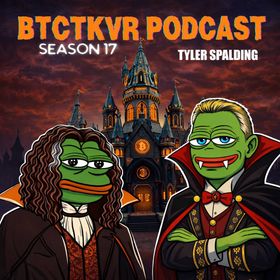
The audio keeps playing while you browse the site.
Read the transcript33,476 words, every line links to the minute it was said
Ask this episode
This episode is a first for me in two ways. It's the first time I interviewed a guest in Romania, and the first time I recorded on the road. Tyler Spalding, co-founder and former CEO of Flexa, came to visit the bear sanctuary near Brașov, so we talked in the car on the drive to Bucharest.
Tyler has been in Bitcoin since January 2011, and he has always cared about one thing above the rest: payments. The original show notes have the short version.
Bears and Romania
First, why Romania? "There's eight types of bears, eight species of bears. I've seen seven of them in the wild, minus the panda in China." Romania "has the largest bear sanctuary in the world, I believe," full of bears "rescued bears from zoos or private ownership or other various types of abuse or orphaned cubs."
As for the car, "This is something a little more unique, I think, to have this why-not sort of thing, right?" With "Romanian auto directions and all."
From the Space Shuttle to Payments
Tyler started as an engineer. "Got to work on the space shuttle program, got to meet all the astronauts, kind of a hardware engineer by training." He was responsible for "hundreds of millions of dollars' worth of spaceflight hardware," and "your product gets demoed on live TV, which is also sort of scary."
Then came payments, which he says are harder than they look. "It's why there's so few successful payments companies," because "it's just extremely hard to do."
CPU Mining in 2011
When he found Bitcoin, "this was before any exchanges existed, so I couldn't just go buy it anywhere." So he mined. "I used my laptop to start mining, CPU mining on your laptop way back then, and then graduated into GPU very quickly, then started using some of the first pools."
Payments Over Store of Value
"I'll be totally honest in that the store of value isn't as interesting to me. So for me, it was all about payments, being able to make a payment quickly and easily." He calls it settlement assurance. The web "is a stateless network, and Bitcoin or other crypto systems are just a stateful network."
Store of value is fine, "but for me I was very much in the payments narrative." He believed bitcoin "can truly change the status quo of how payments work today and I still believe that can happen."
The Block Size Years
During the block size fight, Tyler worked at Raise, a gift card marketplace, and went to the early conferences. "I was a big blocker for sure, like 100%, in that I always wanted to use this money." He was "very disappointed when the 2X fell through."
What frustrated him most was losing merchants. Before, "there were a number of large merchants accepting Bitcoin directly." He named "Expedia, there was Dell, there was Microsoft, Steam." Then they stopped, "because people just weren't using it," and "the blocks were all full. It was way too expensive."
Looking back, he had a mature view of how things turned out. "It's clearly not usable as payments, but it's a great store of value." And he's "not going to be bitter."
Everything Is Debt
We got philosophical about money. "Everything is debt." People owe each other, and "we create some element of something or a settlement asset to settle and that becomes our money." He calls the barter origin story "a false narrative," and says he has never seen a documented example "and I have hundreds of books on this."
On history, "the most similar version of Bitcoin was Bit Gold." I asked the obvious question, and he dodged it with style: "I'm not saying anyone is Satoshi."
What should Bitcoin be used for? "There's never one right answer. The answer is whatever consensus believes it to be." And that question "is what causes all the drama."
Buying Everything With Bitcoin
I asked if he ever used Silk Road. "No, never." He only looked at it to study the checkout flow, "because for me, it's all about traction." But he spent a lot. "I tried to use Bitcoin for everything." In his words, "I've spent so much Bitcoin early on, I can't even calculate now."
My favorite story was from 2016. He wanted last-minute tickets for a game, and the seller was worried about being scammed with a reversible payment. So Tyler asked, "do you know about this thing called Bitcoin?" The seller said "yeah, this is great," and the answer was "just send the Bitcoin."
Freedom of Choice
Tyler isn't Bitcoin-only. "For me, it's all about the freedom of choice and being able to choose in a currency or an asset that you want to spend and use as freely as possible." With something like Zcash, "you obviously get the privacy-preserving aspect, which I think could even be more important." He also likes the old idea of bitcoin as a money container, like a shipping container for value. "If I have a euro and I want to then trade that into a dollar," you could route it through bitcoin.
And he thinks other chains have helped Bitcoin more than many Bitcoiners admit, by bringing in "more capital," "more infrastructure" and "more attention." After all, "Bitcoin doesn't have a team. There's no foundation." His advice: "Take a step back and be like, why do I like this thing?"
The Use Case Magazine
Tyler kept hearing one question. "So the what is the use case was the question that came up again and again and again and again." So he made a magazine with "former editors at CoinDesk, writers from across the ecosystem, great graphic designers."
The team even went to Hong Kong to photograph "the money changers that people literally buying stablecoins and what they were using them for."
He wants it to last. Imagine a magazine about "the use case of the Internet" from 2000. "I want to put it on my shelf, look at it as like kind of be a moment in time with this artifact." As a fellow magazine maker, I loved that.
Privacy and Lightning
On privacy, "I think that's the number one thing where people think that it's private and it's not." He "firmly, firmly" believes "in the right to privacy," and says "having some privacy, I think, is just so critical for using it at scale."
Quantum computing came up too. His view: "I think we're still exponentially off from where it would need to be."
Acceptance Is Everything
His biggest lesson from Flexa: "what's overlooked is the acceptance. Like it doesn't matter if you have the best app in the world, the best asset in the world." Big merchants won't retrain staff at "10,000 stores." So "acceptance is the massive, massive key to unlock any digital asset payments."
Flexa's answer is to get into the point of sale and keep it invisible. He mentioned "an integration with InComm." And the merchant? "The reality is they just don't care." It has to be simple on both sides.
What Makes This Episode Worth Listening To
Tyler is one of the few people who has actually put crypto payments into real stores, and he has been spending bitcoin since 2011. If you care about bitcoin as money, his point about acceptance is the one to remember. And you get a road trip through Romania as a bonus.
You can read the full transcript, the original show notes, or visit Tyler Spalding's guest page.
Listen to Tyler Spalding on Spotify, Apple Podcasts, and More
Time stamps:
- 00:02:55– Eight species of bears
- 00:03:44– A podcast in a car
- 00:05:35– The space shuttle program
- 00:09:12– Payments are hard
- 00:10:35– CPU mining in 2011
- 00:12:30– Payments over store of value
- 00:13:57– Changing how payments work
- 00:17:49– Everything is debt
- 00:22:48– Bit Gold
- 00:25:09– What should Bitcoin be used for?
- 00:28:54– Spending bitcoin on everything
- 00:31:35– Game tickets with bitcoin
- 00:34:00– Freedom of choice
- 00:40:14– Money containers
- 00:41:36– Free marketing for Bitcoin
- 00:56:03– What is the use case?
- 00:59:02– A magazine as an artifact
- 01:01:54– A big blocker
- 01:02:31– When merchants stopped
- 01:03:50– A great store of value
- 02:45:24– Quantum is far off
- 02:51:08– Lightning frustrations
- 02:57:06– Griefing
- 03:02:12– The right to privacy
- 03:10:44– InComm
- 03:11:46– One tap
- 03:12:42– Acceptance is the key
- 03:13:50– Merchants don't care
Verify this episode
This is the SHA-256 fingerprint of the MP3 as published here, timestamped in the Bitcoin blockchain with OpenTimestamps. If one byte of the file changes, the fingerprint changes.
- SHA-256
dbdeff48a7df4d7445104197ddcde51e82944afe829ac4ea084824579d20ef68- Proof
- 2026-01-15_s17_e2_tyler_spalding_on_bitcoin_payments_altcoins_bears.mp3.ots · all episode hashes (proof)
- Status
- Anchored in Bitcoin block 974,312
- Timestamped
- After release. The episode came out on 15 Jan 2026, but this proof was made on 3 Nov 2026 and anchored in block 974,312, so it proves this exact file existed by 3 Nov 2026, not on the release date.
How to check it yourself
- Download the MP3 and the proof into the same folder.
- Run
sha256sum 2026-01-15_s17_e2_tyler_spalding_on_bitcoin_payments_altcoins_bears.mp3(on a Mac:shasum -a 256 2026-01-15_s17_e2_tyler_spalding_on_bitcoin_payments_altcoins_bears.mp3). The result must match the SHA-256 above. - Install the OpenTimestamps client (
pip install opentimestamps-client) and runots verify 2026-01-15_s17_e2_tyler_spalding_on_bitcoin_payments_altcoins_bears.mp3.ots. It hashes the MP3 again and checks the proof against your own Bitcoin node, then prints the block and the date the file existed by. Without a node,ots info 2026-01-15_s17_e2_tyler_spalding_on_bitcoin_payments_altcoins_bears.mp3.otsshows the block height to look up in any block explorer.
Related
S17 E2: Tyler Spalding on Bitcoin Payments, Altcoins & Bears
In January 2026, Tyler Spalding came to Romania to visit the Bear Sanctuary in Zărnești, Brașov. So I took advantage of the…
S17 E13: Charlie Spears on Blockspace Media, the Purity Spiral & the Case for Classical Maximalism
Editor’s note: this conversation was streamed live in mid-March 2026, a week after the US switched to daylight saving time (which…
S17 E36: Yonatan Sompolinsky on Kaspa Covenants, DAGKnight & Coordination Markets
Yonatan Sompolinsky came to Europe for a reason he would only describe on record as a secretive meeting of DAGKnight magicians…

Comments
Comments run on my own server. No trackers, no tracking cookies.