




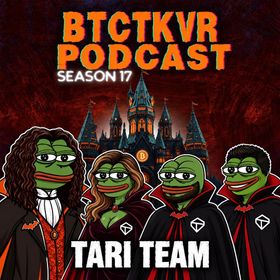
S17 E45: Talking Tari & Privacy with Naveen Jain, Mr. Fox & Marguerite de Courcelle
The audio keeps playing while you browse the site.
Read the transcript28,991 words, every line links to the minute it was said
Ask this episode
There are projects in this space that are famous for what they shipped. Tari used to be famous for what it has not. Announced in the ICO-era twilight of 2017 and 2018, fronted by Fluffypony of Monero fame, promising tokenized event tickets and video game assets on a Mimblewimble chain merge-mined with Monero, it spent years as the privacy space’s favorite proxy for Half Life 3 and GTA 6. “Coming in two weeks” was the community joke, and for a long time the joke was the product.
Then, quietly, Tari shipped. The layer one went live in 2025, the layer two arrives on November 11, and the people running the project today are new and full of energy. Fluffypony, the original evangelist and de facto face of the project, is gone. In his place is a council, a core contributor program, and a community takeover that happened months before this recording. I sat down with co-founder Naveen Jain, council member Mr. Fox, and Marguerite deCourcelle (better known as Coin Artist) to find out what Tari actually is now that the meme is over and the mainnet is real.
(Sponsored by Braiins Hashpower, Layer 2 Labs, Cake Wallet, SideShift, and Orange Rock. Cake Wallet sponsored the $100 Monero giveaway. Naveen picked 43, Fox picked 55, Marguerite picked 23, and the average landed on 40. Congratulations to whoever guessed it.)
What Tari Actually Is (3:42)
The short version: Tari is a confidential by default layer one, a Mimblewimble implementation written in Rust, with an upcoming high-performance programmable layer two called the Oodle on top. The longer version is more interesting, because the design choices are genuinely unusual.
The base layer is secured by four mining lanes, each receiving an equal 25% share of block production: RandomX merge-mined with Monero, RandomX solo mined, C29 for GPUs, and SHA-3 for ASICs. The stated goal is that anyone can mine Tari regardless of hardware, from a laptop to a warehouse. The security argument is the more compelling one. A 51% attack requires controlling multiple algorithms at once, and the Monero merge-mining lane borrows the security budget of one of the most battle-tested proof-of-work networks in existence. Small proof-of-work chains get attacked all the time. Tari’s answer is to make the attacker’s shopping list absurdly long.
The mining client, Tari Universe, deserves a mention because everyone in this interview kept returning to it: a one-click miner that detects your hardware and starts earning. Marguerite’s anecdote about opening the app, not realizing it was mining, and finding XTM waiting for her a few minutes later is either great product design or a warning about how little attention she pays to her laptop’s use of computation resources. Probably both.
The Ticketmaster Killer That Wasn’t (9:02)
The most historically valuable segment of the conversation is Naveen’s account of Big Neon, the ticketing company Tari built as its reference design application. This part of the story has been memory-holed, and it answers the question everyone asked in 2018: what happened to the tickets?
The answer is brutally mundane. They built a real ticketing business, signed exclusive venue contracts across the US market, and were earning real fiat revenue. Then the pandemic killed live events worldwide, the math of a ticketing startup stopped working overnight, and the remnants were sold to Spotify. Naveen still argues ticketing is a great reference design for the chain, and he is probably right, but the lesson stands on its own: you can do everything correctly and still get flattened by a virus.
The One-Way Peg (15:28)
The two-token structure raised my eyebrow, and I said so on air. XTM lives on the base layer. The L2 token is obtained by burning XTM one for one, and there is no native peg back. If you want to return to layer one, you trade with someone who holds it, via exchanges or atomic swaps. Fox was candid about why: letting the L2 mint L1 coins would mean the L2 has control over the base layer’s supply, and that is a security hole they refuse to open.
It is a defensible design, but it is also a one-way door dressed in tokenomics language, and users should understand that before they burn anything. The holy grail remains the two-way peg model that Paul Sztorc’s drivechains are attempting with the ecash hard fork, and Tari’s team is explicit about why they chose not to chase it.
For those who would rather skip the mining rig, XTM trades on MEXC, SafeTrade, nonKYC, and wrapped on Uniswap. Or, as Fox put it, you can just download Tari Universe and push the button.
The C29 Bug and the Case for the Lanes (20:04)
A chat question from Alpha Ark 84 forced the most technically honest moment of the episode. Tari recently suffered a consensus issue on the C29 lane, where blocks were easier to mine than intended. It was corrected via hard fork. Naveen’s framing was that the network was never meaningfully at risk, and Fox backed it with the stronger argument: even if someone had exploited the weakened lane, three other lanes were still doing honest proof of work, and the exploiter would have controlled at most a quarter of block production.
The multi-lane design did not just survive its first real test. It justified itself. That said, “we had a bug and the architecture saved us” is still “we had a bug,” and a skeptical listener should note that the fix required a hard fork coordinated by the same small team whose competence is the real security layer at this stage of the project.
The Beam Question (23:42)
I asked the question that hangs over every technically impressive, commercially invisible chain: how is Tari different from Beam, the other programmable Mimblewimble project that built confidential assets, an algorithmic stablecoin, and Lelantus integration, and wasn’t successful despite all of it?
Programmable Confidentiality (30:21)
The L2’s pitch is what Tari calls programmable confidentiality: default-private transactions where issuers can opt into visibility. Naveen’s example is a confidential stablecoin backed by real dollars, peer-to-peer private for users, while the issuer retains a full view of the transaction graph for compliance. Fox offered the sharper use cases: securities trading without broadcasting positions, escrow systems with smart contract enforcement and privacy, and markets that are underserved because they carry social stigma.
The most honest version of this came later, when Fox explained why he personally joined. He runs an online art commissioning platform for the furry fandom, and Stripe’s content policies constrain what artists can sell. A confidential stablecoin plus smart contract escrow plus no bank permission is, for his community, not an ideology but a product they need. I have interviewed three furries on this show now, and I did not expect the most concrete privacy-coin use case of the season to come from commissioned art, but here we are. Real problems make real users.
The Linkin Park Lesson (39:54)
He maps this directly onto crypto’s degeneration from white papers to technical papers to JPEGs to tickers. In the ICO era we at least pretended to read. Meme coins dispensed with the pageantry entirely. It is a cynical observation from a man asking you to care about his protocol, and it is also accurate, which is why it stings.
Marguerite’s Puzzles (1:01:25)
Coin Artist’s origin story belongs in the permanent record of this show. Her first crypto puzzle, arguably the first crypto puzzle ever, was a 2014 portrait commission for Bitcoin Magazine featuring Amir Taaki and Cody Wilson for the Dark Wallet launch. While painting a tribute to transaction obfuscation, she realized the painting itself could hide something, so she embedded a Bitcoin private key in the artwork.
She mined Bitcoin on gaming GPUs in 2012, lived through the Ethereum ICO, MaidSafe, Decred, and the BitMEX wild west, then founded the game studio behind Neon District, which acquired an AI studio in 2022 and pivoted into what is now Blockade Labs and Skybox. Taaki, for the record, went on to build DarkFi and returned to this show for a seven-hour marathon. Marguerite never got a thank you for the portrait. Some things never change.
And then, mid-answer, she let slip that there is something hidden in Tari’s blockspace that nobody has ever found. A collaborative treasure, buried in the chain. Naveen confirmed there are several. If that does not make at least one listener fire up a node and go hunting, I do not understand this industry anymore.
The Gaming Detour (1:54:20)
The final hour wandered into the arcade: Final Fantasy VII versus Final Fantasy X (I will defend X until I die), Ocarina of Time, Fallout New Vegas, Phasmophobia, Doom, John Carmack open-sourcing the Doom engine against everyone’s advice, Tim Sweeney and his cypherpunk roots, Vitalik rage-quitting World of Warcraft into Ethereum, and Amir Taaki learning C++ because a rumor promised a nude Lara Croft mod that did not exist. I once pitched John Romero myself on NFT assets and play-to-earn mechanics, and his objection about gambling, friction, and fun still stands as the sober counterpoint to everything in this paragraph.
There is a thread connecting all of it to Tari’s thesis, which is that the next wave of crypto users will arrive through play rather than finance. Marguerite mined Bitcoin on a gaming GPU in 2012, back when Satoshi was emailing Laszlo Hanyecz to ask him to ease off the GPUs so newcomers could mine on their CPUs. The industry has since traded colored coins on Counterparty and the Rare Pepe Directory for Namecoin archaeology, Steemit dreams, and bored ape museums.
It watched so-called Bitcoin maximalists sell NFT spaceships for Infinite Fleet, a game that never shipped, while mocking altcoin gaming as a scam. The open source soul of the space, the one Donald McIntyre spent his career writing about, has been crowded out by institutional grade seriousness. Marguerite’s closing argument, that Tari wants to rebuild the end-to-end journey from mining your first coin to building your first game, is the clearest statement of the project’s actual ambition: not to be a better Solana, but to be the chain where normal people accidentally become cypherpunks.
The Community Takeover (2:15:35)
Mr. Fox’s account of the past few months matters more than any roadmap. After Fluffypony’s departure, Tari had open source code but no open source community structure: the work happened behind closed doors and the community had no way in. Fox, who contributes to Open edX in his other life, wrote the core contributor program, got it through the grinder of community mistrust, and now sits on an inaugural council whose successor will be elected by the contributors it onboarded. Marguerite frames her council role as force multiplication for people she considers more talented than herself.
Marguerite also offered the gentlest possible correction to the Fluffypony mythology: the people who wrote Tari’s code largely never left, and big personalities departing can make room for the builders to be seen. That is the diplomatic version, and it may even be true, but it is also the kind of thing departing-founder projects always say in year one. Ask me again after the Oodle has been live for six months.
Whether the Oodle’s November 11 launch delivers that is a question the market will answer with its usual cruelty. But for the first time in Tari’s eight-year history, the answer will be about the product and not the waiting.
To start mining, download Tari Universe and push the button. To argue with the community, the Discord, Telegram, and forum links are on the same page. To follow Marguerite’s puzzles and games, she is @coin_artist on X.
Listen to the Tari team (Naveen Jain, Mr. Fox, Marguerite de Courcelle) on Spotify, Apple Podcasts, YouTube & More!
Time stamps:
- 0:00– Intro
- 1:27– Welcome to S17 E45: Naveen, Mr. Fox & Marguerite
- 3:42– What Is Tari? Mimblewimble, Four Mining Lanes & the Oodle
- 6:01– Can Tari Compete With Solana?
- 7:12– Meme Coins vs. Real Businesses
- 9:02– The Ticketmaster Killer That Wasn’t
- 9:58– Big Neon, the Pandemic & the Spotify Exit
- 12:00– How Dependent Is Tari on Monero’s Hashrate?
- 13:06– Why Four Mining Lanes and Two Tokens?
- 15:28– The One-Way Peg: Burning XTM for the L2
- 16:23– Tari Script on L1, Full Programmability on L2
- 17:33– Sponsors: Layer 2 Labs & Braiins Hashpower
- 20:04– The C29 Consensus Bug & How the Lanes Held Up
- 23:42– The Beam Question: Great Tech Is Not Enough
- 26:58– What Is Tari’s Killer Use Case?
- 30:21– Programmable Confidentiality: Securities, Escrow & Stigma Markets
- 31:35– Fox’s Cat Shirt & the $100 Monero Giveaway
- 32:16– Sharing Security With Monero: The Underappreciated Part
- 34:49– Did the Monero Community Stick Around?
- 37:32– From White Papers to Tickers: The Decline of Ideas
- 39:54– Naveen’s Linkin Park Lesson: The Lowest Common Denominator
- 43:51– Build Contests, Encrypted Messengers & Private Voting
- 45:28– Learning English From Linkin Park
- 48:11– The Meteora Bank Vault Listening Party
- 50:07– Mining Q&A: Pool Censorship & RandomX Changes
- 53:59– The Pool That Kept the XTM
- 54:18– Will Other Privacy Chains Copy the Model?
- 55:32– Sponsors: SideShift & Orange Rock
- 57:11– Marguerite (Coin Artist) Joins
- 58:25– From the Ethereum ICO to MaidSafe to Decred
- 1:01:25– The First Crypto Puzzle Ever: Dark Wallet, Amir Taaki & Cody Wilson
- 1:02:52– There Is Treasure Hidden in Tari’s Blockspace
- 1:03:35– What Marguerite Does on the Tari Council
- 1:06:32– Building for Humans or for AI Agents?
- 1:09:49– Giveaway Mechanics: Three Numbers, One Winner
- 1:10:40– Attracting Normies: Blink, Browser Agents & Small Beginnings
- 1:13:40– Tari Universe: Mining Without the UX Nightmare
- 1:15:08– Where to Buy XTM (Or Just Mine It)
- 1:16:55– Mining Monero and Tari at the Same Time
- 1:18:21– Satoshi’s Email to Laszlo
- 1:18:51– Naveen’s Number Is 43 & He Has to Go
- 1:19:11– Does Gaming Belong on a Blockchain?
- 1:20:09– Neon District, Axie & the PFP Ceiling
- 1:22:20– Vibe Coding Three Games in One Weekend
- 1:25:41– Online Poker, Frozen Accounts & the First Bitcoin Gamblers
- 1:28:22– The Winning Number: 40
- 1:30:39– If Monero and Tari Were Roommates
- 1:32:11– Privacy-First Games: Fog of War & Front-Running
- 1:40:01– Skybox, Modding Communities & Creator Royalties
- 1:44:19– Mr. Fox Is a Furry (the Third One on This Podcast)
- 1:46:26– The Real Use Case: Commissioning Art Without Bank Permission
- 1:48:26– The Manicure Question
- 1:49:17– Lessons From Neon District & Loot Boxes
- 1:51:36– Vlad’s Brother, the CS:GO Knife & the Rome Vacation
- 1:54:20– Top Three Games of All Time
- 2:02:25– John Carmack & the Open Source Doom Engine
- 2:03:51– Tim Sweeney: The Cypherpunk Behind Unreal
- 2:07:39– Amir Taaki’s Lara Croft Origin Story
- 2:08:41– Vitalik Rage-Quitting WoW & Colored Coins
- 2:11:46– Bringing the Soul Back to Open Source
- 2:13:35– What Fox Wants Built First: Payments Without Permission
- 2:15:35– The Community Takeover & the Core Contributor Program
- 2:18:49– Councils, Leaders & the Decentralization Paradox
- 2:22:56– Andreas Antonopoulos, Vitalik & the Need for Faces
- 2:26:22– The NATO Problem: Organizations Without a Purpose
- 2:29:29– Steemit, Twitter Tip Bots & Make It Rain Doge
- 2:32:02– Counterparty, Rare Pepes & NFT Archaeology
- 2:35:21– When VCs Discovered OpenSea
- 2:37:10– Infinite Fleet & the Game That Never Shipped
- 2:40:17– John Romero: Why Play-for-Money Kills Fun
- 2:44:35– Cats: Hunter & Salieri
- 2:47:23– A Mini-Game for Vlad’s Website
- 2:48:04– The Trojan Horse Thesis Revisited
- 2:49:04– The Builders Never Left
- 2:49:42– Different Leaders for Different Eras
- 2:52:48– Why Seven Years? And How Long Until the L2 Matters?
- 2:55:11– How to Start Mining Tari Today
- 2:56:21– Outro
Verify this episode
This is the SHA-256 fingerprint of the MP3 as published here, timestamped in the Bitcoin blockchain with OpenTimestamps. If one byte of the file changes, the fingerprint changes.
- SHA-256
7d1a426b03017c9bc6d9646979e7130660971f4774874d22af7308594d840ead- Proof
- 2026-09-30_s17_e45_talking_tari_with_naveen_jain_fox_marguerite_de_courcelle.mp3.ots · all episode hashes (proof)
- Status
- Anchored in Bitcoin block 974,312
How to check it yourself
- Download the MP3 and the proof into the same folder.
- Run
sha256sum 2026-09-30_s17_e45_talking_tari_with_naveen_jain_fox_marguerite_de_courcelle.mp3(on a Mac:shasum -a 256 2026-09-30_s17_e45_talking_tari_with_naveen_jain_fox_marguerite_de_courcelle.mp3). The result must match the SHA-256 above. - Install the OpenTimestamps client (
pip install opentimestamps-client) and runots verify 2026-09-30_s17_e45_talking_tari_with_naveen_jain_fox_marguerite_de_courcelle.mp3.ots. It hashes the MP3 again and checks the proof against your own Bitcoin node, then prints the block and the date the file existed by. Without a node,ots info 2026-09-30_s17_e45_talking_tari_with_naveen_jain_fox_marguerite_de_courcelle.mp3.otsshows the block height to look up in any block explorer.
Related
S17 E13: Charlie Spears on Blockspace Media, the Purity Spiral & the Case for Classical Maximalism
Editor’s note: this conversation was streamed live in mid-March 2026, a week after the US switched to daylight saving time (which…
S17 E18: Dr. K on Scaling Proof of Work, Soaping the Competition with Quai & Unifying Physics
Dr. K (Karl Kreder), architect of the Quai Network, came back for his second appearance on Bitcoin Takeover to defend his…
S17 E44: Marc De Mesel on the Bitcoin Cash Bet, the Privacy Coin Basket & the Price of Conviction
There is a particular kind of person the Bitcoin Cash community produced in its glory years, and Marc De Mesel is the…

Comments
Comments run on my own server. No trackers, no tracking cookies.