




Crypto Coder Bob on Sovereignty, Full Nodes and Bingo Cards (S6 E2 Full Article)
The audio keeps playing while you browse the site.
Read the transcript15,757 words, every line links to the minute it was said
Ask this episode
Crypto Coder Bob uses a Bob the Builder avatar on Twitter, and it fits. He builds his own tools, runs his own node, and wrote his own code for generating seeds from dice rolls. He also knows most people won't do any of that, and that's what made our conversation interesting.
It was the second episode of Season 6, where I brought on people who had never been on a Bitcoin podcast. The original show notes summarize it. Here's the full story.
A Journal Club and a White Paper
Bob's start was unusual. In 2017, as a new hire, he joined his company's journal club, where "someone picks or the group picks a scientific paper to read and the group reads it and then they meet." "And coincidentally, the first paper was the Bitcoin white paper." It helped that he was "formally trained in computer science and business."
"The Bitcoin white paper immediately appealed to me. It's not that long." He saw both sides at once: "the computer science side of what this meant, as well as the economic implications of this." The result: "I was hooked from the first page, which is hard for me."
He still sees it as young. "It's just an early technology." But, "the genie in the bottle has been released and it's not going back in."
Off Zero First, Then Nodes
We started with a familiar pain: his first node showed zero inbound connections until he worked out his router's port settings. "It wasn't as easy as I thought it would be."
That shaped his view of node evangelism. He has helped at least one friend run a node, but "that's easier said than done." The order matters. First, get people "off zero and teach them how to stay off zero." Then teach them to protect their sats. Nodes come after that.
"You're never going to run a node before you own coin." A node, in his words, is "basically working to strengthen your investment." And you need to be "at least, I don't know, four out of 10 technically savvy."
I pushed back a bit. "Anyone who has ever operated some sort of torrent file to download stuff should more easily understand how Bitcoin full nodes work." In Romania and the rest of the Eastern Bloc, 20 years ago we "had like 90% piracy," so peer-to-peer software never felt exotic to us. Bob said I was overestimating the people he talks to. Their reality is "I've never used command line. I've never written a line of code." "It's not untarring files and opening ports. We're just not there yet with the general public." He supports plug-and-play node solutions with graphical interfaces, even though he went straight to "bare bones Bitcoin Core" himself.
Lightning, Liquid and Tipping GIFs
Bob was optimistic about layers. "Obviously Bitcoin is the settlement layer," and Lightning and possibly Liquid were where he saw the future. He'd also just read about RGB. His personal reason for loving Lightning: "as a GIF creator myself, I'd love to receive some small amount of sats for my hard work in Adobe After Effects."
How Private Is Your Stack?
We talked about buying Bitcoin without giving away too much. Every option has a weak spot. Bitcoin ATMs? "How about the security cams of the gas station where the Bitcoin ATM lies?" Rewards apps? "You're pretty much a marketer's dream." Bisq offers options like money orders, but "it's really hard to do if you want to be truly anonymous in how you collect coins."
SIM Swaps and Suspicious Phone Calls
This was the most practical part of the episode. Call your carrier and require a PIN or in-person ID for account changes, "because a SIM swap attack is pretty much fatal for all your accounts at this point." Then test them. "Pretend that you're trying to change your things and see if they require you to go through these security and authentication steps."
He answers unknown calls but waits for the caller to speak first. If the utility company says it's sending someone over, "especially if you're holding coin, ask them, run through a couple questions to make sure that they are who they say they are."
And the classic rule: "keeping your mouth shut is always the best option." He joked that being on my show was bad opsec, then quickly added: "But we don't actually own any Bitcoin, so-"
Generations and Inflation
Bob thinks people understand money through the crises they lived through, from Executive Order 6102, which forced Americans to hand in gold in 1933, to Nixon ending dollar convertibility to gold in 1971. For his generation, "Keeping your money in your bank account is just going to be a losing proposition because inflation is going to eat it away over time."
Older relatives are a harder sell. "My grandparents won't even let me touch the HDMI cable on a television." He doesn't call it a lost cause, though, "because you can break it down into terms they understand."
Dice, Coldcard and Sats in Your Head
His hardware recommendation was the Coldcard. But "you can generate secure wallets, arguably just as secure, with just dice." He made his own code for it public and recommends it "as an experiment for people really interested in mnemonic wallets or BIP32 to try out."
What he loves about mnemonics is "self-sovereignty inside of your head that you can freely move around with." He also likes Tails, which "comes with an Electrum wallet built right into it" and runs over Tor.
Fire Drills for Your Coins
My favorite advice from this episode: "just like people do fire drills, you got to run through a drill of: how do I move my coins if I need to move my coins now?" Practice recovery before you need it. "It's going to make you sleep better at night."
He also warned against keeping everything on a phone with no backup. "It would be catastrophic to know someone lost their holdings because they lost their phone and I recommended a phone wallet." And on the day we recorded, people were reporting they "couldn't withdraw from Cash App," which he called "kind of a scary sign."
The Davey Bingo Card
Then we got to the meme that got him noticed. When Dave Portnoy got interested in crypto in August 2020, Bob started a thread predicting what Davey would do next. "Why don't I just make a bingo board of this?"
It also came with a growth tip for small accounts. Using TweetDeck, he'd be one of the first replies under Portnoy's posts, and the bingo board had "been getting more love than any of my posts ever." His advice: "you can be a small account, but you can get love if you're the first to act on a big post." He planned a V2 with new squares, and kept the original as his pinned tweet even while people were "hating on me" for it.
What do you win? "Self-sovereignty and Twitter clout." Crossing off the shitcoin square brought trouble. "We all know Davey bought LINK at suggestion of the Winklevii twins. The LINK Marines came out in full force against me." Portnoy sold his Bitcoin within days, which says something about how fast that card could fill up.
The serious point: "each of us really should have our own bingo card, not even as a joke." Getting off exchanges, running a node and learning your recovery steps are squares worth crossing off.
What Makes This Episode Worth Listening To
Bob is a builder who doesn't expect everyone to be one. His advice is practical and honest about where people really are. Also, he wants to be a "future meme expert witness" one day, and I believe him.
You can read the full transcript, the original show notes, or visit Crypto Coder Bob's guest page.
Listen to Crypto Coder Bob on Spotify, Apple Podcasts, and More
Time stamps:
- 00:02:04– Opening the node port
- 00:03:32– The journal club
- 00:04:29– Hooked by the white paper
- 00:09:15– Helping friends run nodes
- 00:13:02– Four out of 10 technically savvy
- 00:15:35– The torrent argument
- 00:16:26– Not untarring files yet
- 00:24:02– Bare bones Bitcoin Core
- 00:26:11– Lightning, Liquid and RGB
- 00:32:05– Privacy when buying Bitcoin
- 00:39:45– SIM swap protection
- 00:42:26– Answering suspicious calls
- 00:45:48– Keep your mouth shut
- 00:48:36– Inflation and generations
- 00:56:17– Coldcard and dice
- 00:57:49– Sats in your head
- 01:03:28– Fire drills for your coins
- 01:20:51– Getting noticed with TweetDeck
- 01:21:34– The Davey Bitcoin bingo card
- 01:36:30– Future meme expert witness
Verify this episode
This is the SHA-256 fingerprint of the MP3 as published here, timestamped in the Bitcoin blockchain with OpenTimestamps. If one byte of the file changes, the fingerprint changes.
- SHA-256
f5dc810ba2172feda64bdbddca8ccfb3ec0edf944ef530ae976143f6ff0a63ec- Proof
- 2020-08-18_recording-1_postproductions_2020-08-18-t12-19-56pm-final-mix.mp3.ots · all episode hashes (proof)
- Status
- Anchored in Bitcoin block 974,312
- Timestamped
- After release. The episode came out on 18 Aug 2020, but this proof was made on 3 Nov 2026 and anchored in block 974,312, so it proves this exact file existed by 3 Nov 2026, not on the release date.
How to check it yourself
- Download the MP3 and the proof into the same folder.
- Run
sha256sum 2020-08-18_recording-1_postproductions_2020-08-18-t12-19-56pm-final-mix.mp3(on a Mac:shasum -a 256 2020-08-18_recording-1_postproductions_2020-08-18-t12-19-56pm-final-mix.mp3). The result must match the SHA-256 above. - Install the OpenTimestamps client (
pip install opentimestamps-client) and runots verify 2020-08-18_recording-1_postproductions_2020-08-18-t12-19-56pm-final-mix.mp3.ots. It hashes the MP3 again and checks the proof against your own Bitcoin node, then prints the block and the date the file existed by. Without a node,ots info 2020-08-18_recording-1_postproductions_2020-08-18-t12-19-56pm-final-mix.mp3.otsshows the block height to look up in any block explorer.
Related
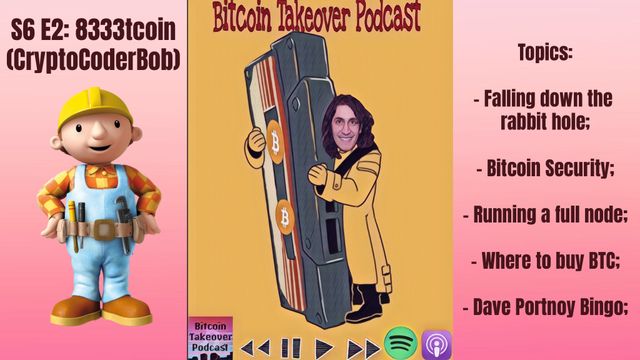
S6 E2: Crypto Coder Bob on Sovereignty and Bingo Cards
Crypto Coder Bob (8333tcoin on Twitter) talks about sovereignty through nodes and cryptography, as well as using Bingo cards as…

S1 E3 Remastered: Zack Voell on Bitcoin & Politics
(This remaster is sponsored by Helen’s Pizza, 183 Newark Avenue, Jersey City, where you can buy pizza, pasta, and coffee with…
S17 E40: Amir Taaki & Prof. Richard Werner on Decentralization, Community Banks & the Coming CBDC Panopticon
(Recorded live at Mallorca Blockchain Days in front of an audience, this episode is a crossover between the conference’s final…

Comments
Comments run on my own server. No trackers, no tracking cookies.