




Jarret Dyrbye on Lightning Apps, Sparkshot and Money Socket (S6 E7 Full Article)
The audio keeps playing while you browse the site.
Read the transcript15,179 words, every line links to the minute it was said
Ask this episode
Jarret Dyrbye, JD2983 on Twitter, first got noticed in Bitcoin for ForkDrop.io, a site that helped people claim and dump the coins from Bitcoin forks. By the time we talked in September 2020, he had moved on to building with Lightning: Sparkshot, a pixel art marketplace, and Money Socket, a protocol for connecting apps to your wallet.
He's a builder who tells you what isn't working. The original show notes give the short version of our 98-minute talk. Here's the longer one.
Lightning Works, People Just Don't Spend
I opened by asking whether Lightning had lived up to the hype. "I think Lightning's doing really well," he said, but the popular story about Bitcoin had lost "the work-in-progress aspect of Bitcoin," replaced by "a lot of talk about stock-to-flow ratios."
The real problem was deeper. "The general problem is users aren't really used to using Bitcoin. People speculate on it and they get very excited about it, but they're not necessarily using it to pay their bills or, you know, earn income." And since Lightning is all about spending, "there's not a lot to spend on." People "do a couple transactions and then they go away." "It's still very much in the experimental phase."
From Satoshi's Place to Sparkshot
Sparkshot was "directly inspired by what we saw at Satoshi's Place," the Lightning canvas where anyone could pay to paint pixels. JD and his co-founder used it in the first weeks after launch and "riffed on what we thought a proper, fully realized app would look like."
They fixed a problem they'd seen. On Satoshi's Place, people would draw elaborate pieces, and then someone would paint over them. On Sparkshot, the artist uploads the base image and buyers pay to reveal pixels, so "your art isn't going to be stomped by somebody else. It's sort of there for all time because you paid for it."
There are no logins. Buyers just pay, and artists are "identified by a signed message from a Bitcoin address." That "opens up a world of anonymous art," with "artists that contribute anonymously and then users that respond to the art in anonymous ways." I loved that idea.
The philosophy is simple: "we don't care who you are, we just care whether you paid the invoice." He admitted that it creates moderation problems. Satoshi's Place got "porn that went up, and different off-color messages," which "just pushes back on the app designers." He was looking at ideas like Reddit's subreddits and artist reputation, where "if an artist has done good work in the past," buyers can trust the new piece.
The art that works best embraces the format. He compared it to "Where's Waldo," a big image full of tiny details, and pointed to pixel artists on Instagram and Twitter who "get a lot done in a small amount of pixels." Artists can even price their pixels higher.
Sparkshot took "more or less two years to develop." The pixel reveal "was an easy problem and it was sort of an excuse to build the tech stack." After Satoshi's Place, "the gold rush is on, like Lightning works, you can build a cool app with Lightning."
Money Socket
Money Socket is "a way to embed access to your wallet into an application." Today, you scan a QR code, approve the payment, and wait. In his logs, the time from invoice to payment is "typically about 20 seconds, 25 seconds."
With Money Socket, you'd connect your browser to your wallet, "whether that's your node, like if you have a myNode in the closet, or whether you have a phone in your pocket." Then you authorize a budget. It's for tiny amounts: "We're not talking about coffee-sized purchases. We're talking about sub-cent payments." Set "1,000 sats for your session," and "you just click on the pixels you want to buy and they just get bought."
He also had a clever idea for newcomers. Someone playing online poker could connect with Money Socket, and they're "only going to see 10 US dollars. They're not going to see Bitcoin." Later, "they can then say, 'Oh, wait, this is Bitcoin. How does Bitcoin enable this?'"
How He Got Here
JD spent nine years in "distributed systems, deep backend stuff" at "a three-letter corporation that is not IBM, but similar." He tinkered with Bitcoin on evenings and weekends. When that job ended with "a decent severance package," he thought, "Oh, I should just sit down and work on this Bitcoin thing for however many months." He's been working mostly on Bitcoin since the beginning of 2017.
Why don't more good developers join? Some "wouldn't touch Bitcoin with a 10-foot pole." And he said, half-joking, "everybody on Twitter looks like a nut and probably is a nut." His answer was to show what can be built, "and hopefully make the case of why new startups should go do something crazy like Sparkshot."
He noted that you can get "lots of Twitter traction amongst the insiders by signaling to them." What he wanted was products "to appeal to the non-converted."
The ForkDrop SEO Lesson
We compared notes on search traffic. At ForkDrop, they wrote plenty of articles. "The pure Bitcoin articles hardly got any search traffic." The traffic went to "how do you run Tor Browser on Ubuntu, Ubuntu live boot, how do I use Tails." The lesson: "There's all kinds of people that are looking to learn these tools that aren't interested in Bitcoin." I told him I'd written articles about Bitcoin and Pokemon and about Bitcoin and Jim Morrison, and got plenty of negative feedback from the community for them. JD had seen the Morrison one go by, and "it was kind of weird to see." But he got the point. Someone who likes Jim Morrison and hates Bitcoin might click, and "you have whatever your 10 seconds to make a point before they click away."
Wallets Aren't Ready
JD didn't think fees were the main barrier. "That software isn't ready." Show regular people "base58-encoded text," make them manage fees and Lightning channels, and you lose them. "From all the usability stuff I've had, seen, tried to, like, teach people to use wallets, like, we're just so far off."
He expected something like "the Hotmail equivalent of Bitcoin," but as "an open source project that is easy and simple to set up and run." He liked myNode, RaspiBlitz and BTCPay Server, and imagined a plumber who starts on Coinbase, gets shut down, and realizes "I can just, like, run my own bank."
His comparison: "it's going to take 15 years of, like, just crazy scrambled eggs type stuff to kind of figure out how to use Bitcoin," before it becomes like the Linux desktop, "all very composable."
Tor, Speculation and Real Bitcoin
"Most Bitcoining should be done through Tor, if you have the option." He wasn't naive about it. Tor "started with the US Navy," and "it's not perfect, but it is much, much better than just using the clear internet."
On price, he was a skeptic. To him, stock-to-flow is "nonsense economics, because it's not measuring demand." Marketing Bitcoin to friends might give "a 20X price bump, but then we're going to get an 85% correction."
He'd met people at his local meetup who lost money in QuadrigaCX, the Canadian exchange that collapsed in 2019. "They talk like that was real Bitcoin, but it wasn't real Bitcoin." His advice: "do manage your own security."
He ended with the cypherpunk way of dealing with a crazy world: "you just write code and you change how the future is gonna go."
What Makes This Episode Worth Listening To
JD was an honest builder at a time when most people only wanted to talk about price. A lot of what he worried about in 2020, from wallet UX to app design, still matters today.
You can read the full transcript, the original show notes, or visit Jarret Dyrbye's guest page.
Listen to Jarret Dyrbye on Spotify, Apple Podcasts, and More
Time stamps:
- 00:01:41– Lightning is doing well
- 00:02:50– Users aren't used to using Bitcoin
- 00:05:20– Inspired by Satoshi's Place
- 00:06:49– Anonymous art
- 00:09:58– Revealing pixels
- 00:11:08– We just care whether you paid
- 00:16:10– Where's Waldo and pixel art
- 00:20:09– Two years to build
- 00:22:00– What is Money Socket?
- 00:23:36– Connecting your browser to your wallet
- 00:26:25– From enterprise storage to Bitcoin
- 00:29:45– Everybody on Twitter looks like a nut
- 00:37:13– SEO lessons from ForkDrop
- 00:42:05– Poker players and dollars
- 00:52:58– Software isn't ready
- 00:57:52– The Hotmail of Bitcoin
- 01:04:15– Use Tor
- 01:13:13– 15 years of scrambled eggs
- 01:16:55– Stock-to-flow and demand
- 01:27:55– Quadriga victims
- 01:33:36– Just write code
Verify this episode
This is the SHA-256 fingerprint of the MP3 as published here, timestamped in the Bitcoin blockchain with OpenTimestamps. If one byte of the file changes, the fingerprint changes.
- SHA-256
a6a9d585e5de353ef5a681965980c31242af1b0149a514b70861be18d23029df- Proof
- 2020-09-07_s6_e7_jarret_dyrbye_on_lightning_network_development__sparkshot__money_socket__more.mp3.ots · all episode hashes (proof)
- Status
- Anchored in Bitcoin block 974,312
- Timestamped
- After release. The episode came out on 7 Sept 2020, but this proof was made on 3 Nov 2026 and anchored in block 974,312, so it proves this exact file existed by 3 Nov 2026, not on the release date.
How to check it yourself
- Download the MP3 and the proof into the same folder.
- Run
sha256sum 2020-09-07_s6_e7_jarret_dyrbye_on_lightning_network_development__sparkshot__money_socket__more.mp3(on a Mac:shasum -a 256 2020-09-07_s6_e7_jarret_dyrbye_on_lightning_network_development__sparkshot__money_socket__more.mp3). The result must match the SHA-256 above. - Install the OpenTimestamps client (
pip install opentimestamps-client) and runots verify 2020-09-07_s6_e7_jarret_dyrbye_on_lightning_network_development__sparkshot__money_socket__more.mp3.ots. It hashes the MP3 again and checks the proof against your own Bitcoin node, then prints the block and the date the file existed by. Without a node,ots info 2020-09-07_s6_e7_jarret_dyrbye_on_lightning_network_development__sparkshot__money_socket__more.mp3.otsshows the block height to look up in any block explorer.
Related
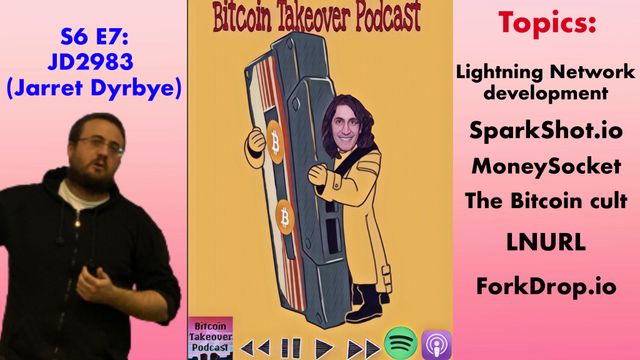
S6 E7: Jarret Dyrbye (JD2983) on Lightning Development, SparkShot.io & Socket.Money
Jarret Dyrbye is the developer of Lightning-based digital art marketplace SparkShot & MoneySocket protocol.
S16 E31: Andrew Camilleri "Kukks" on Ark, BTCPay Server & Open Source Bitcoin Software
Andrew Camilleri (Kukks), CTO of Ark Labs, on VTXOs, batches, Arkade OS, why Lightning is not the target and why he prefers Ark…
S14 E1: Burak Keceli on Ark & Bitcoin 2nd Layers
Ark is a liquidity protocol developed by Burak Keceli, which aims to offer scalable and privacy-preserving off-chain transactions…

Comments
Comments run on my own server. No trackers, no tracking cookies.